The landscape of digital marketing has long sought to align itself with the rigors of the hard sciences, positioning A/B testing as the definitive “randomized controlled trial” of the corporate world. From e-commerce giants to SaaS startups, the ability to split-test user experiences is touted as a scientific method for optimizing conversion rates and maximizing revenue. However, a growing body of evidence suggests that the statistical foundations upon which most digital experiments are built are dangerously outdated. Current industry standards for A/B testing frequently rely on classical statistical models that were developed for agricultural and physics experiments nearly a century ago, failing to account for the dynamic, high-velocity nature of modern internet commerce. This misalignment has led to a “replication crisis” in digital marketing, where reported “wins” often fail to materialize as actual revenue gains.
At the heart of this controversy are three fundamental issues: the widespread misuse of statistical significance tests, a systemic neglect of statistical power, and the inherent inefficiency of classical fixed-sample testing models. In response to these challenges, a new framework known as the AGILE statistical approach is emerging. Borrowing from the sophisticated methodologies used in modern clinical medical trials, the AGILE method promises to harmonize the need for scientific rigor with the business demand for speed and flexibility.
The Crisis of Significance and the “Peeking” Problem
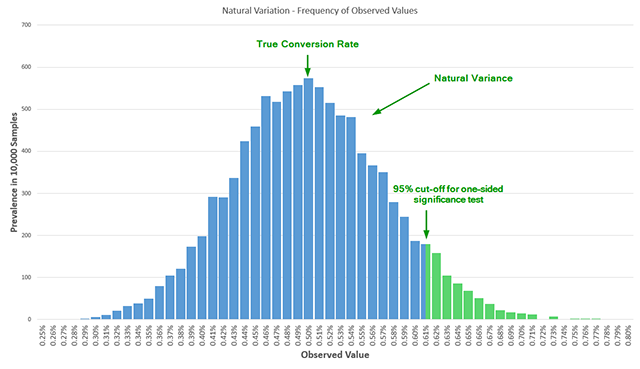
The most prevalent error in contemporary A/B testing is the misunderstanding of p-values and statistical significance. In a standard experiment, a significance test—such as the Student’s T-test—is used to determine if the difference in conversion rates between a control group and a variant is likely due to a genuine effect or merely the result of random noise. However, these classical tests carry a strict requirement that is frequently ignored by practitioners: the sample size must be fixed in advance.
In a typical marketing environment, stakeholders are often eager to see results. This leads to “data peeking,” the practice of checking the results of a test daily or even hourly and stopping the experiment as soon as a “significant” result appears. Statistically, this is catastrophic. When a researcher peeks at the data multiple times without adjusting the mathematical model, the probability of a false positive (Type I error) skyrockets.
Historical data from as early as 1969 has demonstrated that the more frequently a practitioner checks their results, the more they inflate their error rate. For instance, if a test is designed with a nominal 5% error rate (95% confidence), peeking at the data just five times increases the actual error rate to roughly 16%. Peeking ten times pushes the error rate to 25%, meaning one in every four “winning” tests is actually a false alarm. This phenomenon creates an environment of “Garbage In, Garbage Out,” where marketing teams implement changes based on illusory data, ultimately leading to stagnant growth despite a series of perceived experimental successes.
The Invisible Threat of Under-Powered Experiments
While false positives capture much of the attention in statistical critiques, the “silent killer” of A/B testing is a lack of statistical power. Statistical power, often referred to as test sensitivity, represents the probability that a test will correctly detect a true effect of a certain size. In a review of influential A/B testing literature published between 2008 and 2014, researchers found that only one out of seven major books properly addressed the concept of power.
Running an under-powered test is akin to using a low-resolution microscope to look for a small organism; even if the organism is there, the tool isn’t sensitive enough to see it. Many free online sample size calculators operate at a default power of 50%, which is essentially no better than a coin toss. For a business, an under-powered test results in “Type II” errors—false negatives. This means a company might discard a website layout or a pricing strategy that would have actually increased revenue, simply because the test was not designed with enough users to prove the lift was real.
The relationship between power, sample size, and the Minimum Detectable Effect (MDE) is a delicate balance. To achieve 90% power to detect a small 5% lift in conversion, a website may need hundreds of thousands of visitors. When marketers realize the sheer volume of traffic required for a rigorous test, they often compromise by lowering the power or raising the MDE, leading to experiments that are either destined to fail or incapable of detecting the subtle improvements that drive long-term incremental growth.
The Economic Inefficiency of Fixed-Sample Testing
The third major hurdle is the rigidity of classical models. In traditional physics or agriculture, a researcher might set up an experiment and wait months for the results without the ability to intervene. In digital marketing, however, there are significant financial and ethical incentives to stop a test early. If a new checkout process is clearly “breaking” the website and causing a 20% drop in sales, waiting for the pre-determined sample size of 100,000 users is financially irresponsible. Conversely, if a variant shows a massive 50% improvement within the first week, continuing the test for another month represents a massive “opportunity cost” in lost revenue.
Classical statistics do not allow for this flexibility. Stopping a test early for “efficacy” (success) or “futility” (failure) using standard T-tests invalidates the results. This creates a friction between the data scientist, who demands the test run to completion, and the marketing executive, who needs to move fast. This tension has paved the way for the adoption of more sophisticated “Sequential Analysis” methods, which have been standard in the medical field for decades to protect patient safety while ensuring trial efficiency.
The AGILE Statistical Approach: A New Paradigm
The AGILE statistical method represents a synthesis of sequential testing and error-spending functions designed specifically for the high-stakes world of Conversion Rate Optimization (CRO). Unlike classical methods, AGILE is built on the premise that data will be monitored as it accrues.
Key Components of the AGILE Framework:
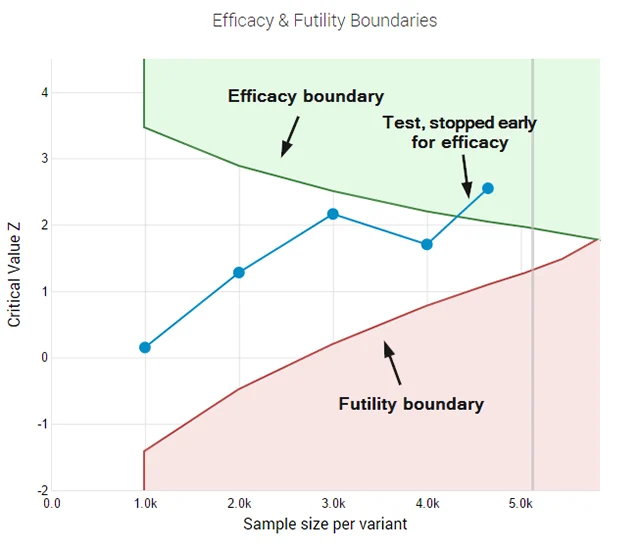
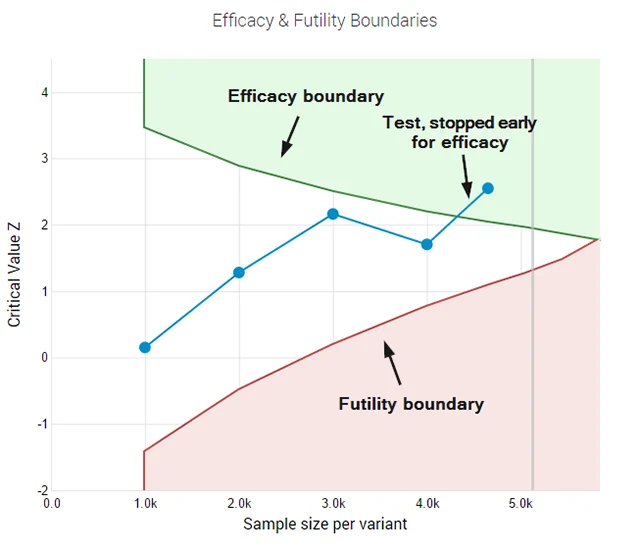
- Error-Spending Functions: This mathematical technique allows researchers to “allocate” a portion of their allowable error rate to each interim analysis. If you plan to check the data four times, the AGILE method adjusts the significance threshold at each point, ensuring that the overall probability of a false positive remains strictly controlled (e.g., at 5%).
- Futility Stopping Rules: One of the most powerful features of AGILE is the ability to “fail fast.” If the data indicates that a variant has almost no chance of reaching significance, the test can be terminated early for futility. This allows teams to stop wasting traffic on losing ideas and move on to the next hypothesis.
- Mandatory Power Consideration: The AGILE design process requires the user to define power and MDE upfront, forcing a level of rigor that prevents the creation of “blind” experiments.
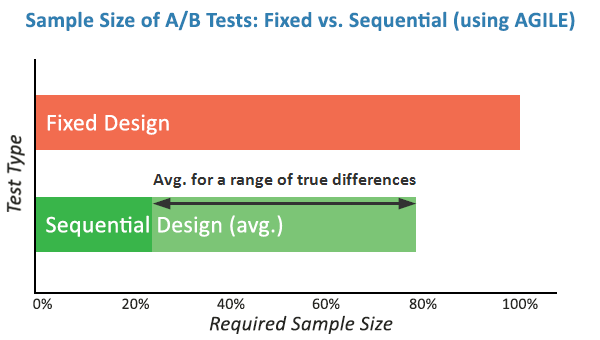
- Efficiency Gains: Simulations have shown that the AGILE method can reduce the required sample size by 20% to 80% in cases where the true lift is significant. By allowing for early wins and early closures of losing tests, the method maximizes the “velocity” of an experimentation program.
Evolution and Timeline of Experimental Standards
The shift toward AGILE and sequential methods marks a significant era in the timeline of digital experimentation:
- 1920s–1930s: Ronald Fisher and Jerzy Neyman develop the foundations of classical frequentist statistics for agriculture and biology.
- 1960s–1970s: The medical community begins adopting “Group Sequential Designs” for clinical trials to address ethical concerns regarding early stopping.
- 2000s: Google and Amazon popularize A/B testing in the tech world, largely using simplified versions of classical 1920s statistics.
- 2010–2015: The “Peeking Problem” becomes widely recognized in the data science community, leading to a surge in interest for Bayesian and Sequential alternatives.
- 2017–Present: The introduction of frameworks like AGILE provides a structured, step-by-step process for CRO practitioners to apply clinical-grade statistics to digital marketing.
Industry Reactions and Broader Implications
The adoption of more rigorous frameworks like AGILE has met with a mix of enthusiasm and resistance within the marketing community. Skeptics argue that the mathematical complexity of error-spending functions is a barrier to entry for smaller marketing teams. However, proponents argue that the cost of “illusory wins” is far higher than the cost of learning better statistics.
Industry experts suggest that as AI and machine learning become more integrated into marketing automation, the need for solid statistical foundations will only grow. An AI that optimizes based on false-positive A/B test results will eventually steer a company into a local maximum of inefficiency.
“The transition from ‘fixed-sample’ to ‘agile’ testing is not just a technical change; it’s a cultural shift,” says one industry analyst. “It moves us away from hunting for p-values and toward a genuine understanding of risk and reward.”
Analysis of Future Impact
The broader implications of adopting the AGILE method extend beyond simple conversion rates. For large-scale enterprises, the efficiency gains promised by AGILE (up to 80% faster testing) could equate to millions of dollars in reclaimed opportunity costs. Furthermore, the ability to statistically guarantee a “futility” result provides a level of confidence in negative results that is currently missing in most marketing departments.
As digital markets become more saturated and the “easy wins” of CRO are exhausted, the companies that thrive will be those that can detect small, incremental gains with high precision. By aligning digital marketing with the proven statistical paths of clinical medicine, the AGILE method offers a roadmap for a more honest, efficient, and ultimately more profitable era of digital experimentation. The “science” of marketing is finally catching up to the 21st century.