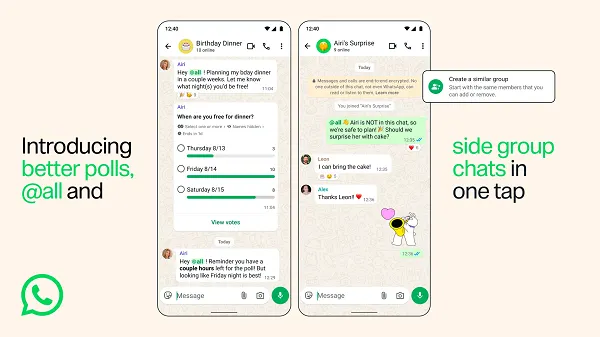
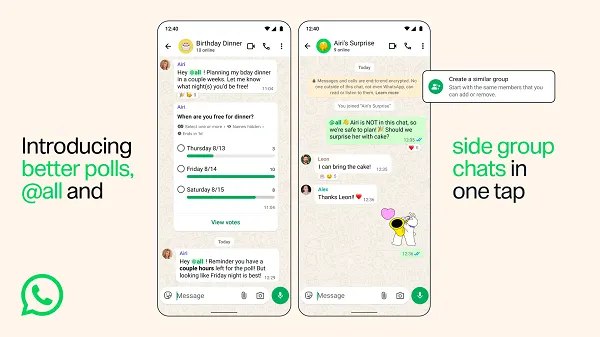
WhatsApp, the globally ubiquitous messaging platform owned by Meta, has rolled out a suite of substantial updates aimed at refining its group chat functionalities, enhancing conversational dynamics, and streamlining user coordination. These new features, announced recently, address long-standing user requests and common pain points associated with managing communication within increasingly complex and populous digital groups. The enhancements include more sophisticated group polls, an improved process for initiating new groups, and a pivotal "@all" alert function designed to ensure critical messages reach every member. Additionally, the platform has introduced a one-tap option to create side-chats, facilitating more focused discussions without cluttering the main conversation threads.
The Evolving Landscape of Digital Communication
The role of messaging applications in daily life has transcended simple one-to-one communication, evolving into sophisticated platforms that underpin social interaction, community building, and even professional collaboration. Group chats, in particular, have become central to how individuals organize events, share information, and maintain connections across diverse networks. However, as groups grow in size and activity, challenges related to information overload, ensuring engagement, and making collective decisions often emerge. WhatsApp, with its monumental global user base exceeding two billion, constantly navigates these challenges by introducing features that aim to maintain its competitive edge and cater to the nuanced demands of its diverse users.
WhatsApp’s Journey: From Simple Messaging to Global Giant
Founded in 2009 and acquired by Facebook (now Meta Platforms) in 2014 for an astounding $19 billion, WhatsApp rapidly ascended to become the world’s most popular messaging application. Its initial appeal stemmed from its simplicity, cross-platform compatibility, and the absence of traditional SMS costs. Over the years, the platform has progressively integrated a wide array of features, moving beyond basic text messaging to include voice and video calls, multimedia sharing, end-to-end encryption (implemented in 2016), disappearing messages, and robust business tools. The introduction of the "Communities" feature in late 2022 marked a significant step towards enabling larger organizational structures within the app, allowing multiple related groups to be managed under a single umbrella. These latest group chat updates can be seen as a natural evolution, enhancing the micro-level interactions within these broader community structures, and making large-scale communication more manageable and effective. The platform continually faces competition from rivals such as Telegram, Signal, and various regional messaging apps, compelling it to innovate and refine its offerings to retain its dominant market position.
Deep Dive into New Group Functionalities
The recent updates are strategically designed to imbue WhatsApp group chats with greater conversational functionality and refined management capabilities, directly addressing common user frustrations and enhancing the overall utility of group communication.
Enhanced Group Polls: Precision and Privacy in Decision-Making
Building upon the existing polling feature, WhatsApp has significantly upgraded its group chat polls with several key functionalities. Users can now set a time limit for poll voting, introduce the option to hide voter names from poll responses, and even edit poll questions within 15 minutes of posting. These refinements are poised to transform how groups gather consensus and make decisions.
The ability to set a time limit for poll voting introduces a crucial element of urgency and efficiency. In dynamic group settings, particularly for event planning, project coordination, or quick decision-making, a defined voting window can prevent prolonged indecision and ensure timely outcomes. This feature is particularly beneficial for active groups where messages can quickly get buried, allowing members to respond within a clear timeframe.
The introduction of anonymous voting is a significant step towards fostering more honest and unbiased feedback. In many social and professional contexts, individuals may feel reluctant to express their true preferences if their vote is publicly visible, fearing judgment or potential conflict. By hiding voter names, WhatsApp empowers members to participate more freely, encouraging genuine input on sensitive topics, controversial choices, or simply to ensure that opinions are not swayed by peer pressure. This enhances the integrity of the polling process, leading to more representative results.
Furthermore, the option to edit poll questions within 15 minutes of posting addresses a common user frustration: the inability to correct typos, clarify ambiguities, or refine questions after they have been launched. This flexibility improves the user experience, eliminating the need to delete and recreate polls, thereby saving time and reducing potential confusion. These enhancements collectively elevate WhatsApp’s polling capabilities to a more sophisticated level, aligning them with or even surpassing features found in dedicated survey tools or more business-centric communication platforms. Data from various digital collaboration studies often highlight that clear, time-bound, and unbiased decision-making tools significantly improve group productivity and member satisfaction, underscoring the value of these specific updates.
The @all Alert: Ensuring Critical Information Reaches Every Member
One of the most anticipated new features is the "@all" alert option, which allows users to notify all group members of important and/or time-sensitive messages. WhatsApp explicitly highlighted its utility: "No more tagging people one by one or hoping your message gets noticed in a busy group chat. Use @all to notify everyone about urgent messages, like school or office closures, event deadlines, or last-minute changes to your plans."
This function directly tackles the problem of information oversight in busy group chats, where a constant stream of messages can easily cause critical announcements to be missed. For scenarios demanding immediate attention, such as emergency alerts, schedule changes for a large event, or urgent organizational announcements, the @all feature provides a reliable mechanism to ensure widespread dissemination. This is particularly valuable for educational institutions communicating with parents, businesses coordinating with employees, or community organizers disseminating vital updates.
However, WhatsApp has also implemented crucial safeguards to prevent potential misuse and mitigate "alert fatigue." For larger groups with more than 32 people, the @all function will be exclusively available to group admins. This administrative control is vital for preventing spam, maintaining order, and ensuring that the feature is used judiciously for genuinely urgent communications rather than trivial matters. Furthermore, individual group members retain the ability to mute @all notifications if they choose, offering a layer of user autonomy and control over their notification preferences. This balance between ensuring message reach and preventing disruption is critical for the long-term efficacy and user acceptance of such a powerful notification tool. Digital communication experts often caution that powerful alert features, if unchecked, can lead to users disengaging from notifications altogether, diminishing their intended impact. WhatsApp’s approach demonstrates a thoughtful consideration of these potential pitfalls.
Streamlined Group Creation and Side-Chats: Fostering Focused Conversations
While the original announcement alluded to an "improved group creation process," specific details were not extensively elaborated. Drawing on common application development trends, this likely implies a more intuitive, guided experience for users when setting up new groups. This could involve streamlined steps for adding members, clearer initial settings for group permissions, more prominent options for naming and describing the group, or enhanced privacy controls from the outset. Such improvements lower the barrier to entry for users wishing to organize new groups, encouraging more structured and purposeful group formation.
Perhaps more socially significant is the introduction of a one-tap option to start a new "side-chat." WhatsApp explained its purpose: "It’s perfect for splitting off into a side conversation to plan a surprise party, coordinate event logistics, or dive deeper into a topic without cluttering the main chat." This feature directly addresses the natural human tendency for sub-grouping within larger social units. In any large gathering, smaller conversations inevitably branch off. Digitally, this translates to the need for focused discussions that do not derail or overwhelm the primary group’s topic.
Side-chats offer practical benefits for planning discreet events, such as surprise parties, or for coordinating complex logistics that involve only a subset of the main group members. They allow for more in-depth discussions on specific sub-topics without generating excessive notifications for the entire group, thus maintaining the clarity and focus of the main conversation. While the feature offers clear advantages in terms of organization and discretion, it also subtly acknowledges the social dynamics of group communication, including the potential for private conversations that might not be intended for all eyes. The original article playfully hinted at "uncomfortable revelations of the existence of side-chats," a testament to the inherent social complexities that even well-intentioned features can introduce. Similar functionalities exist in professional collaboration tools like Slack (with its threads and private channels) and Discord, demonstrating WhatsApp’s move towards accommodating more sophisticated group interaction patterns.
A Chronology of Innovation: WhatsApp’s Commitment to User Experience
These recent updates are not isolated but rather part of a continuous trajectory of innovation from WhatsApp, reflecting its commitment to evolving with user needs and market demands. Over the past few years, WhatsApp has systematically introduced features that have incrementally bolstered its group communication capabilities:
- 2016: End-to-End Encryption: A foundational update that secured all communications, building user trust and privacy.
- 2018: Group Voice and Video Calls: Expanding real-time interaction beyond text.
- 2020: Increased Group Call Limits: Adapting to the surge in remote communication during the pandemic, increasing participants for voice and video calls.
- 2021: Disappearing Messages: Offering more privacy controls and options for managing message longevity.
- 2022: Communities Feature: A monumental update allowing users to organize multiple related groups under a single umbrella, providing tools for announcements to an entire community. This feature paved the way for the necessity of more refined tools like "@all" and enhanced polls within individual groups.
- 2022: Increased Group Member Limits: Gradually increasing the maximum number of participants in a single group, eventually reaching up to 1024 members. This significant expansion makes features like "@all" and sophisticated polls absolutely indispensable for effective communication in such large assemblies.
Each of these developments has contributed to WhatsApp’s robust ecosystem, laying the groundwork for the current enhancements that further empower users to manage and engage within their digital communities more effectively.

Expert and User Perspectives on the Updates
The introduction of these new group chat features is generally anticipated to be met with positive reception from the vast majority of WhatsApp users, particularly those who actively participate in large and dynamic groups. The enhanced polls will likely be lauded for their improved utility in decision-making, offering greater flexibility and promoting more honest feedback. The "@all" alert function, while powerful, is expected to be welcomed for its ability to cut through the noise of busy chats, provided users and admins exercise discretion. The option to mute these alerts will be crucial for managing potential notification fatigue.
From the perspective of digital communication analysts, these updates solidify WhatsApp’s position as a comprehensive communication platform. Experts might infer that Meta’s strategy is to continue enriching WhatsApp’s core functionalities to retain its massive user base against emerging competitors and to prepare the ground for future integrations, potentially including more sophisticated business tools or even augmented reality features down the line. Analysts might highlight that the updates demonstrate WhatsApp’s responsiveness to user feedback and its ongoing effort to balance robust functionality with user simplicity, a critical challenge for any mass-market application. They could also point out that these features align with broader trends in digital collaboration, where efficiency, focused communication, and effective decision-making tools are paramount.
Broader Implications for Digital Interactions and Meta’s Vision
The implications of these WhatsApp updates extend beyond mere convenience, impacting various facets of digital interaction, from personal social dynamics to professional organizational structures, and feeding into Meta’s broader strategic objectives.
Impact on Businesses and Organizations
For small to medium-sized businesses, non-profits, and educational institutions, these enhanced group chat features offer significant advantages. The improved polls can streamline internal decision-making processes, from choosing event dates to gathering team preferences. The "@all" alert becomes an invaluable tool for urgent internal communications, such as company-wide announcements, IT outage notifications, or critical policy updates, ensuring that every employee is informed without the clutter of mass emails. The ability to create side-chats facilitates project-specific discussions or departmental planning without disrupting the main organizational chat, fostering more agile and focused collaboration. These tools can reduce reliance on separate communication platforms for basic coordination, potentially increasing efficiency and reducing communication overhead.
Reshaping Social and Community Dynamics
On a social level, these updates are likely to reshape how individuals interact within their personal and community groups. Friend groups planning outings, family groups coordinating events, or community associations organizing local initiatives will find the new polls and alerts particularly useful for swift decision-making and ensuring everyone is on the same page. The anonymous polling feature could empower more introverted members to voice their opinions without reservation. However, the introduction of side-chats, while practical for focused discussions, might also subtly alter group dynamics, potentially leading to increased awareness (or sometimes awkward revelations) of parallel conversations, necessitating a new etiquette for digital group interactions.
Meta’s Strategic Imperative
From Meta’s perspective, these updates are a critical component of its ongoing strategy to strengthen its ecosystem and ensure WhatsApp’s continued dominance. By consistently adding sophisticated features that enhance user experience and address evolving communication needs, Meta aims to increase user engagement, retention, and time spent on the platform. This sustained engagement is vital not only for its immediate advertising revenue potential (where applicable) but also for its long-term vision of an interconnected metaverse, where WhatsApp could serve as a fundamental communication layer. These enhancements also provide more robust tools for the "Communities" feature, further integrating disparate groups into a more cohesive, manageable structure, reflecting Meta’s ambition to build platforms that support vast, organized digital populations. Ultimately, these updates represent a calculated move to reinforce WhatsApp’s value proposition, demonstrating its commitment to being more than just a simple messaging app, but a comprehensive platform for personal, professional, and community-wide communication.