Direct Message (DM) automation, the deployment of pre-programmed or artificially intelligent responses to incoming social media messages, has transcended mere convenience to become a critical component of modern business strategy, particularly as 2026 approaches. The exponential surge in message volume across platforms, coupled with the maturing capabilities of AI chatbots, has fundamentally reshaped customer expectations, demanding near-instantaneous and personalized interactions around the clock. Businesses that fail to adapt risk falling behind in an increasingly competitive digital marketplace where customer experience is paramount.

The Rise of Conversational Commerce: A Strategic Imperative
The digital landscape has undergone a profound transformation, positioning messaging applications as central hubs for consumer interaction. Platforms like Instagram, Facebook Messenger, WhatsApp, and even emerging channels on TikTok and X (formerly Twitter) are no longer just for personal communication but have evolved into vibrant marketplaces and primary customer service touchpoints. This shift is particularly evident in the burgeoning field of social commerce, which analysts project will surpass $100 billion in the U.S. alone by 2026. This monumental growth underscores the urgency for businesses to streamline their conversational strategies, making DM automation not just an advantage, but a strategic imperative.

Customers today expect more than just static product pages; they seek dynamic, personalized interactions that mimic the immediacy of human conversation. Whether it’s inquiring about product availability, tracking an order, or seeking technical support, the expectation is for quick, accurate, and relevant responses, irrespective of business hours. Automated DMs, capable of delivering answers to frequently asked questions, providing digital files or links, and offering updates like delivery tracking, directly address these evolving demands. This capability is crucial for converting passive scrollers into engaged leads and loyal customers, thereby directly impacting sales and brand perception.
Understanding DM Automation: Mechanisms and Evolution
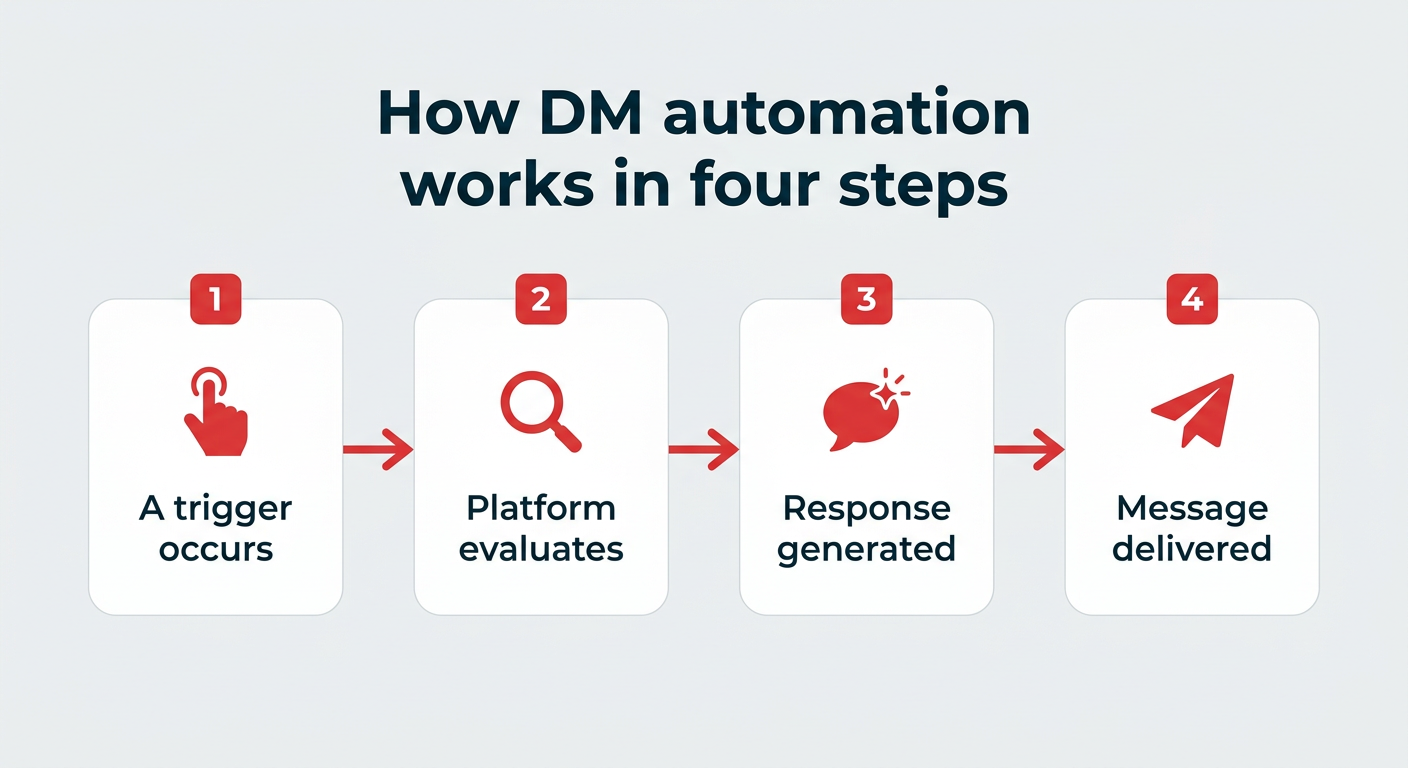
At its core, DM automation operates on a sophisticated trigger-action loop. A user’s action—sending a message, commenting a specific keyword, or initiating a chat—acts as a trigger, prompting the automated system to evaluate the input, generate an appropriate response, and deliver the message, all without human intervention. This process ensures consistent, rapid engagement, fundamentally altering the pace of customer service.
Historically, automated messaging began with rudimentary auto-replies, simple pre-written messages sent in response to any incoming contact. Over time, this evolved to include rule-based systems, which employed Boolean operators to match specific keywords or phrases to pre-defined answers. The true revolution, however, arrived with the advent of Artificial Intelligence (AI) and Natural Language Processing (NLP). Modern AI chatbots can interpret natural language, understand context, and engage in multi-turn conversations, offering a far more sophisticated and human-like interaction.
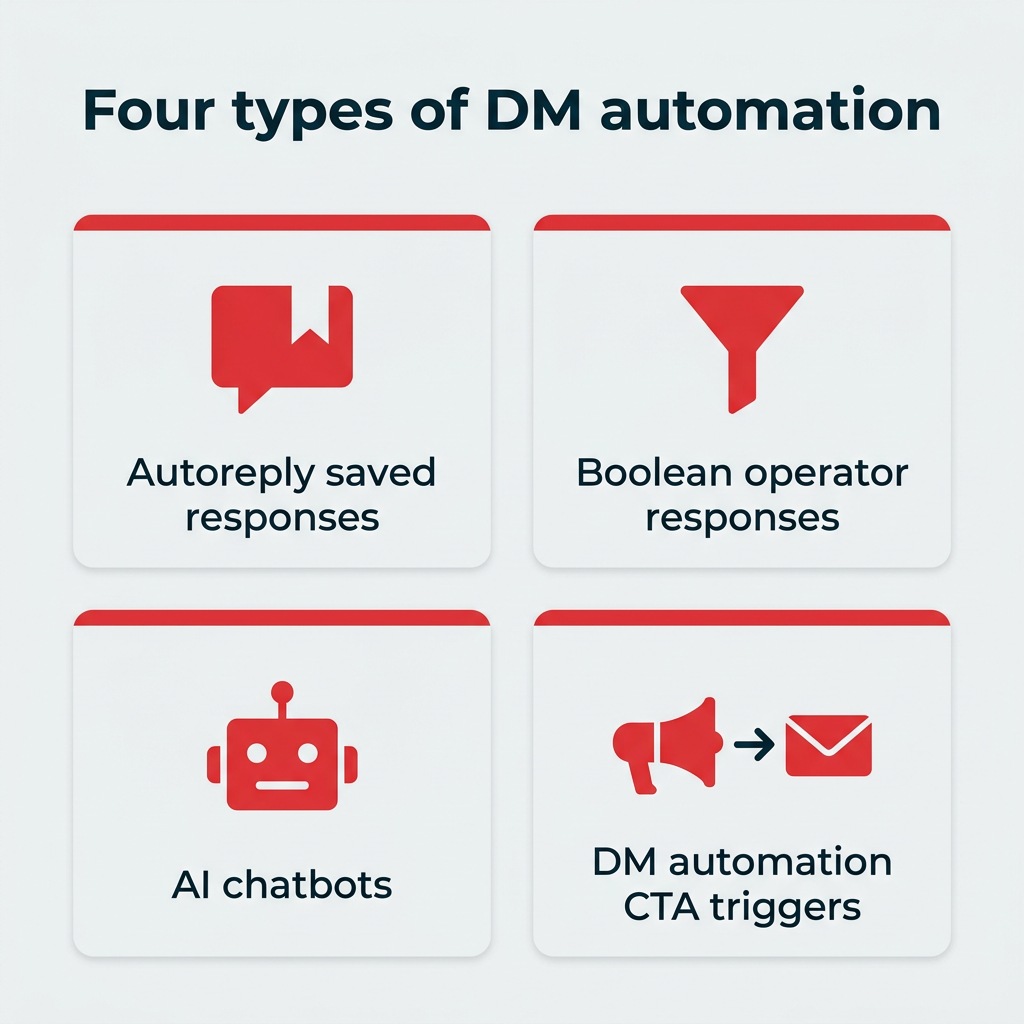
Currently, DM automation broadly encompasses four primary types:
- Auto-Reply Saved Responses: The simplest form, where pre-written messages are manually triggered or set to automatically respond to all initial DMs, often providing general greetings or informing users of response times.
- Boolean Operator Responses: Rule-based systems that detect specific keywords (e.g., "shipping," "returns," "hours") and deliver corresponding pre-configured answers. These are more targeted than general auto-replies.
- AI Chatbots: The most advanced form, utilizing NLP to understand the nuance and context of user queries, allowing for dynamic, personalized conversations and problem-solving without strict keyword matching.
- DM Automation CTA Triggers: A rapidly growing tactic, particularly on visual platforms like Instagram Reels. Users are prompted to comment a specific keyword on a post, which then automatically triggers a direct message containing a link, offer, or resource, effectively turning content engagement into direct lead generation.
Transforming Customer Engagement: Key Business Benefits

DM automation is not merely a tool for efficiency; it is a strategic asset that fundamentally enhances a business’s customer care capabilities, freeing human teams to focus on high-value interactions.
1. Unprecedented Efficiency and Resource Optimization:
The most immediate benefit of DM automation is the significant reduction in the workload for customer service teams. Repetitive queries—such as requests for business hours, location, or payment options—can be handled instantly and accurately by automated systems. This offloading allows human agents to dedicate their expertise to complex, sensitive, or high-value customer issues, such as resolving product quality complaints or managing intricate loyalty programs. Gartner, a leading research and advisory company, predicts that by 2029, agentic AI will autonomously resolve 80% of common customer service issues without human intervention, underscoring the immense potential for resource reallocation.

Companies like 1-800-Flowers exemplify this balanced approach. While their automated systems handle initial inquiries and common questions, they strategically offer a clear, clickable option to connect with a human representative for issues requiring nuanced understanding or empathy. This hybrid model ensures both speed and quality in customer interactions, maximizing satisfaction.
2. Personalized Service at Scale:
Advanced conversational AI chatbots, powered by sophisticated NLP, can interpret the context of DMs and provide tailored responses. This means customers can use natural language, just as they would with a human, and receive relevant information. For instance, if a customer types, "I haven’t received my order," the AI can follow up by asking for an order number or address, then retrieve and relay tracking information directly. The key differentiator is the chatbot’s ability to "remember" the conversation history, creating a more natural and personalized experience.
This capability allows businesses to deliver individualized support to a vast number of customers simultaneously, a feat impossible for human teams alone. While AI excels at data retrieval and routine problem-solving, it’s crucial to acknowledge its limitations. Situations demanding emotional intelligence, creative problem-solving, or discretionary decisions (e.g., offering a replacement to secure customer loyalty) still require human intervention. Therefore, every robust DM automation system must incorporate a seamless escalation path to a live agent, ensuring that complex cases are handled with the necessary human touch.
3. Uninterrupted 24/7 Response Coverage:
In the globalized digital economy, traditional business hours are increasingly obsolete. Customers operate across diverse time zones and expect immediate assistance, irrespective of the hour. DM automation provides perpetual service, ensuring that inquiries are addressed instantly, whether it’s midnight or midday. This continuous availability significantly boosts customer satisfaction and prevents potential sales losses due to delayed responses.

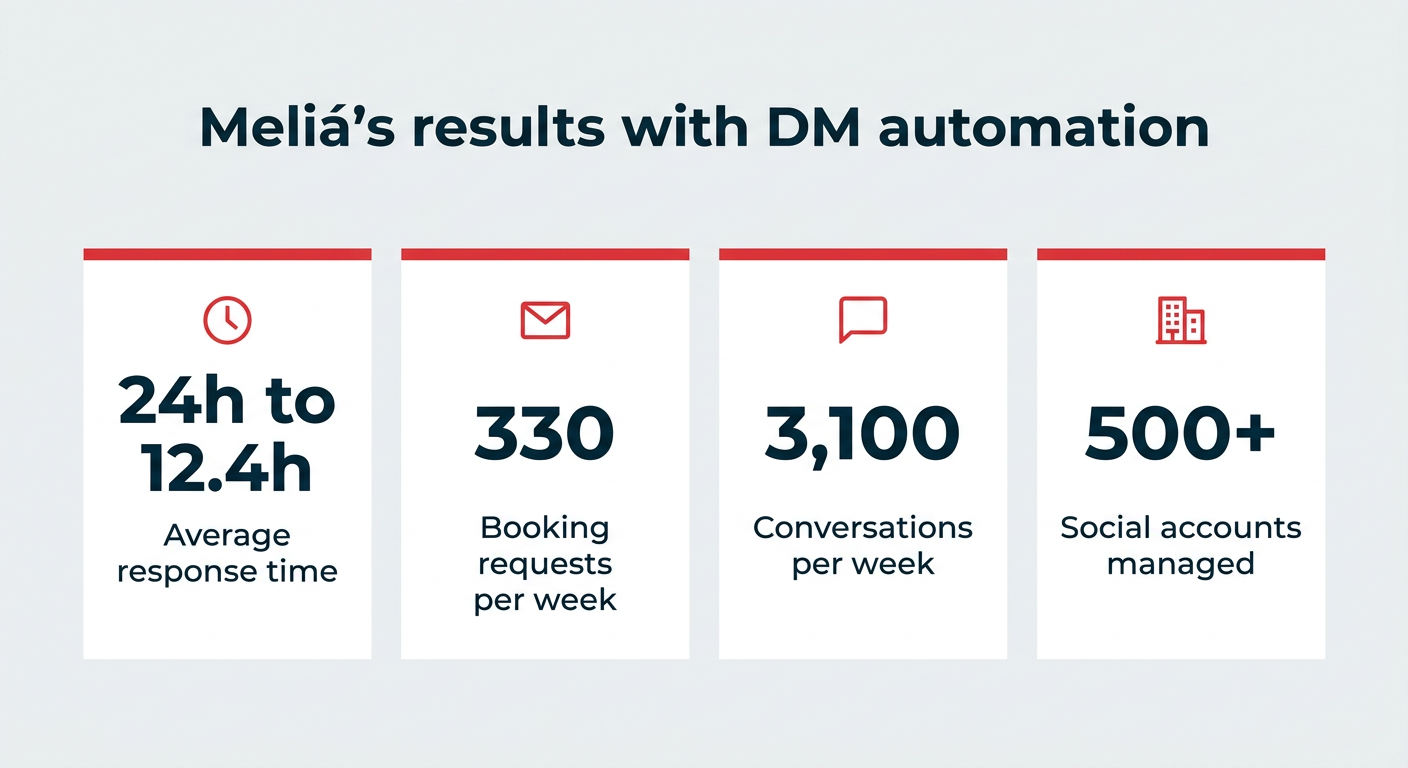
Meliá Hotels, Europe’s third-largest hotel group, effectively leverages DM automation to manage its extensive global social media presence, encompassing over 500 accounts and handling approximately 3,100 conversations weekly. Faced with a surge in booking inquiries via social media, Meliá implemented DM automation within their customer care strategy. By setting up auto-responders for off-hours, which inform customers of expected response times and alternative contact details for urgent matters, Meliá dramatically reduced its average human response time from 24 hours to a mere 12.4 hours. This strategic implementation also led to a substantial increase, averaging 330 booking requests per week through social media channels, demonstrating the direct impact of 24/7 coverage on business growth.
4. Interactive FAQs and Potent Lead Generation:
Automating frequently asked questions stands as one of the most significant time-savers for customer service teams. Rather than waiting in queues, customers receive immediate answers, while agents are spared the monotony of typing out the same responses repeatedly. These automated FAQs typically manifest in two forms: conversational bots that prompt users to type their questions, or "tap-to-answer" chatbots that present a menu of common questions for quick selection. The latter, requiring minimal friction, often leads to higher engagement rates.

Beyond customer service, DM automation has evolved into a powerful lead generation tool, particularly through DM automation CTAs. By embedding calls-to-action within social media content (e.g., "Comment ‘GUIDE’ for our free ebook!"), businesses can automatically deliver valuable resources, discount codes, or sign-up links via direct message. This strategy transforms passive content consumption into active engagement and list-building. Some sophisticated chatbots can even capture user information, such as email addresses, during these interactions, simultaneously delivering content and growing marketing databases. This mechanism is especially effective on platforms dominated by short-form video content, where quick, interactive engagement is key.
Implementing DM Automation Across Social Platforms

The native capabilities for DM automation vary significantly across social media platforms, often requiring third-party tools for comprehensive, cross-platform management.
Instagram:
Instagram DM automation offers three primary native functions:

- Saved Replies: Pre-written phrases or answers saved for quick manual insertion into DMs. While not fully automated, they reduce typing time.
- Frequently Asked Questions (FAQs): Business or Creator accounts can set up a list of up to four common questions with automated answers. These can be configured to appear as tap-options when a user initiates a message. To set this up, navigate to your Professional dashboard > Tools > Frequently asked questions in the Instagram app.
- Comment-to-DM Triggers: This powerful feature allows businesses to set a keyword that, when commented on a Reel or post, automatically triggers a DM. This is a popular method for creators and brands to deliver content or promotions.
For capabilities beyond these native limits, such as multi-step conversations or complex CTA automations across numerous posts, a dedicated Instagram automation tool is essential.
Facebook:
Facebook (via Meta Business Suite) provides more robust native DM automation tools for Messenger and, by extension, WhatsApp Business:

- Instant Replies: Automatically send a message to anyone who messages your Page.
- Away Messages: Inform customers when you’re unavailable and provide alternative contact methods.
- Frequently Asked Questions: Similar to Instagram, you can create multiple Q&A pairs, with the option to include images, videos, or buttons linking to URLs in the answers.
- Keyword Responses: Set up automated replies triggered by specific keywords in incoming messages.
- Contact Information, Location, Hours: Automatically provide these details upon request.
These automations are configured within Meta Business Suite > Inbox > Automations. The integration with WhatsApp means similar automated replies can be extended to WhatsApp Business conversations from the same central hub.
X (formerly Twitter):
As of 2026, X does not offer native DM automation features. Businesses heavily reliant on X for customer service or engagement must utilize third-party social media management platforms like Hootsuite Social OS. These tools allow for the implementation of welcome messages, keyword-based replies, and human agent handoffs on X, bridging the platform’s native functionality gap.

LinkedIn:
LinkedIn maintains a deliberately restrictive stance on automation, particularly concerning outreach, to preserve its professional networking ethos. For company pages, LinkedIn offers native "Away" messages and quick replies to manage inbound messages. However, aggressive third-party automation tools that violate LinkedIn’s terms of service can lead to account restrictions. B2B teams should prioritize tools that adhere strictly to LinkedIn’s rules, focusing on responsive inbound messaging rather than mass, unsolicited outreach.
TikTok:
TikTok’s DM automation capabilities are still evolving. Native automated messaging options are limited, compelling most brands to rely on third-party tools for keyword-based replies. A notable exception is TikTok Shop, which supports automated messages for order inquiries, shipping updates, and delivery questions. Brands whose TikTok strategy heavily involves DMs should plan to integrate a dedicated TikTok management tool for comprehensive automation.

Choosing the Right Tools: A Comparative Analysis
Selecting the appropriate DM automation tool requires evaluating platform support, AI sophistication, pricing models, ease of setup, and enterprise-grade features like governance and analytics.

| Tool | Platforms Supported | AI Capabilities | Pricing Model | Ease of Setup | Enterprise Features |
|---|---|---|---|---|---|
| Hootsuite Social OS (Nest) | Instagram, Facebook, X, TikTok, LinkedIn, and more | AI chatbot with conversational context and routing | From $99/user/month (Standard) | Moderate, full onboarding support | SSO, governance, analytics, CRM integrations |
| ManyChat | Instagram, Facebook, WhatsApp, TikTok | Keyword flows plus AI add-ons | Free tier, paid from monthly fee | Easy | Limited |
| Chatfuel | Instagram, Facebook, WhatsApp | AI and rule-based flows | Paid monthly | Easy | Limited |
| Customers.ai | Instagram, Facebook, web | AI plus lead capture | Paid monthly | Moderate | Some |
| Native Platform Tools | One platform each | Basic keyword and FAQ only | Free | Very easy | None |
While native tools offer a cost-free entry point, their limitations in functionality and cross-platform management quickly become apparent for growing businesses. Unified social media management platforms like Hootsuite provide a far more efficient and scalable solution, justifying the investment through saved time, enhanced capabilities, and comprehensive reporting.
The Hootsuite Advantage: Unified Social Customer Care

For businesses aiming for seamless, comprehensive social customer care across all major platforms, Hootsuite Social OS, particularly its Nest component, presents a compelling solution. Nest allows businesses to assign, reply to, and automate messages across all social profiles and team members from a single, integrated dashboard. This unified approach eliminates the inefficiency of toggling between multiple platforms and tools.
Hootsuite’s integrated AI orchestration layer, Wisdom, intelligently routes each message to the most appropriate automated response or human agent, ensuring efficiency and accuracy. Concurrently, Vigil maintains workflow governance and compliance, critical for regulated industries. Beyond DM automation, Hootsuite Social OS provides a holistic suite of social media management tools, including content scheduling, detailed analytics, team collaboration features, and robust social listening capabilities. This ecosystem ensures that DM automation is not an isolated function but an integral part of a broader, well-coordinated social media strategy. Nest’s auto-responses, saved replies, AI-powered chatbot, intelligent message routing, and virtual agents are designed to elevate customer satisfaction, a sentiment often captured through automated post-interaction surveys.

Strategic Best Practices for Effective DM Automation
Implementing DM automation effectively requires careful planning and adherence to best practices to build customer trust and maintain brand integrity.

- Be Transparent: Always inform users upfront that they are interacting with an automated system. This manages expectations and prevents frustration. A simple disclaimer like "You’re chatting with our virtual assistant" suffices.
- Offer a Human Handoff: Provide a clear, accessible path for customers to connect with a live agent for complex issues. This can be a button, a specific keyword ("Speak to a human"), or an automated escalation when the bot cannot resolve an inquiry.
- Define Clear Objectives: Before setting up automation, identify what specific goals it will serve—e.g., reducing response times, generating leads, answering FAQs, or providing 24/7 support.
- Map Customer Journeys: Understand common customer queries and interaction flows to design logical, intuitive automated conversation paths.
- Use Personalized Language: While automated, responses should still sound natural and reflect your brand’s voice. Incorporate variables like customer names where possible to enhance personalization.
- Craft Clear Calls-to-Action (CTAs): For DM automation triggers, ensure CTAs in your social posts are unambiguous, guiding users precisely on what to comment or tap.
- Prioritize Data Privacy and Compliance: Ensure your automation tools and practices comply with data protection regulations (e.g., GDPR, CCPA). Be transparent about data collection and usage.
- Implement A/B Testing: Continuously test different automated responses, CTAs, and conversation flows to optimize engagement rates and effectiveness.
- Monitor Performance and Optimize: Regularly review analytics related to response times, resolution rates, customer satisfaction scores, and lead conversion to identify areas for improvement.
- Avoid Spamming: Use DM automation for inbound responses and legitimate lead generation. Avoid unsolicited mass DMs, as this violates platform terms of service and erodes trust.
- Keep Content Updated: Ensure automated responses are always current and accurate. Outdated information can quickly lead to customer frustration.
Done thoughtfully and strategically, DM automation transforms reactive customer service into proactive customer engagement, strengthening brand loyalty and driving business growth in the dynamic digital landscape of 2026 and beyond.

 rifanmuazin
 Pevita Pearce