


The Enduring Power of Commercial Email Marketing
Email has long been a cornerstone of digital communication, and its utility in marketing remains undiminished despite the proliferation of newer channels. For businesses, commercial email represents a direct line to customers, enabling personalized communication at scale. The reported ROI figures highlight its cost-effectiveness, positioning it as one of the most efficient digital marketing channels available. This efficiency, however, is contingent on strategic execution and a deep understanding of the technical and legal frameworks governing email. Without proper adherence to these principles, even the most compelling promotional messages risk being unseen, undermining potential revenue and damaging sender reputation.
Navigating the Regulatory Landscape: The CAN-SPAM Act and Beyond
The definition of commercial email is not merely academic; it is legally binding. According to the Federal Trade Commission’s (FTC) CAN-SPAM Act, any electronic mail message whose primary purpose is the advertisement or promotion of a commercial product or service falls under this classification. This foundational legal definition is paramount for ensuring campaign compliance and preserving a healthy sender reputation. Enacted in 2003, the CAN-SPAM Act established national standards for the sending of commercial emails, empowering consumers with the right to opt-out of receiving unwanted messages. Key requirements include:
- Accurate Header Information: Senders must not use false or misleading header information, and the "From," "To," "Reply-To," and routing information must accurately identify the person or business initiating the message.
- Relevant Subject Lines: Subject lines must not be deceptive and should accurately reflect the content of the message.
- Identification as an Advertisement: The email must clearly and conspicuously disclose that it is an advertisement or promotional material, unless the recipient has given affirmative consent to receive it.
- Physical Postal Address: Every commercial email must include a valid physical postal address of the sender.
- Clear Unsubscribe Mechanism: Senders must provide a clear and conspicuous way for recipients to opt out of receiving future emails from them. This must be a "one-click" unsubscribe process, and the mechanism must remain active for at least 30 days after the email is sent.
- Prompt Opt-Out Honor: Senders must honor opt-out requests promptly, within 10 business days.
Beyond the CAN-SPAM Act, a global tapestry of regulations further complicates the landscape for international businesses. The General Data Protection Regulation (GDPR) in Europe and Canada’s Anti-Spam Legislation (CASL) are notable examples. GDPR places a strong emphasis on consent, requiring explicit, informed, and unambiguous consent for processing personal data, including for marketing communications. CASL, similarly, demands express consent for sending commercial electronic messages, coupled with strict rules on content and identification. Navigating these diverse legal requirements necessitates a robust understanding of where an audience resides and tailoring compliance strategies accordingly. Failure to comply can result in substantial fines, reputational damage, and severe deliverability issues.
Commercial vs. Transactional Email: A Critical Distinction
The differentiation between commercial and transactional emails is not just a nuance; it is a critical factor influencing legal obligations, deliverability rates, and overall email strategy.
- Commercial Emails: As defined, these messages primarily aim to promote products, services, or brands. Examples include newsletters, promotional offers, sales announcements, product launch notifications, and re-engagement campaigns. They are subject to the full scope of regulations like CAN-SPAM, GDPR, and CASL.
- Transactional Emails: These messages facilitate or confirm an agreed-upon commercial transaction or an ongoing relationship. Their primary purpose is informative, not promotional. Examples include order confirmations, shipping updates, password reset emails, account notifications, legal updates (e.g., privacy policy changes), and customer support responses. Generally, transactional emails have different, often less stringent, legal requirements regarding consent and unsubscribe mechanisms, as they are typically expected by the recipient as part of a service or interaction. Consequently, they tend to enjoy higher open rates and superior deliverability.
The Hybrid Gray Area: Applying the Primary Purpose Test
Some emails inherently blur the lines, incorporating elements of both commercial and transactional content. A classic example is a purchase receipt that also includes a promotional coupon code for a future purchase. In such cases, the FTC applies the "primary purpose test." If the main objective of the email is to confirm a purchase or deliver essential information related to a transaction, it is classified as transactional, even if it contains secondary promotional content. Conversely, if the primary goal is to entice a new sale or promote a product, even if it references a previous interaction, it leans towards a commercial classification. Misinterpreting this can lead to compliance violations, particularly if an email primarily promotional in nature is sent without the required consent or unsubscribe options, under the guise of being transactional.

Types of Commercial Emails Driving Real Results
Effective commercial email marketing involves a diverse toolkit of email types, each designed to achieve specific business outcomes within the customer lifecycle.
- The Promotional Blast: These are the high-speed sprints of email marketing, designed for rapid impact and immediate conversions. They typically announce sales, limited-time offers, new product arrivals, or seasonal promotions. Their content is often direct, featuring prominent calls-to-action (CTAs), striking visuals, and a clear sense of urgency or exclusivity. Promotional blasts are measured by immediate sales, click-through rates, and conversion rates. For instance, a flash sale email for a clothing brand might announce "48-Hour Summer Clearance – Up to 50% Off!" with direct links to product categories.
- The Newsletter: In contrast to the sprint of a promotional blast, newsletters are the marathon runners, focusing on long-term relationship building, brand loyalty, and thought leadership. They deliver valuable content, industry insights, educational articles, company news, or curated product selections. Newsletters aim to keep subscribers engaged and informed, fostering a sense of community. Their success is measured by open rates, content engagement (clicks on articles), and subscriber retention. A tech company’s newsletter might feature articles on emerging technologies, customer success stories, and upcoming webinars, subtly integrating product mentions.
- The Retention/Re-engagement Email: These emails act as a business’s comeback specialists, designed to rekindle interest from subscribers who have become inactive or drifted away. Triggered by a lack of recent engagement (e.g., no opens or clicks in 60-90 days) or an abandoned cart, these campaigns aim to win back attention. Content often includes special offers to incentivize return, requests for feedback, or reminders of the value proposition. A streaming service, for example, might send a "We Miss You!" email offering a discounted month of service or highlighting new content based on past viewing habits.
- The Product Launch/Update Email: These emails serve as the starting pistol for new innovations or significant product enhancements. They build anticipation, communicate key features and benefits, and drive initial adoption. Launch emails often follow a sequence, starting with teasers, progressing to detailed announcements, and culminating in purchase opportunities. Updates might inform users of new functionalities, bug fixes, or upcoming changes. A software company launching a new feature might send an email detailing its capabilities, showing screenshots, and providing a link to a demo or a free trial.
Supporting Data and Market Insights
The impressive ROI figures for commercial email are not isolated. Industry reports consistently demonstrate email’s effectiveness. A 2023 report by Statista projected that the number of global email users would reach 4.73 billion by 2026, highlighting the massive addressable market. Furthermore, a study by McKinsey found that email is 40 times more effective at acquiring new customers than Facebook or Twitter. The Direct Marketing Association (DMA) has often cited email as consistently delivering one of the highest ROIs among marketing channels, often exceeding other digital avenues. Specific data points underscore the value of best practices:
- Personalization: Emails with personalized subject lines are 26% more likely to be opened (Campaign Monitor). Personalized calls-to-action convert 202% better than generic ones (HubSpot).
- Mobile Optimization: Over 50% of emails are opened on mobile devices (Litmus). Emails that are not optimized for mobile are often deleted within 3 seconds.
- Segmentation: Segmented campaigns can result in a 760% increase in email revenue (Campaign Monitor).
These statistics collectively paint a clear picture: email marketing is not just alive; it is thriving, provided marketers employ sophisticated strategies and adhere to technical best practices.
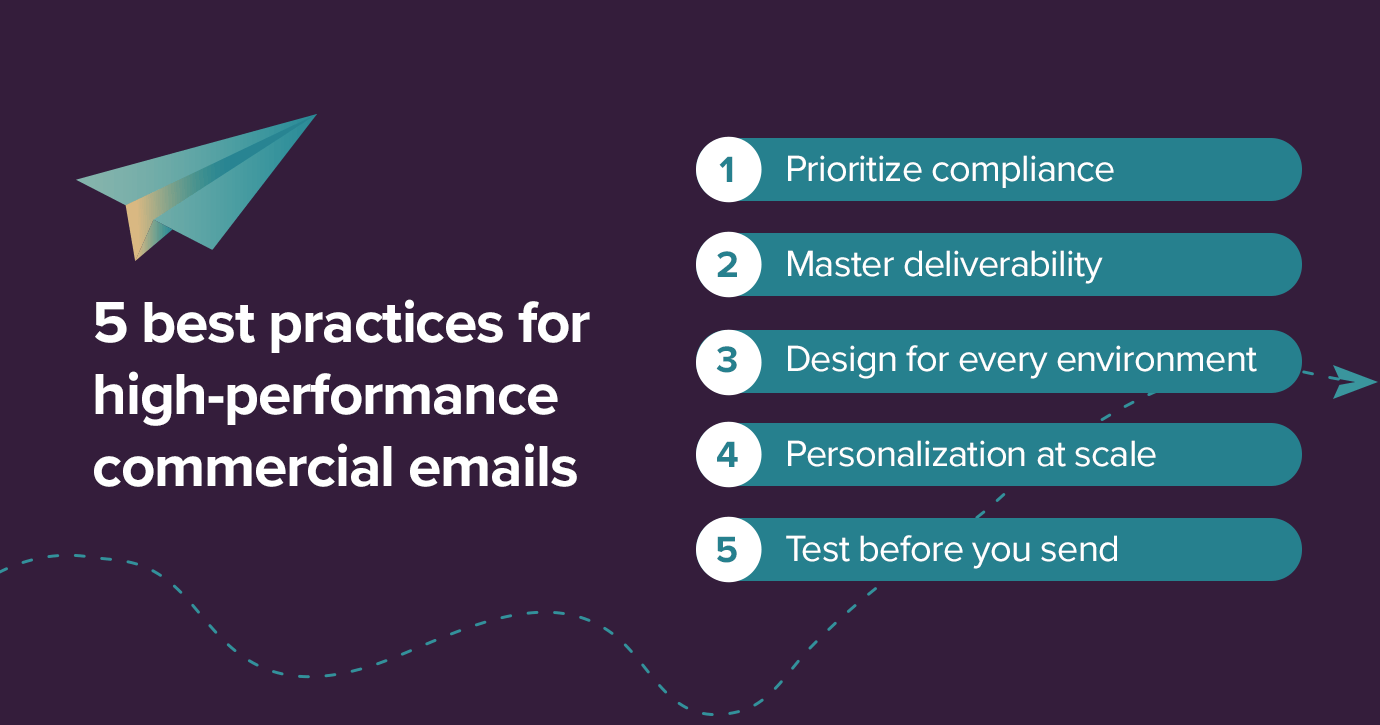
5 Best Practices for High-Performance Commercial Emails
Strategy lays the groundwork, but flawless execution is what truly wins the race in email marketing. These five best practices are crucial for ensuring commercial emails perform at their peak, landing in the inbox and converting recipients into customers.
1. Prioritize Compliance Above All Else
Compliance is the bedrock of trust and deliverability. Beyond the legal mandate, adhering to regulations like CAN-SPAM, GDPR, and CASL builds a strong foundation of credibility with subscribers and Internet Service Providers (ISPs). Each email must unequivocally include your physical business address and a simple, one-click unsubscribe mechanism. Major mailbox providers (MBPs) like Gmail and Yahoo have reinforced these requirements, making compliance non-negotiable for high-volume senders. Additionally, ensuring your "from" name and subject line accurately represent your content—avoiding deceptive practices—is critical. Honoring unsubscribe requests within the stipulated 10 business days (or immediately, as per GDPR standards) is not just a legal requirement but a fundamental respect for recipient preferences. Transparent and honest email practices signal legitimacy to recipients and ISPs alike, directly influencing engagement rates and sender reputation. Non-compliance, conversely, leads to increased spam complaints, blocklisting, and severe financial penalties, as demonstrated by numerous regulatory actions against violators.
2. Master Deliverability: Earning Your Place in the Inbox
Email deliverability refers to the ability of an email to reach a subscriber’s inbox, rather than being routed to a spam folder or blocked entirely. MBPs continuously assign and update a sender’s reputation based on a multitude of signals, including engagement metrics, complaint rates, and list hygiene. This reputation dictates the fate of every email sent.
- Authentication (SPF, DKIM, DMARC): These are no longer optional but table stakes.
- SPF (Sender Policy Framework): Verifies that the sender’s IP address is authorized to send emails on behalf of a domain.
- DKIM (DomainKeys Identified Mail): Uses digital signatures to verify the authenticity of the sender and ensure the email hasn’t been tampered with in transit.
- DMARC (Domain-based Message Authentication, Reporting & Conformance): Builds on SPF and DKIM, instructing receiving mail servers how to handle emails that fail authentication checks and providing reporting on authentication failures. Implementing these protocols proves sender legitimacy to MBPs.
- Engagement is King: Low open rates, click-through rates, and high delete-without-open rates signal to MBPs that recipients do not value your mail. This can severely degrade sender reputation. Strategies to boost engagement include sending relevant content, segmenting audiences, and using interactive elements. Re-engagement campaigns or suppressing inactive subscribers are crucial to avoid mailing them "into oblivion," which negatively impacts overall engagement metrics.
- Complaint Rates: Every spam complaint is a significant blow to sender reputation. The industry standard is to keep complaint rates below 0.1%. Higher rates often indicate issues with list acquisition practices (e.g., purchased lists, unclear opt-ins) or excessive sending frequency, rather than content problems. Regular monitoring and prompt action are vital.
- List Hygiene: Maintaining a clean email list is paramount. Hard bounces (permanent delivery failures), spam traps (email addresses used by ISPs to catch spammers), and role-based addresses (like info@ or admin@, which can trigger spam filters) all damage reputation. Regular list validation and removal of chronic bouncers and inactive addresses prevent these issues.
- Send Consistency and IP Warm-up: Sudden, large spikes in email volume can appear suspicious to MBPs. For new sending IPs or significantly increased sending volumes, a gradual "warm-up" process is essential. This involves sending emails in increasing batches over several days or weeks, allowing MBPs to calibrate and build trust with the new sending pattern.
- Separate Subdomains/Dedicated IPs: Using distinct subdomains or dedicated IP addresses for commercial emails versus transactional emails is a critical risk mitigation strategy. This segregation ensures that a temporary dip in the reputation of your commercial sending due to a problematic campaign does not impact the deliverability of critical transactional emails, such as order confirmations or password resets.
3. Design for Every Environment and User
The modern email ecosystem is incredibly fragmented, encompassing a vast array of devices, operating systems, and email clients, each with its own rendering quirks. Overlooking this diversity can lead to a broken user experience.
- Dark Mode Optimization: Dark mode, a display setting that uses a dark background with light text, is increasingly popular. However, many commercial emails are not designed for it, leading to issues like invisible text, disappearing logos, or illegible color schemes. Implementing specific CSS techniques (e.g.,
prefers-color-schememedia query) and thorough testing across various dark mode clients (e.g., Apple Mail, Gmail, Outlook) is essential to ensure brand consistency and readability. - Mobile Responsiveness: With a significant percentage of emails opened on mobile devices, responsive design is non-negotiable. This includes using single-column layouts, optimizing images for faster loading, ensuring large and easily tappable touch targets (at least 44px by 44px), and using thumb-friendly button placement. Text should be legible without zooming, typically at least 14-16px for body copy.
- Accessibility: Beyond dark mode and mobile, considering accessibility for all users is vital. This involves using descriptive alt text for images, maintaining a logical reading order, ensuring sufficient color contrast, and avoiding reliance solely on color to convey information. An email that looks perfect on a desktop in light mode might be completely unusable on a mobile device in dark mode, or for a user with visual impairments, underscoring the necessity of comprehensive testing.
4. Personalization at Scale: Beyond "Hi [Name]"
Basic name personalization is a starting point, but true personalization leverages data to create highly relevant and engaging experiences for individual subscribers.
- Dynamic Content Blocks: Utilizing data points such as purchase history, browsing behavior, demographic information, geographic location, or engagement patterns allows for the creation of dynamic content. This means different subscribers see different product recommendations, offers, or content based on their unique profiles.
- Behavioral Triggers: Implementing automated email flows based on specific user actions or inactions significantly boosts relevance. Examples include cart abandonment emails, post-purchase follow-ups, browse abandonment reminders, birthday offers, or re-engagement emails after a period of inactivity.
- Advanced Segmentation: Moving beyond broad demographic segmentation, advanced strategies involve micro-segmentation based on psychographics, lifestyle, brand affinity, or predicted future behavior (e.g., customers likely to churn, high-value customers).
- AI and Machine Learning: Increasingly, AI and machine learning are being deployed to predict optimal send times, recommend products with higher accuracy, and even dynamically generate personalized content variations, leading to significant improvements in open rates, click-through rates, and conversions. The key is to start with simpler behavioral triggers and gradually scale up to more sophisticated, data-driven personalization.
5. Test Before You Send: The Ultimate Quality Control
The complexity of the email ecosystem means that what appears perfect in an email builder can render completely broken in a subscriber’s inbox. The risk of broken links, rendering issues across 100+ email clients, and formatting inconsistencies is substantial. A single rendering error can undermine brand credibility and negate the effort invested in campaign creation.
- Comprehensive Rendering Tests: Tools like Litmus allow marketers to preview emails across a vast array of email clients, devices, and dark/light mode environments before deployment. This catches critical issues such as image display problems, text legibility issues, and layout distortions.
- Link Validation: Ensuring all links are active, correctly routed, and free from typos is fundamental. Broken links lead to frustration and lost conversion opportunities.
- Subject Line and Preheader Text Testing: Testing different subject lines and preheader text combinations can reveal which ones perform best in terms of open rates and avoid triggering spam filters.
- Spam Filter Testing: Utilizing spam checker tools helps identify elements in the email (e.g., certain keywords, image-to-text ratio) that might trigger spam filters, allowing for adjustments before sending.
- Accessibility Checks: Verifying that the email is accessible to users with disabilities, including screen reader compatibility and sufficient color contrast.
Investing in rigorous pre-send testing is not merely a precautionary measure; it is an essential component of quality assurance that protects brand reputation, maximizes campaign effectiveness, and ensures that every carefully crafted commercial email reaches its intended audience as designed.
Broader Impact and Implications: The Future of Email Marketing
Commercial email marketing’s strategic importance extends beyond individual campaign metrics. It plays a pivotal role in the entire customer lifecycle, from initial acquisition and onboarding to retention, loyalty, and advocacy. Its adaptability allows it to integrate seamlessly with other marketing channels, creating cohesive omnichannel experiences.
Looking ahead, the landscape of email marketing will continue to evolve, driven by advancements in artificial intelligence, stricter privacy regulations, and increasing consumer demand for hyper-personalization and interactive content. AI will likely refine predictive analytics for send times and content recommendations, while new privacy frameworks will necessitate even greater transparency and user control over data. Interactive emails (AMP for Email) that allow users to complete actions within the inbox will become more prevalent, further enhancing engagement. The ongoing need for adaptation, continuous learning, and investment in robust email infrastructure and testing tools will be critical for businesses aiming to maintain their competitive edge and continue harnessing email’s unparalleled ROI.
Train Like a Champion, Send Like a Pro
Commercial email is undeniably a powerful revenue driver when approached with a focus on strategic design, rigorous technical execution, and robust deliverability practices. Understanding the nuances of commercial email, differentiating it from transactional messages, and implementing best practices are not merely optional extras; they are fundamental to achieving that coveted $36 ROI per dollar spent. Success in this domain often hinges on meticulous technical execution and comprehensive pre-send testing. It is time for businesses to embrace a champion’s mindset, meticulously preparing and optimizing every campaign to sprint toward inbox success and secure lasting customer engagement.








