

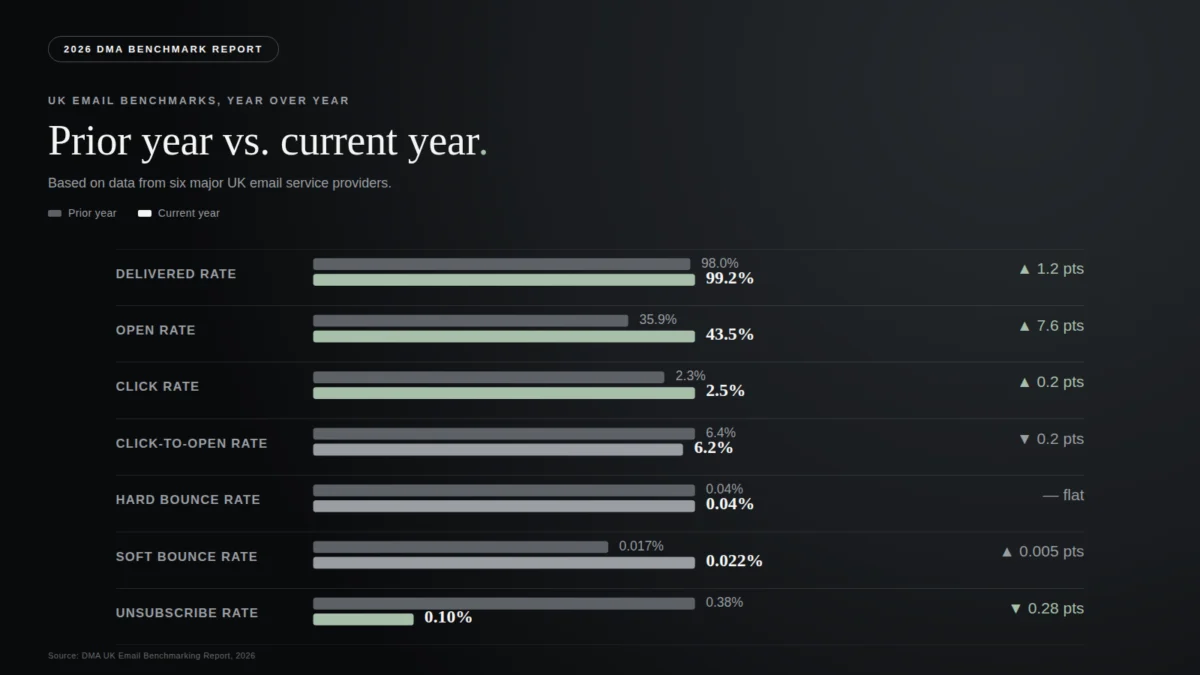
The latest DMA UK Email Benchmarking Report, sponsored by Validity, unveils a dynamic and evolving email marketing ecosystem. While year-over-year metrics show a generally positive trajectory for the channel, the report critically highlights the increasing complexity in measuring true engagement and ROI. Key findings underscore the imperative for marketers to shift focus from traditional metrics like open rates to more nuanced indicators such as Inbox Placement Rate (IPR) and Return on Relationship (RoR), especially in an environment increasingly shaped by artificial intelligence and stringent privacy regulations. The study, drawing on data from six major email service providers, offers the most comprehensive assessment of UK email performance to date, signaling that "good" email marketing is no longer about volume, but precision, relevance, and measurable impact in a channel as competitive as email, where "good" is a perpetually moving target. This comprehensive analysis provides a clearer read yet on where the bar sits and what truly separates good programs from great ones, enabling marketers to harness the massive revenue uplift this channel can drive.
The Evolving Landscape of UK Email Marketing: A Background
Email marketing has long been a cornerstone of digital strategy, consistently delivering high ROI for businesses across sectors. However, the last few years have introduced significant shifts, from heightened consumer privacy concerns to the rapid integration of artificial intelligence into daily digital interactions. The Data & Marketing Association (DMA) UK, a leading authority for the data and marketing industry, collaborates with industry specialists like Validity, a global leader in email deliverability and data quality, to produce this annual benchmarking report. This initiative serves as a vital compass for marketers navigating these complex changes, providing empirical data and strategic insights. The report’s methodology, aggregating data from half a dozen major Email Service Providers (ESPs), ensures a robust and representative view of the UK market, making it an indispensable resource for strategic planning. This year’s edition, in particular, delves into the subtle yet profound transformations that demand a re-evaluation of established metrics and strategies. Marketers can access a copy of the full report to explore these findings in detail.
Headline Performance Metrics: A Deeper Dive into Channel Health
On the surface, the report presents an encouraging narrative for the email channel, with year-over-year data reflecting a generally positive trend. Across the board, key metrics such as delivered rates and, to a lesser extent, click-through rates have shown modest but consistent improvements. The overall delivered rate, for instance, has climbed, indicating better list management and a general adherence to technical sending standards across the industry. This reflects a growing understanding among UK marketers of the foundational importance of getting emails to their intended destinations. While specific percentage increases vary by metric, the overarching message is one of resilience and continued relevance for email as a direct communication channel. For instance, preliminary data suggests an overall delivered rate now hovering around 99.2%, a testament to improved sender practices. Click rates, while experiencing a smaller overall uptick, still contribute positively to the channel’s health, suggesting that despite evolving inbox dynamics, subscribers continue to engage with compelling content. This positive trajectory is particularly noteworthy given the increasing scrutiny from mailbox providers and the dynamic nature of consumer engagement. However, as the report meticulously unpacks, these headline figures mask a more intricate story beneath the surface, particularly concerning the true efficacy of email delivery and the evolving nature of subscriber interaction.
Sectoral Performance Disparities and Strategic Shifts
While overall trends offer a positive outlook, a granular analysis reveals significant variance in email performance across different sectors, underscoring the diverse challenges and opportunities inherent in each. The report highlights that sectors such as Retail and Travel, traditionally heavy users of email for promotional campaigns, recorded some of the lowest click rates, averaging 1.0 percent and 1.2 percent respectively. This lower engagement could be attributed to several factors, including intense promotional competition, consumer fatigue from frequent communications, and the increasing influence of AI in filtering and summarizing email content, which may bypass the traditional "open and click" journey. Industry analysts suggest that in these sectors, transactional emails might still perform strongly, but mass marketing efforts face tougher competition for attention.
Conversely, the Business-to-Business (B2B) sector demonstrated a remarkably sharp improvement in delivered rates, escalating from 90.7 percent to an impressive 95.6 percent. This significant leap is a clear signal that B2B marketers have substantially sharpened their acquisition and list hygiene practices. Experts from Validity attribute this improvement to a concerted effort in validating email addresses at the point of collection, implementing more rigorous opt-in processes, and actively culling non-engaged or bouncing addresses from their databases. This proactive approach not only enhances deliverability but also improves sender reputation, leading to better inbox placement. Other sectors, such as Finance and Public Services, generally maintained steady, high deliverability rates, reflecting their typically more regulated and permission-based sending practices. The report implies that while some sectors are grappling with evolving engagement dynamics, others are demonstrating best practices in foundational email hygiene, setting a benchmark for the industry.
The Critical Distinction: Delivery vs. Inbox Placement Rate (IPR)
One of the most crucial insights from the report is the stark distinction between "delivery" and "deliverability," particularly concerning Inbox Placement Rate (IPR). A high delivered rate, such as the reported 99.2 percent, might initially appear strong, suggesting that emails are successfully reaching their destination servers. However, this metric alone does not reveal how many of those emails actually land in the recipient’s primary inbox, rather than being shunted to spam folders or blocked altogether. That critical distinction is captured by the Inbox Placement Rate (IPR), the true measure of an email’s reach.
Globally, IPRs are currently averaging around 87 percent. This means that approximately one in eight legitimate, permission-based marketing emails never makes it to the intended inbox, representing a significant loss in potential engagement and revenue. The UK average IPR, while slightly higher at approximately 91 percent, has experienced a concerning decline of more than two points year-over-year. This deterioration is largely attributed to mailbox providers, such as Microsoft (which commands roughly 30 percent share of UK inboxes), tightening their enforcement of bulk sender requirements. These providers are implementing more sophisticated spam filters, stricter authentication protocols (like DMARC, SPF, and DKIM), and reputation-based filtering algorithms. As a result, maintaining a strong sender reputation and adhering to evolving best practices has become paramount. For any marketing leader tracking email ROI, IPR is arguably the most critical metric. A typical sender operating at a 90 percent inbox placement rate has an immediate, double-digit lift available in their email performance, even before investing another dollar in content, creative, or segmentation. Improving IPR requires a proactive approach to list hygiene, content optimization, and continuous monitoring of sender reputation, directly impacting the bottom line.
Navigating the AI Frontier: The Evolving Click Story and Attribution Challenges
While overall click rates have seen only a slight increase, the report uncovers a more complex and fascinating shift occurring beneath the surface, largely driven by the pervasive integration of Artificial Intelligence into email clients. AI-generated email summaries and intelligent assistants are increasingly capable of surfacing key information, including call-to-action (CTA) links, directly within the inbox interface, often before a subscriber even opens the full message. This transformative interaction fundamentally alters the traditional engagement funnel. On one hand, it can accelerate the user journey, driving immediate traffic to a desired landing page by presenting high-intent links upfront. On the other hand, it means senders are, in essence, ceding the click decision to an AI’s judgment about which link is most relevant or important.
This paradigm shift likely contributes to the observed weak sector-level click numbers for Retail and Travel. It is improbable that these programs genuinely lost half their click performance year-over-year, as a purely numerical decline would suggest a catastrophic failure in engagement. More plausibly, AI summaries and assistants are facilitating fewer, but potentially higher-intent, clicks. Subscribers might be clicking directly on a product link surfaced by AI without registering an "open" or a traditional "click" within the email body. This phenomenon highlights that the real story isn’t necessarily declining performance, but rather an urgent and critical need for sophisticated, multi-touch attribution models. Marketers must now account for these AI-mediated interactions to accurately measure the true impact and ROI of their email campaigns, moving beyond simplistic last-click attribution to understand the full customer journey. This necessitates investing in advanced analytics and data integration to connect AI-driven engagement signals with broader conversion pathways.
Beyond Direct Engagement: The Brand Billboard Effect of Inactive Subscribers
A significant finding from the report challenges conventional wisdom regarding inactive email subscribers. Nearly every email program carries a segment of subscribers who have not opened or clicked an email in a considerable period, often constituting as much as 50 percent of the total list. Marketers are frequently reluctant to mail to these "inactive" segments, primarily due to concerns about negatively impacting deliverability rates or incurring unnecessary sending costs. However, this reluctance often overlooks email’s powerful, albeit passive, role as a "brand billboard" in the inbox.

Even when subscribers do not actively open or click a message, they still encounter the sender name and subject line. This repeated exposure fosters brand recognition, reinforces brand messaging, and maintains top-of-mind awareness. The report compellingly demonstrates that this passive brand exposure can still elicit responses, albeit indirectly. Subscribers might see an email from a trusted brand and, without opening it, proceed to visit a physical store, search for a product review online, or navigate directly to the brand’s website. When these alternative, brand-driven responses are factored into the overall revenue calculation, inactive subscribers can astonishingly account for roughly 25 percent of a program’s total revenue. This significant contribution is driven largely by established brand reputation and latent interest, rather than immediate direct engagement signals. This revelation provides a meaningful number to bring into any strategic conversation about list suppression strategy or the overall valuation of an email program. It suggests a more nuanced approach to list management, where a segment of inactive subscribers might be strategically maintained for their brand-building value, rather than indiscriminately suppressed, requiring careful balancing of deliverability concerns with brand visibility objectives.
The Fading Reliability of Open Rates: A Metric Under Scrutiny
The utility of open rates as a primary success metric has been significantly diminished, though not entirely eliminated. The report emphasizes that open rates are no longer as useful as they once were, largely due to advancements in privacy features and changes in how email clients operate. Zeta Global, a key contributor to this year’s report, recently published data indicating a striking discrepancy: unique opens stood at 40 percent, against a "true open" rate (with mailbox provider inflation stripped out) of a mere 11 percent. This suggests that approximately three-quarters of recorded opens may not reflect a genuine, human interaction with the email.
Validity has observed this trend firsthand. In Q1, many of their customers reported significant drops in Gmail open rates. This decline was largely explained by changes to Gmail’s image-fetching behavior and general inbox updates, rather than a genuine collapse in subscriber engagement. Crucially, click rates for the same customers remained steady over the same period, confirming that subscribers had not disengaged from the content. This phenomenon gained significant traction with Apple Mail Privacy Protection (MPP), introduced in 2021, which pre-fetches email content and pixels, artificially inflating open rates and making it nearly impossible to discern actual human opens for Apple users. Consequently, while open rates still carry some directional value—an 80 percent open rate typically still outperforms a 60 percent open rate in an A/B test, and for Apple-based traffic specifically, an open is only generated when a message has actually achieved inbox placement—marketing leaders are strongly advised to stop treating open rate as a standalone success metric. Its diminishing accuracy necessitates a shift towards more reliable indicators of engagement and conversion.
Embracing Continuous Optimization in an AI-Powered Era
The report posits that the traditional model of A/B testing, where marketers meticulously test one variable at a time in scheduled cycles, is rapidly losing its relevance. The exponential growth in processing power combined with sophisticated AI capabilities has ushered in an era where an entire email program can be treated as a continuous testing environment. In this advanced paradigm, improvements are not merely identified; they are automatically implemented in real-time, moving beyond static test cycles to dynamic, adaptive optimization.
This shift means that email platforms, augmented by machine learning algorithms, can continuously analyze vast datasets to identify optimal sending times, subject line variations, content personalization, and even ideal CTA placements. These insights are then applied instantaneously, allowing marketers to maximize engagement and conversion rates with unprecedented agility. While the nature of testing evolves, the fundamental need for measurement remains constant. However, the focus of measurement must pivot towards different, more insightful signals. These include bounce rates (hard and soft), spam complaint rates, unsubscribe rates (which, if managed well, can be a healthy sign of list hygiene), reply rates (especially in B2B contexts), engagement duration (time spent on landing pages), and ultimately, post-click conversion metrics that tie directly to business objectives. The emphasis moves from isolated campaign performance to the holistic health and responsiveness of the entire email ecosystem, driven by continuous data feedback loops and AI-driven adjustments.
Introducing Return on Relationship (RoR): The Holistic KPI for Long-Term Value
In light of the evolving metrics and the push towards continuous optimization, the report introduces a new, powerful Key Performance Indicator (KPI) that merits attention from the C-suite: Return on Relationship (RoR). Unlike traditional last-touch attribution models that assign value solely to the final interaction before a conversion, RoR tracks the cumulative impact of all engagement signals over time. This includes opens (where accurately measurable), clicks, repeat purchases, retention rates, and even passive brand exposure.
RoR is designed to capture whether a history of consistent, relevant email engagement is effectively building enough trust and affinity with subscribers to make the next message worth opening, the next offer worth considering, and the next purchase worth making. It moves beyond transactional metrics to evaluate the long-term value generated by cultivating a strong, enduring relationship with the customer through the email channel. For example, a customer who consistently opens, clicks, and eventually converts, but then becomes a repeat buyer years later, demonstrates a relationship built over time. RoR helps quantify this sustained loyalty and advocacy, providing a more holistic view of email’s strategic value to the business. By focusing on RoR, marketers can better demonstrate how their email programs contribute not just to immediate sales, but to enhanced customer lifetime value, reduced churn, and strengthened brand equity, aligning marketing efforts more closely with broader business objectives and fostering a more sophisticated understanding of email’s true ROI.
Strategic Imperatives for Future Email Success: The Bottom Line for ROI
Translating these critical benchmarks and insights into tangible revenue growth requires a proactive and adaptive approach from marketing leaders. The report crystallizes three core priorities for organizations looking to elevate their email marketing programs and maximize ROI in the coming year:
-
Prioritize Inbox Placement and Deliverability Hygiene: The foundational importance of getting emails into the inbox cannot be overstated. Marketers must move beyond mere "delivery rates" and relentlessly focus on Inbox Placement Rate (IPR). This involves rigorous list hygiene, implementing robust authentication protocols (DMARC, SPF, DKIM), monitoring sender reputation diligently, and understanding the specific requirements of major mailbox providers like Microsoft. Investing in deliverability tools and expertise is no longer optional; it is a prerequisite for ensuring that marketing efforts even have a chance to succeed. This fundamental focus provides an immediate, measurable uplift in potential engagement and revenue.
-
Implement Advanced Attribution Models for AI-Influenced Clicks: With AI increasingly mediating subscriber interactions and potentially bypassing traditional open/click pathways, marketers must upgrade their attribution strategies. Simple last-touch models are insufficient in an AI-driven inbox environment. The imperative is to invest in multi-touch attribution systems that can accurately track and credit all touchpoints, including AI-generated direct clicks, passive brand exposure, and subsequent offline actions. This will provide a clearer, more accurate understanding of email’s contribution to the customer journey and enable more informed budget allocation and content optimization decisions.
-
Cultivate Return on Relationship (RoR) through Holistic Engagement: Shifting the focus from isolated campaign metrics to the cumulative strength of customer relationships is vital for long-term success. RoR serves as a powerful KPI to articulate email’s strategic value to the C-suite, demonstrating its role in building customer loyalty, driving repeat purchases, and enhancing customer lifetime value. This involves measuring a broader array of signals, including engagement duration, reply rates, and retention, and designing email programs that prioritize building trust and consistent value over short-term transactional gains. By fostering stronger relationships, marketers can ensure their email channel remains a powerful engine for sustainable growth.
Programs built to measure these critical, forward-looking metrics—inbox placement, reply signals, relationship strength, rather than just superficial opens and clicks—are the ones that will invariably emerge as the new leaders in next year’s benchmarking report. Teams utilizing advanced platforms such as Validity Engage are already integrating this kind of continuous, AI-assisted optimization into their day-to-day program management. This proactive approach transforms these annual benchmarks from a mere report card into an ongoing practice of refinement and innovation, ensuring sustained relevance and superior performance in the dynamic world of email marketing. Learning more about Validity Engage can provide insights into how such continuous optimization is being implemented in practice.








