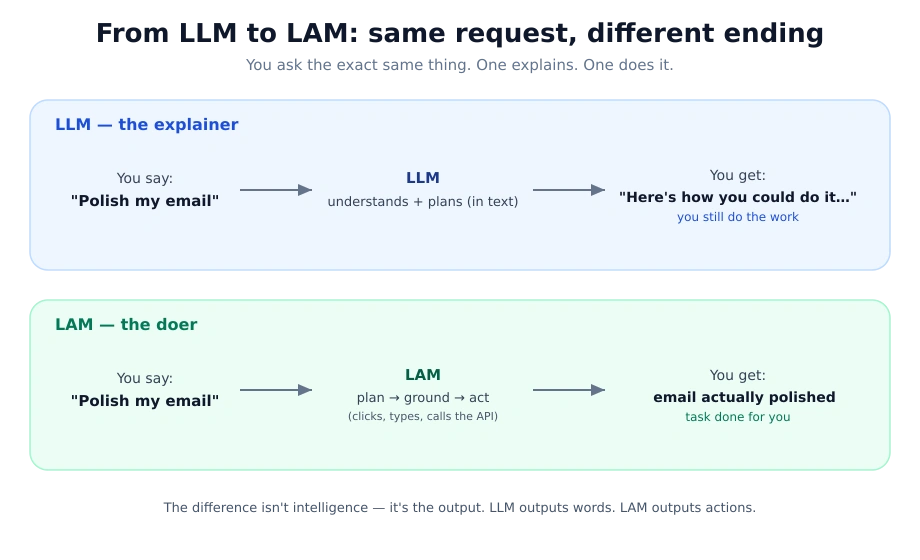
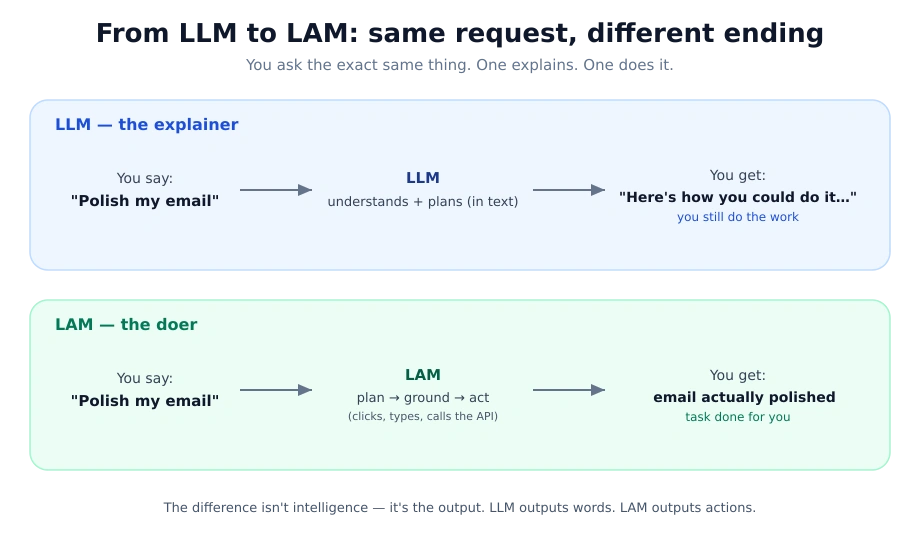
The rapid evolution of artificial intelligence has transitioned from a focus on generative text to a focus on autonomous execution. As enterprises race to integrate “AI Agents” into their workflows, a critical technical schism has emerged between two primary architectures: Agentic Large Language Models (LLMs) and Large Action Models (LAMs). While both systems can fulfill a command such as “Polish my email and send it,” the underlying mechanisms, reliability profiles, and resource requirements differ fundamentally. Understanding this distinction is no longer a matter of academic interest but a strategic necessity for organizations deploying AI in production environments.
The Core Distinction: Intelligence vs. Execution
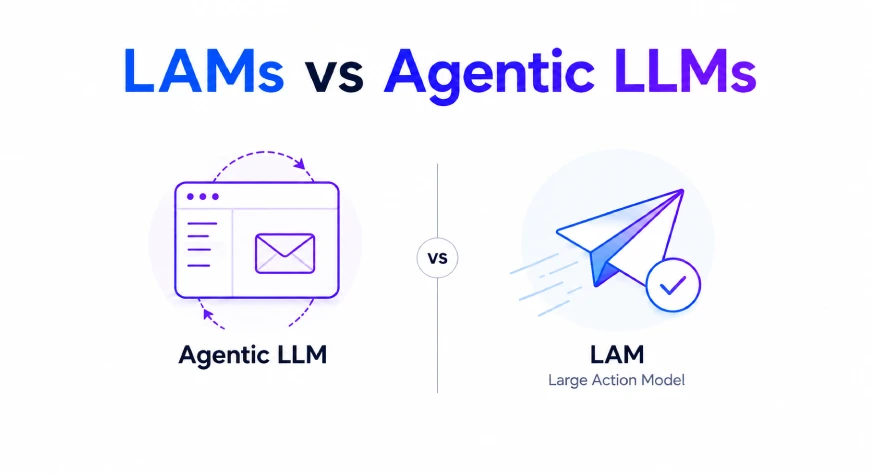
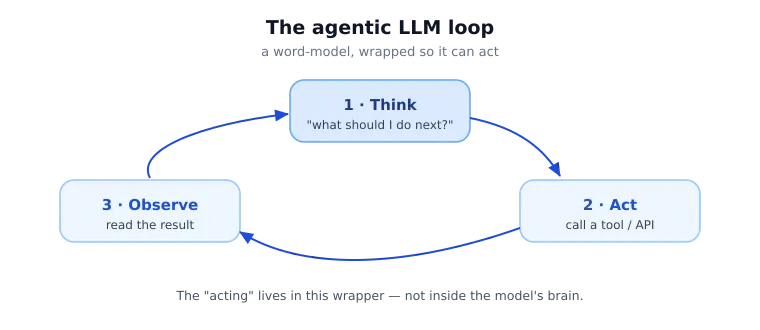
At the most basic level, the difference lies in where the “ability to act” resides. An Agentic LLM is a general-purpose reasoning engine—such as GPT-4o, Claude 3.5, or Gemini 1.5—placed within a structured software loop. In this configuration, the model’s primary function remains word prediction. Its ability to interact with the world is “borrowed” from external scaffolding, often referred to as a ReAct (Reason + Act) framework. The model reads a goal, reasons about the necessary steps, selects a tool from a provided list, and interprets the results of that tool’s action.
Conversely, a Large Action Model (LAM) is designed from the ground up with execution as its primary objective. Rather than being trained solely on the vast expanse of the internet’s text, a LAM is trained on “action trajectories.” These datasets include sequences of API calls, user interface (UI) interactions, and successful multi-step task completions. In a LAM, the ability to navigate a software interface or execute a command is baked into the model’s weights, not just prompted in a wrapper.
A Chronology of Autonomous AI Development
The journey toward autonomous AI has moved through several distinct phases over the last half-decade, leading to the current divergence between Agentic LLMs and LAMs.
- The Generative Era (2020–2022): The release of GPT-3 and similar models focused on text-to-text transformations. These models could summarize, translate, and draft content but had no inherent way to interact with external software.
- The Tool-Use Breakthrough (2023): Developers began experimenting with “wrappers” like AutoGPT and BabyAGI. This period saw the introduction of “function calling” by OpenAI, allowing models to output structured data (JSON) that external systems could use to trigger APIs.
- The Agentic LLM Standard (2024): Frameworks like LangGraph, CrewAI, and Microsoft’s AutoGen standardized the “Agentic” loop. This allowed general-purpose models to be used as orchestrators for complex workflows, though reliability remained a significant hurdle.
- The Rise of the LAM (2025–Present): Research from entities like Salesforce (xLAM) and Adept (ACT-1) shifted the focus toward specialized models. These models demonstrated that smaller, more focused architectures could outperform massive generalist models if they were trained specifically on action-oriented data.
Technical Deep Dive: The Agentic LLM Loop
The Agentic LLM functions through a cycle of observation and inference. When a user provides a prompt, the system follows a specific orchestration logic:
- Reasoning: The model analyzes the prompt and determines what information it lacks.
- Tool Selection: It identifies an external tool (e.g., a Google Calendar API or a Python interpreter) that can provide that information.
- Action: The orchestration layer executes the tool based on the model’s instructions.
- Observation: The model receives the output from the tool and decides if the task is complete or if further steps are required.
The primary advantage of this approach is flexibility. Because the “intelligence” is general-purpose, the same model can be used for creative writing in one moment and debugging code in the next. However, this flexibility comes at the cost of reliability. Generalist LLMs are prone to “hallucinating” API parameters or getting stuck in infinite loops where they repeat the same unsuccessful action. In production environments, these failures can lead to significant latency and increased operational costs.
Technical Deep Dive: The Large Action Model (LAM)
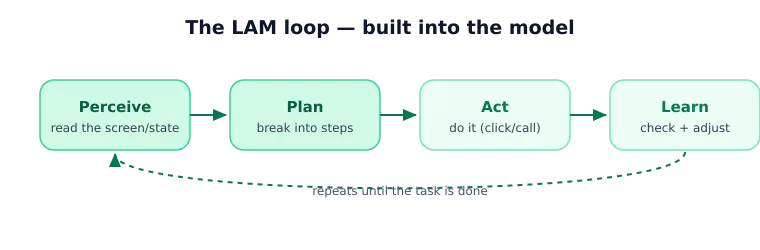
Large Action Models utilize a different architectural philosophy, often described as the “Perceive, Plan, Act, Learn” cycle. The training process for these models is significantly more specialized.
A key milestone in this field was the development of the AgentOhana pipeline by Salesforce researchers. This pipeline unified diverse action data—ranging from web navigation to database queries—into a single training format. By training on these trajectories, the model learns the “grammar” of actions. It understands that clicking a “Submit” button must be preceded by filling out required fields, not because it reasoned it out from text, but because it has mapped the statistical likelihood of that sequence in a software environment.
One of the most striking examples of LAM efficiency is Salesforce’s xLAM-1B, often called the “Tiny Giant.” Despite having only 1 billion parameters, it has demonstrated the ability to outperform GPT-3.5 (a model roughly 175 times its size) on specific function-calling benchmarks. This suggests that for specialized tasks, “bigger” is not necessarily “better”; “more relevant” training data is the deciding factor.
Supporting Data: Performance and Resource Metrics
The shift toward LAMs is driven by three primary metrics: reliability, latency, and cost.
- Success Rates: In recent benchmarks involving complex API orchestrations, specialized LAMs have maintained success rates of 90-95%, while generalist LLMs using ReAct loops often fluctuate between 60-75% due to reasoning errors or formatting inconsistencies.
- Inference Costs: Running a 70B or 400B parameter generalist model to perform a simple database entry is computationally expensive. A 1B or 7B parameter LAM can perform the same task at a fraction of the cost, making it more viable for high-volume enterprise applications.
- Latency: Because LAMs are smaller and trained for direct output of actions, they bypass the lengthy “chain-of-thought” reasoning steps that Agentic LLMs require. This results in faster response times for the end-user.
Industry Reactions and Strategic Implementations
The tech industry has responded to this divergence with two distinct strategies. Companies like OpenAI and Anthropic continue to push the boundaries of generalist models, betting that “scaling laws” will eventually make their models smart enough to handle actions without specialized training. They are integrating “computer use” capabilities directly into their flagship models (e.g., Claude 3.5 Sonnet’s ability to control a cursor).
On the other side, enterprise-focused companies like Salesforce and specialized startups like Rabbit and Adept are leaning into the LAM philosophy. Salesforce’s “Agentforce” initiative emphasizes the use of specialized models that can operate within the guardrails of specific business processes.
Industry analysts suggest that the most robust systems will likely be hybrids. A generalist Agentic LLM might handle the initial customer interaction, using its superior language skills to understand nuance and intent. Once a specific intent is identified—such as “process a refund” or “update a shipping address”—the task is handed off to a LAM. This “routing” strategy ensures that the broad reasoning is handled by the generalist, while the high-stakes, structured execution is handled by the specialist.
Implications for the Enterprise
For organizations looking to deploy AI agents, the choice between an Agentic LLM and a LAM depends on the “action space” of the task.
When to choose an Agentic LLM:
- The task requires high levels of creative interpretation or linguistic nuance.
- The tools and APIs involved are constantly changing, requiring a model that can adapt to new documentation on the fly.
- The workflow involves “open-ended” reasoning where there is no single correct path to a solution.
When to choose a LAM:
- The task involves a “closed” system with fixed APIs or UI workflows.
- Reliability and consistency are paramount (e.g., financial transactions).
- The system must operate at scale with low latency and minimal compute costs.
The Future Outlook: 2026 and Beyond
As we move further into 2026, the distinction between “chatting” and “doing” will continue to sharpen. The emergence of LAMs represents a move toward the “industrialization” of AI, where specialized models act as the reliable machinery of the digital economy. While the Agentic LLM remains the “brain” capable of broad thought, the Large Action Model is becoming the “hands” that interact with the world.
The long-term impact of this divergence will be seen in the democratization of automation. As LAMs become smaller and more efficient, they will eventually move from the cloud to “on-device” execution. Your smartphone or laptop may soon host a local LAM capable of managing your files, scheduling your meetings, and interacting with your apps without ever sending sensitive action data to a centralized server.
In conclusion, the gap between Agentic LLMs and Large Action Models is a reflection of the classic trade-off between generalist flexibility and specialist precision. For the modern enterprise, the goal is not to choose one over the other, but to build an orchestration layer that leverages the strengths of both—creating a system that can not only think and reason but also act with unfailing accuracy.