
Email, far from fading into obsolescence, continues to solidify its position as a cornerstone of digital communication, yet a significant chasm is rapidly forming between organizations that strategically invest in robust measurement, deliverability, and optimization, and those that rely on outdated assumptions. This stark reality is meticulously detailed in Sinch Mailgun’s comprehensive 2026 Email Impact Report, released on April 17, 2026. The report, a critical resource for marketers and technologists, synthesizes insights from a global survey of over 1,200 email senders and an exhaustive analysis of more than 400 billion real emails transmitted through Sinch Mailgun’s infrastructure throughout 2025. Spanning five critical chapters—ROI, industry benchmarks, deliverability, AI adoption, and investment trends—the findings illuminate the evolving landscape of email marketing and provide a clear roadmap for navigating its complexities in the latter half of 2026 and beyond.
The Enduring Power of Email: A Strategic Imperative
Despite the proliferation of new communication channels, email retains an unparalleled strategic importance within organizations. The Sinch Mailgun report unequivocally states that a staggering 78% of senders consider email to be "very" or "extremely" important to their organization’s overall success. This level of intrinsic buy-in is a testament to email’s unique ability to foster direct customer relationships, drive conversions, and serve as a reliable owned channel in an increasingly fragmented media environment. Unlike transient social media trends or fluctuating paid advertising costs, email offers a direct line to a brand’s audience, making it an invaluable asset for nurturing leads, supporting customers, and announcing critical updates. This perceived value, however, often diverges sharply from actionable evidence.
Unlocking ROI: From Conviction to Evidence
A core paradox highlighted by the report is the disconnect between email’s perceived importance and the active measurement of its return on investment (ROI). Fewer than half of senders actively track the ROI of their email programs—specifically, only 46% for promotional emails and 43% for transactional communications. This suggests that a significant majority of email teams are operating on conviction and intuition rather than data-driven insights, leaving substantial opportunities for strategic improvement and budget justification untapped.
For those who do measure, the results are compelling. A remarkable 60% of senders tracking promotional email ROI report returns exceeding $10 for every $1 spent, while 13% achieve an even more impressive ROI of over $40:1. Transactional emails demonstrate similar efficacy, with 62% of measuring senders reporting returns above the $10:1 threshold, and 13% again seeing returns greater than $40:1. Intriguingly, Sinch Mailgun’s analysis suggests that such exceptionally high ROIs (above $40:1) might actually signal underinvestment. In such scenarios, the efficiency is so high that allocating additional budget could yield even greater absolute returns, indicating that many organizations are leaving potential revenue on the table by not scaling their successful email initiatives.
The primary obstacle to increasing email investment, cited by 43% of senders, is budget constraints. Yet, the report argues that securing additional budget is inherently difficult without robust data to support the case. To bridge this gap, the report recommends an intermediate step: tracking revenue per campaign. While perhaps not a perfect attribution model from the outset, this metric provides tangible evidence of email’s financial contribution, serving as a crucial stepping stone toward more comprehensive ROI tracking. This foundational data allows marketers to move beyond anecdotal evidence and present a compelling, financially-backed argument for increased investment, thereby initiating a virtuous cycle of data-driven growth.
Benchmarking Reality: Insights from 400 Billion Emails
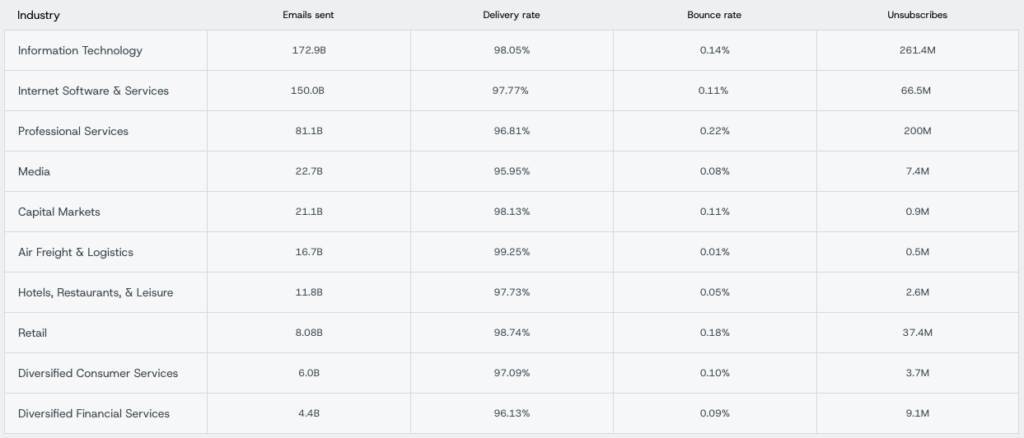
Historically, email industry benchmarks have often relied on self-reported survey data, which can be prone to inaccuracies and subjective interpretations. Chapter 2 of the 2026 Email Impact Report breaks new ground by leveraging real sending data from Sinch Mailgun’s infrastructure, analyzing performance across the top 10 industries by volume in 2025. This granular, data-driven approach offers an unprecedented view into actual email performance, revealing where true benchmarks reside.
The performance metrics vary significantly across industries, reflecting the diverse nature and intent of email communications. For instance, the Air Freight & Logistics sector demonstrates exceptional deliverability, leading with a 99.25% delivery rate and an astonishingly low 0.01% bounce rate. This superior performance is largely attributed to the predominance of transactional sends—shipping confirmations, tracking updates, and delivery notifications—which are highly anticipated and desired by recipients. Conversely, the Media industry recorded the lowest delivery rate among the top 10, at 95.95%. This lower rate is a natural consequence of high-volume promotional sends to broad audiences, where engagement can be more varied and spam complaints more frequent.
Beyond Delivery Rates: The Imperative of Inbox Placement

A critical insight from the report is the distinction between delivery rate and actual inbox placement. An email counted as "delivered" by a mail server merely indicates acceptance; it does not guarantee that the message landed in the recipient’s primary inbox. Many "delivered" emails may end up in spam folders, rendering them effectively unseen. The report makes a compelling case for senders to pair traditional delivery rate tracking with sophisticated inbox placement testing. This dual approach provides a far more accurate understanding of email reach, revealing whether messages are truly connecting with their intended audience or languishing in digital purgatory.
The analysis also sheds light on the contextual importance of metrics like unsubscribe rates. The Information Technology sector, for example, logged the highest raw number of unsubscribes at 261 million. However, when viewed against its colossal sending volume of 172.9 billion emails, this translates to a relatively low unsubscribe rate of approximately 0.15%. In contrast, the Retail industry generated 37.4 million unsubscribes from a much smaller volume of 8.08 billion sends, indicating a significantly higher unsubscribe rate per email. This comparison underscores that raw unsubscribe volume, without the crucial context of send volume, is a meaningless metric. Understanding the rate of unsubscriptions, especially in relation to engagement metrics, provides a more actionable insight into audience satisfaction and list health.
Strengthening Foundations: The Deliverability Evolution
The foundational importance of email deliverability is widely acknowledged, with 89% of senders recognizing its significance to their organization. Encouragingly, 43% of senders reported an improvement in their inbox placement over the past 12 months, signaling genuine progress in email infrastructure and best practices. A major catalyst for this improvement has been the significant growth in DMARC (Domain-based Message Authentication, Reporting, and Conformance) adoption. Driven by increasingly stringent requirements from major email service providers like Gmail, Yahoo, and Microsoft, DMARC has become an essential protocol for email authentication, combating phishing and spoofing, and bolstering sender reputation.
The report highlights a pivotal shift in DMARC implementation: for the first time in Sinch Mailgun’s research, enforcement policies (quarantine or reject) are outpacing passive monitoring. Over half of DMARC adopters are now actively using these stronger policies, up from 43% in 2023 and 54% in 2024 to 61% in 2025. This move towards active enforcement signifies a maturing understanding of email security and a proactive stance against malicious email practices. Such measures not only protect recipients but also enhance the legitimate sender’s reputation, leading to improved inbox placement and overall deliverability.
Bridging the Knowledge Gap: The Challenge of Email Literacy
Despite the demonstrable advancements in email infrastructure and the critical role of deliverability, a significant knowledge gap persists among senders. The report reveals that 36% of senders claim to monitor their "email deliverability rate"—a metric that, in essence, does not exist as a distinct, actionable benchmark. This confusion highlights a fundamental misunderstanding of core deliverability concepts; many conflate simple "delivery" (server acceptance) with true "inbox placement" (landing in the primary inbox). Only a quarter (25%) of senders actively conduct inbox placement tests to ascertain where their emails are truly landing. Furthermore, a concerning 27% of DMARC users are unaware of the specific policy they have in place (e.g., none, monitor, quarantine, or reject). This lack of literacy, despite the availability of sophisticated tools and protocols, poses a substantial risk. Uninformed senders may unwittingly jeopardize their sender reputation, fall victim to blocklists, or simply fail to reach their audience effectively, negating all other marketing efforts. The report emphasizes that while the tools are improving, the understanding and strategic application of these tools are lagging, creating a vulnerability for many organizations.
The AI Imperative: Transforming Email Strategy
The integration of Artificial Intelligence (AI) into email programs is no longer a futuristic concept but a rapidly evolving reality. The 2026 Email Impact Report indicates widespread intent, with 79% of senders either currently using or planning to use AI in their email initiatives. However, the actual regular use of AI sits at a more modest 27%, suggesting that a substantial portion of adopters are still in the experimental phase, rather than systematically integrating AI into their daily workflows.
The most common applications of AI are generative, with 41% using it for copy generation. This is followed by content personalization (36%), dynamic content creation (29%), send time optimization (27%), and data analysis (27%). This pattern reveals a clear trend: AI delivers its most significant value when embedded in strategic decision-making processes, rather than being confined to mere content production. Teams that leverage AI for advanced personalization, predictive send time optimization, and sophisticated A/B testing report compounding returns, as these applications directly enhance engagement and conversion rates. Conversely, teams that restrict AI use to basic tasks like drafting subject lines often see only limited impact, underscoring that the true power of AI lies in its strategic application.
Strategic Integration: Maximizing AI’s Potential
The impact of AI on email program performance is becoming increasingly pronounced, creating a noticeable performance gap. The report highlights that 54% of senders who have implemented AI in their email programs reported moderate or significant year-over-year improvements. In contrast, only 37% of senders who are not using AI observed similar improvements during the same period. This 17-point difference, while not definitively proving causation, consistently points towards AI as a significant differentiator, suggesting that it is beginning to segment email programs into distinct performance tiers.
Notably, 23% of AI users reported that the technology had not helped them at all. This finding further emphasizes that the efficacy of AI is not inherent in the tool itself but in the depth and thoughtfulness of its integration. Simply adopting AI without a clear strategy for how it will enhance decision-making, optimize workflows, and improve customer experience will yield minimal returns. The report underscores that successful AI implementation requires a shift from superficial engagement to deep, systematic integration across various facets of the email program, from content creation and audience segmentation to delivery optimization and performance analytics.
Future Forward: Investment and Priorities for 2026
Looking ahead to 2026, the strategic priorities for email senders are clearly defined. "Taking advantage of AI" and "increasing email engagement" are tied as the top priorities, each cited by 40% of senders. This dual focus underscores a recognition that technological advancement and customer-centric strategies must go hand-in-hand to achieve sustained success.
In terms of investment, the outlook for email programs remains largely positive. A robust 31% of organizations plan to increase their email investment, reflecting a growing confidence in the channel’s ROI and strategic value. The largest segment, 48%, intends to maintain current spending levels, indicating stability and continued commitment. Only a small fraction, 7%, plans to decrease their email investment, suggesting that for most, email remains a vital and valued component of their marketing ecosystem. These investment trends align with the report’s overarching findings, demonstrating a market that is increasingly valuing data-driven strategies and technological innovation in email marketing.
A Tripartite Strategy for Sustained Growth
The Sinch Mailgun 2026 Email Impact Report concludes with a straightforward yet powerful message: email works. The extensive data analysis, spanning ROI figures, industry benchmarks, and deliverability trends, provides irrefutable evidence of its efficacy. However, the report also offers a crucial caveat: future success will not be evenly distributed. The email programs poised to pull ahead are those that commit to investing simultaneously in three interconnected areas: measurement, deliverability, and optimization.
- Measurement: This involves moving beyond assumptions to rigorously prove ROI with real data, tracking key metrics, and building robust attribution models.
- Deliverability: This entails consistently ensuring emails reach the inbox through diligent authentication (like DMARC, SPF, DKIM), meticulous list hygiene, and continuous monitoring of sender reputation and inbox placement.
- Optimization: This requires leveraging advanced tools, particularly AI, and employing systematic testing to continually refine and improve email performance at scale, from personalization and content relevance to send times and audience segmentation.
Crucially, the report emphasizes that none of these areas necessitate a massive initial budget. Rather, they are strategic investments that, when implemented consistently and thoughtfully, yield compounding returns over time. The cumulative effect of better measurement, improved deliverability, and continuous optimization creates a powerful flywheel for sustained growth and competitive advantage in the dynamic world of email marketing.
Expert Commentary and Industry Outlook
Industry experts have largely welcomed the Sinch Mailgun report, highlighting its timely insights. "The 2026 Email Impact Report serves as a crucial compass for marketers navigating an increasingly complex digital landscape," commented Dr. Evelyn Reed, a leading marketing analyst. "It underscores that email is not merely surviving but thriving, albeit with a growing chasm between those who master its intricacies and those who operate on outdated assumptions. The emphasis on robust measurement and AI integration reflects a broader shift in marketing towards accountability and efficiency." A spokesperson for Sinch Mailgun, in a recent press briefing, added, "Our data clearly indicates that foundational elements like DMARC are no longer optional but critical for maintaining sender reputation and inbox reach. The knowledge gap around these basics is a significant concern that the industry must address collectively." The report’s findings resonate with the broader industry trend towards a more sophisticated, data-driven approach to digital marketing, where email continues to play an irreplaceable role as a high-ROI, direct-to-consumer channel.
In essence, the 2026 Email Impact Report paints a clear picture: email is not just here to stay; it is evolving. The future of email marketing belongs to those who embrace data, prioritize deliverability, and strategically integrate AI, transforming their programs from mere communication tools into powerful engines of growth and customer engagement.