rifanmuazin
The landscape of digital marketing is undergoing a seismic shift, driven by the rapid integration of artificial intelligence. Yet, as marketing leaders grapple with understanding their brand’s presence within this new frontier, a fundamental challenge emerges: the data itself is inherently unreliable. The very metrics CMOs and CFOs rely on for strategic decision-making regarding AI visibility are, by their nature, estimates, prone to fluctuations, and in many crucial aspects, unknowable. This realization, while potentially discomforting, is the crucial first step toward developing a more effective and actionable approach to measuring AI impact.
The core of this challenge lies in the nascent methodologies employed by AI visibility platforms. Tools from prominent players like Profound, seoClarity, Peec, and AirOps, alongside countless others currently being piloted, operate on probabilistic models. Prompt volume numbers are not exact counts but rather statistical estimations. Mention rates can vary significantly from one run to the next. Most critically, the metric that many marketers covett—the precise number of individuals who saw an AI response mentioning their brand in a given month—remains, for all practical purposes, beyond direct measurement.
This is not a indictment of the platforms themselves, many of which are valuable tools for those who understand their limitations. Instead, it is a recognition of a structural reality inherent to the AI medium. Once this fundamental uncertainty is accepted, it liberates marketers to focus on what can be gleaned from the data: directional insights, trends, and competitive intelligence, rather than an elusive pursuit of absolute precision.
Understanding the Genesis of AI Visibility Data
To navigate the complexities of AI visibility measurement effectively, it is imperative to understand the origins of the data being presented. Every platform operates by feeding a set of prompts into one or more Large Language Models (LLMs), meticulously recording instances where a specific brand is mentioned or cited, and then aggregating this information into scores or trend lines. The divergence in methodologies primarily stems from how these platforms attempt to estimate the volume of prompts being issued. Broadly, four primary approaches are currently in play:
-
Panel and Survey-Based Estimation: This method leverages data derived from consumer panels or surveys to infer prompt volume. Its primary advantage lies in its attempt to mirror actual human behavior. However, it is constrained by the inherent accuracy limitations of panel data, particularly the potential for significant margins of error, especially within niche verticals or B2B categories where panel sizes are inherently smaller.
-
Clickstream and Traffic Inference: This technique analyzes anonymized browsing behavior to deduce the extent of query activity across various AI platforms. While valuable for providing directional comparisons between platforms (e.g., assessing the growth trajectory of ChatGPT versus Gemini), its reliability diminishes when attempting to pinpoint individual prompt or topic-level engagement.
-
Keyword-to-Prompt Modeling: This is arguably the most prevalent approach. It utilizes existing keyword research data to estimate the likelihood of a given prompt theme being queried within AI contexts. The logic is that if a particular search term garners significant volume on traditional search engines, a proportional amount of that user intent is likely to manifest in AI interactions. The critical flaw in this model, however, is the reliance on an assumed conversion factor from search volume to AI prompt volume, which often fails to account for the distinctly different ways users interact with LLMs compared to traditional search engines.
-
Direct API Sampling: This transparent method involves running a fixed set of predefined prompts at regular intervals and reporting the findings. While offering clarity on precisely what was queried, it makes no claim about the overall real-world volume of such queries.
None of these methods are inherently "wrong"; each possesses genuine utility. However, none can replicate the deterministic, logged, and directly user-behavior-tied nature of data provided by tools like Google Search Console. Internalizing this fundamental distinction is key to developing a more robust and insightful AI visibility program.
The Measurement Problem: A Deeper Dive into Medium-Specific Challenges
A common critique leveled against AI visibility measurement centers on the uncertainty at the platform level: disparate tools yielding conflicting numbers, disagreements on the significance of certain prompts, and inconsistencies in sentiment scoring. While all these observations are valid, the more profound issue extends beyond the tools themselves to the very nature of the AI medium.

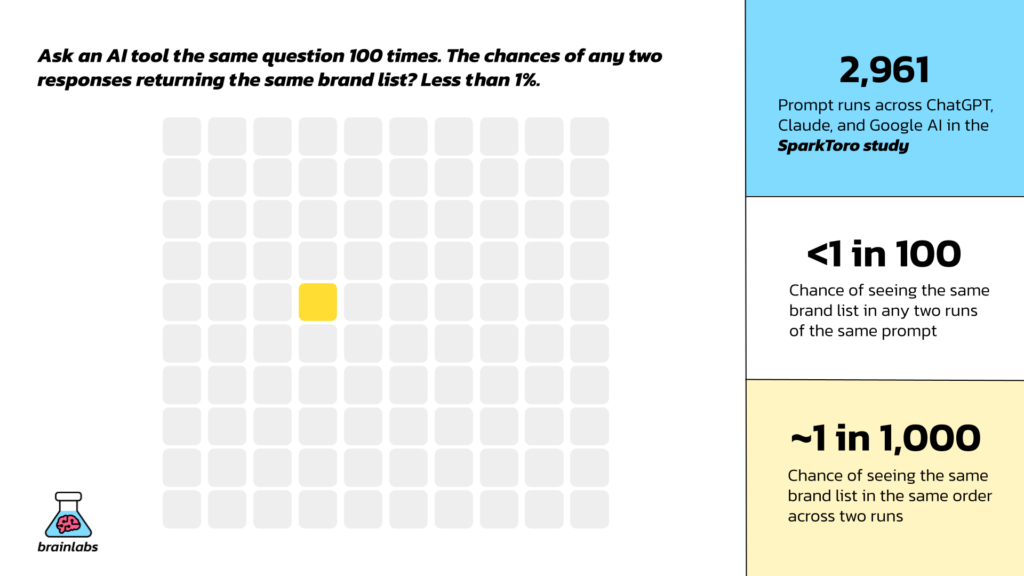
Rand Fishkin, through his rigorous research at SparkToro, has provided some of the most compelling evidence regarding the inconsistency of AI responses. In a study involving nearly 3,000 prompt runs across ChatGPT, Claude, and Google AI, his findings were stark: there is less than a 1 in 100 chance that any of these AI tools will provide the same list of brand recommendations for the identical prompt across two separate runs. Achieving the same order of recommendations is even rarer, closer to 1 in 1,000.
This inherent variability fundamentally undermines the concept of a "ranking," which has long been the cornerstone of traditional SEO reporting. In the AI search paradigm, a brand is not in "position three." Instead, it might be mentioned in 47% of responses to a given prompt cluster. This is not a lesser version of a ranking; it represents a fundamentally different signal that necessitates a paradigm shift in how we conceptualize and analyze performance. The transition from a positional metric to a mention-rate metric is a crucial acknowledgment of this new reality.
The "Zero-Click" Conundrum: A Disconnect Between Awareness and Action
The chasm between understanding the nature of AI interactions and adapting marketing strategies accordingly is particularly evident in the context of "zero-click" search. This concept, while not new, is simple: when a user queries an AI for a recommendation, such as "best accounting software for a growing startup," they receive a curated answer without the need to click through to multiple verification sources. Citation links within AI responses are rarely clicked. Most professionals acknowledge this reality.
Yet, despite this awareness, many marketing leaders revert to asking: "Why is our LLM click volume so low?" Or, more disconcertingly, "This only accounts for about 1% of organic traffic; does it even matter?" The root of this persistent focus on clicks is not ignorance but the deeply ingrained legacy of attribution infrastructure. For two decades, the measurement stack has been meticulously designed to quantify clicks and link them to tangible outcomes. Tools like Google Analytics 4, Search Console, and UTM parameters all operate under the assumption that value is primarily derived through a click. When clicks cease to be the primary conduit for influence, the entire measurement framework requires a fundamental reorientation—a task far more complex than simply updating a dashboard.
What transpires when a brand is mentioned in an AI response is more akin to a brand impression than a direct website visit. However, this impression is amplified significantly by the perceived authority and objectivity of the AI. Users absorb this commentary on a brand’s positioning, and while it may not register in immediate website analytics, it subtly shapes the consideration set that ultimately drives branded search queries, direct website visits, or purchase decisions. This is the "halo effect" of AI mentions—a growing and tangible influence that, at present, is largely unmeasured by traditional means.
Intelligence Over Accounting: A New Framework for AI Visibility
Given the inherent imprecision of absolute numbers in AI visibility data, the focus must shift to what can be reliably tracked: trends, competitive benchmarks, directional signals, prompt-level patterns, and citation source breakdowns. These elements offer genuine meaning within a probabilistic data environment, provided they are leveraged to generate actionable insights rather than merely populate reporting slides.
At Brainlabs, this philosophy is encapsulated as "intelligence over accounting." It represents a deliberate departure from the instinct to treat AI visibility metrics as equivalent to impression counts or keyword rankings—numbers to be reported and compared week-over-week as ends in themselves.
In practice, this translates to several key strategies:
-
Test Multiple Data Sources and Seek Convergence: When data from different platforms, such as seoClarity and Profound, tell a consistent directional story—for example, a shared decline in visibility across mid-funnel financial services queries—that signal holds significant weight, even if the exact numerical values differ. Convergence across imperfect sources is more valuable than a false sense of precision derived from a single, potentially flawed, data point.
-
Prioritize Mentions Over Citations: This may seem counterintuitive to an SEO audience accustomed to valuing backlinks. However, growing evidence suggests that being mentioned within AI responses profoundly influences downstream brand behavior, including branded search volume, direct traffic, and ultimately, conversions. The mention itself is the primary signal; the citation link is a welcome, but secondary, benefit.
-
Read AI Metrics Alongside Traditional SEO KPIs: AI visibility data does not supersede organic traffic analysis; rather, it contextualizes it. An increase in branded search volume concurrently with a decrease in organic click volume could plausibly be explained by enhanced AI mentions. Similarly, if a competitor’s domain authority remains static while their share of AI citations climbs, it indicates a shift in where authority is being established. These are the nuanced narratives that AI visibility data, when interpreted intelligently, can reveal.
The Anatomy of Effective AI Visibility Reporting
To construct AI visibility reporting that is both honest about its inherent limitations and genuinely useful, a practical framework is essential. This involves a deliberate shift in focus:
-
Lead with Direction, Not Decimals: Instead of stating, "Our mention rate is 43.7%," which offers little actionable context, a more effective approach is to report, "Our mention rate on high-intent financial services prompts has increased by 12 points quarter-on-quarter." This highlights a meaningful trend and relative movement, acknowledging that a precise absolute percentage lacks a reliable baseline for comparison. The emphasis should always be on trends and relative comparisons, not static point-in-time snapshots.
-
Segment by Prompt Intent, Not Solely by Platform: Knowing that a brand is mentioned more frequently on ChatGPT than Gemini offers limited strategic value. More actionable intelligence is derived from understanding visibility across different prompt categories. For instance, identifying that a brand is prominent on high-commercial-intent prompts but absent from category-awareness prompts provides clear direction for content and optimization efforts.
-
Build the Halo Effect into Your Framework: Even in the absence of precise measurement tools, the halo effect of AI mentions must be explicitly acknowledged in reporting. This involves noting correlations between periods of improved AI visibility and subsequent trends in branded search volume or direct traffic. Monitoring branded search uplift following content investments aimed at enhancing AI citation rates is also crucial.
-
Report AI Visibility Alongside, Not Instead of, Traditional Metrics: AI visibility data should be viewed as an additive layer to the existing measurement stack, not a replacement. Organic traffic, GSC data, and conversion rates remain indispensable. AI visibility data provides a critical lens into the influences shaping these traditional metrics at a layer above the click.
The Benchmark for a New Era
Traditional SEO once offered marketers a relatively clear pathway from query to click to outcome—a rare form of certainty in the digital realm. The erosion of this clarity in the AI era naturally prompts a search for the nearest available proxy for that lost precision, even if that proxy is inherently unreliable.
However, the brands poised to dominate AI search will not be those who simply find the most convincing-looking numbers for their board presentations. They will be the organizations that embrace the inherent imprecision of the current landscape, invest in directional intelligence, and cultivate content and distribution strategies robust enough to ensure presence across the diverse sources that LLMs draw from.
While the data will undoubtedly improve and measurement methodologies will mature, and attribution models will evolve to incorporate zero-click influence, the current reality is that imprecise yet actionable insights are far more valuable than precise but paralyzing data. The uncomfortable truth is that AI visibility data, in its current form, is flawed. The imperative for marketers is to acknowledge this imperfection and learn to leverage it effectively.
For organizations seeking to understand how Brainlabs approaches AI visibility measurement for clients across diverse sectors like retail, financial services, and B2B, engaging with their expert team offers a path toward developing a more sophisticated and impactful AI strategy.