
 rifanmuazin
The digital marketing landscape is perpetually evolving, yet email remains an indispensable tool, a direct conduit to customer engagement. However, the seemingly simple act of hitting ‘send’ on an email campaign can quickly devolve into a frustrating exercise in futility if a marketer’s contact database is riddled with invalid addresses. Bounce notifications, rather than engagement metrics, become the disheartening feedback. This pervasive challenge underscores a critical need for modern marketing professionals: proactive email list validation automation, a strategic imperative that transforms reactive list cleanups into an always-on defense mechanism, crucial for safeguarding deliverability and protecting the bottom line.
This article delves into the mechanics of automated email verification, illuminates the often-underestimated true costs associated with poor data quality, and provides a structured framework for implementing a strategy designed to maintain pristine email lists.
The Evolving Landscape of Email Marketing and Data Quality
Email marketing has consistently demonstrated its resilience and effectiveness, projected to experience a compound annual growth rate (CAGR) of 15.92 percent between 2024 and 2030. This robust growth trajectory solidifies email’s position as a cornerstone of digital strategy, driven significantly by advancements in automation and personalization. Yet, this growth also brings heightened scrutiny from Email Service Providers (ESPs) like Gmail, Outlook, and Yahoo, which continuously refine their algorithms to combat spam and protect user inboxes. For marketers, this means that merely sending emails is no longer sufficient; ensuring those emails reach their intended recipients in the inbox, not the spam folder, is paramount.
Historically, email list maintenance was often a periodic, manual chore—a reactive "scrubbing" of databases to remove obviously bad addresses after a campaign had already suffered performance issues. However, as databases have scaled and the sophistication of spam filters increased, this reactive approach has proven insufficient and costly. The modern era demands a proactive, continuous approach to data hygiene, where invalid or risky email addresses are identified and managed before they can negatively impact campaign performance. This shift represents a fundamental evolution in marketing operations, moving from occasional damage control to continuous preventive care.
Understanding Email List Validation Automation
Email list validation automation leverages advanced technology to systematically verify the authenticity and deliverability of email addresses within a database. Unlike traditional one-time list scrubbing, which is a snapshot in time, automation integrates seamlessly into ongoing data workflows. It acts as a perpetual security checkpoint for a Customer Relationship Management (CRM) system and other marketing platforms, automatically flagging addresses that are invalid, risky, or dormant before any messages are dispatched.
Conceptually, automated validation functions much like airport security: every passenger (email address), whether new or existing, undergoes a thorough check before being allowed into the system. This continuous vetting process ensures that only legitimate, deliverable contacts populate a marketing list, thereby protecting the sender’s reputation around the clock. This real-time or near real-time verification process typically involves several checks, including:
- Syntax Validation: Ensuring the email address adheres to standard formatting rules (e.g., presence of "@" and a domain).
- Domain Validation: Confirming that the domain exists and has valid MX (Mail Exchange) records.
- SMTP Verification: Simulating an email send to the mail server to confirm if the mailbox truly exists without actually sending a message.
- Spam Trap and Disposable Email Detection: Identifying addresses known to be spam traps (honeypots set up by anti-spam organizations to catch spammers) or temporary, disposable email addresses.
- Greylisting and Role-Based Email Detection: Flagging addresses that might temporarily reject emails or are generic (e.g., info@, support@), which often have lower engagement.
By integrating these checks at various touchpoints, automated validation significantly reduces the ingress of poor-quality data, ensuring a cleaner, more responsive database from the outset.
The Pervasive Threat: Hidden Costs of Neglected Email Lists
A neglected email list, seemingly innocuous, can inflict substantial and often hidden costs that erode marketing effectiveness and business profitability in multiple dimensions:
-
Diminished Sender Reputation and Deliverability: The most immediate and critical impact of a "dirty" list is on sender reputation. ESPs meticulously monitor metrics like bounce rates, spam complaints, and engagement levels. High bounce rates, particularly hard bounces (due to non-existent addresses), signal to ESPs that a sender is not maintaining a healthy list, leading to lower sender scores. This, in turn, results in more emails being diverted to spam folders or blocked entirely, regardless of their content or the recipient’s actual interest. The average global inbox placement rate hovers around 85%, meaning 15% of legitimate emails never reach the inbox. A poor sender reputation can drastically reduce this percentage for an individual sender.

-
Wasted Marketing Spend and Skewed Analytics: Every email sent to an invalid address represents wasted resources. This includes the direct cost per email in volume-based pricing models, but more significantly, the opportunity cost of misallocated marketing budget and effort. Furthermore, campaigns targeting dirty lists yield inaccurate performance metrics. Low open rates, click-through rates, and conversions might be attributed to poor creative or strategy, when in fact, a significant portion of the audience never received the email. This skews A/B test results, misinforms segmentation strategies, and leads to flawed strategic decisions based on unreliable data.
-
Increased Spam Trap Hits and Blacklisting: Spam traps are email addresses specifically designed to catch senders who acquire lists improperly or fail to maintain them. Hitting a spam trap can severely damage a sender’s reputation, leading to immediate blacklisting by major ESPs and anti-spam organizations. Recovering from blacklisting is a protracted and arduous process, often requiring significant resources and causing prolonged disruption to email communications.
-
Operational Inefficiencies and Resource Drain: Manually identifying and removing invalid email addresses from large databases is a labor-intensive, error-prone task. Marketing and sales operations teams spend valuable hours on data hygiene instead of focusing on strategic initiatives like campaign optimization, lead nurturing, or customer relationship building. This inefficiency translates directly into higher operational costs and lower productivity. Studies show that poor data quality costs businesses billions annually in the U.S. alone, with data professionals spending 30-40% of their time on data cleaning.
-
Compromised Personalization and Segmentation: Effective marketing hinges on accurate data. If a significant percentage of a segment—say, customers who haven’t purchased in six months—consists of invalid addresses, any re-engagement campaign targeting this group will yield misleading results. Marketers might incorrectly conclude a strategy is ineffective, abandoning it prematurely, simply because the underlying data was flawed. This undermines the ability to deliver relevant, personalized content, a critical driver of modern customer engagement.
-
Compliance Risks and Penalties: While not directly a compliance issue, poor data hygiene can indirectly increase the risk of violating data privacy regulations like GDPR and CCPA. Sending unsolicited emails to unverified addresses, or failing to maintain accurate records of consent, can expose organizations to fines and reputational damage. Maintaining a clean list is a demonstration of responsible data stewardship.
Strategic Imperatives: Five Business-Critical Benefits of Automation
Implementing an automated email verification strategy shifts an organization’s stance from defensive to offensive, creating compounding value far beyond merely a clean list. Here are five ways automated email list validation delivers a powerful and strategic impact:
-
Protect and Build Your Sender Reputation: Your sender reputation is arguably the single most valuable asset in email marketing, directly determining whether your messages land in the inbox or are shunted to the spam folder. Automated validation acts as a proactive guardian. By continuously identifying and removing invalid, non-existent, or risky email addresses, it drastically reduces negative signals like hard bounces and potential spam trap hits. This consistent demonstration of responsible sending practices builds trust with ESPs, leading to improved sender scores, higher inbox placement rates, and ultimately, ensuring your valuable messages consistently reach your target audience.
-
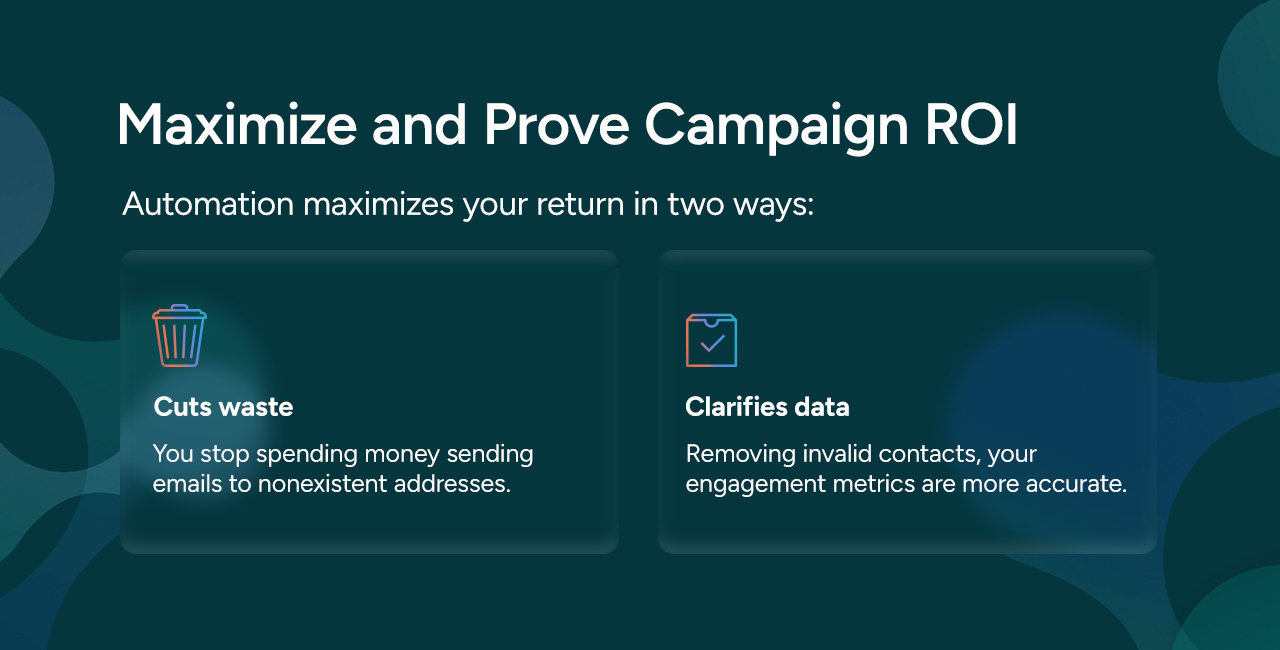
Maximize and Prove Campaign ROI: Email marketing boasts an exceptional return on investment (ROI), often cited as $36 for every dollar spent. However, this impressive ROI is only achievable if emails successfully reach their intended inboxes. Automation maximizes this return in two fundamental ways:
- Reduced Waste: By eliminating undeliverable addresses, automated validation ensures that marketing spend is directed only towards potentially engaged recipients, optimizing budget allocation.
- Accurate Performance Metrics: With clean data, campaign analytics—open rates, click-through rates, conversion rates—become genuinely reflective of campaign effectiveness. This enables marketers to accurately measure ROI, justify investments, and make data-driven decisions to refine strategies for maximum impact.
-
Enhance Personalization and Segmentation: The bedrock of effective, modern marketing is reliable data. Consider a scenario where a marketing team aims to run a highly personalized re-engagement campaign for customers who have shown specific browsing behavior but haven’t purchased in three months. If 20% of that carefully constructed segment contains invalid addresses, the campaign’s true performance will be obscured, and valuable insights lost. Automated email verification ensures the foundational integrity of your segments, providing accurate data for precise targeting, enabling sophisticated personalization, and empowering truly informed decision-making based on actionable insights.
-
Drive Radical Efficiency for Marketing and Sales Operations: The time of marketing and sales operations teams is a premium resource. Manually managing email lists—exporting, cleaning spreadsheets, and re-uploading comma-separated values (CSV) files—is not only time-consuming but also prone to human error, which can jeopardize data integrity. An automated process liberates operations specialists from these tedious, low-value tasks, allowing them to redirect their expertise towards high-impact strategic work. For organizations utilizing powerful CRM platforms like Salesforce, this translates into a game-changing enhancement. Teams can trust the reliability of the data within their CRM, streamlining lead routing, ensuring accurate reporting, and facilitating more precise sales forecasting and pipeline management. This operational efficiency fosters agility and allows teams to focus on growth-driving activities.
-
Secure Your Email List at the Point of Entry: Real-time email validation automation acts as a vigilant security guard for your entire database. By integrating a verification API (Application Programming Interface) at every data capture point—from newsletter signup forms and content download gates to demo request forms and e-commerce checkout processes—organizations can drastically reduce the influx of bad data. This serves as the crucial first line of defense against common issues like typos, outright fake email addresses, and the pervasive problem of bot-driven signups that frequently rely on invalid or disposable addresses to pollute lists. Preventing bad data from entering the system initially is far more cost-effective and efficient than cleaning it up later.
Implementing a Robust Automation Strategy: A Four-Step Framework
Building a robust and effective email verification strategy requires a methodical approach. Follow this four-step framework to ensure a successful implementation:
Step 1: Audit Your Current Email List and Identify Goals
Before deploying any new solution, a comprehensive assessment of existing list management practices is essential. Begin by conducting a thorough "health check" on your current email lists. Analyze performance metrics across different segments: identify lists or segments exhibiting unusually high bounce rates, low engagement, or elevated spam complaint rates. These indicators pinpoint areas of greatest data decay and potential vulnerability.
Concurrently, define clear, measurable goals for your organization. What does success look like? Is the primary objective to reduce hard bounce rates by a specific percentage, improve overall inbox placement, or clean up specific legacy lists that haven’t been touched in years? Establishing these baselines and objectives will be crucial for measuring the ROI of your automation efforts and demonstrating their value internally. This initial audit provides the necessary context and justification for the investment.
Step 2: Choose the Right Email Verification Service
The market offers numerous email verification services, but when evaluating vendors, accuracy and security must be paramount. A seemingly "cheap" tool that frequently flags valid emails as false positives can lead to significant lost revenue by inadvertently suppressing legitimate subscribers. Conversely, a tool that misses invalid addresses undermines the entire purpose of verification.
Look for a secure, scalable solution that offers:
- Industry-Leading Accuracy: This is non-negotiable. The service must reliably distinguish between valid, invalid, risky, and disposable email addresses with minimal false positives or negatives.
- Real-time API: Essential for integrating verification directly into web forms and signup processes to prevent bad data entry.
- Bulk Verification Capabilities: For periodic cleaning of existing, large databases.
- Robust Security and Data Privacy Compliance: Ensure the vendor adheres to stringent data protection standards (e.g., GDPR, CCPA compliance) and employs advanced security protocols to protect your sensitive customer data.
- Detailed Reporting and Analytics: The ability to understand the composition of your list and the types of issues identified.
- Seamless Integrations: Compatibility with your existing marketing automation platforms, CRMs, and other sales tools.
- Scalability: The ability to handle your current and future email volume without performance degradation.
Investigating vendor reviews, accuracy claims, and security certifications is a critical part of this selection process.
Step 3: Integrate with Your Marketing and Sales Stack
True automation is achieved when your email verification tool is seamlessly integrated with your existing marketing and sales technology ecosystem.
- For Existing Data: Connect the chosen verification tool to your CRM (e.g., Salesforce, HubSpot) and marketing automation platform (e.g., Marketo, Pardot). Schedule regular bulk verifications to proactively combat data decay, as email addresses naturally become invalid over time due to job changes, domain expirations, or account closures. Many leading solutions offer native connectors or robust APIs to facilitate this.
- For New Data (Point of Entry): Implement the verification API on all your web forms, including newsletter sign-ups, lead generation forms, and checkout pages. This real-time validation allows users to immediately correct typos before submitting their information, prevents bots from injecting fake addresses, and ensures that only clean, deliverable emails enter your system from the very first interaction. This ‘front-door’ defense is crucial for maintaining list hygiene long-term.
Step 4: Monitor and Refine
Implementation is not the end; it’s the beginning of a continuous improvement cycle. Regularly review the verification reports and analytics provided by your service. Look for patterns and insights:
- Are you observing a sudden increase in invalid emails from a specific lead source or campaign? This might indicate an issue with that particular acquisition channel or partner.
- Is a particular web form attracting an unusually high volume of bot traffic or disposable email addresses? This could signal a need to implement additional CAPTCHA or reCAPTCHA security measures.
- Are there specific types of invalid emails (e.g., syntax errors, non-existent domains) that dominate your reports?
Use these actionable insights to refine your acquisition strategies, tighten your list capture rules, and continuously optimize your overall data hygiene processes. Ongoing monitoring ensures that your email list remains pristine and responsive, adapting to new threats and evolving data landscapes.
The Future of Email Marketing: A Proactive Approach to Data Hygiene
In an increasingly competitive and data-driven marketing environment, email list validation automation is no longer a luxury but a fundamental necessity. The era of "batch and blast" is long gone; modern email marketing thrives on precision, personalization, and deliverability. Organizations that embrace automated hygiene demonstrate a commitment to data quality, which translates directly into superior marketing performance, enhanced customer relationships, and a stronger brand reputation.
The implications extend beyond mere marketing metrics. Clean data forms the bedrock of accurate business intelligence, enabling more reliable sales forecasting, better resource allocation, and a clearer understanding of customer behavior. By automating email list hygiene, businesses transform their approach to data from reactive problem-solving to proactive strategic advantage. This not only prevents bad data from entering and festering but also ensures that every marketing effort is concentrated on real, engaged individuals, maximizing the return on every dollar and every minute invested.
Ultimately, the future of successful email marketing belongs to those who prioritize and actively manage the quality of their contact data. A proactive, automated approach to email list validation is the cornerstone of this future, protecting revenue, enhancing reputation, and ensuring the long-term sustainability of email as a powerful communication channel.









