The field of digital marketing currently stands at a crossroads where the drive for scientific rigor often clashes with the practical demands of fast-paced business environments. A/B testing, fundamentally a randomized controlled trial (RCT), serves as the primary mechanism for establishing causal relationships between website changes and user behavior. While these experiments are structurally identical to those conducted in high-stakes fields such as genetics, physics, and clinical medicine, a growing body of evidence suggests that the methodologies employed by most digital practitioners are lagging nearly half a century behind modern statistical standards. This disconnect has led to a proliferation of "illusory findings," where reported conversion lifts fail to materialize in actual revenue, casting doubt on the efficacy of the entire Conversion Rate Optimization (CRO) industry.
The crisis in A/B testing stems from three fundamental flaws: the widespread misuse of statistical significance tests, a systemic neglect of statistical power, and the inherent inefficiency of classical fixed-sample testing models. In response to these challenges, a new framework known as the AGILE statistical approach is gaining traction. Borrowed from the rigorous world of pharmaceutical trials, AGILE seeks to reconcile the need for statistical validity with the business reality of "data peeking" and the necessity for early decision-making.
The Historical Context of Experimental Design
To understand the current state of digital experimentation, one must look back at the origins of frequentist statistics. The classical approach to significance testing, largely popularized by Ronald A. Fisher in the 1920s, was designed for agricultural and laboratory settings where data collection was a discrete, final event. In these scenarios, a scientist would plant seeds, wait for the harvest, and analyze the results once.
However, the digital revolution of the early 2000s transformed the experimenter’s laboratory into a real-time stream of data. As companies like Google, Amazon, and Netflix began running thousands of concurrent tests, the "fixed-sample" requirement of classical statistics became a bottleneck. By the mid-2010s, the industry reached a tipping point. While the tools for running tests became more accessible, the understanding of the underlying math did not keep pace. This led to what many experts call the "p-hacking" era of marketing, where practitioners would run tests until they saw a "winning" result on their dashboard and then immediately stop the experiment—a practice that invalidates the very statistical guarantees they rely on.
The Pitfalls of "Data Peeking" and Significance Inflation
The most prevalent error in modern A/B testing is the misuse of the Student’s T-test and other classical significance models. These tests operate under a strict mathematical assumption: the sample size must be fixed in advance, and the data must only be analyzed once.
In a typical business environment, this is rarely the case. Stakeholders often monitor dashboards daily. If a variant shows a 95% "confidence" level on day three, the temptation to stop the test and declare a winner is overwhelming. This is known as "data-driven optional stopping" or "peeking." The mathematical consequence of this behavior is a drastic inflation of the Type I error rate (false positives).
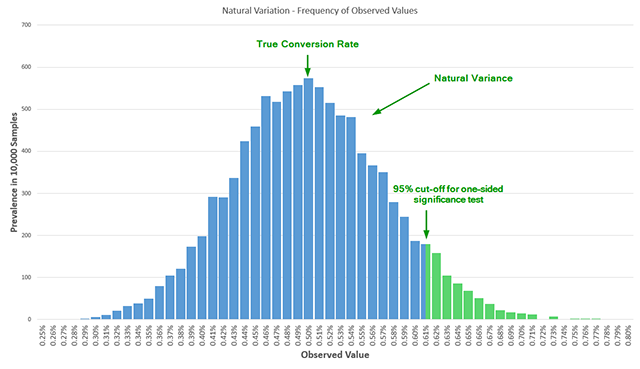
Statistical research dating back to 1969 has demonstrated that the more frequently an experimenter checks the data, the higher the probability of finding a "significant" result purely by chance. For instance, if a practitioner peeks at the data just five times throughout the duration of a test, the actual error rate is roughly 3.2 times higher than the reported nominal error rate. If they peek ten times, the error rate is five times higher. Without adjusting for these multiple looks, a reported 95% confidence level may actually represent only an 75% or 80% certainty, leading businesses to implement changes that provide no real value or, worse, actively harm their conversion rates.
The "Power" Vacuum in Digital Marketing
While significance (the probability of a false positive) receives most of the attention in marketing literature, statistical power (the probability of a true positive) is frequently ignored. Statistical power, or "test sensitivity," is the ability of an experiment to detect a lift when one actually exists.
A review of influential A/B testing literature published between 2008 and 2014 revealed that only one out of seven major books discussed power in a proper context. This omission has profound implications. Running an under-powered test is akin to using a low-resolution microscope to look for bacteria; if you don’t see anything, it doesn’t mean the bacteria aren’t there—it means your equipment wasn’t sensitive enough to find them.
The relationship between power and sample size is uncompromising. To detect a small 5% lift with high certainty (90% power), a website may need hundreds of thousands of users. Many free online calculators defaults to 50% power—essentially a coin toss. When companies run under-powered tests, they often conclude that a variant "didn’t work" and abandon a potentially lucrative strategy, unaware that the test simply lacked the sensitivity to confirm the gain. This leads to a high rate of Type II errors (false negatives), which can be just as costly to a business as false positives.
Inefficiency and the Economic Cost of Fixed-Sample Testing
The third major issue is the sheer inefficiency of classical methods. In industries like agriculture, waiting for a fixed harvest is a biological necessity. In digital marketing, it is a financial burden.
Consider a scenario where a test is planned for 88,000 users to detect a 10% lift. If the variant is actually a "home run" that delivers a 20% lift, a classical test still requires the practitioner to wait for all 88,000 users to pass through the system before calling the result. This "dead time" represents a massive opportunity cost. The company is losing the revenue they would have gained by implementing the winner sooner, and they are wasting traffic that could be used for the next experiment.
Conversely, if a variant is performing disastrously, a fixed-sample test technically requires the experimenter to keep showing that inferior version to users until the pre-set sample size is reached, resulting in unnecessary revenue loss.
The AGILE Solution: Lessons from Clinical Trials
To solve these dilemmas, the AGILE statistical method adapts sequential analysis techniques used in medical research. In clinical trials, it is often considered unethical to continue a study if a drug is clearly saving lives or, conversely, clearly causing harm. Therefore, biostatisticians developed "error-spending functions" that allow for interim analyses while maintaining strict control over the total error rate.
The AGILE approach introduces several key components to the A/B testing workflow:
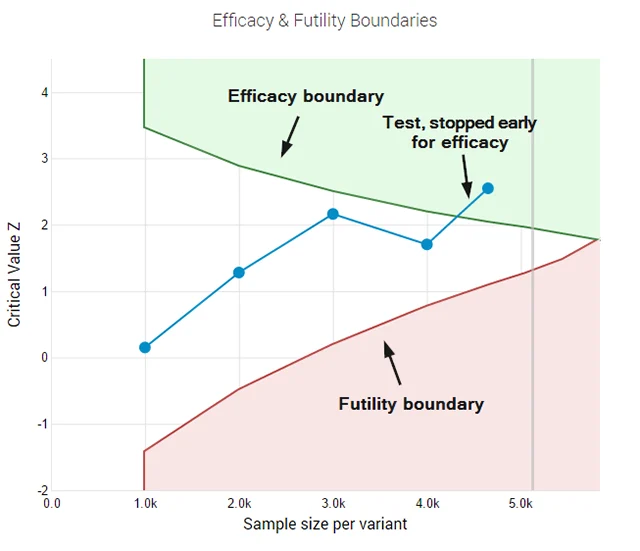
- Interim Monitoring with Error-Spending: Instead of one final look, AGILE allows for multiple scheduled analyses. It uses a mathematical formula to "spend" a portion of the allowed error rate at each look. This ensures that the final probability of a false positive remains at the desired level (e.g., 5%), regardless of how many times the data was checked.
- Efficacy Stopping Rules: If a variant performs exceptionally well early on, the AGILE method provides a statistically sound way to stop the test early and implement the winner, capturing the "lift" much faster.
- Futility Stopping Rules: Perhaps the most significant advantage of AGILE is the ability to "fail fast." If, after a certain amount of data, it becomes mathematically improbable that a variant will ever reach significance, the test can be terminated for futility. This prevents the "sunk cost fallacy" where teams wait weeks for a test that is destined to be flat or negative.
- Sensitivity Alignment: AGILE forces practitioners to define their desired power and minimum effect size upfront, ensuring that every test is designed with enough sensitivity to be meaningful.
Industry Implications and the Path Forward
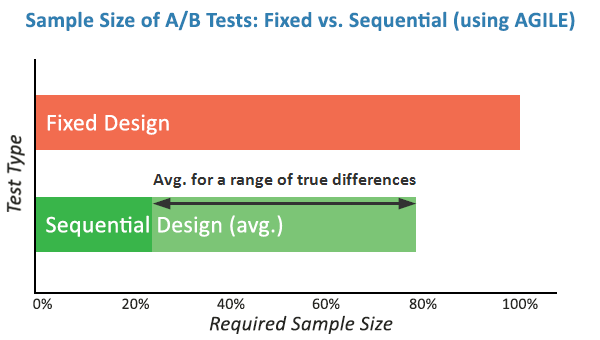
The adoption of more sophisticated statistical methods like AGILE is expected to have a transformative impact on the ROI of digital marketing departments. Data simulations suggest that the AGILE method can provide efficiency gains of 20% to 80% compared to classical fixed-sample tests. For a high-traffic e-commerce site, this translates to dozens of additional tests per year and millions of dollars in potentially captured revenue.
Furthermore, moving toward a more rigorous framework addresses the "credibility gap" often found between data science teams and executive leadership. When marketing results are backed by the same level of statistical integrity as a pharmaceutical trial, stakeholders can have greater confidence in the projected outcomes.
As the digital landscape becomes increasingly competitive, the companies that thrive will be those that treat experimentation not as a series of "guesses" backed by flawed dashboards, but as a disciplined scientific endeavor. The transition from classical, rigid statistics to flexible, AGILE methodologies represents the next major milestone in the professionalization of digital marketing and conversion rate optimization. By acknowledging the limitations of 20th-century tools in a 21st-century environment, practitioners can finally align their scientific aspirations with their business realities.


 Ali Ikhwan
 Dwi Wanna