

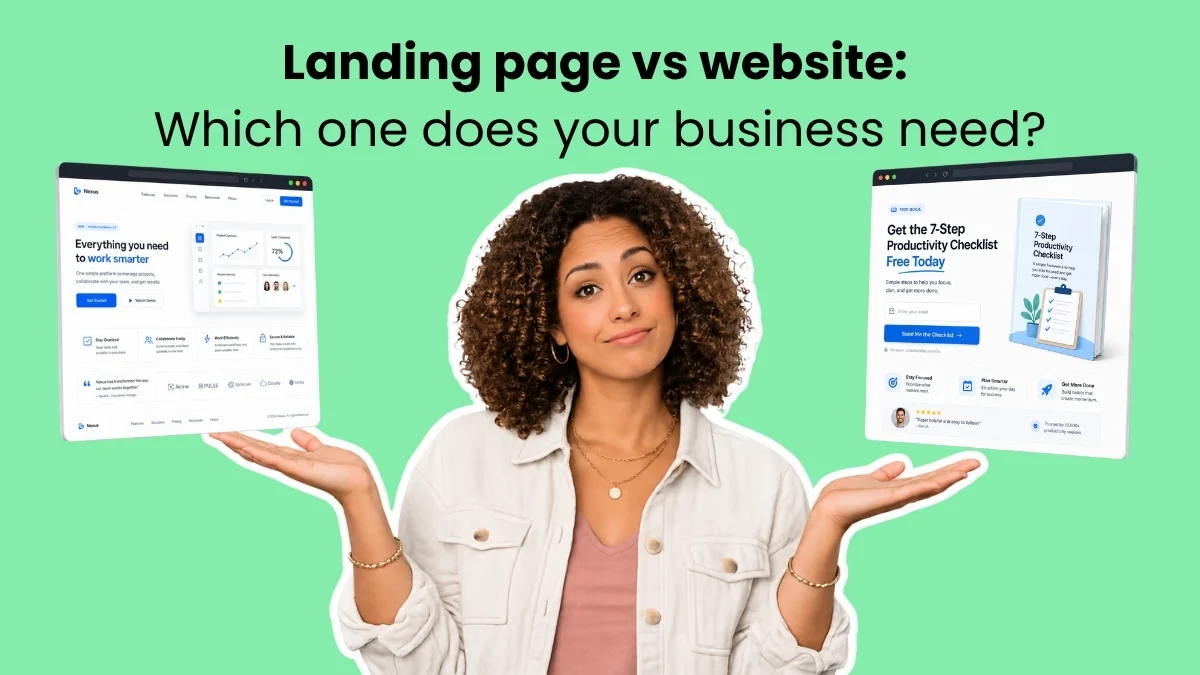
Online entrepreneurs and small business owners frequently grapple with a fundamental question: whether to establish a comprehensive website or opt for a streamlined landing page, or perhaps integrate both into their digital strategy. This crucial decision underpins a business’s online presence, influencing everything from initial audience engagement to long-term growth and conversion rates. Understanding the distinct functionalities, strategic applications, and operational implications of each digital asset is paramount for setting a venture on a trajectory for sustained success in the competitive digital marketplace. This analysis delves into the core definitions, comparative advantages, and strategic deployment of websites and landing pages, providing clarity for businesses navigating their digital footprint.
Understanding the Digital Landscape: Websites as Comprehensive Digital Hubs
A website serves as a multifaceted digital storefront, typically comprising five or more interconnected web pages designed to offer a holistic view of a business or entity. Its architecture is built for exploration, enabling visitors to navigate through various sections such as a homepage, "About Us" page, services or product listings, contact information, and often a blog or resource library. The primary objective of a website is to foster familiarity, educate visitors, and provide answers to a broad spectrum of inquiries, thereby building trust and brand loyalty over time. It functions as a central repository for all information pertinent to a business, acting as a one-stop digital destination.
The development and maintenance of a comprehensive website inherently demand a significant investment of time, financial resources, and ongoing upkeep. This includes costs associated with domain registration, web hosting, design and development (which can range from hundreds to tens of thousands of dollars depending on complexity and customization), content creation, and regular updates for security and functionality. Despite these considerations, a well-constructed website offers unparalleled advantages in establishing a robust online identity, facilitating search engine optimization (SEO) for organic visibility, and providing a platform for rich content marketing strategies. For instance, a podcast like "Foodie Buddies" might leverage its website to host episode archives, share guest bios, publish recipes discussed on air, and provide a direct channel for listener engagement, allowing visitors to delve deeply into the brand’s offerings at their own pace. This extensive navigational capacity allows for a layered user experience, catering to diverse visitor needs and interests.
Precision Marketing: The Role of Landing Pages in Conversion
In contrast to the expansive nature of a website, a landing page is a singular, standalone web page meticulously crafted with one specific goal and a singular call to action (CTA). Its design deliberately limits navigation options, minimizing distractions and channeling the visitor’s focus toward a predetermined objective. The essence of a landing page lies in its directness: a visitor arrives, processes the presented information, and is prompted to either execute the specified action or depart. There are no secondary menus, no links to other parts of a broader site, and no extraneous information to divert attention.
Common objectives for landing pages are highly targeted and include capturing email sign-ups for newsletters or lead magnets, promoting a specific product or service with a direct purchase link, registering attendees for webinars or events, or serving as a "link-in-bio" directory on social media platforms. Because every element on a landing page—from its headline to its imagery and copy—is meticulously aligned with a single conversion goal, these pages typically achieve significantly higher conversion rates compared to general browsing pages or homepages. The absence of choice simplifies the user journey, guiding them efficiently toward the desired outcome. For example, while the "Foodie Buddies" podcast maintains a comprehensive website, they might strategically deploy a landing page as a "link directory" in their social media profiles. This single link then directs followers to a concise page featuring links to their latest episodes, merchandise store, or a specific event registration, providing an optimized pathway for followers to engage with current campaigns without navigating the entire website. This focused approach is a cornerstone of effective campaign-specific marketing.
A Side-by-Side Analysis: Structural and Behavioral Distinctions
The fundamental differences between landing pages and websites extend beyond their structural composition to the behavioral patterns they cultivate in users. Analogously, a website can be perceived as a continent—a vast, interconnected landmass with multiple cities, roads, and points of interest, allowing for extensive exploration and diverse experiences. A landing page, conversely, is akin to a solitary island off the coast—isolated, focused, and designed to present a singular, compelling offering to every arriving visitor.
| Feature | Landing Page | Website |
|---|---|---|
| Number of Pages | One | Five or more |
| Navigation | None or minimal (e.g., social links) | Full menu connecting all pages |
| Primary Goal | One specific action (e.g., signup, purchase) | Exploration, education, brand building |
| Calls to Action | One primary CTA | Multiple, spread across various pages |
| Time to Launch | Minutes to hours | Days to weeks, potentially months |
| Cost | Low, often integrated with existing tools | Higher: hosting, design, development, maintenance |
| Best For | Campaigns, lead generation, product launches, A/B testing, rapid validation | Established businesses, comprehensive information, content marketing, long-term SEO |
The structural simplicity of a landing page directly translates to a focused user experience, minimizing decision fatigue and maximizing the likelihood of conversion. Visitors are presented with a clear value proposition and a single path forward. Websites, while offering depth and breadth, inherently scatter attention across multiple navigation points, making them less effective for immediate, targeted conversions unless specifically designed campaign pages are used within the broader site. This distinction is critical for businesses in allocating resources and defining their digital marketing objectives.
Strategic Deployment: When to Leverage Each Tool
The decision to employ a landing page, a website, or both, is deeply intertwined with a business’s current stage, marketing objectives, and available resources.
When to Prioritize a Landing Page:
Landing pages are indispensable when the objective is singular focus and high conversion. They are ideal for:
- Running Specific Campaigns: Whether it’s a paid advertisement campaign on social media or search engines, or an email marketing push, directing traffic to a landing page ensures that the investment translates into measurable actions.
- Promoting Lead Magnets: Offering a free e-book, webinar registration, or trial requires a dedicated page to capture visitor information efficiently.
- Launching New Products or Services: A landing page can generate excitement and pre-orders for a new offering without requiring a complete overhaul of an existing website.
- Testing New Ideas: Entrepreneurs can rapidly validate market interest for a new product concept or service by building a landing page in an afternoon, directing traffic to it, and analyzing conversion data before committing significant resources to a full website or product development. This lean approach saves time and capital.
- Establishing an Initial Online Presence: For startups or solo entrepreneurs, a landing page offers a quick, cost-effective way to get online, collect email addresses, and begin building an audience without the complexities of a full site.
When a Website Becomes Indispensable:
A website becomes a non-negotiable asset as a business matures and its offerings diversify, requiring a broader platform for information dissemination and brand building. It is best suited for:
- Established Businesses with Extensive Offerings: When a business provides multiple product lines, a diverse range of services, or a substantial portfolio, a website provides the necessary structure to organize and present this information effectively.
- Content Marketing and SEO: A blog or resource section within a website allows businesses to publish valuable content, attracting organic search traffic over the long term and establishing authority in their niche. A single landing page rarely achieves significant SEO traction on its own.
- Building Comprehensive Brand Authority: A full website allows for the development of detailed "About Us" pages, team profiles, testimonials, and case studies, which are crucial for building credibility and fostering customer trust.
- Facilitating Customer Support and FAQs: Dedicated pages for frequently asked questions, support documentation, and detailed contact information enhance customer service and reduce direct inquiries.
- E-commerce Stores: For businesses selling multiple products, an e-commerce website with product catalogs, shopping carts, and secure payment gateways is essential for transactional purposes.
It is crucial to recognize that these tools are not mutually exclusive but often complementary. Even businesses with robust websites benefit significantly from using targeted landing pages for specific marketing initiatives. Directing ad traffic and email promotions to focused landing pages, rather than a general homepage, dramatically improves conversion rates by eliminating distractions and streamlining the user journey toward a single, desired action.
The Entrepreneurial Journey: Starting Lean and Scaling Up
A common question among nascent businesses is whether it is feasible to operate solely on landing pages. The answer, increasingly, is yes. Many creators, coaches, consultants, and solo entrepreneurs successfully build and sustain their businesses entirely through a strategic deployment of landing pages. This model often relies heavily on email marketing to compensate for the informational breadth typically provided by a website.
In this paradigm, a landing page acts as the initial point of contact—the "front door"—where visitors are encouraged to subscribe to an email list, register for an event, or purchase a specific digital product. Once a visitor converts into a subscriber, the email sequence takes over the role of education, trust-building, and ongoing promotion that a website would traditionally fulfill. Through a series of automated or manual emails, the business can share valuable content, build rapport, introduce new offerings, and nurture leads toward further engagement or purchases. The email list, in this context, becomes the primary asset, and the landing page serves as an efficient mechanism for audience acquisition.
This approach offers significant advantages for startups:
- Low Barrier to Entry: Businesses can establish an online presence and begin generating revenue without the significant upfront investment of a full website.
- Rapid Deployment: Landing pages can be designed and published in a matter of hours, allowing for quick market testing and adaptation.
- Cost-Effectiveness: Many digital marketing platforms include landing page builders, hosting, and SSL certificates as part of their standard subscriptions, reducing the need for separate vendors. These platforms often integrate drag-and-drop editors, AI-powered content assistance, and built-in payment processing, democratizing access to sophisticated online tools.
- Focus on Core Business: By simplifying the online infrastructure, entrepreneurs can dedicate more time and resources to product development, service delivery, and direct customer engagement.
For many, starting with a suite of well-designed landing pages is a pragmatic first step, allowing them to validate their business model and build an audience. As the business grows, acquires more content, and expands its offerings, the transition or addition of a full website becomes a natural and strategic evolution.
Industry Insights and Expert Perspectives
Digital marketing strategists consistently emphasize the importance of alignment between digital tools and business objectives. According to recent industry reports, landing pages can achieve conversion rates significantly higher than typical website pages, often ranging from 5% to 15% or even higher for highly optimized campaigns, compared to the average website conversion rate of 2-3%. This stark difference underscores the power of focused design and a clear call to action.
"The digital landscape demands agility and precision," states Dr. Evelyn Reed, a leading e-commerce analyst. "For small businesses and startups, every dollar and every minute counts. Landing pages offer an immediate pathway to revenue and audience building, allowing them to iterate quickly and gather invaluable market feedback without the overhead of a traditional website. It’s about ‘doing one thing well’ before expanding to ‘doing many things comprehensively.’"
Data further suggests that businesses leveraging specialized landing page builders often report a quicker time to market for new campaigns, with 68% of small businesses indicating that they can launch a new landing page campaign within a day. This contrasts sharply with the weeks or months typically required for website development or significant updates. The efficiency gains are particularly critical in fast-paced markets where timely engagement can mean the difference between capturing a trend and being left behind.
Financial and Operational Implications

The financial disparity between developing and maintaining a website versus a landing page is substantial. A custom-designed, professional website can easily incur costs ranging from $2,000 to $20,000 or more, depending on complexity, features, and the involvement of designers and developers. This is followed by recurring expenses for hosting (typically $10-$100 per month), domain renewal, and ongoing maintenance, security updates, and content management.
Conversely, landing pages are often a far more economical solution. Many email marketing platforms and digital marketing suites include robust landing page builders as part of their subscription packages, which can range from $20 to $200 per month. These integrated solutions often bundle hosting, SSL security, and drag-and-drop editors, eliminating the need for separate investments in these areas. The operational overhead is also significantly lower; launching and managing a landing page requires less technical expertise and fewer ongoing resources compared to a multi-page website. This makes landing pages an attractive option for businesses with limited budgets or those preferring to allocate resources directly to marketing campaigns and product development rather than infrastructure.
Addressing Common Queries: An FAQ Expansion
What is the fundamental difference between a landing page and a website?
A landing page is a single, standalone web page designed with a singular focus and a specific call to action, aiming to achieve one immediate conversion goal (e.g., lead capture, direct sale). It typically has minimal to no navigation. A website, conversely, is a collection of interconnected web pages (five or more) designed for broad exploration, education, and brand building, offering extensive navigation and catering to multiple objectives.
What is the difference between a microsite and a landing page?
A microsite is a small, focused cluster of web pages (typically two to five) created for a specific marketing campaign, product launch, or event. It functions as a mini-website, often with its own domain, separate from a company’s main website, providing more depth than a single landing page but less breadth than a full corporate site. A landing page is even more constrained, being a single page with one specific conversion goal and limited navigation. Use a microsite when a campaign requires multiple content pages to inform or engage, and a landing page when a single, focused conversion point is the priority.
Do you absolutely need a website if you have a landing page?
No, not necessarily. Many businesses, especially those in their nascent stages or operating with a lean model (e.g., coaches, freelancers, digital product creators), can effectively run their entire operation using a series of well-crafted landing pages complemented by a robust email marketing strategy. Landing pages can handle lead generation, product sales, and content delivery through email, deferring the need for a full website until the business requires more extensive informational or transactional capabilities.
Is a landing page generally cheaper to implement and maintain than a website?
Yes, in the vast majority of cases. Developing a custom website involves significant costs for design, development, content creation, hosting, and ongoing maintenance, often totaling thousands of dollars initially and recurring monthly fees. A landing page, on the other hand, can often be created using affordable or even free tools integrated into existing marketing platforms, with minimal setup time and lower recurring costs. This makes landing pages an incredibly cost-effective option for targeted marketing efforts.
Can a landing page serve as a replacement for a traditional homepage?
For new businesses or those with a very narrow product/service offering, a landing page can effectively function as a homepage, particularly if the primary goal is to capture leads or drive a single conversion. In such scenarios, a focused landing page can often outperform a traditional homepage by eliminating distractions and directing visitors straight to the core value proposition. However, as a business grows, diversifies its offerings, or aims to build extensive brand authority and provide comprehensive information, a multi-page website with a traditional homepage and navigation becomes more beneficial and necessary.
What are the SEO implications of using landing pages versus a website?
Websites, particularly those with blogs and rich content, are inherently better for long-term organic SEO due to their ability to host a large volume of keyword-rich content, build internal linking structures, and accrue domain authority over time. Landing pages, being single-page entities, have more limited SEO potential for broad keywords. However, they can be highly optimized for specific, long-tail keywords relevant to their singular offer, often benefiting from direct ad campaigns rather than organic search alone.
The Broader Impact and Implications
The ongoing debate between landing pages and websites underscores a fundamental shift in digital marketing toward greater precision and efficiency. For businesses, especially small and medium-sized enterprises (SMEs), understanding the nuanced differences and strategic applications of these tools is not merely a technical choice but a critical business decision with profound implications for growth, profitability, and customer engagement.
The ability to rapidly deploy focused landing pages allows businesses to be agile, test market assumptions efficiently, and pivot strategies based on real-time data. Simultaneously, a robust website provides the foundational infrastructure for long-term brand building, comprehensive information dissemination, and sustained organic growth. The most successful digital strategies often involve a harmonious blend of both: using the website as the central brand hub and employing landing pages for specific, high-conversion campaigns. This hybrid approach allows businesses to leverage the strengths of each, creating a dynamic and resilient online presence capable of adapting to the ever-evolving demands of the digital economy.








