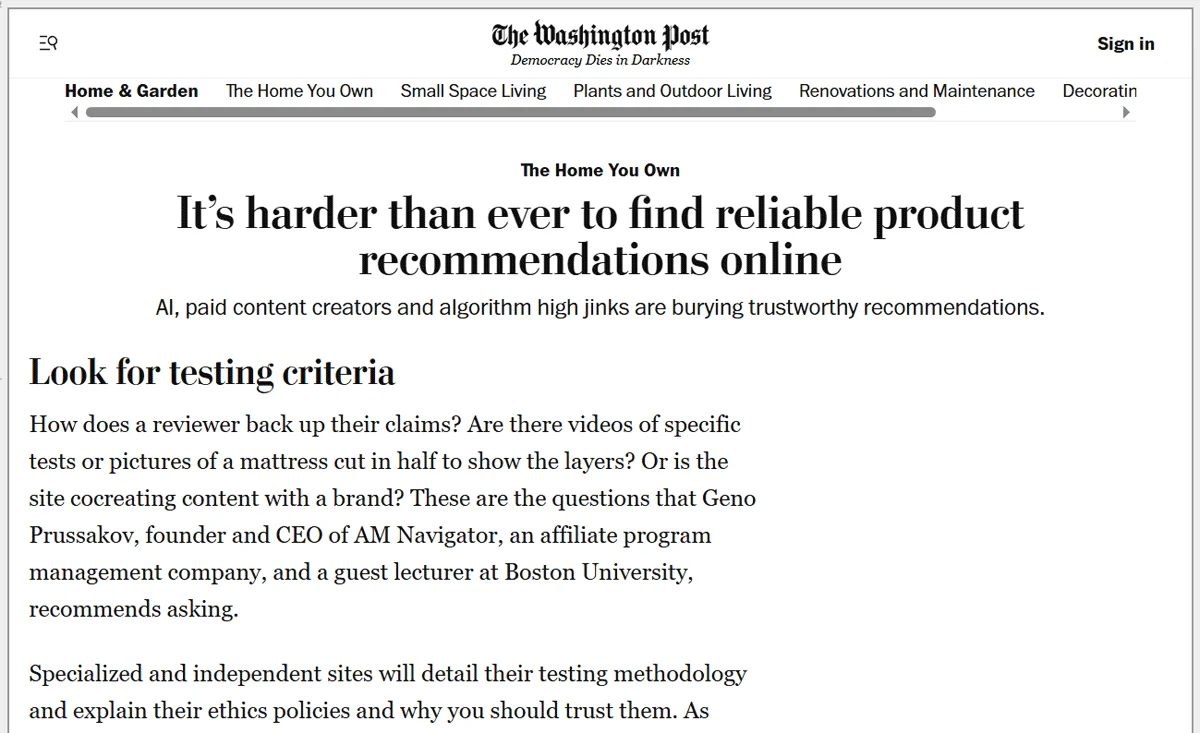
The landscape of digital consumerism has undergone a seismic shift as traditional media conglomerates increasingly pivot toward affiliate marketing and "commerce content" to bolster declining advertising revenues. This transition, which has accelerated over the past decade, has placed legacy publications at the center of a complex ethical debate regarding the boundaries between editorial independence and financial incentive. On January 13, 2025, a comprehensive report by The Washington Post brought this issue to the forefront, examining how major media players utilize their established authority to influence consumer purchasing decisions through curated product recommendation lists. As these "Best of" guides become a primary revenue driver for the publishing industry, the mechanisms behind product selection and the transparency of financial arrangements have come under intense scrutiny by both industry analysts and federal regulators.
The Commercialization of Media Authority
For decades, the value of a media brand was rooted in its perceived objectivity and the "Chinese Wall" that theoretically separated editorial staff from advertising sales. However, the digital age has dismantled many of these traditional barriers. Major media entities, including The New York Times, CNN, Forbes, and Hearst, have launched dedicated commerce divisions—such as Wirecutter and CNN Underscored—specifically designed to monetize search engine authority. These divisions produce high-ranking content that captures "bottom-of-the-funnel" search traffic: users who are ready to purchase and are seeking a final recommendation.
The monetization of search engine authority is a sophisticated process. When a reputable news site publishes a product roundup, it benefits from decades of accumulated domain authority, allowing the article to rank at the top of Google search results. This visibility, combined with the brand’s inherent trust, creates a powerful endorsement mechanism. However, the rise of affiliate marketing—a performance-based model where publishers earn a commission on sales generated through their links—introduces a potential conflict of interest. The fundamental question facing the modern consumer is whether a product is recommended because it is truly the best in its class, or because the manufacturer offers the highest commission rate or a lucrative placement fee.
A Chronology of the Affiliate Media Pivot
The integration of affiliate marketing into mainstream media has evolved through several distinct phases:
- The Early Adoption Phase (1996–2010): Affiliate marketing was largely the domain of niche bloggers and specialized coupon sites. Amazon Associates, launched in 1996, provided the blueprint, but major media outlets remained focused on display advertising and print subscriptions.
- The Consolidation Phase (2011–2016): As digital ad rates began to stagnate due to the dominance of Google and Facebook, publishers began experimenting with commerce content. The 2016 acquisition of The Wirecutter by The New York Times for approximately $30 million served as a definitive signal to the industry that product recommendations were a viable and prestigious business model.
- The Expansion and Optimization Phase (2017–2023): "Service journalism" became a standard department in newsrooms. Outlets began hiring "Commerce Editors" and "SEO Specialists" to optimize content for high-intent keywords. This era saw the rise of sophisticated tracking technology and data-driven content creation.
- The Transparency and Regulation Era (2024–Present): Following increased scrutiny from the Federal Trade Commission (FTC) regarding disclosure requirements and a series of Google "Product Review Updates" aimed at prioritizing high-quality, hands-on testing, publishers have had to refine their methodologies to maintain both search rankings and consumer trust.
Supporting Data: The Scale of the Affiliate Economy
The financial stakes of this transition are substantial. According to industry reports from the Performance Marketing Association and Rakuten Advertising, the affiliate marketing industry is estimated to be worth over $17 billion globally. Within the media sector, affiliate revenue now frequently accounts for 15% to 30% of a digital publisher’s total annual income.
A survey of digital publishers conducted in 2024 revealed that over 80% of major media outlets now utilize affiliate links within their content. Furthermore, consumer behavior data suggests that nearly 40% of U.S. shoppers begin their journey by searching for "best [product category]" lists, with a significant majority expressing higher trust in recommendations coming from established news brands compared to social media influencers. This trust is the "currency" that publishers are currently leveraging, making the preservation of that trust a critical business priority.
Internal Vetting Mechanisms and Industry Standards
Despite the inherent potential for bias, many large media organizations have implemented rigorous vetting processes to protect their brand reputation. Industry experts and affiliate program managers note that reputable publishers typically employ four primary methods to ensure product quality:
- Dedicated Testing Laboratories: Leading publishers often invest in physical testing facilities where products are subjected to standardized stress tests, performance benchmarks, and long-term durability assessments.
- Expert Consultations: Editors frequently interview subject matter experts—ranging from dermatologists for skincare reviews to structural engineers for home improvement guides—to add a layer of professional validation beyond simple consumer experience.
- Aggregated User Sentiment Analysis: Beyond their own testing, publishers analyze thousands of verified purchase reviews across multiple retail platforms to identify common failure points or recurring praise that might not be evident in a short-term trial.
- Brand History and Compliance Checks: Vetting often extends to the manufacturer’s history, including their track record for customer service, warranty fulfillment, and ethical manufacturing practices.
However, the reality of the business model means that financial arrangements can still influence the final presentation. While editorial teams may select the "top five" products based on merit, the order in which those products appear, or the inclusion of a "budget pick," may be influenced by which merchant offers a higher Earnings Per Click (EPC) guarantee or a flat placement fee.
Official Responses and Ethical Frameworks
In response to the growing discourse on commerce content integrity, several media organizations have published "Editorial Standards for Reviews." These documents typically assert that their product recommendations are made independently of their business teams. The standard industry defense is that if a publisher recommends a poor-quality product simply for a high commission, they will suffer from high return rates—which claws back the commission—and a permanent loss of reader trust.

The Federal Trade Commission (FTC) has also updated its "Guides Concerning the Use of Endorsements and Testimonials in Advertising." These regulations require clear and conspicuous disclosure when a publisher has a financial relationship with a brand they are reviewing. Failure to comply can lead to significant fines, though enforcement in the vast landscape of digital content remains a logistical challenge.
Broader Impact and Consumer Implications
The proliferation of media-driven product lists has profound implications for the digital ecosystem. For small businesses and innovative startups, the current "pay-to-play" or "authority-to-play" model can be a barrier to entry. If a superior product is manufactured by a company without an affiliate program or the budget for placement fees, it may never appear on a "Best of" list, regardless of its quality.
For consumers, the saturation of this content requires a higher level of digital literacy. To navigate this environment effectively, analysts suggest several strategies for critical evaluation:
Cross-Referencing Multiple Sources
Consumers are encouraged to compare lists from at least three independent media outlets. If the same product appears across diverse publications with different ownership structures, the recommendation is more likely to be based on merit.
Analyzing Disclosure Clarity
The placement and wording of an affiliate disclosure can be telling. Transparency regarding how the publication earns money is often a proxy for the transparency of their review process.
Identifying "Sponsored" vs. "Editorial" Content
Many publishers now include "Sponsored" or "Partner Content" tags on articles that are purely paid advertisements, while "Editorial" reviews are theoretically independent. Distinguishing between these labels is essential for an objective assessment.
Verifying Technical Specifications
Consumers should look for objective data—such as weight, battery life, or material composition—rather than subjective adjectives like "amazing" or "game-changing." A review that focuses on verifiable data is generally more reliable than one that relies on marketing rhetoric.
Analysis: The Future of Trust in Online Recommendations
The intersection of journalism and commerce is likely to remain a point of friction as long as the digital advertising market remains volatile. The "Washington Post" inquiry underscores a growing demand for accountability in an era where "authority" is easily commodified. As artificial intelligence begins to generate its own product summaries and recommendations, the value of human-led, transparent, and rigorous testing by established media brands may actually increase—provided those brands can prove that their recommendations are not for sale to the highest bidder.
Ultimately, the sustainability of commerce content depends on a delicate balance. Media companies must generate revenue to survive, but if they sacrifice their editorial integrity for short-term affiliate gains, they risk destroying the very authority that makes their recommendations valuable in the first place. The coming years will likely see a further professionalization of this field, with stricter industry-wide standards and more sophisticated consumer tools designed to peel back the layers of digital endorsement.