
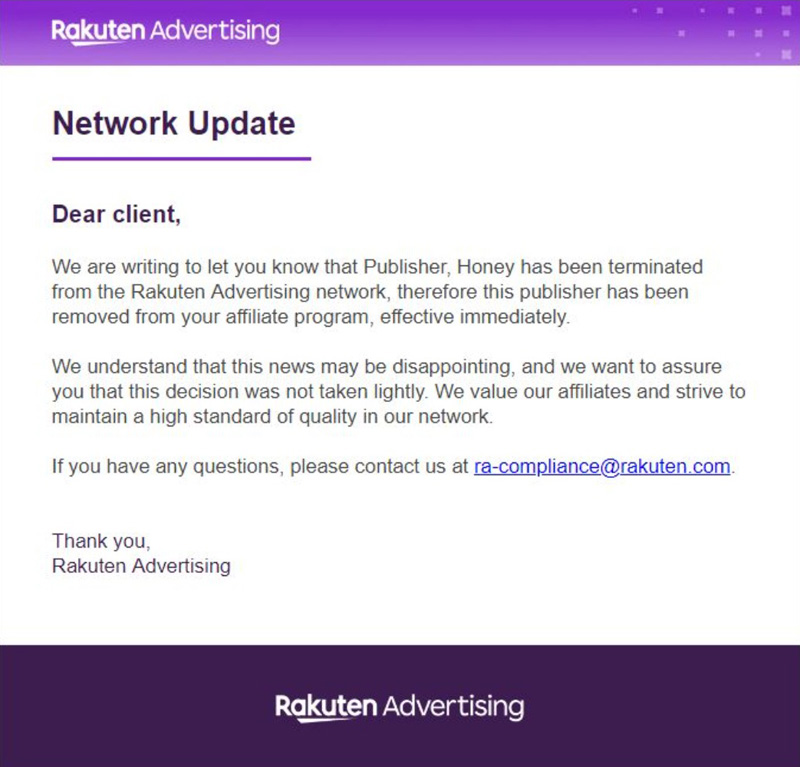
The global affiliate marketing landscape experienced a seismic shift in January 2026 as two of the industry’s most prominent networks, Rakuten Advertising and impact.com, took the unprecedented step of removing or suspending PayPal Honey from their platforms. This move, targeting an entity that PayPal acquired for $4 billion in 2020, marks one of the most significant enforcement actions in the history of the partnership economy. The removal follows a series of high-profile investigations into the browser extension’s technical practices, specifically regarding attribution manipulation and the violation of industry-standard "stand-down" protocols.
Chronology of the Removal
The disciplinary actions unfolded during the week of January 12, coinciding with Affiliate Summit West, the largest affiliate marketing conference in the United States. On Monday, January 12, Rakuten Advertising issued a formal announcement stating that Honey had been "terminated from the network." The network characterized the move as a necessary measure to "maintain a high standard of quality," signaling that the breach of trust was severe enough to warrant a permanent severance.
Four days later, on Friday, January 16, impact.com followed suit. The platform’s leadership confirmed that Honey was found to be "out of compliance" with platform policies. Unlike Rakuten’s total termination, impact.com initially categorized its action as a removal from the "Discovery Marketplace" and a suspension. David A. Yovanno, CEO of impact.com, explicitly cited "attribution manipulation" as the primary driver for the suspension, emphasizing that such behavior undermines the fundamental trust required for a healthy partnership ecosystem.
The Investigations: MegaLag and Ben Edelman
The catalysts for these network-level interventions were two independent investigations that surfaced in the weeks leading up to the removals. The first was a detailed video report by the investigative content creator MegaLag, which visualized how the Honey browser extension interacted with affiliate links in real-time. The second, and perhaps more technically damning, was a research report published by Ben Edelman, a Harvard Business School associate professor and a well-known expert in online fraud and consumer protection.
Edelman’s investigation revealed that Honey had allegedly implemented "tester-detecting" mechanisms. These scripts were designed to identify when the extension was being monitored or tested by compliance officers or researchers. When a "tester" was detected, the extension would behave according to network rules; however, in a standard consumer environment, it would engage in prohibited "stand-down" violations. This concealment suggested a level of intentionality that made it difficult for networks to ignore the breach of contract.
Technical Context: Attribution Manipulation and Stand-Down Rules
To understand the gravity of the situation, one must look at the mechanics of the "last-click" attribution model that dominates the affiliate industry. In this model, the last affiliate to "touch" the consumer before a purchase receives 100% of the commission. This creates a vulnerability where software-based affiliates, such as browser extensions, can "fire" a cookie at the very last second—often while the user is already on the checkout page—thereby overwriting the cookie of a content creator, blogger, or review site that originally drove the customer to the brand.

To prevent this "cookie hijacking," the industry established "stand-down" rules. These rules mandate that a browser extension must remain inactive if a valid affiliate cookie is already present in the user’s browser. The investigation into Honey alleged that the extension was intentionally ignoring these rules, effectively stealing commissions from other partners in the ecosystem. By concealing this behavior from automated testing tools, Honey was able to maintain its presence on major networks for years despite long-standing suspicions from affiliate managers.
The Economic Impact on the Partnership Economy
The removal of a $4 billion asset from major networks is not merely a technical dispute; it is a significant financial event. When PayPal acquired Honey Science Corp, it was the largest acquisition in PayPal’s history, intended to integrate shopping rewards directly into the payment giant’s ecosystem. The suspension from Rakuten and impact.com effectively cuts off a massive revenue stream for Honey and, by extension, PayPal.
Furthermore, the timing of the announcement at Affiliate Summit West served as a powerful signal to the industry. By taking action during the year’s most significant gathering of advertisers and publishers, Rakuten and impact.com asserted their roles as gatekeepers of integrity. Industry analysts suggest this move may embolden other networks to take similar action against high-revenue publishers who engage in borderline or "grey-hat" technical practices.
Five Critical Lessons for Affiliate Program Management
The "Honey Incident" provides a blueprint for how modern affiliate programs should be managed to ensure long-term sustainability and fairness.
1. The Proximity Risk of "One Bad Apple"
In the affiliate world, a single non-compliant partner can poison the well for an entire program. High-quality content creators—such as major media houses, niche bloggers, and influencers—often perform extensive due diligence before joining a brand’s affiliate program. If they see that a brand allows "cookie-stuffing" extensions or partners known for attribution manipulation, they are likely to decline the partnership. They recognize that their efforts to educate and convert customers will likely be "poached" at the checkout screen, resulting in zero compensation for their work.
2. The Fallacy of Network-Only Policing
A common mistake among brand managers is the total reliance on affiliate networks for compliance. While networks like Rakuten and impact.com eventually took action in this case, the violations had allegedly been occurring for an extended period. Networks face an inherent conflict of interest: they earn an "override" or percentage of the revenue generated by publishers. Consequently, there is a financial disincentive to remove high-volume publishers. Brands must conduct their own independent audits and use third-party policing tools to ensure their terms and conditions are being met.
3. The Necessity of Technical Literacy
The Honey case highlights the complexity of modern affiliate technology. Concepts such as "soft clicks," "stand-down triggers," and "script obfuscation" are now central to program management. Organizations like The Affiliate & Partner Marketing Association (APMA) in the UK have recently conducted audits across dozens of brands to study these issues. Their findings suggest that attribution rules are often misunderstood or improperly implemented. Affiliate managers must stay informed about these technical nuances to protect their marketing budgets.
4. Avoiding Broad Generalizations
While the Honey incident has cast a shadow over browser extensions, industry experts warn against banning entire classes of affiliates. Not all downloadable software publishers (DSPs) engage in predatory behavior. Many provide legitimate value by increasing conversion rates or providing rewards to closed user groups (CUGs). The lesson is to evaluate each partner on an individual basis rather than implementing blanket bans that could stifle innovation and reach.
5. The Imperative of Base Diversification
The most significant vulnerability exposed by this event is the lack of diversification in many affiliate programs. Audits frequently reveal that a staggering 80% of a program’s revenue is often driven by a single type of affiliate—usually coupon or cashback sites. If that single source is removed due to compliance issues or network changes, the brand’s affiliate revenue collapses.
To mitigate this, robust programs should aim to recruit across a wide spectrum of affiliate types. A truly diversified base includes:
- Content and Influence: Bloggers, mass media publishers, and social media influencers.
- Specialized Groups: Affinity groups, card-linked offer providers, and charities.
- Emerging Media: Podcasters, Connected TV (CTV) partners, and video marketers.
- B2B and Professional: Consultants, educators, and service providers.
- Technical Solutions: Retargeting partners, cart abandonment solutions, and post-checkout platforms.
Future Implications for the Industry
The de-platforming of PayPal Honey is likely a precursor to a more regulated and transparent affiliate marketing environment. As brands become more sophisticated in their data analysis, the "black box" nature of browser extensions will face increased scrutiny. The industry is moving toward a "multi-touch" or "fractional" attribution model, which may eventually render the "last-click" manipulation tactics used by some extensions obsolete.
For now, the message from the major networks is clear: no entity, regardless of its parent company’s size or its revenue-generating potential, is above the rules. As the partnership economy continues to grow—projected to reach over $15 billion globally by the end of 2026—the focus on trust and transparency will remain the cornerstone of successful brand-publisher relationships. Managers who prioritize policing, technical understanding, and diversification will be the ones to thrive in this new era of accountability.