

While digital optimization programs frequently celebrate a consistent stream of "wins," a significant gap remains between reported experimental success and the actual revenue reflected on corporate balance sheets. This discrepancy often creates friction between marketing teams and Chief Financial Officers (CFOs), who demand clear evidence of incremental value. The root of the problem is rarely a reporting error; rather, it is a fundamental misunderstanding of how customer data should influence decision-making. For data to create genuine economic value, it must change a business decision that would have otherwise been made differently, and the resulting outcome must outweigh the costs of implementation and long-term maintenance.
The Personalization Paradox: Correlation vs. Causation
The drive toward hyper-personalization is often fueled by industry benchmarks that suggest a direct link between personalized experiences and rapid growth. A widely cited study by McKinsey & Company found that faster-growing companies generate approximately 40% more of their revenue from personalization than their slower-growing counterparts. While this data point is frequently used to justify massive investments in personalization technology, it often masks a critical logical fallacy: the confusion of correlation with causation.
Industry analysts note that fast-growing companies typically possess superior resources, including cleaner data architectures, higher-tier engineering talent, and larger marketing budgets. In this context, personalization may not be the primary driver of growth but rather a luxury enabled by pre-existing success. When organizations fail to distinguish between who is doing well and what specifically caused that success, they risk over-investing in strategies that yield diminishing returns.
A landmark study conducted by researchers at Yahoo illustrates the dangers of relying on observational data rather than controlled experimentation. The study examined whether display advertisements increased the likelihood of users searching for a specific brand. When researchers looked at the data observationally—comparing users who saw the ads to those who did not—the results suggested a massive "lift" of between 870% and 1,200%. However, when a randomized controlled trial (RCT) was conducted using a holdout group, the actual lift was revealed to be a mere 5.4%. This discrepancy, later highlighted by experimentation experts Ron Kohavi and Stefan Thomke in the Harvard Business Review, underscores the "selection bias" inherent in most customer data. Data can tell you how customers currently behave, but it cannot predict how they will respond to a change in experience without rigorous testing.
The Wharton Study: Quantifying the Value of Audience Differences
Recent academic research has further complicated the narrative surrounding personalization. In a 2024 study, Wharton researchers Anya Shchetkina and Ron Berman investigated when customer differences are actually worth acting upon. They analyzed five common personalization methods across two large-scale field studies that were nearly identical in setup, featuring approximately 20 variations of the same general problem.

The results revealed a startling inconsistency in the value of personalization. In the first study, personalized experiences outperformed a "one-size-fits-all" rollout of the best-performing version by 18%. In the second study, however, the gain from personalization was only 4%. The 4x difference in value was not attributed to the sophistication of the algorithms used, but rather to the nature of the customer data itself. Specifically, the value of personalization depended entirely on whether the available data could identify groups that responded differently to the experiences being tested.
This leads to a critical realization for digital strategists: an abundance of customer data does not automatically increase the value of personalization. Value is only unlocked when data identifies meaningful differences in response. Many organizations invest heavily in data collection (the "first half" of the equation) without ensuring they have the experimental infrastructure to validate response differences (the "second half").
The Crossover Test: A Four-Question Diagnostic for Personalization
To prevent the proliferation of low-value personalization rules, organizations are increasingly adopting the "Crossover Test." This framework serves as a gatekeeper, ensuring that separate experiences are only built when they are economically justified. Before committing resources to a personalized segment, teams must answer four key questions:
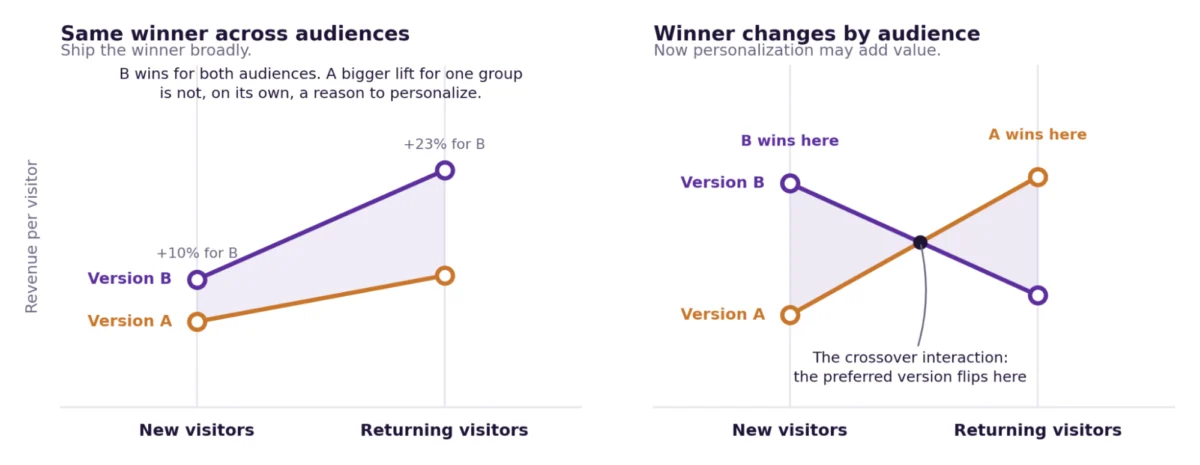
1. Does the winner change, or does one group just respond more strongly?
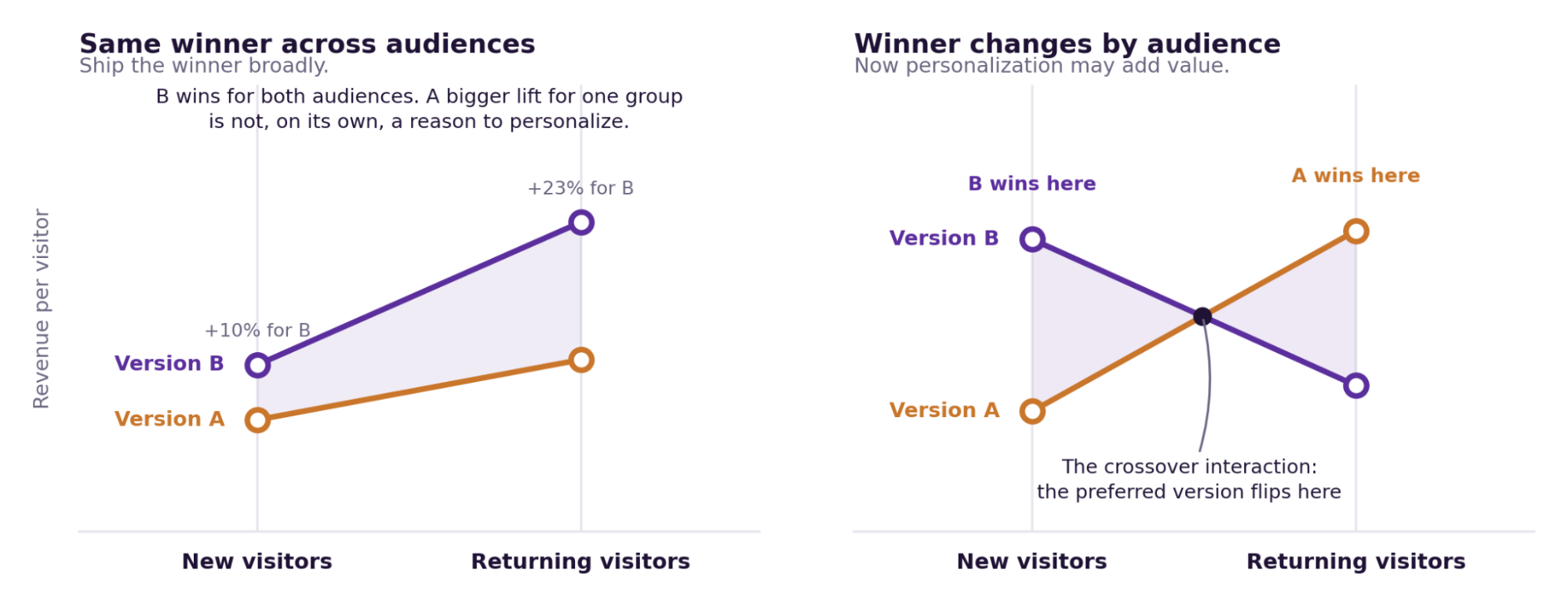
This is the core of the crossover interaction. If "Version B" of a webpage outperforms "Version A" for the general population by 3%, but outperforms it by 9% for returning visitors, many teams would immediately label returning visitors as a personalization opportunity. However, if Version B is the winner for everyone, the most efficient decision is to ship Version B to the entire audience. Personalization is only required when the best decision flips—for example, if Version B wins for new users but Version A wins for returning ones.
2. Was the segment defined prior to the analysis?
Data dredging, or "p-hacking," occurs when analysts slice post-test data in dozens of ways until they find a statistically significant result in a sub-segment. These "discoveries" are often the result of random noise rather than true behavioral differences. Valid personalization must be based on hypotheses defined before the test begins.
3. Is the signal available early enough to act?
A common pitfall is identifying a high-value segment based on data that only becomes available after the critical decision point. For instance, if a specific behavior is only identifiable after a customer reaches the checkout page, it cannot be used to personalize the homepage experience for that same session.

4. Does the incremental value cover the total cost of ownership?
Every personalized experience introduces "technical debt" and operational overhead. This includes the cost of initial development, content creation, quality assurance (QA), ongoing maintenance, and the complexity added to reporting. If the projected lift does not significantly exceed these costs, the simpler, unified experience is the superior investment.
The Economics of the Break-Even Point
To move from qualitative "wins" to quantitative profitability, teams must calculate the Minimum Lift Needed (MLN). The formula is a straightforward assessment of the break-even point:
Minimum Lift Needed = (Annualized Incremental Cost of Personalization) / (Annual Profit Generated by the Target Group)
Consider a hypothetical scenario for a high-traffic e-commerce site. A specific segment accounts for 240,000 annual visits. The current revenue per visit (RPV) is $4.00, resulting in $960,000 in annual revenue. With a 40% profit margin, the group generates $384,000 in annual profit. If the cost to maintain a personalized rule for this group—including design, QA, and platform fees—is $18,000 per year, the personalization must generate a minimum lift of 4.7% just to break even.
A real-world example from the travel and hospitality sector illustrates the danger of ignoring this math. A brand tested a personalized landing page for repeat visitors who had previously viewed premium properties. The test was a success, showing a 6% lift in revenue. However, because the target audience was relatively small, the 6% lift only translated to $13,500 in incremental profit. The operational cost to maintain the seasonal offers and QA for that specific rule was $15,000. Despite the "winning" test result, the personalization would have resulted in a net loss of $1,500 per year.
Implementation and the Role of Unified Data Platforms
For personalization to move beyond one-off rules, organizations require a robust data architecture. The challenge for most teams is not a lack of segments, but a lack of usable signals. This is where Data Platforms (CDPs) play a vital role. By unifying behavioral, purchase, and CRM data into a single customer profile, companies can identify more nuanced audience characteristics.
However, the technology is only as good as the experimentation culture it supports. Platforms like Wingify’s Data Platform and Personalization Suite allow teams to carry unified audiences into the testing environment. This ensures that hypotheses about customer differences are validated through the Crossover Test before being turned into permanent, targeted experiences. The goal is to move away from "launch and forget" rules toward a model of continuous measurement.
Long-Term Accountability: The Persistent Holdout
Even when individual personalizations pass the Crossover Test, the cumulative impact of an optimization program can be difficult to measure. Successive wins often overlap, and the sum of reported lifts usually exceeds the actual growth seen in the business. To combat this, leading tech companies like Airbnb have pioneered the use of persistent holdout groups.
By keeping a small percentage of traffic (e.g., 1-5%) completely isolated from all experimental changes over a long period (6-12 months), organizations can measure the true aggregate impact of their optimization efforts. This provides the "ground truth" that finance departments require. While the results from a persistent holdout may be more modest than the combined totals of individual test reports, they offer a credible, factual basis for future investment in the program.
Conclusion: A New Standard for Optimization
The future of personalization lies in a more disciplined, economically grounded approach to customer data. The era of personalizing for the sake of "relevancy" is giving way to an era of personalizing for the sake of profitability. By focusing on crossover interactions, calculating the minimum lift needed, and utilizing persistent holdouts, organizations can ensure that their optimization programs are not just generating a list of wins, but are actively driving the bottom line.
The most successful teams will be those that recognize that most customers, most of the time, are actually quite similar in their needs. The true skill in optimization is not in personalizing everything, but in identifying the rare, high-leverage opportunities where a different experience genuinely leads to a different—and better—result.







