
 rifanmuazin
The landscape of digital communication is undergoing a significant transformation, yet email steadfastly retains its position as a cornerstone of marketing and customer engagement strategies. However, a critical divergence is emerging within this enduring channel: a widening chasm between organizations that strategically invest in robust measurement, stringent deliverability practices, and continuous optimization, and those that continue to operate on mere assumptions and outdated methodologies. This stark reality is meticulously detailed in Sinch Mailgun’s comprehensive 2026 Email Impact Report, a pivotal analysis for businesses navigating the complexities of modern digital outreach.
Published on April 17, 2026, the report offers an unparalleled glimpse into the state of email marketing, drawing insights from a global survey of over 1,200 email senders. Crucially, it augments these self-reported findings with an exhaustive analysis of more than 400 billion real emails processed through Sinch Mailgun’s infrastructure throughout 2025. This dual-pronged approach provides a uniquely accurate and actionable perspective, moving beyond anecdotal evidence to present data-backed truths. The report is structured across five critical chapters, delving into the intricate facets of Return on Investment (ROI), industry benchmarks, the ever-crucial domain of deliverability, the burgeoning adoption of Artificial Intelligence (AI), and prevailing investment trends. The findings presented within are not merely statistics; they are a strategic roadmap for email senders aiming to thrive in the competitive second half of 2026 and beyond.
The Enduring Power of Email and the ROI Measurement Challenge
Email’s intrinsic value to organizations remains undeniable, with a staggering 78% of senders categorizing it as “very” or “extremely” important to their operations. This level of organizational buy-in is a rare feat for any marketing channel, underscoring email’s unparalleled ability to foster direct, personalized communication, drive conversions, and build lasting customer relationships. Its cost-effectiveness, scalability, and direct path to the consumer’s inbox consistently outperform many other digital channels in terms of potential reach and engagement. Email serves as a versatile tool, from nurturing leads and announcing product launches to providing critical transactional updates and fostering brand loyalty.
However, the report highlights a significant disconnect between organizational belief and demonstrable evidence. Despite email’s perceived importance, fewer than half of senders actively measure the ROI of their email programs. Specifically, only 46% track the ROI of promotional emails, and a slightly lower 43% do so for transactional communications. This suggests that a majority of teams are operating on conviction rather than concrete, data-driven insights. The inability to quantify email’s financial impact often stems from challenges in attributing revenue across complex customer journeys, integrating data from disparate systems, and developing sophisticated attribution models. Without clear ROI metrics, email programs, regardless of their intrinsic value, struggle to secure increased budget and strategic priority.
For those who do measure, the returns are compelling. A significant 60% of senders measuring promotional email ROI report returns exceeding $10 for every $1 spent, with 13% achieving an extraordinary ROI of over $40:1. Similarly, 62% of those tracking transactional email ROI also cross the $10:1 threshold, and 13% report returns above $40:1. While these high figures are impressive, Sinch Mailgun’s research provocatively suggests that such exceptionally high returns might, in some instances, signal underinvestment rather than peak efficiency. An ROI that is excessively high could imply that there is untapped potential, and additional strategic investment could yield even greater absolute returns, albeit potentially at a slightly lower, yet still robust, ROI percentage.
The primary impediment to scaling email investment is cited as budget constraints by 43% of senders. This creates a challenging paradox: budget is difficult to secure without compelling performance data, yet many teams lack the necessary data collection and analysis infrastructure to make a robust case. The report wisely recommends an intermediate step for organizations grappling with this challenge: starting with simpler metrics like “revenue per campaign.” While not a perfect attribution model, this initial step can provide enough tangible evidence to begin advocating for increased resources, paving the way for more sophisticated ROI tracking over time. “In an increasingly data-centric marketing world, operating on intuition alone for a channel as critical as email is a recipe for stagnation,” states an inferred industry analyst. “The organizations that will truly lead are those that can unequivocally demonstrate email’s contribution to the bottom line.”
Unveiling Real-World Email Benchmarks from 400 Billion Sends
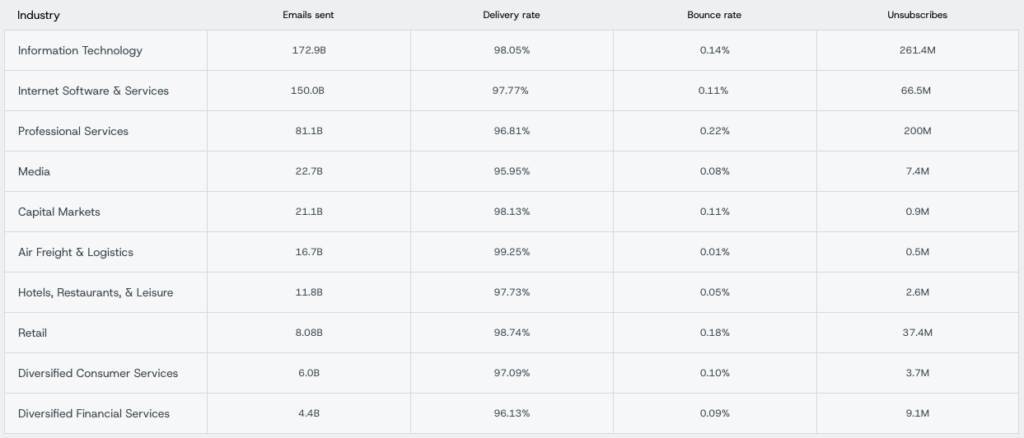
A groundbreaking aspect of the 2026 Email Impact Report is its methodology for establishing industry benchmarks. Unlike many existing reports that rely on surveys and self-reported estimates—data often susceptible to bias or inaccuracy—Chapter 2 of this report leverages real sending data. By analyzing 400 billion emails transmitted through Sinch Mailgun infrastructure across the top 10 industries by volume in 2025, the report provides an unparalleled, objective view of performance metrics.
The resulting industry benchmarks reveal significant variations. Air Freight & Logistics leads with an impressive 99.25% delivery rate and a minuscule 0.01% bounce rate. This exceptional performance is largely attributable to the nature of their communications: predominantly transactional sends such as shipping confirmations and tracking updates. These messages are highly anticipated and desired by recipients, leading to minimal rejections and high engagement. Conversely, the Media industry sits at the lower end of the top 10, with a 95.95% delivery rate. This is understandable given the industry’s characteristics, which typically involve high volumes of promotional content sent to broader audiences, naturally leading to increased downward pressure on delivery metrics, including higher spam complaints and unsubscribes.

However, the report issues a crucial caveat: delivery rate alone can be a misleading metric. An email technically “delivered” to a spam folder still counts towards the delivery rate, despite failing to reach its intended audience in the inbox. The report strongly advocates that senders must pair delivery rate tracking with active inbox placement testing. This involves sending test emails to various mailbox providers (like Gmail, Outlook, Yahoo) and monitoring where they land—in the primary inbox, promotions tab, or spam folder. This holistic approach provides a far more accurate understanding of email reach and effectiveness. “Relying solely on delivery rate is akin to celebrating that your mail was dropped at the post office, without knowing if it ever reached the recipient’s mailbox,” comments a Sinch Mailgun spokesperson. “Inbox placement is the true measure of whether your message has a chance to be seen.”
Another critical insight from the benchmark data pertains to unsubscribe rates. Information Technology, despite logging the highest raw number of unsubscribes at 261 million, demonstrated a relatively low rate of approximately 0.15% when contextualized against its colossal 172.9 billion sends. In stark contrast, Retail generated 37.4 million unsubscribes from a much smaller volume of 8.08 billion sends, indicating a significantly higher unsubscribe rate per email. This comparison unequivocally demonstrates that raw unsubscribe volume, devoid of send volume context, is meaningless. Marketers must analyze unsubscribe rates proportionally to truly understand list health and content relevance. High unsubscribe rates, even with relatively smaller raw numbers, can signal issues with audience targeting, content fatigue, or inadequate segmentation.
Advancements in Deliverability Meet Lingering Knowledge Gaps
The foundational importance of deliverability is widely acknowledged, with 89% of senders recognizing its significance to their organization. Encouragingly, 43% report an improvement in their inbox placement over the past 12 months, signaling genuine progress in infrastructure and best practices. A key driver of this improvement is the significant growth in DMARC (Domain-based Message Authentication, Reporting & Conformance) adoption. This critical email authentication protocol has seen a notable surge, largely propelled by stringent requirements from major mailbox providers such as Gmail, Yahoo, and Microsoft, which have mandated stronger authentication for bulk senders.
The report highlights a pivotal development: for the first time in Sinch Mailgun’s research, DMARC enforcement is outpacing passive monitoring. Over half of DMARC adopters are now utilizing “quarantine” or “reject” policies, rather than merely “monitor.” A “quarantine” policy directs suspicious emails to the spam folder, while a “reject” policy prevents them from being delivered at all. This shift signifies a more proactive and robust approach to email security, helping to combat phishing, spoofing, and brand impersonation. The visual data further illustrates this trend, showing DMARC adoption growing from 43% in 2023, to 54% in 2024, and reaching 61% in 2025. This rapid increase reflects an industry-wide push towards enhancing email trust and security, benefiting both senders and recipients.
However, this technical progress is not uniformly matched by sender understanding. A concerning 36% of senders claim to monitor their “email deliverability rate,” a metric that, as the report clarifies, does not technically exist in a meaningful way. This confusion underscores the fundamental difference between an email being accepted by a server (delivery rate) and an email actually reaching the inbox (inbox placement). Only 25% of senders actively run inbox placement tests to ascertain where their emails truly land. Furthermore, a significant 27% of DMARC users are unaware of the specific policy (monitor, quarantine, or reject) they have implemented. This indicates a critical literacy gap: while the tools and infrastructure for better deliverability are improving, the understanding and strategic application of these tools among a substantial portion of senders lag behind.
The implications of this knowledge gap are profound. Poor deliverability translates directly to lost revenue, diminished brand reputation, and wasted marketing efforts. Emails sent but not received are not only ineffective but can also harm a sender’s reputation with Internet Service Providers (ISPs), leading to future delivery issues. “The technical advancements in email authentication are vital, but their full potential is realized only when marketers and IT professionals truly understand what they’re measuring and why,” explains an inferred deliverability expert. “Ignoring inbox placement or misunderstanding DMARC policies is like driving a high-performance car without knowing how to read the dashboard – you’re unlikely to reach your destination efficiently or safely.”
AI’s Transformative, Yet Uneven, Impact on Email Programs
The rise of Artificial Intelligence (AI) has permeated nearly every aspect of digital marketing, and email is no exception. The report indicates widespread interest, with 79% of senders either currently using or planning to use AI in their email programs. However, the reality of consistent, systematic integration is more nuanced. Only 27% of senders report regular use of AI, suggesting that a significant portion of adopters are still in the experimental phase, rather than fully embedding AI into their core workflows.
The most prevalent AI application is copy generation, cited by 41% of senders, highlighting AI’s utility in streamlining content creation. Following this are content personalization (36%), dynamic content (29%), send time optimization (27%), and data analysis (27%). This pattern reveals a clear trend: AI delivers its most significant value when it is integrated into decision-making processes, extending beyond mere content production. Teams that leverage AI for sophisticated tasks such as personalization, optimizing send times based on individual recipient behavior, and A/B testing variations across vast audiences are reporting “compounding returns.” This means that the benefits of AI are not linear but grow exponentially as AI systems learn and refine their recommendations over time. In contrast, teams employing AI solely for superficial tasks, such as drafting basic subject lines, are observing limited impact.
A compelling data point underscores AI’s potential to differentiate performance: 54% of senders who have implemented AI report moderate or significant year-over-year improvements in their email programs. This contrasts sharply with only 37% of senders who are not using AI reporting similar improvements within the same timeframe. This 17-point gap serves as the clearest indicator yet that AI is beginning to stratify email programs into distinct performance tiers. While the report acknowledges that this does not definitively prove causation, the consistent direction of the data strongly suggests a correlative link between AI adoption and enhanced email program efficacy.
Despite the promise, 23% of AI users state that it has not helped them at all. This finding reinforces a critical insight: the difference between those realizing value from AI and those who are not lies not in the tool itself, but in the depth and strategic integration of AI. Superficial use or a lack of clear objectives will inevitably lead to disappointing results. For AI to be truly transformative, it must be integrated thoughtfully into the entire email marketing lifecycle, from audience segmentation and content creation to deployment, testing, and performance analysis. “AI is not a magic wand; it’s a powerful accelerator for those who know how to drive it,” an inferred marketing futurist observes. “The future of email marketing belongs to those who strategically weave AI into the fabric of their operations, using it to unlock deeper insights and create hyper-personalized experiences at scale.”
Strategic Investment for the Future of Email
Looking ahead to 2026, the strategic priorities for email marketers are clear. “Taking advantage of AI” and “increasing email engagement” are tied as the top priorities, each cited by 40% of senders. This dual focus underscores a recognition that leveraging advanced technology is crucial for driving better interactions with subscribers.
In terms of financial commitment, the report provides a cautiously optimistic outlook: 31% of organizations plan to increase their email investment, while a substantial 48% intend to maintain their current spending levels. Only a small minority, 7%, anticipate decreasing their email investment. This indicates a general confidence in email’s continued relevance and effectiveness, with a notable segment actively seeking to capitalize on its potential through greater resource allocation. The commitment to maintain or increase investment signals a belief in email’s sustained ROI and its foundational role in the marketing mix.
The report’s concluding message is straightforward and impactful: email continues to be a highly effective channel. This is unequivocally supported by the data across ROI metrics, industry benchmarks, and positive deliverability trends. However, the programs poised to achieve sustained competitive advantage are those that are simultaneously investing in three interconnected areas:
- Measurement: Moving beyond assumptions to prove ROI with verifiable data. This involves implementing robust tracking, attribution models, and regularly analyzing performance metrics.
- Deliverability: Consistently ensuring emails reach the inbox through proactive authentication (DMARC, SPF, DKIM), diligent list hygiene, and continuous monitoring of inbox placement.
- Optimization: Leveraging advanced tools, particularly AI, and employing rigorous A/B testing to continually refine and improve campaign performance at scale.
Crucially, the report emphasizes that none of these strategic imperatives necessitate an immediate, massive budget outlay to initiate. Each area offers accessible entry points for improvement, and the benefits of investing in them are cumulative, compounding significantly over time. Small, consistent efforts in these three pillars can lead to substantial long-term gains in email program effectiveness and overall business impact.
Broader Industry Implications: A Call to Strategic Action
The Sinch Mailgun 2026 Email Impact Report serves as a critical barometer for the evolving email marketing landscape, highlighting a clear bifurcation within the industry. On one side are the forward-thinking organizations that are embracing data, technology, and best practices to maximize their email channel’s potential. On the other are those who, despite recognizing email’s importance, risk falling behind due to a reliance on outdated methods and a lack of critical understanding.
The implications are clear: the era of “set it and forget it” email marketing is over. Success in the modern email ecosystem demands a proactive, data-driven, and technically astute approach. Organizations that prioritize understanding their ROI, mastering the nuances of deliverability, and strategically integrating AI will not only see superior performance but will also build more resilient, impactful, and compliant communication strategies. The widening gap observed in this report is not merely a statistical anomaly; it is a call to strategic action for all email marketers to invest wisely in measurement, deliverability, and optimization, ensuring that email remains a powerful and profitable engine for growth in the years to come.









