rifanmuazin
Generative artificial intelligence (GenAI) has rapidly become an indispensable component of the modern email marketing workflow, fundamentally reshaping industry practices and expectations. According to the authoritative State of Email Report 2026, GenAI tools now represent the most impactful AI application in email marketing, signaling a profound shift in operational efficiency and strategic focus. This technological integration has dramatically accelerated email production cycles, with 76% of marketers currently able to produce and dispatch campaigns within a mere three days. This stands in stark contrast to 2024, when a substantial 62% of teams required two weeks or more to develop a single email, highlighting an unprecedented acceleration in the marketing pipeline. Consequently, the demand for AI/Machine Learning (ML) application skills has surged, now ranking as the number one hiring priority for companies, eclipsing content creation, which held the top spot in 2025.
However, this revolutionary technological advancement, while offering unparalleled benefits to legitimate marketers, simultaneously presents a formidable challenge. The same sophisticated tools that empower marketers to craft highly effective and personalized campaigns are being weaponized by cybercriminals, leading to an alarming escalation in the sophistication and volume of phishing attacks. This duality places a unique and critical responsibility on marketers to leverage AI ethically, ensuring the protection of their carefully cultivated brand programs and subscriber trust. Understanding this dual impact – the profound advantages and the looming threats – is crucial for navigating the evolving digital communication landscape.
The Proliferation of AI in Marketing Workflows: A New Era of Efficiency and Personalization
The journey of artificial intelligence from a nascent concept to a foundational element in email marketing has been swift and transformative. Historically, email marketing has grappled with the challenges of scale, personalization, and efficiency. Marketers often spent considerable time on manual tasks, from drafting copy and designing templates to segmenting audiences and A/B testing various elements. The advent of GenAI has served as a powerful catalyst, effectively addressing these long-standing bottlenecks.
For savvy marketers, AI functions as an extraordinary efficiency booster, automating tedious, repetitive tasks and liberating valuable human capital for more strategic endeavors. As Jeanne Jennings, Founder & Chief Strategist at Email Optimization Shop, articulately puts it, “It’s not that AI is doing the work instead of me, it’s that AI is helping me do the work more productively, more efficiently. Maybe it’s an intern, maybe it’s more of a co-pilot.” This sentiment underscores a paradigm shift, where AI is not a replacement but an enhancement, augmenting human capabilities rather than supplanting them.

Beyond merely generating email content, marketing teams are now deploying AI across a broad spectrum of critical functions. These include advanced audience segmentation, dynamic subject line testing, predictive send time optimization, ensuring accessibility compliance for diverse audiences, and implementing sophisticated deliverability improvements to ensure emails reach their intended inboxes. The “State of Email Report 2026” further reveals that as of early 2026, a significant 28% of email teams have achieved “advanced AI adoption,” signifying deep integration of AI into multiple stages of their email marketing workflows. These early adopters are reaping substantial rewards, demonstrating a 75% higher likelihood of achieving return on investment (ROI) exceeding 45:1 from their email campaigns. Furthermore, they are 28% more likely to deploy emails in under a day compared to teams in the nascent stages of AI adoption, illustrating a clear competitive advantage derived from strategic AI implementation. The ability to rapidly iterate, personalize at scale, and optimize performance based on data-driven insights has become a hallmark of leading email marketing operations.
The Dark Side of AI: The Rise of Hyper-Realistic Phishing Attacks
While AI ushers in an era of unprecedented efficiency for legitimate marketers, its capabilities are equally accessible to malicious actors. The same speed and scalability that empower marketing teams are being leveraged by cybercriminals, leading to a dramatic escalation in the sophistication and volume of phishing campaigns. Large language models (LLMs), the backbone of GenAI, have drastically reduced the time required to craft a convincing phishing email from hours to mere minutes. These AI tools can now generate hundreds of grammatically flawless, contextually relevant phishing emails that are increasingly difficult to distinguish from authentic communications, even for a vigilant recipient.
Rafael Viana, Senior Email Strategist at Validity, succinctly captures this alarming symmetry: “Bad actors have that same superpower. They use AI to create polished, believable emails at massive scale. And frankly, a lazy marketer using that magic button could generate generic content that looks a lot like a spammer to those inbox algorithms. The stakes for trust have never been higher.” This statement highlights a critical concern: the blurred lines between legitimate, albeit generic, AI-generated marketing content and sophisticated spam, posing a significant challenge for both recipients and email service providers.
The era of easily identifiable phishing emails characterized by glaring typos, lack of personalization, and awkward greetings is rapidly drawing to a close. Today’s AI-generated versions are meticulously polished, contextually accurate, and often virtually indistinguishable from genuine brand communications. This evolution has driven phishing incidents to an all-time high. Cybersecurity research paints a grim picture, reporting a staggering 202% increase in phishing email volume during the second half of 2024 alone. Disturbingly, 82.6% of all detected phishing emails now exhibit clear signs of AI generation, underscoring the pervasive adoption of these tools by cybercriminals.
GenAI empowers malicious actors with several advanced capabilities:

- Hyper-personalization at scale: Crafting emails that appear deeply personal and relevant to the recipient, often by leveraging publicly available information or data breaches.
- Circumventing security filters: Generating varied and novel attack vectors that can bypass traditional spam and security filters, which often rely on pattern recognition of known threats.
- Multi-language attacks: Rapidly translating and adapting phishing campaigns to target diverse linguistic groups, expanding their reach and impact.
- Deepfake integration: Beyond text, AI can generate convincing deepfake audio and video. This enables cybercriminals to construct sophisticated multi-channel attacks that are extraordinarily challenging to detect. A high-profile case in 2024 saw a finance worker at a multinational firm defrauded of $25 million after participating in a video call where every participant’s face and voice was entirely AI-generated. This incident served as a stark warning of the evolving threat landscape.
The implications are profound. The Cybersecurity and Infrastructure Security Agency (CISA) estimates that over 90% of successful cyberattacks originate with a phishing email. When AI dramatically enhances an attacker’s ability to create highly convincing and pervasive phishing messages, the risk profile for every organization – and every individual email marketer – escalates significantly.
The Marketer’s Ethical Imperative: Rebuilding Trust in an AI-Driven Inbox
Email marketers find themselves in a unique and challenging position. They are utilizing the very same class of generative AI tools that cybercriminals are weaponizing, a fact that is increasingly recognized by subscribers. This convergence has created a profound trust challenge, extending beyond mere security concerns to impact brand perception and customer loyalty.
As Beth O’Malley, Founder, CRM, Email & Marketing Specialist at astral, wisely observes, “Not everybody can sniff out AI. But when a subscriber gets that feeling that this might be an AI-generated email—that it doesn’t read as expected from this brand—the brain has already made that judgment. AI could accidentally scale bad emails.” This highlights the subtle but potent erosion of trust that can occur when AI-generated content lacks the authentic human touch or deviates from established brand voice, even inadvertently.
To counteract this, it is paramount for marketers to maintain a robust “human in the loop” approach. This involves meticulous review and diligent editing of all AI-generated content to ensure it aligns perfectly with the brand’s identity, tone, and factual accuracy. The stakes are not merely reputational; misleading subject lines, for instance, now carry tangible legal risks, with multiple class-action lawsuits already filed against companies for deceptive marketing practices. While AI can effortlessly generate clever, attention-grabbing subject lines at scale, it also carries the risk of overpromising, using incorrect wording, or even fabricating promotions, all of which can have severe legal and ethical consequences.
Furthermore, the proliferation of AI-generated spam has a direct and detrimental impact on email deliverability across the board. Validity’s 2026 Deliverability Benchmark Report unequivocally documents how AI has facilitated spammers in flooding inboxes, compelling mailbox providers to implement increasingly sophisticated and stringent filtering mechanisms. This, in turn, makes it more challenging for all legitimate senders to consistently achieve optimal inbox placement. Brands that have proactively invested in cultivating genuine subscriber relationships and consistently demonstrated high email engagement are better positioned to navigate these evolving filters and avoid the spam folder. Marcel Becker, Senior Director of Product Management at Yahoo, articulates this perspective: “Whether we use AI to amplify good or bad behavior doesn’t really matter at the end of the day. It’s a means to an end. We want senders to provide the best user experience to our mutual customers, and we want to provide the best user experience on top of that.” This emphasizes the shared goal of a positive user experience, which ultimately dictates AI’s ethical application.

A critical emerging challenge for marketers is “inbox AI.” As Rafael Viana notes, “We are not just optimizing for spam filters anymore. We are optimizing for inbox AI.” With powerful AI tools like Google’s Gemini increasingly integrated into platforms like Gmail, subscribers are relying more heavily on AI to automatically sort, summarize, and filter their incoming emails. This means an email’s visibility and impact can be heavily influenced by how effectively it communicates with these intelligent systems. Despite this burgeoning reality, fewer than one-third of marketers currently possess a strategic approach to optimizing their emails for these AI-driven inboxes. To address this, marketers should adopt SEO-inspired strategies, such as utilizing semantic formatting, front-loading key information, and implementing inbox schemas like Gmail annotations, to ensure their messages are effectively interpreted and surfaced by AI-powered email clients.
Responsible AI Integration: Guardrails for Ethical Email Marketing
The challenges presented by generative AI do not warrant shying away from its immense potential but rather underscore the imperative for thoughtful, responsible, and ethical application. The following strategies are essential for marketers to harness AI’s power while safeguarding trust and performance:
-
Transparency with Subscribers: Building and maintaining trust is paramount. A simple “powered by AI” disclosure, where appropriate, can significantly contribute to transparency. Marketers should also consider updating their privacy policies to clearly articulate how AI is utilized in their communications and, crucially, empower subscribers to manage their exposure to AI-generated content through robust preference centers. This proactive communication fosters trust and gives control back to the consumer.
-
Maintaining the Human Element: AI is a powerful tool, but it does not replace the nuanced creativity, strategic thinking, and emotional intelligence of human marketers. Human guidance and oversight remain absolutely crucial. As Leah Miranda highlights, “There are some emails that are okay for an AI magic button. You can still add in that little twenty percent human sparkle for, say, a newsletter opener. But those types of emails are made for a magic button. You can train an AI really quickly.” She further cautions, “If you are using AI to just write an email without investing the time to build it properly, you’re going to get crap out. Some people think AI is going to solve all their problems. It can—but you’re still going to have to invest in it.” This underscores that AI’s effectiveness is directly proportional to the quality of human input, oversight, and strategic investment.
-
Strategic Focus on Core Foundations: Many marketers initially gravitate towards AI for content generation. While valuable, its true power often lies in supporting the “invisible work” that underpins successful email campaigns. Beth O’Malley emphasizes this: “Copy and design sit at the bottom of the email pyramid of what’s important. What actually drives performance is the invisible work—the infrastructure, the data, the segmentation, the frameworks, understanding what’s working.” Marketers should prioritize using AI to strengthen foundational elements, such as analyzing complex customer behavior, refining customer data, optimizing segmentation, and building robust email frameworks, rather than solely focusing on accelerating content output.

-
Mitigating Bias and Ensuring Data Quality: The principle of “garbage in, garbage out” is acutely relevant to AI. The quality and fairness of AI outputs are directly dependent on the quality, relevance, and representativeness of the data it is trained on and the guardrails provided. Uploading high-quality resources, accurate data, and establishing clear ethical guidelines are essential to avoid generating biased, inaccurate, or irrelevant content. Matt Gore, CTO at Validity, aptly warns, “AI will absolutely amplify performance, but it will just as quickly amplify the consequences of poor data hygiene. If your foundation isn’t solid, AI doesn’t hide the cracks. It exposes them.”
-
Fortifying Deliverability and Security: In an environment rife with AI-powered phishing, robust deliverability and security measures are non-negotiable. Marketers must leverage advanced tools like Litmus for comprehensive email testing and quality assurance before every send. Crucially, implementing and adhering to email authentication protocols such as SPF (Sender Policy Framework), DKIM (DomainKeys Identified Mail), DMARC (Domain-based Message Authentication, Reporting & Conformance), and BIMI (Brand Indicators for Message Identification) is more critical than ever. These protocols verify the sender’s identity, protect subscribers from spoofing attacks that impersonate brands, and signal trustworthiness to mailbox providers. Notably, major providers like Microsoft, Yahoo, and Gmail now mandate SPF, DKIM, and DMARC compliance for senders dispatching over 5,000 emails per day, making these technical safeguards a baseline requirement for high-volume senders.
-
Educating Subscribers: Proactive subscriber education is a vital defense mechanism against sophisticated impersonation attacks. Marketers must clearly communicate what legitimate communications from their brand look like. This includes maintaining consistent email templates, messaging, “from” addresses, and ensuring the implementation of BIMI, which visually verifies brand identity in the inbox. By equipping subscribers with the knowledge to discern authentic messages, brands can significantly reduce the success rate of convincing AI-generated phishing attempts.
The Future: AI as a Force for Good, Guided by Human Stewardship
Despite the escalating cyber threats, the overarching impact of generative AI in email marketing remains overwhelmingly positive when implemented with thoughtful guardrails. The data unequivocally demonstrates that advanced AI adopters are achieving unparalleled speeds in email production, delivering superior personalization, attaining higher ROIs, and are more likely to adhere to critical accessibility standards. In essence, the strategic and responsible integration of AI demonstrably yields significant dividends.
As Leah Miranda succinctly put it, “It’s not that AI is doing the work instead of me. It’s that AI is helping me do the work more productively, more efficiently.” This encapsulates the true potential of AI: to act as an accelerant for human ingenuity and strategic execution. AI serves as an extraordinarily powerful tool for fostering deeper connections with subscribers. When used judiciously, it empowers marketers to produce highly relevant emails at unprecedented speeds and analyze campaign results with greater precision. However, if deployed carelessly or without adequate human oversight, it risks eroding the very trust that forms the bedrock of effective email communication.

Ultimately, the power of email remains undiminished, but the conditions surrounding its deployment have irrevocably changed. Ann Handley’s insightful observation resonates profoundly: “The power of email has not changed, but the conditions around it have. Your pacing, your relevance, your humanity—these are now the difference between being seen and being skipped.” In this new AI-driven era, the human touch, ethical considerations, and strategic application of technology will define success and differentiate authentic brands from the noise.
This article was originally published on validity.com and was refreshed using AI, reviewed, and edited by Lindsey Hiner, Senior Content Marketing Manager at Validity.


 Asro
Asro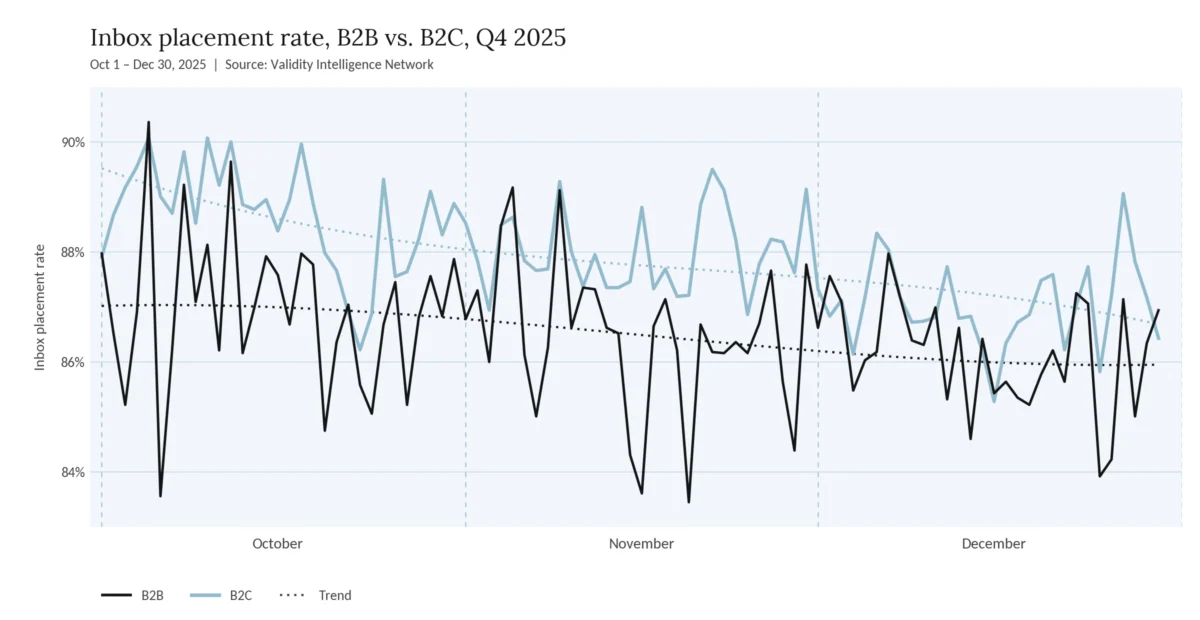
 Nana
Nana