

For many, Semrush has long been the gold standard for tracking traditional Search Engine Results Page (SERP) rankings, a foundational element of digital marketing for decades. While the tool has recently augmented its capabilities with AI visibility features, the rapid evolution of artificial intelligence in search has created a burgeoning market for specialized alternatives. This guide delves into five prominent Semrush AI visibility alternatives – including HubSpot AEO – to assist SEO leaders, content marketers, demand generation managers, and RevOps teams in evaluating the optimal fit for their technology stack, reporting requirements, and budget constraints amidst this transformative shift in the digital landscape.
The Paradigm Shift: Understanding AI Search Visibility
The advent of sophisticated large language models (LLMs) and their integration into search engines and standalone AI assistants has fundamentally altered how users discover and consume information. This seismic shift moves beyond the traditional list of "blue links" to AI-generated answers, summaries, and recommendations. This new frontier is what defines AI search visibility: a brand’s presence, influence, and attribution within these AI-driven responses.
Background Context: The Rise of Answer Engines
For years, search engine optimization (SEO) focused on ranking high in organic search results. Google’s algorithm updates, like Panda, Penguin, and Hummingbird, shaped strategies around keywords, backlinks, and technical performance. However, with the emergence of conversational AI like ChatGPT, Perplexity, Google’s AI Overviews, and Gemini, user queries are increasingly met with synthesized answers rather than a mere list of links. These "answer engines" aim to provide direct, comprehensive responses, often citing multiple sources, rather than requiring users to click through to individual websites. This development has necessitated a new approach to digital presence, as a brand’s content might be "seen" by an AI without a direct click, yet still influence user perception and decision-making.
AI Search Visibility vs. Traditional Rank Tracking: A Crucial Distinction
Traditional rank tracking, the bedrock of SEO, measures a webpage’s position in a sequential list of results for specific keywords. Success is quantified by occupying top positions (e.g., position one, two, or three) in Google’s organic SERP. The underlying mechanisms rely heavily on factors like domain authority, keyword density, and backlink profiles.
In stark contrast, AI search visibility measures whether a brand’s content is retrieved, synthesized, and surfaced as a trusted source within a generated response. There are no "positions" in the traditional sense. Instead, the focus shifts to whether an AI engine can confidently interpret, extract, and attribute a brand’s information. A page might hold a dominant position in Google’s organic results, yet be conspicuously absent from AI-generated answers. This is because AI systems prioritize factors beyond mere ranking signals, such as content clarity, factual accuracy, entity authority, and cross-platform consistency. Content that is well-structured, directly answers questions, and establishes clear topical authority is more likely to be cited by an AI, regardless of its "blue link" ranking.

Core Metrics Defining AI Search Visibility
To effectively measure AI search visibility, three key metrics emerge as critical indicators, providing a more holistic view than any single data point:
- Citation Frequency: This metric tracks how often a brand’s content or entity is explicitly mentioned or referenced as a source within AI-generated answers. It’s not just about being mentioned, but also the context and prominence of the citation. High citation frequency suggests the AI recognizes the brand as an authoritative source on relevant topics.
- Share of Voice (SoV) in AI Answers: Beyond individual citations, SoV measures a brand’s presence relative to its competitors within AI responses for a defined set of queries. It provides insight into how often an AI chooses to reference a brand’s content compared to other players in the market. A strong share of voice indicates competitive advantage in the AI search landscape.
- Sentiment: This metric analyzes the emotional tone and descriptive language used by AI engines when referencing a brand. Is the brand described positively, neutrally, or negatively? Understanding sentiment is crucial for brand reputation management, as AI-generated summaries can significantly shape public perception, even without direct user interaction with the brand’s website.
Collectively, these three metrics offer comprehensive insight into a brand’s performance in the AI search ecosystem. A brand might have frequent citations but suffer from poor sentiment, or achieve a low share of voice but with exceptionally strong, authoritative positioning in the citations it does earn. Understanding the interplay of these metrics is what renders AI visibility measurement truly actionable for strategic content optimization.
Semrush’s Entry into AI Visibility and its Current Landscape
Recognizing the evolving search landscape, Semrush, a titan in the SEO industry, integrated AI visibility tracking as an extension of its robust existing SEO suite. This addition includes monitoring Google AI Overviews, providing limited citation insights, and incorporating keyword data for AI-influenced queries. For organizations already deeply embedded in the Semrush ecosystem for technical SEO, backlink analysis, and competitive research, this integration offers the benefit of reduced tool switching and a unified workspace.
However, Semrush’s AI visibility features currently lean heavily towards Google AI Overviews, Gemini, ChatGPT, and Perplexity, alongside its traditional search integrations. A notable gap exists in its coverage of emerging AI assistants such as Meta AI or Microsoft Copilot. This presents a limitation for teams requiring broader, cross-engine visibility to capture a comprehensive picture of their brand’s presence across all significant AI platforms. Furthermore, for organizations not already standardized on Semrush, the pricing structure can represent a significant barrier to adopting its AI layer, potentially necessitating investment in an entirely new, high-cost platform for what might be a subset of desired features.
A Deep Dive into Leading Semrush AI Visibility Alternatives
The market for AI visibility tools is rapidly expanding, offering a range of solutions that vary significantly in engine coverage, CRM integration capabilities, pricing models, and how deeply AI visibility connects to existing marketing and revenue workflows. The following five alternatives provide distinct approaches for teams seeking to optimize their presence in the age of answer engines.
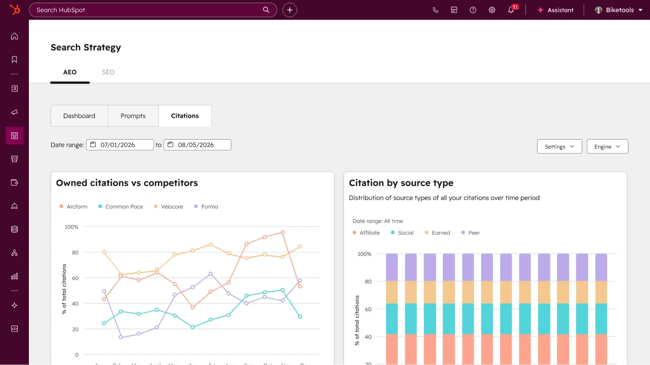
1. HubSpot AEO (Answer Engine Optimization)
Focus: HubSpot AEO is purpose-built to track and enhance brand visibility specifically within AI-generated answers. Unlike many SEO tools that offer AI visibility as an add-on, HubSpot AEO is engineered from the ground up with AI search at its core, reflecting a proactive approach to the future of search. The tool seamlessly connects citation data, share of voice metrics, and competitive comparisons directly to the CRM context and content management tools that marketing and sales teams already utilize.

Key Features:
- Comprehensive citation data and frequency analysis.
- Share of voice tracking against key competitors.
- Monitoring of brand presence across major AI engines (ChatGPT, Gemini, Perplexity).
- Integration with HubSpot’s Marketing Hub for campaign reporting.
- Direct connection to HubSpot’s Smart CRM for pipeline and revenue attribution.
- AI Search Grader for baseline visibility scoring.
What Makes it Different: HubSpot AEO’s most compelling differentiator is its native integration with the broader HubSpot ecosystem. By linking visibility data directly to Marketing Hub’s campaign reporting and Smart CRM’s pipeline and revenue attribution, it closes the critical loop between AI-influenced brand touchpoints and tangible business outcomes. A demand generation team, for instance, can not only ascertain where their brand appears in AI answers but also trace whether those AI-influenced interactions convert into new contacts, qualified deals, and ultimately, revenue. The free AI Search Grader provides a valuable, structured benchmark, scoring AI visibility across major engines and identifying instances where competitors are cited instead. This data offers a defensible starting point for RevOps teams to measure progress and demonstrate ROI.
Expert Insight: Peter Baranik, founder of ColorWee and a seasoned digital marketer, lauds HubSpot AEO for its comprehensive, yet user-friendly, approach: “I super love this tool because it gives you four things out of the box: a visibility score, prompt tracking, citation analysis, and prioritized recommendations, with the main dashboard showing how your brand trends over time across ChatGPT, Gemini, and Perplexity. The setup is straightforward, the data can be interpreted without an SEO team, and at only $50 per month, it doesn’t require a big budget commitment to try.” He acknowledges a current limitation, noting, “One limitation is that it only includes three platforms, so if you care about Claude, Grok, or Google AI Mode, there will be gaps.”
Best for: Marketing, demand generation, and RevOps teams for whom connecting AI visibility data directly to CRM reporting and demonstrating pipeline impact is paramount.
Pro Tip: Begin your AI visibility journey with the free HubSpot AI Search Grader. This foundational benchmark will provide crucial initial data, allowing your RevOps team to establish a quantifiable starting point for measuring the effectiveness of subsequent AI optimization efforts.
2. LLM Pulse
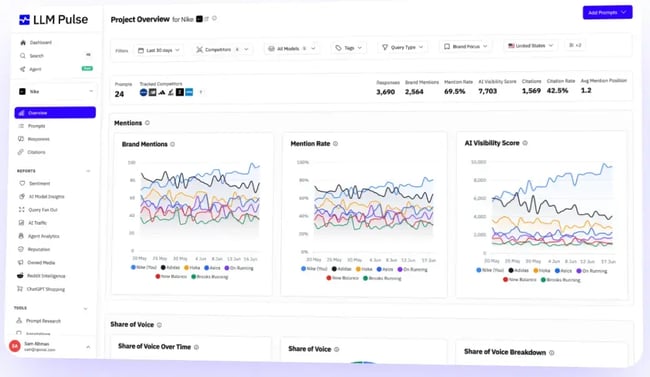
Focus: LLM Pulse positions itself as a dedicated AI visibility platform, offering specialized tools for citation analysis, sentiment tracking, and in-depth query fan-out research across leading AI models. Its unique ability to display actual AI responses, rather than just aggregated scores, makes it invaluable for teams seeking to meticulously audit the precise language and context AI engines employ when referencing their brand.
Key Features:
- Detailed citation analysis and brand mention tracking.
- Sentiment analysis of AI-generated responses.
- Query fan-out research, illustrating diverse prompts AI engines use to retrieve content.
- Direct display of actual AI responses for qualitative auditing.
- White-label reporting options for agencies.
Pricing: Starts at $50/month.
What I Like: LLM Pulse excels in surfacing query fan-out data, a critical feature that reveals the full spectrum of prompts and interpretive pathways AI engines utilize to retrieve and synthesize content on a specific topic. This granular insight is instrumental not just for monitoring, but for proactively designing a robust AI search content strategy that anticipates varied user queries and AI processing methods.
Expert Insight: Doug Darroch, Managing Director at Renaissance Digital Marketing, highlights LLM Pulse’s agency-friendly features: “LLM Pulse stands out because of its white-label reporting. Beyond basic mention tracking, it covers citation analysis, sentiment, query fan-out, and prompt research across the major models, and it shows you the actual AI responses. The main limitation is that the optimization step leans on AI-generated recommendations rather than built-in content production, so you are still the one doing the strategic execution.”
Best for: Digital marketing agencies managing AI visibility for a diverse client portfolio, and brands that require direct access to actual AI responses to understand how their content is being interpreted and presented.
3. BrightEdge
Focus: BrightEdge is an established enterprise SEO platform that has strategically expanded its capabilities to encompass AI search tracking. It integrates features such as Google AI Overview monitoring, sophisticated content recommendations, and large-scale keyword analysis within its comprehensive suite, catering primarily to large organizations with extensive content operations.
Key Features:
- AI Overview monitoring for Google search.
- Content optimization recommendations based on AI insights.
- Enterprise-grade keyword analysis and tracking.
- Integration with existing SEO workflows for technical audits and competitive analysis.
Pricing: Contact BrightEdge for a custom quote (typically reflective of enterprise-level solutions).
What I Like: BrightEdge’s strength lies in its ability to integrate AI visibility tracking into a broader, existing enterprise AI SEO workflow. For large teams already utilizing BrightEdge for their extensive content operations, this integration significantly reduces the need to manage disparate platforms, streamlining reporting and strategic execution.
Expert Insight: Peter Baranik offers a candid perspective on BrightEdge’s suitability: “BrightEdge can be useful if your problem is enterprise SEO workflow, but it’s not enough if your problem is specifically AI search visibility, because buyers are no longer just clicking on ranked pages. They’re using ChatGPT, Google AI Overviews, and Perplexity to summarize markets for them. The data is impressive, but the platform is geared toward large teams with dedicated SEO resources, and the pricing reflects that. If you are a one-man band or a small brand, it’s more tools than you need.”
Best for: Enterprise SEO teams with existing BrightEdge contracts who seek to extend their visibility tracking into AI Overviews and other AI-influenced search features without introducing new, standalone platforms.
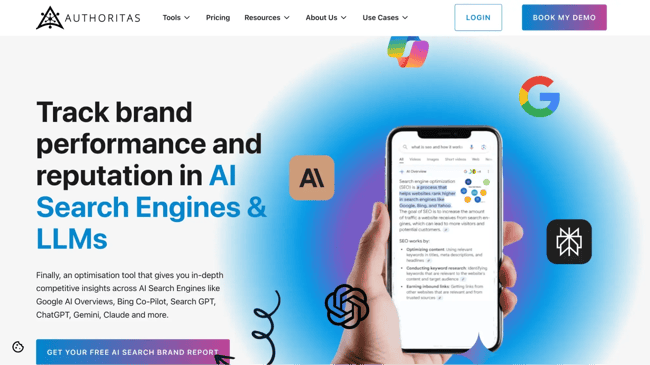
4. Authoritas
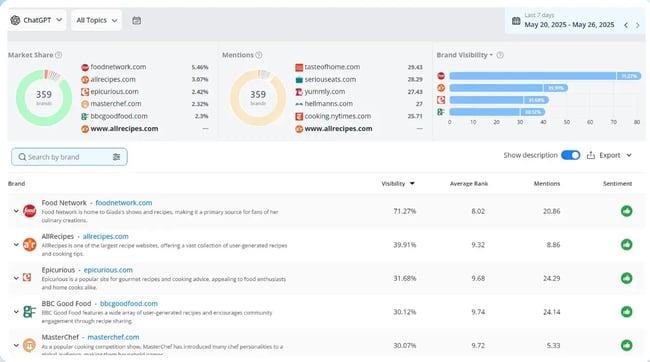
Focus: Authoritas specializes in measuring brand visibility across a variety of AI search experiences. The tool meticulously tracks which entities, specific products, and competitor brands are featured in AI-generated answers, along with the frequency of these appearances. This granular approach provides a clear, structured view of a brand’s actual presence in AI search.
Key Features:
- URL-level AI Overview tracking for Google.
- Entity tracking and analysis within AI answers.
- Competitor visibility benchmarking in AI search.
- Insights into how AI engines perceive and cite content.
Pricing: Contact Authoritas for a custom quote.
What I Like: Authoritas provides marketers with an unambiguous, structured understanding of how their brand manifests in AI search results, eliminating much of the guesswork. Its emphasis on URL-level tracking for Google AI Overviews is particularly useful for content managers needing to pinpoint specific pages that are (or aren’t) being cited.
Expert Insight: Raúl Menoyo, Founder of Citora and a daily user of various AI visibility tools, highlights a key strength: “The feature I genuinely rely on is URL-level AI Overview tracking, which tells me which exact pages Google is citing instead of handing me one vague visibility score. Its blind spot is the standalone assistants. It’s strong on Google and thin on ChatGPT, Claude, and Perplexity, so I have to pair it with something else when a client cares about those.”
Best for: SEO teams primarily focused on Google AI Overviews and requiring precise, page-level citation data to strategically prioritize and optimize content updates.
5. Advanced Web Ranking (AWR)
Focus: Advanced Web Ranking (AWR) offers robust capabilities for tracking how a brand appears across AI search results. It provides detailed insights into which competitors are being surfaced alongside the brand and monitors how overall visibility metrics shift over time, building on its strong foundation as a traditional rank tracker.
Key Features:
- Tracking of AI-influenced SERP features (e.g., featured snippets, AI Overviews).
- Historical data for long-term trend analysis of AI visibility.
- Competitor monitoring in the context of AI-generated answers.
- Multi-location, multi-device, and multi-search engine tracking.
Pricing: Starts at $139/month.
What I Like: AWR’s strength lies in its extensive historical data capabilities, which are invaluable for demonstrating progress and impact over time. This feature is particularly beneficial for reporting to stakeholders who prioritize trend lines and long-term performance metrics over mere current snapshots.
Expert Insight: Manpreet Kaur, an SEO Specialist, praises AWR’s reliability: “This tool has become one of my go-to tools when it comes to keyword tracking and SEO reporting. The thing I like about it is the opportunity to track ranking positions across various locations, devices, and search engines, providing historical trend information along the way. For SEO professionals who need reliable tools for tracking their visibility and getting comprehensive reporting data, Advanced Web Ranking works great.”
Best for: SEO teams managing complex multi-location or multi-market visibility strategies who require dependable historical tracking capabilities in conjunction with emerging AI search data.
Strategic Considerations for Selecting an AI Visibility Tool
Choosing the optimal AI visibility tool is a strategic decision that must align with a brand’s unique buyer journey, internal reporting structures, and the imperative to connect visibility data to revenue workflows. Key questions to guide this decision include:
-
Which AI Engines Matter Most to Your Audience? Begin by analyzing your target audience’s search behavior. If the majority of their research occurs within Google AI Overviews, tools with robust Google coverage like Authoritas or BrightEdge will provide the most relevant signal. Conversely, if your audience predominantly utilizes conversational AI platforms like ChatGPT, Perplexity, or Gemini, cross-assistant tracking becomes paramount. HubSpot AEO and LLM Pulse, which monitor multiple major AI assistants, would be better suited for such scenarios.
-
What is the Best AI Optimization Tool for Your Workflow? The "best" tool is inherently subjective, dependent on the specific workflow you aim to optimize. For teams needing visibility data directly integrated with pipeline management, attribution models, and CRM context, HubSpot AEO offers the most complete solution due to its native connectivity with Smart CRM and Marketing Hub. Agencies focused on client-ready deliverables might find LLM Pulse’s flexible, white-label reporting capabilities particularly advantageous. For those requiring granular insights into Google AI Overviews’ citation mechanisms, Authoritas provides a level of detail often unmatched by alternatives.
-
Which AI Visibility Tools Cover ChatGPT and Perplexity? As of current evaluations, HubSpot AEO and LLM Pulse both offer robust tracking across ChatGPT, Gemini, and Perplexity. While Advanced Web Ranking and Authoritas possess strong traditional search coverage, their integration with standalone AI assistants can vary. Given the dynamic nature of AI development, it is always advisable to confirm the current engine support directly with the vendor before making a commitment.
-
Does the Tool Connect to Your CRM? This is a critical factor for RevOps teams. Most standalone AI visibility tools necessitate manual data exports to integrate citation data into CRM reporting. HubSpot AEO uniquely addresses this friction point, as visibility data appears seamlessly alongside CRM records, campaign performance metrics, and pipeline analytics, eliminating the need for additional integration work. For other tools, a manual bridge—tagging contacts by AI-influenced touchpoints and tracking their journey through the sales pipeline—is necessary, albeit more labor-intensive.
Implementing an AI Search Visibility Strategy: A Pilot Plan
My experience advising marketers on AI search strategy consistently highlights one truth: the effectiveness of citation data is directly proportional to the strength of the reporting infrastructure surrounding it. Teams capable of linking AI visibility to tangible revenue conversations are those that successfully secure sustained investment in this evolving channel. Here’s a six-step pilot plan to launch an effective AI visibility strategy:
Step 1: Define Your Target Queries. Move beyond conventional keyword lists. Identify 10-15 "buyer intent" queries that accurately reflect how your target audience researches solutions within AI engines, particularly at the evaluation and decision stages. Examples include:
- "What are the best [product category] for [specific use case]?"
- "Compare [Brand A] vs. [Brand B] for [specific feature]."
- "How does [your product/service] solve [common customer pain point]?"
- "Reviews of [your product/service] in [industry]."
Step 2: Establish a Baseline. Before deploying any tracking tool, manually run your defined target queries across key AI platforms like ChatGPT, Perplexity, and Gemini. Document the citation frequency, note competitor mentions, and critically analyze how your brand is described. This initial baseline provides a vital starting point against which all subsequent progress will be measured, making your first reporting cycle significantly more meaningful. Leverage HubSpot’s free AI Search Grader for a structured benchmark, which scores your brand’s visibility and identifies competitive gaps.
Step 3: Select Your Tracking Platform. Based on the criteria outlined previously (engine coverage, workflow integration, CRM connectivity, and budget), choose the most appropriate tool for your team. If CRM-connected reporting is a priority, HubSpot AEO is a strong contender. For white-label deliverables, consider LLM Pulse. If Google AI Overviews are your primary focus, Authoritas warrants testing.
Step 4: Prioritize Content Updates. AI visibility gaps often indicate underlying content deficiencies. These are typically areas where your brand’s expertise on a given topic lacks clarity, structured presentation, or up-to-date information, making it challenging for AI engines to confidently retrieve and synthesize. Review your top-performing traditional search pages against your baseline citation data. Pages that rank well in traditional search but appear infrequently in AI answers often require structural enhancements:
- Clear, concise answers: Directly address common questions.
- Entity-rich content: Clearly define and link to key entities (people, places, things) relevant to your industry.
- Structured data implementation: Utilize schema markup to help AI engines understand content context.
- E-E-A-T (Experience, Expertise, Authoritativeness, Trustworthiness) optimization: Ensure content demonstrates strong signals of trustworthiness and domain authority.
Step 5: Measure Presence, Citations, Sentiment, and Business Impact. At the conclusion of your initial reporting cycle (a reasonable starting window is 4 to 8 weeks), meticulously measure four critical aspects:
- Increased Presence: Has your brand’s overall visibility score improved across target AI engines?
- Citation Growth: Are you seeing a rise in the frequency and quality of your brand’s citations?
- Sentiment Shift: Is the sentiment associated with your brand in AI answers becoming more positive or neutral?
- AI-Influenced Touchpoints: How many new contacts, leads, or website visits can be attributed to AI-generated responses?
Step 6: Connect Visibility to Revenue. This is frequently the point where AI visibility pilots falter. Citation data, without direct linkage to revenue attribution, struggles to justify ongoing budget allocation. HubSpot AEO’s native integration with Smart CRM and Marketing Hub enables this crucial connection directly within the platform. For those using standalone tools, a manual "bridge" is required: meticulously tag contacts influenced by AI discovery sources and track their progression through your CRM pipeline. The key is to pre-define AI-influenced touchpoints before the pilot commences, ensuring that attribution logic is firmly in place once data begins to flow.
Frequently Asked Questions About Semrush AI Visibility Alternatives
Can I track AI visibility without switching from Semrush?
Yes, it is entirely feasible to implement AI visibility tracking as a complementary layer to your existing Semrush usage rather than as a direct replacement. Many organizations maintain Semrush for their traditional SEO workflows, including technical audits, backlink analysis, and comprehensive keyword tracking. They then integrate a dedicated AI visibility tool, such as HubSpot AEO, specifically for advanced citation monitoring, share of voice analysis, and broader AI engine coverage. Since these two workflows largely operate independently, there is no inherent technical conflict, allowing teams to leverage the strengths of both platforms.
What is the difference between AI visibility and rank tracking?
Rank tracking measures the specific position a webpage occupies within a list of search results for particular keywords on a given search engine. It quantifies success by numerical ranking (e.g., "position one" or "position five"). In contrast, AI visibility measures if and how a brand’s content appears within AI-generated answers, which inherently lack traditional ranked positions. Instead of linear placement, AI visibility focuses on metrics like citation frequency (how often a brand is mentioned), share of voice (the brand’s presence relative to competitors in AI answers), and sentiment (the descriptive tone used by AI engines when referencing the brand).
Are there any free AI visibility options?
Yes, some free options exist for initial exploration. HubSpot’s AI Search Grader is a complimentary tool that scores a brand’s visibility across major AI engines and highlights areas where competitors are gaining traction. Additionally, manual prompt testing—systematically running your target buyer queries across platforms like ChatGPT, Perplexity, and Gemini and meticulously documenting the results—is a zero-cost method for establishing a baseline. Both approaches serve as excellent starting points before committing to a paid platform. However, these free options have limitations in terms of scale; they do not support ongoing, automated monitoring or comprehensive reporting, making a paid tool more practical for sustained tracking and stakeholder updates.
How do I connect AI visibility to leads and revenue?
Connecting AI visibility to concrete revenue outcomes necessitates establishing a clear bridge between citation data and your CRM records. The most direct and efficient pathway involves utilizing a platform that natively integrates visibility tracking with CRM functionalities. HubSpot AEO, for instance, connects directly to Smart CRM and Marketing Hub, allowing AI-influenced touchpoints to be tied seamlessly to contacts, deals, and pipeline metrics without manual data exports. If you are employing a standalone AI visibility tool, the manual approach involves: 1) clearly defining what constitutes an "AI-influenced touchpoint," 2) tagging contacts in your CRM who have engaged via these sources, and 3) meticulously tracking their conversion path through the sales pipeline. The critical first step is always to establish your attribution logic before launching your pilot, ensuring that the data flows correctly from the outset.
Your Next Move in AI Search Visibility
For the majority of marketing teams, AI search visibility represents a significant, yet often overlooked, reporting gap. My extensive experience working with brands on AI search strategy consistently points to a singular conclusion: citation data’s utility is directly proportional to the robustness of the reporting infrastructure that surrounds it. Teams that can successfully bridge AI visibility data to concrete revenue conversations are those most likely to secure sustained investment and drive measurable impact in this burgeoning channel.
HubSpot AEO’s deep integration with Smart CRM and Marketing Hub currently stands out as the most complete solution for closing this crucial attribution loop. Furthermore, the accessible AI Search Grader offers teams a free, structured starting point for assessment before committing to any full platform.
If your team is currently evaluating Semrush AI visibility alternatives, the recommended approach is clear: begin with the AI Search Grader to establish your baseline, meticulously define your target queries and success metrics before initiating any pilot, and ultimately prioritize the tool that most effectively integrates and makes visibility data actionable within your existing marketing and revenue workflows. The future of digital presence is conversational, and securing your brand’s voice within AI-generated answers is no longer optional—it is imperative.








