A seemingly minor operational adjustment at Rugs Direct, a prominent online home decor retailer, has yielded substantial financial benefits and streamlined delivery processes, according to Sharon Gautschi, chief merchandising officer of Elevated Brands Group, the parent company. The strategic shift involves moving away from exclusively rolling hand-tufted rugs to a more flexible approach that incorporates folding them whenever feasible. This change, while perhaps lacking the immediate glamour of product innovation, represents a profound and highly effective optimization for the e-commerce business.
"This is not glamorous, but it’s so glamorous to me," Gautschi shared in an interview with Digital Commerce 360, underscoring the profound impact of this operational tweak. "We’ve shifted to folding hand-tufted rugs."
The initiative pushed vendors to embrace folding as a viable packaging method, a concept that initially encountered significant resistance. Gautschi explained that this was a "very big mental block" for many suppliers. Hand-tufted rugs, by their nature, possess a considerable thickness and a varied backing material. While some backings offer greater rigidity, others are more pliable. The key insight driving this change is that folding these rugs, when executed correctly, does not result in permanent damage. This understanding was crucial in overcoming vendor skepticism and ensuring the integrity of the product upon arrival.
Elevated Brands Group oversees a portfolio of home decor and furnishings retailers, including Rugs Direct and Lightopia. Rugs Direct holds a significant position within the online retail landscape, ranking No. 622 in the Digital Commerce 360 Top 1000 Database. This esteemed database meticulously tracks North America’s largest online retailers, providing comprehensive rankings based on annual e-commerce sales and other critical metrics. Furthermore, Rugs Direct has also been recognized in Digital Commerce 360’s inaugural AI Rankings, securing the 492nd position, highlighting the company’s forward-thinking adoption of artificial intelligence in its operations.
The Logistics of the Fold: Unpacking the Cost Efficiencies
The logistical challenges associated with shipping rolled rugs are well-documented in the e-commerce sector. Gautschi vividly described the unwieldy nature of these shipments, likening their shape to the iconic "Tootsie Roll candy." This analogy effectively conveys the inherent difficulties: long, cylindrical packages that are often bulky and heavy, particularly for larger dimensions like a 9×12 foot rug.
"When it comes to rugs, no one wants to ship Tootsie Rolls," Gautschi elaborated. "They’re super long. They’re skinny. The big ones are super heavy. You need two or three people to help you with that, 9 by 12."
The significant weight and extended length of these rolled rugs translate directly into higher shipping costs. Carriers often impose surcharges for oversized or unusually shaped packages, significantly impacting the retailer’s bottom line. The transition to folding these rugs has resulted in "huge savings," according to Gautschi.
A primary driver of these savings is the avoidance of "oversized fees." Rolled rugs frequently exceed standard shipping dimensions, triggering additional charges that can substantially inflate the cost of delivery. Furthermore, the folding method mitigates the issue of "telescoping," a phenomenon where packages can appear longer than their actual dimensions when measured by shipping equipment, leading to unexpected charges.
"You’re not getting into any oversized fees," Gautschi stated. "It’s also not telescoping. So that you’re not being charged for something longer than what you thought; it’s a lot more under control. It’s cheaper to begin with, but it’s also more under control where some of those additional fees may not hit you – those penalties."
This procedural change required meticulous coordination and collaboration with Rugs Direct’s entire vendor network. Gautschi emphasized that she has worked with "every single one" of their suppliers to implement this new packaging standard. The commitment to this change underscores its perceived value.
"The cost savings for shipping a folded rug versus rolling far outweigh the one or two rugs – the low percentage of rugs – that may need to be replaced due to some unique situation," Gautschi asserted. This statement highlights a pragmatic assessment of risk versus reward, where the predictable and substantial savings in shipping costs are deemed to significantly outweigh the infrequent instances of potential product damage that might necessitate a replacement.
The Drop-Shipping Model: Navigating the Nuances of Vendor Fulfillment
Rugs Direct operates exclusively on a drop-shipping model, meaning that vendors directly ship products to customers on behalf of the retailer. While this model offers inherent advantages, such as reduced inventory management and lower overhead for Rugs Direct, it also presents certain logistical complexities, particularly concerning shipping timelines.
"We have the relationship, though, with the carriers," Gautschi clarified, "But the vendors ship for us."
This reliance on vendors for fulfillment means that Rugs Direct has less direct control over shipping cutoff dates compared to large retailers with their own extensive warehousing and logistics networks. Companies like Walmart, for instance, can often guarantee delivery dates with greater certainty due to their integrated operations.
"Even if it’s drop-shipped, they can guarantee a date," Gautschi explained. "That’s not as easy for us. But also in general, giant, ginormous Tootsie Roll rugs are not as urgent as the TV you’re trying to get to open on Christmas morning. It’s a challenge for us – something that we don’t tend to promise. But from a marketing perspective, we approach it more like: these are in stock and ready to ship now."
The retailer has adopted a strategy of clear communication regarding shipping availability. This involves working with each vendor individually to establish transparent processes and manage customer expectations effectively, acknowledging that each vendor operates with its own unique set of capabilities and workflows. This proactive approach to managing customer expectations is crucial for maintaining customer satisfaction in a drop-shipping environment.
The Dawn of AI: Enhancing the Customer Journey with Intelligent Agents
This upcoming holiday season marks a significant milestone for Rugs Direct as it fully integrates its artificial intelligence (AI) shopping agent into customer interactions. The introduction of this technology is poised to address common customer inquiries and streamline the purchasing process.
"The kinds of things that customers are asking about, though, usually are return policies," Gautschi noted. "If it’s outside of products, the return policy is the biggest question. But shipping lead times, the agent should be able to answer that because it’s information that’s on the page."
Rugs Direct has meticulously fed its comprehensive return policy and related information into the large language model (LLM) that powers "Ask Cleo," its AI agent. This ensures that the agent is equipped to provide accurate and timely responses to frequently asked questions, thereby freeing up human customer service representatives to handle more complex issues.
The home e-commerce industry, in particular, stands to benefit immensely from the integration of AI and agentic search capabilities. The process of furnishing a home often involves a more nuanced and conversational approach to product selection compared to other retail categories. Customers may have a range of questions about product specifications, compatibility, or aesthetic considerations that they might not even know to ask.
"This entrance of AI or agentic search has been particularly great for the home ecommerce industry because buying something for your home is naturally more conversational than maybe some other products could be, really asking about things that a customer may not know about," Gautschi observed.
She provided illustrative examples from Lightopia, another brand under the Elevated Brands Group umbrella. Customers purchasing lighting fixtures might be unfamiliar with concepts like "color temperature" or the necessity of a "slope-ceiling kit." An AI agent, capable of understanding natural language queries, can provide immediate explanations and guidance, thereby enhancing the customer’s understanding and confidence.
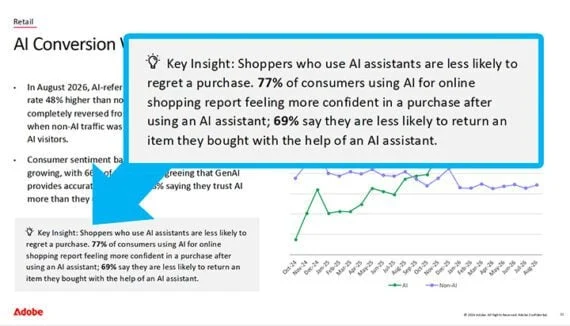
"Then, the agent is able to answer questions for them on the spot to encourage conversion," she stated. "Agents, to me, are things that are provided so that you can really help a customer make a confident purchase decision. My goal is to reduce the buying lead time."
The current average buying process for Rugs Direct spans approximately eight days, while for Lightopia, it extends to around 14 days. The implementation of AI agents aims to significantly shorten these decision-making periods.
"So we really want to make sure to provide the right information and inspiration for customers to be able to buy the right product for them and to keep returns at bay," Gautschi concluded. By empowering customers with readily accessible and accurate information, Rugs Direct and Lightopia aim to foster more informed purchase decisions, ultimately leading to increased customer satisfaction and a reduction in product returns. This strategic use of AI represents a significant step forward in optimizing the customer journey and driving e-commerce success.