

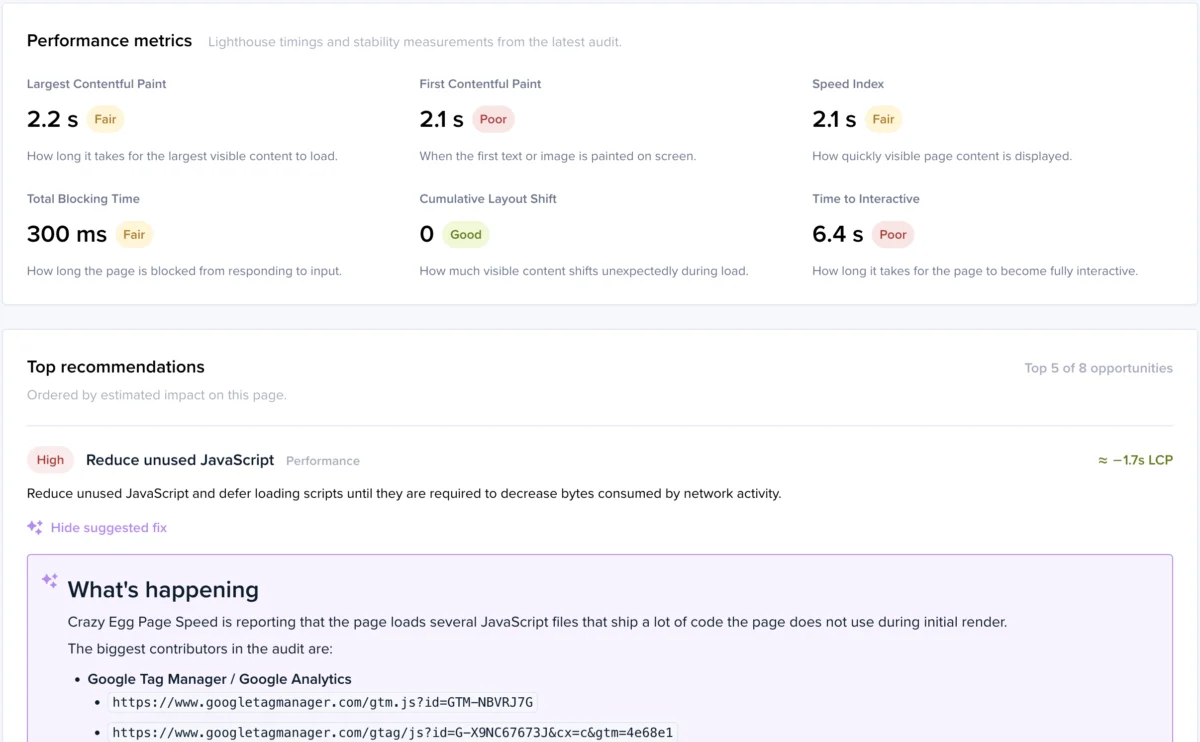
In an era where digital milliseconds translate directly into revenue, Crazy Egg has announced the launch of its Page Speed Audits tool, a diagnostic suite designed to bridge the gap between identifying performance bottlenecks and implementing technical fixes. The tool, which is being offered as a complimentary service, aims to democratize technical Search Engine Optimization (SEO) by providing website owners with daily scans and, more importantly, the specific code required to rectify latency issues.
The release of this feature comes at a critical juncture for web developers and digital marketers. As search engines increasingly prioritize user experience through metrics like Google’s Core Web Vitals, the traditional barrier to optimization has often been the technical expertise required to execute recommendations. Crazy Egg’s new utility attempts to bypass this friction by generating "copy-and-paste" code, allowing non-technical users to apply high-impact changes to their site’s infrastructure in a matter of minutes.
The Technical Mechanics of Page Speed Audits
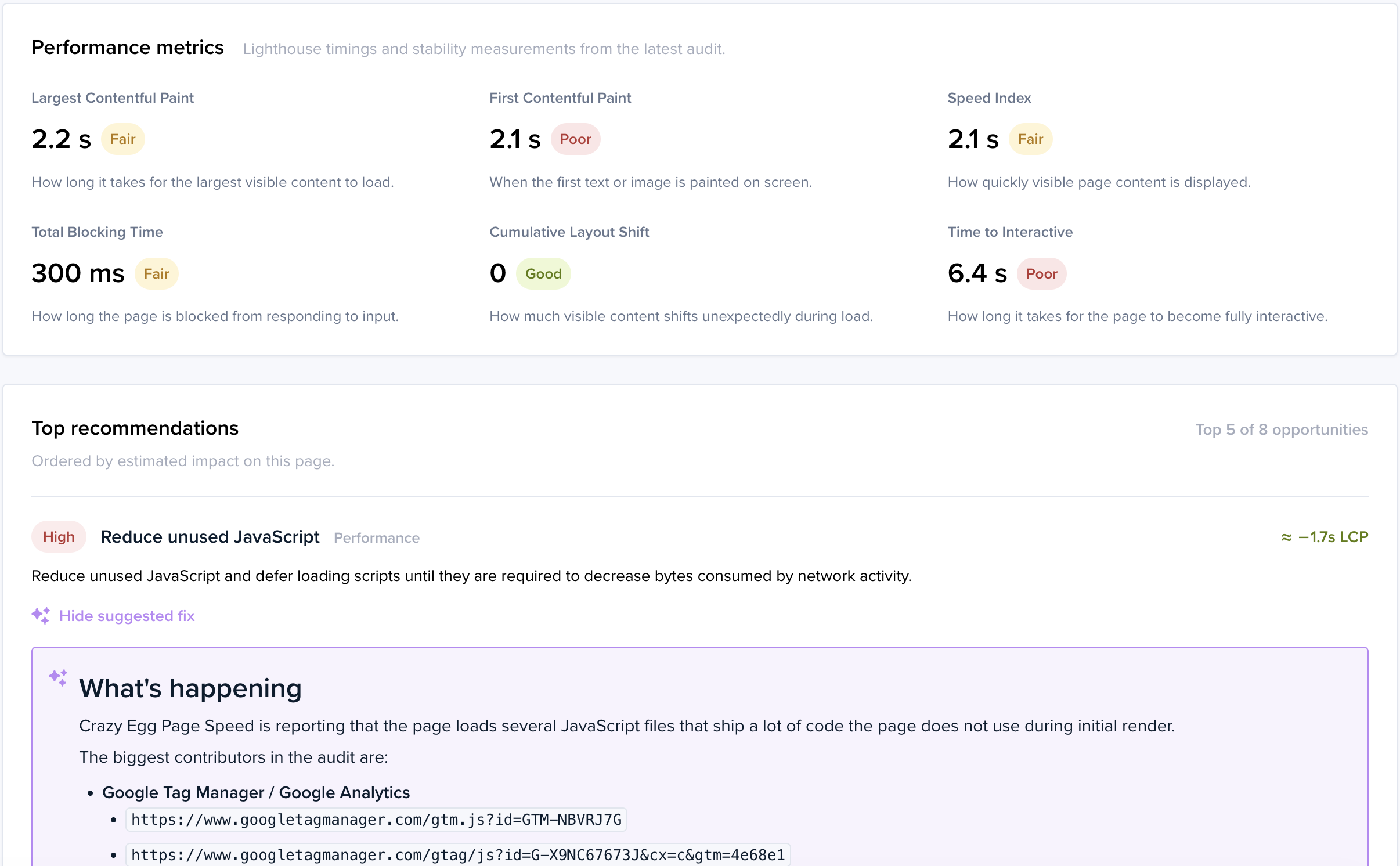
The Page Speed Audits tool functions through an automated daily scanning process. Unlike static reports that offer a snapshot of a website’s health at a single point in time, these audits are designed to track performance fluctuations over a 24-hour cycle. The scanner evaluates every element on a given URL, including high-resolution images, embedded video content, and various scripts or stylesheets that may be contributing to "bloat."
Once the scan is complete, the tool categorizes the findings based on their impact on speed. The primary innovation lies in the delivery of these results. Rather than providing a list of abstract suggestions—such as "leverage browser caching" or "minify JavaScript"—the dashboard presents a list of specific, actionable instructions. For each identified issue, the platform generates the exact snippet of code needed to resolve the problem, tailored to the specific architecture of the scanned page.
Users can access these features by navigating to the "Page Speed" section of the Crazy Egg menu. A notable aspect of the rollout is the lack of a barrier to entry; the service allows for the tracking of unlimited URLs and does not require the installation of the standard Crazy Egg tracking script on the target website to function. This "no-install" requirement significantly lowers the friction for competitive analysis and preliminary site health checks.
The Critical Link Between Load Times and User Retention
The necessity for such a tool is underscored by a wealth of industry data regarding consumer behavior. According to research conducted by Google, as page load time goes from one second to three seconds, the probability of a mobile visitor bouncing increases by 32%. If the load time extends to five seconds, the bounce probability surges to 90%.
In the context of modern e-commerce and lead generation, a delay of even a few hundred milliseconds can result in a measurable drop in conversion rates. For high-traffic sites, this latency translates into thousands, if not millions, of dollars in lost potential revenue. Furthermore, the shift toward mobile-first indexing means that sites optimized solely for desktop speeds are often penalized in search rankings when accessed via mobile devices, which often rely on slower or less stable cellular networks.
By automating the identification of these "speed killers," Crazy Egg is positioning its tool as a fundamental component of Conversion Rate Optimization (CRO). The logic is straightforward: before a user can be converted by a headline, a call-to-action, or a product image, they must first successfully load the page.
The Evolution from SEO to Answer Engine Optimization (AEO)
The launch of the Page Speed Audits tool also reflects a broader shift in the digital landscape from traditional Search Engine Optimization to Answer Engine Optimization (AEO). With the rise of Large Language Models (LLMs) and AI-driven search tools—such as Perplexity, ChatGPT’s SearchGPT, and Google’s AI Overviews—the way information is indexed and retrieved is changing.
Answer engines prioritize websites that are not only authoritative but also technically efficient. AI crawlers require fast access to structured data to synthesize answers for users. A slow-loading site can hinder the ability of these AI agents to scrape and understand content, effectively "hiding" the site from the next generation of search results. By optimizing for speed, site owners are essentially ensuring their content remains accessible to both human visitors and the automated systems that now mediate much of the internet’s traffic.
Chronology of Web Performance Standards
The focus on page speed is not a new phenomenon, but the standards for what constitutes a "fast" site have evolved significantly over the past two decades.
- 2010: Google officially announced that site speed would be a ranking factor for desktop searches.
- 2018: The "Speed Update" made page speed a ranking factor for mobile searches, acknowledging the global shift toward handheld browsing.
- 2020: Google introduced Core Web Vitals (CWV), a set of specific metrics—Largest Contentful Paint (LCP), First Input Delay (FID), and Cumulative Layout Shift (CLS)—designed to measure the "visual stability" and "interactivity" of a page.
- 2024 and Beyond: The focus has shifted toward Interaction to Next Paint (INP), which replaces FID as a more comprehensive measure of responsiveness.
Crazy Egg’s introduction of automated code generation represents the next logical step in this timeline: moving from measurement (knowing there is a problem) to automated remediation (fixing the problem).
Leadership and Strategic Vision
The development of the Page Speed Audits tool has been overseen by Stephen Ngo, the Director of Growth Marketing at Crazy Egg. Ngo, who brings a background in scaling B2B startups such as Nira, Paddle, and ProfitWell, noted the importance of removing technical debt for growing businesses.

Under Ngo’s direction, the company has leaned into a "product-led growth" strategy, offering high-value tools like the Page Speed Audit for free to attract users into the broader Crazy Egg ecosystem. This ecosystem traditionally includes heatmaps, session recordings, and A/B testing tools. By solving the foundational problem of page speed first, Crazy Egg ensures that its other optimization tools are being used on a healthy, high-performing base.
Broader Industry Implications and Analysis
The move to provide free, actionable code for site optimization is likely to put pressure on other SEO tool providers. Traditionally, "technical SEO audits" were the domain of premium software suites or expensive consultants. By automating the most labor-intensive part of the process—the writing of the fix—Crazy Egg is commoditizing a service that was previously a significant expense for small to medium-sized businesses.
Industry analysts suggest that this trend toward "automated SEO" will continue. As the web becomes more complex, with bloated JavaScript frameworks and heavy media files, the average website owner is becoming less capable of managing performance manually. Tools that offer "one-click" or "copy-paste" solutions are becoming the preferred choice for a market that values speed of execution over deep technical understanding.
Furthermore, the impact on the developer-marketer relationship cannot be overlooked. In many organizations, there is a natural friction between marketing teams, who want to add more tracking scripts and high-res visuals, and development teams, who want to maintain site performance. A tool that provides the specific code to optimize these assets can serve as a bridge, allowing marketers to present developers with solutions rather than just problems.
Conclusion: The Future of Web Optimization
As digital competition intensifies, the margin for error regarding website performance has narrowed to near zero. Crazy Egg’s Page Speed Audits provide a necessary utility for maintaining visibility in both traditional and AI-driven search environments. By offering this tool free of charge and focusing on the immediate implementation of fixes, the company is addressing a significant pain point in the digital marketing workflow.
The transition to a faster web is no longer a luxury but a requirement for survival in the modern attention economy. With daily scans and automated code generation, the path to a high-performing website has been significantly shortened, placing the power of technical optimization in the hands of the general user. For businesses looking to improve their SEO, AEO, and overall user experience, the message is clear: speed is the foundation upon which all other digital success is built.







