
 rifanmuazin
The traditional landscape of digital marketing, once defined by static campaigns and infrequent "big bang" launches, is undergoing a fundamental shift toward the principles of continuous improvement and agile experimentation. As market conditions become increasingly volatile and consumer attention spans shorten, the industry is moving away from one-off A/B tests toward a more sophisticated framework known as iterative testing. This methodology, long a staple of software engineering and product development, involves a cyclical process of testing, measuring, and refining marketing assets based on a continuous stream of data-driven insights. Rather than seeking a single, transformative "home run," modern marketing teams are focusing on a series of "base hits"—small, incremental changes that compound over time to deliver superior return on investment (ROI) and more predictable growth.
The Evolution of Marketing Experimentation
Historically, marketing experimentation was a linear process. A team would develop a hypothesis, launch a test, analyze the results, and then conclude the project. However, this approach often fails to account for the dynamic nature of user behavior and the rapid evolution of digital platforms. In contrast, iterative testing operates on a loop. By building each experiment on the evidence gathered from the previous one, marketers can adapt to shifting trends in real-time. This approach addresses what industry experts call the "slow leak" phenomenon—the subtle, daily drainage of marketing budgets caused by underperforming headlines, confusing navigation, or mismatched messaging that goes unnoticed in traditional testing cycles.
The adoption of these principles has been accelerated by the availability of advanced conversion rate optimization (CRO) tools. For instance, platforms such as Unbounce have introduced features like "Smart Traffic," which utilizes machine learning to begin optimizing visitor paths after as few as 50 visits. This represents a significant departure from older models that required thousands of data points and weeks of waiting to achieve statistical significance.
Data-Driven Insights and the Performance Gap
The necessity of an iterative approach is underscored by recent industry data. According to the 2024 Conversion Benchmark Report, there are stark disparities between general marketing assumptions and actual user performance. One of the most significant findings involves the complexity of language used on landing pages. The report indicates that pages written at a 5th-to-7th-grade reading level convert at a rate of 11.1%, which is more than double the conversion rate of pages utilizing professional-level or academic writing. Furthermore, a negative correlation of -24.3% exists between word complexity and conversion rates, suggesting that clarity and simplicity are paramount in the digital age.

Device-specific behavior also highlights the need for constant refinement. While approximately 83% of landing page visits currently occur on mobile devices, desktop sessions continue to convert at an average rate that is 8% higher. This gap suggests that many mobile experiences remain unoptimized for the specific needs of on-the-go users. Iterative testing allows teams to probe these discrepancies, testing device-specific hypotheses to close the performance gap rather than applying a "one-size-fits-all" strategy.
A Strategic Framework for Iterative Testing
To successfully implement an iterative testing program, marketing organizations must move beyond random experimentation and adopt a structured, six-step process.
Step 1: Hypothesis Formulation
The foundation of any successful iteration is a laser-focused hypothesis. Broad goals, such as "improving the website," are replaced with specific, measurable statements. A high-quality hypothesis follows a predictable structure: "By changing [Variable X] to [Variable Y], we expect [Metric Z] to increase because of [Reasoning]." For example, a team might hypothesize that changing a generic "Submit" button to "Get My Free Quote" will increase click-through rates by 10% because it more clearly defines the value proposition.
Step 2: Prioritization via the Impact-Effort Matrix
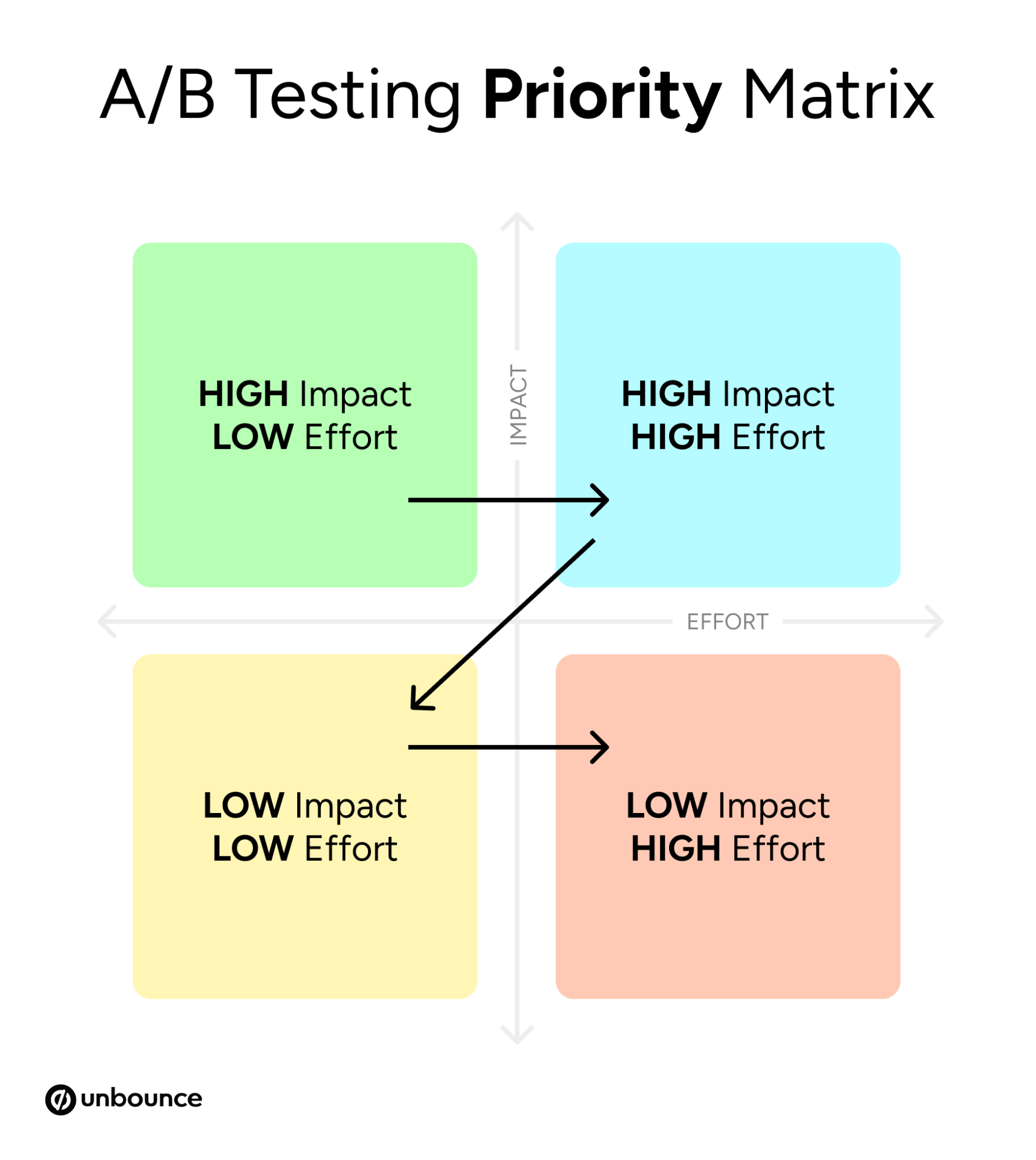
Marketing resources are rarely infinite. Therefore, teams must prioritize tests based on their potential impact and the technical effort required to implement them. Using a 2×2 matrix, "Quick Wins"—changes that are low effort but offer high potential impact—are prioritized first. This builds organizational momentum and provides immediate data to inform more complex "Big Bets" later in the cycle.
Step 3: Development of Minimal Testable Variations
Iterative design discourages over-complication. Instead of redesigning an entire page, teams should isolate a single element—such as a headline, a hero image, or a form length. This isolation is critical; if too many variables are changed at once, it becomes impossible to determine which specific change caused the shift in performance.

Step 4: Data Collection and Statistical Validation
The integrity of an iterative program depends on statistical significance. This metric ensures that the results of a test are not merely the result of random chance. Marketers are advised to maintain tests until they reach a confidence level of at least 95%, while also ensuring that the sample size is large enough to represent the broader audience. Pulling the plug on a test too early is a common pitfall that leads to "false positives" and misguided strategy.
Step 5: Analysis and Extraction of Actionable Insights
Once a test concludes, the focus shifts from "who won" to "why they won." If a simpler headline outperformed a clever one, the insight is not just about that specific page; it is a broader realization that the target audience values clarity over brand personality. These insights are then documented to inform the next round of testing.
Step 6: Scaling and Successive Iteration
Successful learnings are not just kept in a vacuum; they are scaled across other channels. A winning headline on a landing page might be tested as an email subject line or as ad copy on social media. Conversely, a "failed" test is viewed as a valuable data point that narrows the search for what does work, preventing future wasted spend on ineffective tactics.
Organizational Collaboration and Broader Implications
The shift toward iterative testing requires a cultural change within an organization. It necessitates the breaking down of silos between marketing, sales, and customer support. Customer support teams, for example, often possess direct knowledge of user frustrations and frequently asked questions. By integrating this qualitative feedback into the testing backlog, marketing teams can create experiments that solve real-world user problems rather than relying solely on internal hunches.
From a broader economic perspective, iterative testing is becoming a survival mechanism for SaaS and e-commerce companies. In an era of rising customer acquisition costs (CAC), the ability to incrementally improve conversion rates can be the difference between a profitable campaign and a net loss. By reducing the time it takes to identify and fix "leaky" funnels, companies can scale their operations more efficiently.
Furthermore, the role of Artificial Intelligence (AI) in this process cannot be ignored. AI-driven optimization tools are now capable of analyzing vast datasets to suggest hypotheses that human marketers might miss. As these tools become more integrated into the iterative workflow, the speed of the feedback loop is expected to accelerate even further, moving from weekly cycles to near-instantaneous adjustments based on live user data.
Conclusion: Progress Over Perfection
The transition to an iterative testing model marks the end of the "set it and forget it" era of digital marketing. The most successful brands in 2025 and beyond will be those that view their marketing assets as living documents, subject to constant scrutiny and refinement. By prioritizing speed, simplicity, and evidence-based decision-making, marketing teams can move beyond the unpredictability of "gut feelings" and build a sustainable engine for growth.
In summary, iterative testing is not merely a technical process; it is a strategic commitment to progress over perfection. By embracing a cycle of continuous learning, organizations can ensure that their marketing efforts remain in sync with the ever-evolving needs of their audience, ultimately driving higher conversions and long-term brand loyalty.








