

The digital marketing sector is witnessing a significant shift as Instapage, a long-standing leader in landing page technology, announces the comprehensive integration of artificial intelligence across its entire ecosystem. This move marks the evolution of the company from a specialized landing page builder into a holistic, AI-powered marketing platform designed to streamline the transition from lead generation to conversion. By consolidating page generation, email automation, and experimentation into a single AI-driven workflow, the platform aims to address the persistent inefficiencies faced by marketing teams operating in an increasingly complex and budget-conscious environment.
Since its inception in 2012, Instapage has focused on the technical nuances of Conversion Rate Optimization (CRO). The company’s trajectory has moved from offering a top-rated drag-and-drop builder to developing a multifaceted suite that encompasses personalization, experimentation, and advanced analytics. The latest strategic pivot reflects a broader industry trend where standalone tools are being replaced by integrated environments that leverage generative AI to reduce the "friction of creation." According to industry data, the average marketing team utilizes over a dozen different SaaS tools, often leading to data silos and manual handoff errors. Instapage’s new direction seeks to eliminate this "stitching" of tools by embedding AI into every stage of the marketing funnel.
A Chronological Evolution of Landing Page Technology
To understand the impact of Instapage’s AI transition, it is necessary to examine the timeline of the company’s development alongside the broader MarTech landscape. In 2012, the primary challenge for marketers was the "developer bottleneck," where creating a high-converting landing page required significant coding knowledge or lengthy turnarounds from technical departments. Instapage addressed this by democratizing design through its visual builder.
By 2018, the focus shifted from mere creation to optimization. The industry saw a surge in demand for A/B testing and heatmapping. Instapage responded by expanding its CRO suite, allowing users to run experiments without leaving the platform. However, the emergence of generative AI in the early 2020s created a new paradigm. Marketers were no longer just looking for easier ways to move elements on a page; they were looking for ways to generate the content and structure itself.
Entering 2026, the landscape has been redefined by lean operations. Organizations are now tasked with maintaining high output with smaller headcounts and tighter budgets. The release of Instapage’s AI page generation, AI email generation, and AI Collections represents the culmination of a multi-year effort to automate the most time-consuming aspects of digital marketing: copywriting, layout design, and lead follow-up.
Solving the "Blank Page" Problem Through AI Page Generation
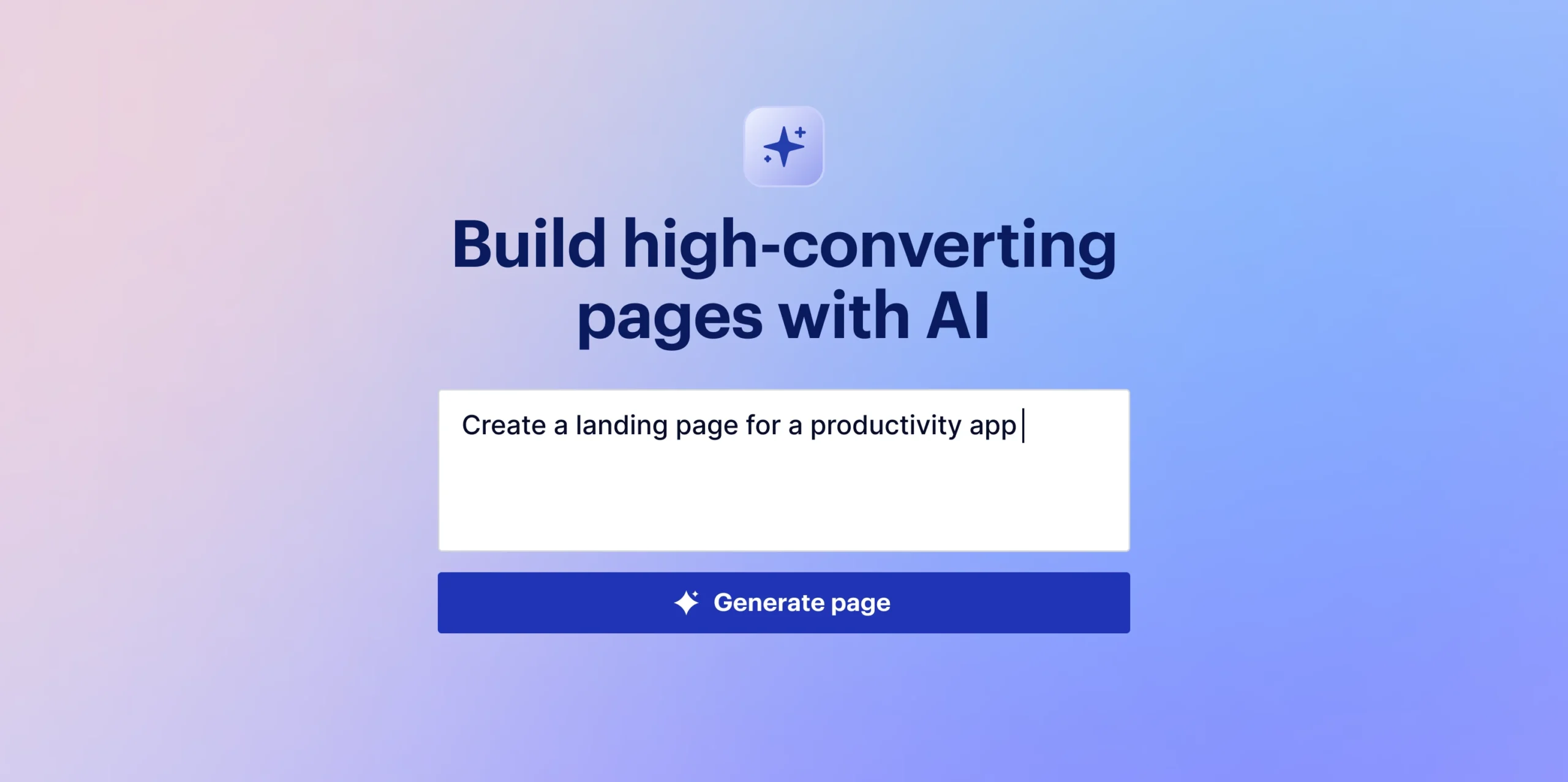
One of the primary psychological and operational barriers in marketing is the "blank page syndrome." Even with a clear value proposition, the transition from an idea to a functional, aesthetically pleasing, and conversion-optimized layout can take days or weeks. Instapage’s new AI page generation tool allows users to input a description of their goals, target audience, and brand voice, which the AI then uses to construct a complete page in seconds.
Unlike many standalone AI generators that produce static or difficult-to-edit outputs, Instapage has integrated this feature with its "pixel-perfect" drag-and-drop builder. This hybrid approach addresses a common critique of AI in design: the lack of granular control. In many competing systems, if a user wishes to change a specific section or move an element, they are often forced to regenerate the entire page, consuming additional tokens and time. Instapage’s architecture allows the AI to provide the foundation, while the human marketer retains total creative control to refine details manually. This synergy between automated generation and manual refinement is designed to accelerate the workflow without sacrificing brand integrity.

Integrated AI Email Systems and Lead Continuity
The expansion into AI-powered email represents a strategic move to capture more of the post-click experience. Traditionally, a lead generated on a landing page would be exported to a third-party Email Service Provider (ESP) or a CRM. This separation often results in a "leaky bucket," where follow-up responses are delayed or lack the context of the specific page that captured the lead.
The Instapage AI email generator allows teams to write tailored messaging for specific interactions directly within the platform. By selecting the goal, audience, and tone, marketers can deploy automated responses that are contextually aligned with the landing page content. This integration ensures that the "conversation" with the lead remains consistent. Data from recent marketing performance reports suggests that leads contacted within the first five minutes are nearly 100 times more likely to be qualified than those contacted after 30 minutes. By unifying the lead capture and follow-up tools, Instapage aims to help businesses hit these critical windows of opportunity through automation.
Supporting Data and Market Analysis
The move toward an all-in-one AI platform is supported by several key market indicators:
- Efficiency Gains: Recent studies in the SaaS sector indicate that generative AI can reduce the time spent on content creation by up to 60%. For marketing teams, this translates to a significantly higher volume of active campaigns without a corresponding increase in labor costs.
- The "Lean Team" Trend: As of 2024 and 2025, venture capital and corporate spending have shifted toward profitability over growth at all costs. This has forced marketing departments to become "leaner." Instapage’s messaging specifically targets this demographic, offering a way to scale performance without adding headcount.
- Conversion Statistics: Integrated platforms typically see higher conversion rates due to the reduction in technical friction. When the landing page, the experiment (A/B test), and the follow-up email are all managed in one ecosystem, the data feedback loop is faster, allowing for real-time optimization.
Broader Industry Implications and Official Perspective
Industry analysts suggest that the "unbundling" of marketing tools that defined the 2010s is currently reversing into a "rebundling" phase, driven by AI. The ability of a single platform to handle copy, design, and automation creates a powerful competitive advantage against specialized tools that require complex integrations like Zapier or custom APIs.
While official statements from Instapage emphasize the "end-to-end" nature of the new platform, the company also acknowledges the transitional nature of these technologies. Certain AI features are currently in beta, reflecting a cautious but steady rollout strategy. This allows the platform to gather user data and refine the AI’s output before a total global release. The company has positioned this update not just as a feature parity move with other AI tools, but as a fundamental redesign of how marketing work is performed.
The implications for the workforce are also notable. As AI takes over the "heavy lifting" of layout and initial drafting, the role of the marketer is shifting toward that of a "strategist and editor." Rather than spending hours in a builder, the modern marketer will spend more time analyzing performance data and refining the prompts that drive the AI, effectively acting as a director of an automated production line.
Conclusion and Future Outlook
Instapage’s transformation into an AI-powered marketing platform marks a definitive end to the era of fragmented landing page builders. By providing a solution that covers the entire lifecycle of a digital campaign—from the first prompt-driven design to the final automated follow-up—the company is setting a new standard for what constitutes a "complete" marketing stack.
As these tools move out of beta and become standard across the industry, the barrier to entry for high-level digital marketing will continue to lower. Small and medium-sized businesses, which previously could not afford the specialized design and copywriting teams required for high-conversion campaigns, now have access to the same technological capabilities as enterprise-level organizations. The success of this transition will ultimately be measured by the performance data of its users: whether the speed of AI-driven creation translates into the sustainable revenue growth that Instapage has promised since its founding in 2012. For now, the platform stands as a prominent example of the "AI-first" future of the MarTech industry.







