In a significant advancement for digital marketers and small businesses, AWeber, a long-standing player in email marketing services, has officially launched its AI Signup Form Builder. This new tool represents a pivotal shift away from the traditional, often time-consuming process of adapting pre-designed templates, instead offering a generative approach that custom-builds forms tailored to specific business needs from the outset. Announced on June 3, 2026, the innovation aims to drastically reduce the effort and time spent on creating effective lead capture mechanisms, empowering users to craft unique, brand-aligned forms with unprecedented speed and precision.
The Evolution of Online Form Building: From Manual Code to Intelligent Automation
The journey of online form creation has seen several transformative stages. In the early days of the internet, building a signup form was a meticulous, code-intensive endeavor, requiring proficiency in HTML and CSS. Developers painstakingly crafted each field, button, and layout element. The advent of WYSIWYG (What You See Is What You Get) editors and drag-and-drop builders marked the first major democratization of form creation, allowing non-coders to visually assemble forms. This was followed by the widespread adoption of template galleries, offering a starting point for various industries and purposes. While these templates provided convenience, they often came with a hidden cost: the extensive customization required to make a generic design truly reflect a unique brand identity.
Traditional templates, by their very nature, are designed for broad appeal. This universality, while initially appearing to be a benefit, frequently becomes their greatest limitation. A template might offer a basic structure, a default headline like "Subscribe to our newsletter," and a standard set of fields. However, for a business offering a niche "five-day email course on dog training," this generic starting point is fundamentally misaligned. The subsequent hours spent adjusting fields, rewriting headlines, swapping color palettes, and rearranging layouts transform what was intended as a shortcut into a laborious process of working backward from someone else’s design. This "template gap" – the chasm between a generic blueprint and a brand-specific, conversion-optimized asset – demands significant investment in copywriting, design decisions, and field logic. By the time a template is sufficiently customized, the time expenditure often rivals, or even exceeds, the effort of starting from scratch with a clear, specific vision. Moreover, templates inherently anchor creative thinking, subtly steering users to adapt to an existing structure rather than innovating from the ground up to serve their unique audience and offer.
A New Paradigm: AWeber’s AI Signup Form Builder in Detail
AWeber’s AI Signup Form Builder introduces a fundamentally different approach, prioritizing the user’s specific requirements over a pre-defined gallery. The system operates on a generative principle, creating forms dynamically based on user input, rather than requiring selection and modification of existing designs. This capability is delivered through three primary interaction methods:
-
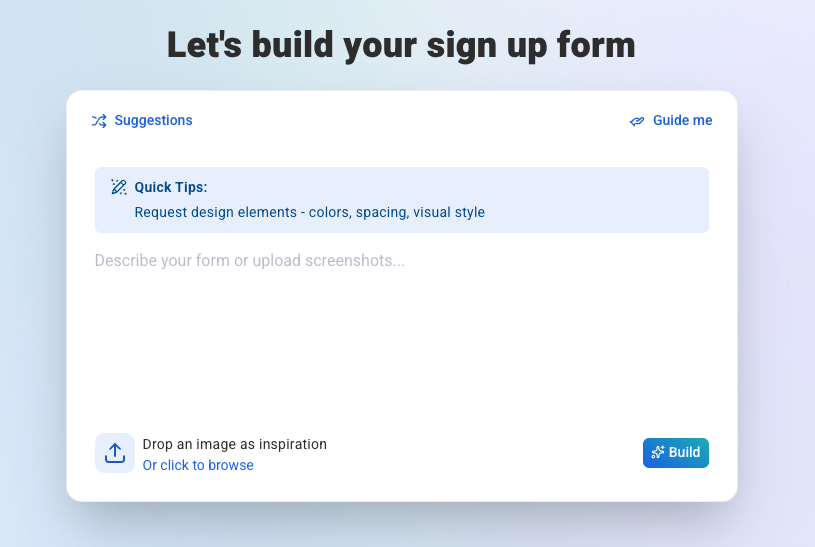
Describe It: Users can articulate their needs in natural language, much like conversing with a human designer. A simple prompt such as "A simple one-field form for a free guide on meal planning for busy parents" triggers the AI to generate a form precisely matched to that description. This includes a relevant, compelling headline, an appropriate number of fields, and copy that aligns seamlessly with the specified offer. The underlying AI leverages advanced natural language processing (NLP) to interpret user intent, translating textual descriptions into visual and functional form elements. This method dramatically accelerates the initial build phase, bypassing generic placeholders entirely.

-
Upload a Screenshot: Recognizing that visual inspiration often sparks creative ideas, AWeber’s AI builder allows users to upload screenshots of any form they admire from elsewhere online. The AI then intelligently analyzes the uploaded image, extracting key design cues such as layout, typography, color schemes, and structural elements. It then uses these visual insights as inspiration to produce a new form, customized to the user’s brand and specific content requirements. This feature moves beyond mere imitation, enabling users to harness the aesthetic appeal of successful designs while ensuring the output remains authentically their own. It serves as a powerful creative shortcut, allowing users to leverage external design trends without the manual effort of replicating them.
-
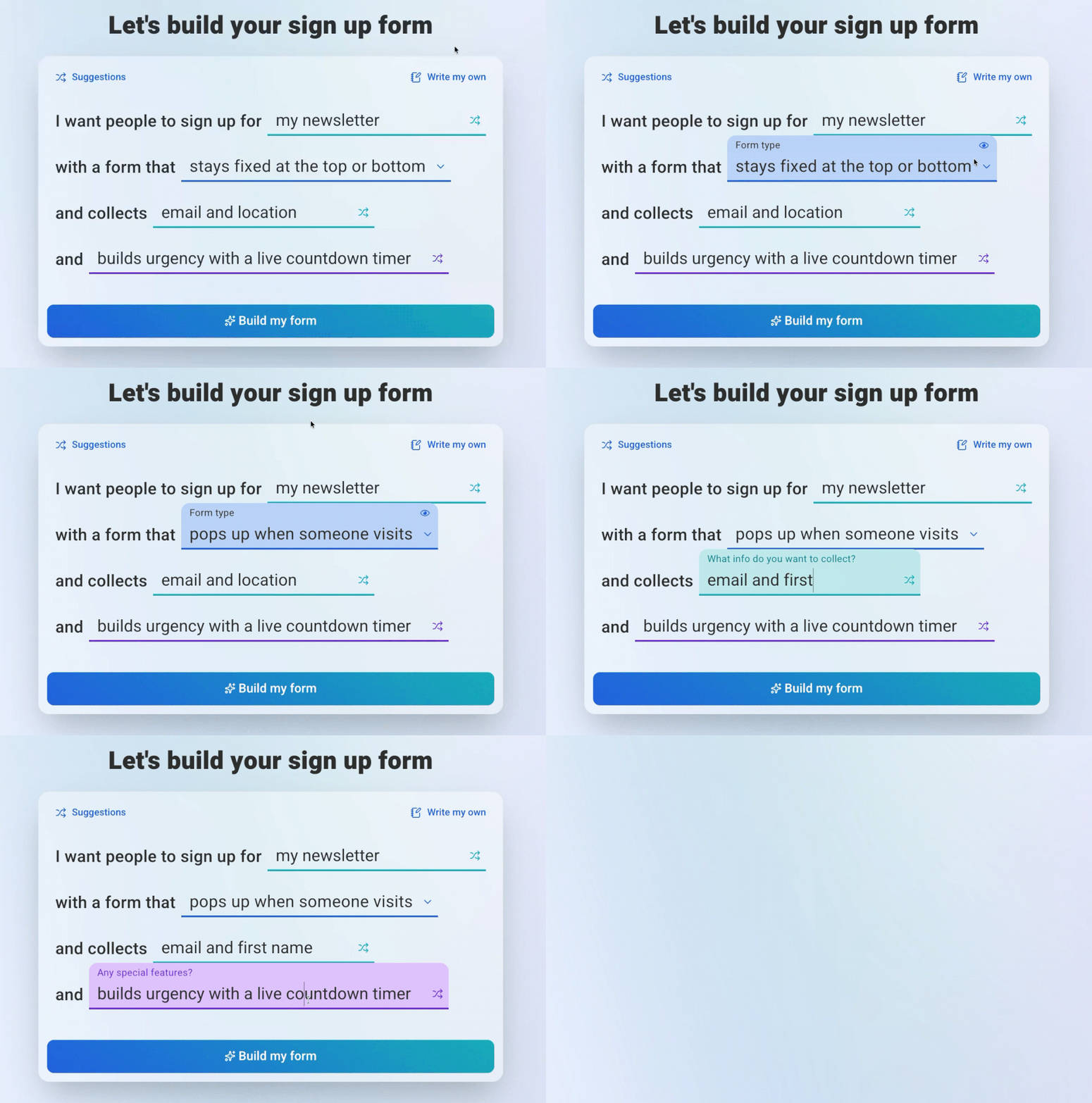
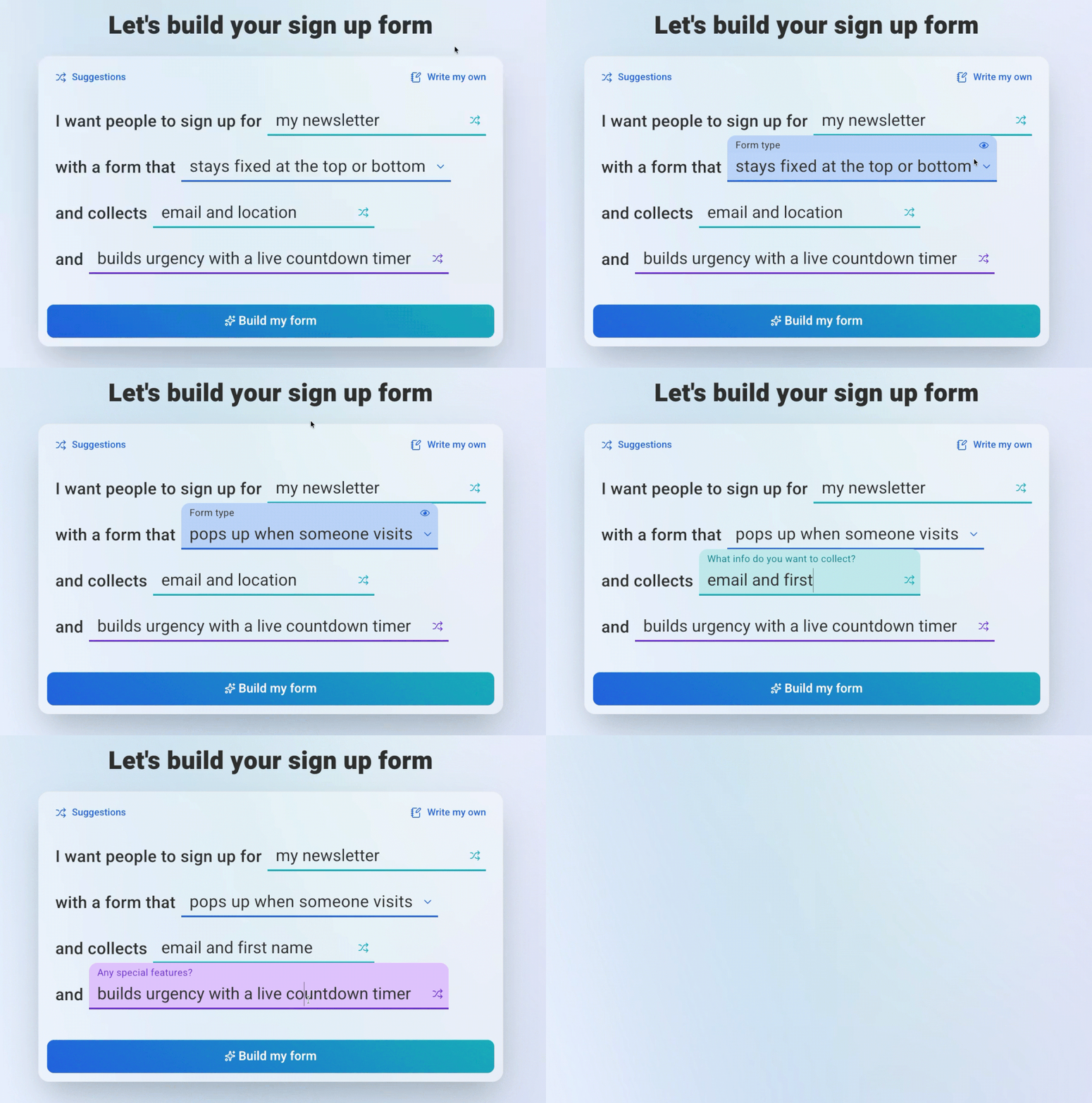
Use Guided Prompts: For users who prefer a more structured approach, the builder offers a series of guided prompts. By answering a few targeted questions about their audience, the nature of their offer, and their overarching goals, the AI meticulously assembles a form. This method ensures that critical strategic considerations are incorporated from the outset, leading to highly specific and optimized outputs. The structured input minimizes ambiguity, guaranteeing that the generated form aligns closely with the user’s marketing objectives.
Following the initial generation, the refinement process also benefits from AI integration. Users can continue to interact with the builder conversationally, issuing commands like "shorten the headline," "add a checkbox for GDPR consent," or "change the button text to ‘Get My Guide Now’." The form updates in real-time based on these plain language instructions, eliminating the need to navigate complex settings panels or field editors. This iterative, conversational editing capability significantly enhances user experience and accelerates the finalization of the form.
The Unmatched Efficiency: A Comparison with Traditional Builders
The contrast between AWeber’s AI Form Builder and conventional drag-and-drop or template-based builders is stark, particularly in terms of speed and quality. Traditional methods often involve a lengthy iterative process of selecting, modifying, testing, and refining. Each step is manual, consuming valuable time that could otherwise be dedicated to core business activities. Studies consistently show that small business owners dedicate a substantial portion of their week to marketing tasks, with form creation often being a bottleneck. An AI-powered solution dramatically compresses this timeline.
For instance, consider a fitness coach requiring a signup form for a new online course versus a B2B SaaS company seeking leads for a software demo. A traditional template gallery would present both with a similar set of generic starting points. The fitness coach would then have to re-craft every piece of copy, select appropriate imagery, and adjust fields to resonate with their audience’s aspirations for health and wellness. The SaaS company would likewise need to overhaul the template to reflect their professional, solution-oriented brand. AWeber’s AI builder, conversely, starts with their unique descriptions, generating distinct forms with headlines, field counts, and copy that inherently match their respective offers and brand voices from the very first iteration. This eliminates the "fixed set of options" dilemma inherent in template galleries, where users often find themselves compromising if the ideal form doesn’t already exist.
Supporting Data and Industry Context: The Growing Demand for Personalization and Efficiency
The launch of AWeber’s AI Signup Form Builder arrives at a time when personalization and efficiency are paramount in digital marketing. Research indicates that personalized experiences can significantly boost conversion rates. According to Epsilon, 80% of consumers are more likely to make a purchase from a brand that provides personalized experiences. In the context of signup forms, this translates to forms that speak directly to the visitor’s needs and interests, rather than presenting a generic plea for subscription. Highly optimized, personalized forms have been shown to increase conversion rates by as much as 200-300% compared to generic alternatives.
Furthermore, the rise of Artificial Intelligence across various business functions underscores a broader industry trend towards intelligent automation. From AI-powered content generation to predictive analytics, businesses are increasingly leveraging AI to streamline operations, enhance customer engagement, and derive deeper insights. The email marketing sector, in particular, has been quick to adopt AI for tasks like email subject line optimization, audience segmentation, and send-time optimization. Integrating AI into the fundamental process of lead capture via signup forms is a logical and necessary progression. It democratizes sophisticated design and copywriting capabilities, making them accessible to small businesses and individual entrepreneurs who may lack the resources for dedicated design teams or professional copywriters.
When Templates Retain Value: Inspiration, Not Imitation
While the AI builder marks a significant leap forward, it doesn’t render templates entirely obsolete. Their utility shifts from direct application to serving as a source of inspiration. If a user encounters a form online that captivates their attention—perhaps due to its innovative layout, compelling call-to-action (CTA), or efficient field structure—that design holds inherent value. The screenshot feature of AWeber’s AI Signup Form Builder specifically capitalizes on this. Users can capture an image of an inspiring form, upload it, and then describe their own business and offer. The AI intelligently extracts the structural and aesthetic cues from the inspirational design and applies them to a brand-new form, uniquely tailored to the user’s specifications. This approach allows for "inspiration without imitation," providing a creative shortcut that avoids brand mismatch and ensures originality. It transforms templates from rigid constraints into flexible springboards for innovation.
Broader Impact and Implications for the Digital Marketing Landscape
AWeber’s introduction of an AI Signup Form Builder has several significant implications for the broader digital marketing ecosystem:
-
Democratization of High-Quality Design: Small businesses and individual marketers, often constrained by budget and time, can now create highly professional and effective signup forms without needing extensive design skills or hiring external agencies. This levels the playing field, allowing smaller entities to compete more effectively with larger organizations.
-
Increased Efficiency and Productivity: By automating the initial design and copywriting phases, businesses can significantly reduce the time spent on form creation, redirecting valuable resources to other critical marketing activities such as content creation, audience engagement, or analytics. This translates directly into improved operational efficiency and potentially higher ROI on marketing efforts.
-
Enhanced Personalization and Conversion Rates: The ability to generate forms precisely tailored to specific offers, audiences, and brand identities will lead to more engaging and relevant user experiences. This personalization is a key driver of higher conversion rates, ultimately leading to more leads and subscribers for businesses.
-
Competitive Pressure and Innovation: The move by AWeber is likely to spur further innovation within the email marketing and form builder industries. Competitors will face pressure to integrate similar AI-powered functionalities, accelerating the adoption of generative AI across various marketing technology platforms. This could lead to a new generation of even more sophisticated and intelligent marketing tools.
-
Shifting Skill Requirements: As AI handles more of the tactical execution, marketers may find themselves focusing more on strategic thinking, prompt engineering, and refining AI outputs. The emphasis could shift from manual design to effectively communicating needs to AI systems and analyzing their performance.
-
Future of AI in Marketing: This development underscores the growing role of AI in transforming traditionally manual or template-driven marketing tasks into automated, intelligent processes. It paves the way for future advancements, such as predictive AI that suggests optimal form layouts based on user behavior data, or dynamic forms that adapt in real-time to individual visitor profiles.
Conclusion: Building the Future of Digital Engagement
The launch of AWeber’s AI Signup Form Builder on June 3, 2026, marks a definitive turning point in the creation of digital lead capture mechanisms. By moving beyond the limitations of generic templates and embracing generative AI, AWeber is empowering businesses to craft highly personalized, brand-aligned forms with unprecedented speed and precision. The capability to describe a form in plain language, draw inspiration from existing designs, or utilize guided prompts, followed by conversational refinement, streamlines a process that has historically been a significant time sink.
This innovation is not merely about creating forms faster; it is about enabling deeper personalization, improving conversion rates, and freeing marketers from repetitive tasks to focus on strategic growth. It exemplifies how artificial intelligence can democratize sophisticated design and copywriting, making powerful marketing tools accessible to all. The form is ready when you are, ensuring that the moment a subscriber signs up, they receive a perfectly timed welcome email, initiating a seamless customer journey. Businesses are encouraged to explore this new frontier in digital engagement and build their first AI-generated signup form, transforming their approach to subscriber acquisition.