The Bill and Melinda Gates Foundation recently unveiled its inaugural “Goalkeepers” report, a comprehensive data-driven study designed to track progress toward the United Nations Sustainable Development Goals (SDGs). Titled “Goalkeepers 2017: The Stories Behind the Data,” the report serves as both a diagnostic tool and a call to action for the international community. By analyzing specific datasets and highlighting successful case studies, the foundation aims to identify urgent global problems, showcase promising solutions, and facilitate the spread of best practices in the ongoing battle against extreme poverty and preventable disease.
The 2017 report represents a pivotal moment in global health philanthropy, shifting the focus from abstract aspirations to measurable outcomes. The document is structured around 18 key indicators—ranging from child mortality and HIV prevalence to financial inclusion and agricultural productivity—providing a granular view of where the world stands in its commitment to end poverty by 2030. Among the most striking findings in the report is the progress made in maternal health, specifically through the lens of Ethiopia’s healthcare transformation.
The Evolution of Global Health Initiatives: A Chronology of Progress
The Goalkeepers report does not exist in a vacuum; it is the latest iteration of a decades-long global effort to standardize and track human development. The trajectory began in earnest in 1990, the baseline year for many current health metrics. At that time, global maternal mortality rates were staggeringly high, and the infrastructure for tracking these deaths was often rudimentary.
In 2000, the United Nations established the Millennium Development Goals (MDGs), a set of eight objectives intended to be met by 2015. MDG 5 specifically targeted a 75% reduction in the maternal mortality ratio. While the world fell short of that specific target, the period between 1990 and 2015 saw a 44% decline in maternal deaths globally. Following the conclusion of the MDG era, the international community adopted the Sustainable Development Goals (SDGs) in late 2015. The Goalkeepers report was launched in 2017 to ensure that the momentum gained during the MDG era did not stall, providing an annual “report card” to hold governments and organizations accountable for the 2030 targets.
Case Study: Ethiopia’s Strategic Intervention in Maternal Mortality
One of the central narratives of the Goalkeepers 2017 report is the dramatic reduction of maternal mortality in Ethiopia. Bill and Melinda Gates have frequently described maternal mortality as one of the most devastating forces a community can face, noting that the death of a mother puts children in immediate danger and destabilizes the family unit.
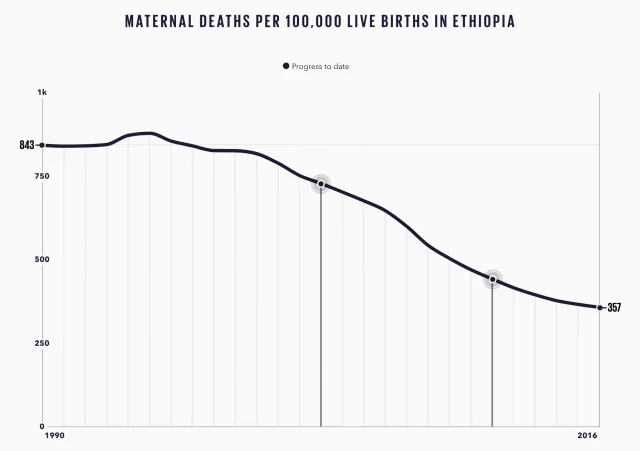
According to data from UNICEF and the World Health Organization (WHO), Ethiopia’s maternal mortality ratio dropped from 843 deaths per 100,000 live births in 1990 to 357 per 100,000 in 2015. This represents a significant achievement for a nation with limited resources. The report attributes this success to a focused, systemic approach. Ethiopia invested heavily in its Health Extension Program, deploying more than 38,000 health extension workers—mostly women—to rural areas. These workers provided essential prenatal care, encouraged facility-based deliveries, and educated communities on reproductive health.
This localized approach addressed the “three delays” that contribute to maternal death: delay in seeking care, delay in reaching a healthcare facility, and delay in receiving adequate treatment upon arrival. By placing trained professionals within walking distance of rural homes, Ethiopia effectively shortened the distance between at-risk mothers and life-saving interventions.
Supporting Data: The Global Landscape of Maternal Health
While Ethiopia serves as a beacon of progress, the UNICEF maternal mortality dataset used in the Goalkeepers analysis reveals a complex and often somber global picture. In 2015, UNICEF recorded approximately 302,530 maternal deaths worldwide due to complications from pregnancy or childbirth. This averages out to 168.7 deaths per 100,000 live births globally.
The data highlights a profound disparity between regions. In high-income countries, the maternal mortality ratio is approximately 12 per 100,000 live births. In contrast, Sub-Saharan Africa bears the heaviest burden, accounting for roughly two-thirds of all maternal deaths globally. In some regions, the lifetime risk of maternal death is as high as 1 in 36, compared to 1 in 4,900 in developed nations.
The primary causes of these deaths—severe bleeding (hemorrhage), infections (sepsis), high blood pressure during pregnancy (pre-eclampsia and eclampsia), and complications from delivery—are largely preventable or treatable with modern medical interventions. The UNICEF data underscores that the challenge is not a lack of medical knowledge, but rather a lack of access to that knowledge and the infrastructure required to implement it.
The Role of Information Design and Data Transparency
A distinguishing feature of the Goalkeepers 2017 report is its emphasis on information design. The Bill and Melinda Gates Foundation utilized a multi-medium approach—integrating text, high-resolution imagery, video testimonials, and interactive charts—to make the data more accessible to policymakers and the general public.
Experts in data visualization note that the “spotless” design of the report is intentional. By making the data engaging, the foundation ensures that the information is not only consumed by academics but also by influencers and voters who can pressure governments for change. The use of horizontal bar charts and trend lines allows users to compare national progress against global averages, creating a transparent environment where successful nations can be emulated and lagging nations can be identified for further support.
The integration of UNICEF’s publicly available datasets further enhances the report’s credibility. By utilizing figures that are vetted by inter-agency groups, including the WHO and the World Bank, the Goalkeepers report avoids the appearance of bias and aligns itself with the highest standards of international statistical reporting.
Official Responses and Strategic Implications
The launch of the report has drawn reactions from global health leaders and international bodies. In statements accompanying the release, Bill Gates emphasized that while the world has made “extraordinary” progress, that progress is not inevitable. He warned that shifts in political priorities or reductions in foreign aid could jeopardize the gains made over the last two decades.
Melinda Gates highlighted the gendered aspect of the data, noting that maternal mortality is a primary indicator of the overall health of a society. “When a mother dies, the ripple effects are catastrophic,” she stated, referring to the increased likelihood of infant mortality and the loss of economic productivity within the community.
From a policy perspective, the implications of the Goalkeepers report are clear: investment in primary healthcare infrastructure is the most effective way to combat maternal mortality. The Ethiopian model suggests that training and deploying community-based health workers is more cost-effective and impactful than building large, centralized hospitals that remain inaccessible to rural populations.
Broader Impact: The Path Toward 2030
The Goalkeepers 2017 report serves as a foundational document for the SDG era. It establishes a baseline for future years and identifies the “accelerators”—key interventions that have the potential to speed up progress across multiple goals. For maternal health, these accelerators include family planning services, improved nutrition for adolescent girls, and the professionalization of midwifery.
As the international community moves toward the 2030 deadline for the Sustainable Development Goals, the focus remains on closing the gap between the highest and lowest-performing nations. The report suggests that if every country could match the rate of improvement seen in nations like Ethiopia, the global maternal mortality ratio could drop to well below the SDG target of 70 deaths per 100,000 live births.
The conclusion of the 2017 analysis is one of cautious optimism. The data proves that extreme poverty and maternal death are not intractable problems; they are challenges that respond to targeted investment, political will, and rigorous tracking. By turning data into stories and stories into action, the Goalkeepers initiative aims to ensure that the progress of the past quarter-century is not just maintained, but accelerated for the generations to come. Through the continued use of platforms like UNICEF’s data portal and the foundation’s own reporting tools, the world is now better equipped than ever to diagnose its most urgent problems and implement the solutions necessary to solve them.