The landscape of artificial intelligence has undergone a fundamental transformation throughout 2025 and early 2026, shifting away from passive large language models toward autonomous agents capable of independent execution. While the research community spent the previous years debating whether a model could effectively use a single tool, the current frontier is defined by a more rigorous set of requirements: long-horizon reliability, survival in dynamic digital environments, self-verification, and the ability to recover from unforeseen failures without human intervention. As organizations move from experimental pilots to full-scale agentic deployments, the criteria for success have moved beyond simple response accuracy to encompass the entire lifecycle of a professional workflow.
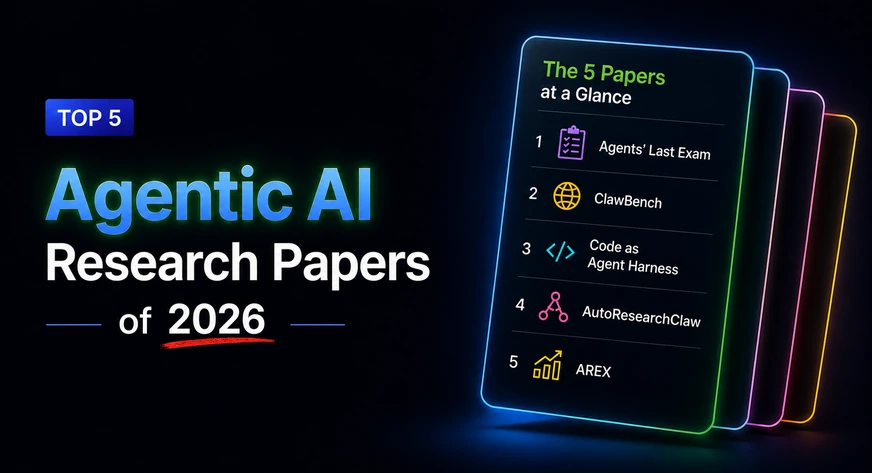
The following analysis examines five seminal research papers that characterize this shift. These works collectively redefine how agents are evaluated, how they interact with the live web, and how they utilize code as a fundamental infrastructure for reasoning. By moving past the "chatbot" paradigm, these papers provide the blueprint for the next generation of autonomous systems designed to perform economically valuable labor across various industries.
The Shift Toward Professional Workflow Evaluation: Agents’ Last Exam
The most significant bottleneck in the adoption of agentic AI has historically been the lack of benchmarks that reflect real-world professional requirements. Traditional benchmarks like MMLU or HumanEval measured isolated knowledge or code snippets but failed to capture the complexity of multi-step, multi-day projects. "Agents’ Last Exam" (ALE) represents a definitive break from these academic metrics, introducing a framework specifically designed to test whether an agent can finish a job rather than just answer a question.
Developed with contributions from over 250 industry experts, ALE spans 1,000 tasks across 55 subfields, including finance, medicine, legal services, and engineering. Unlike previous tests, ALE does not provide the agent with a "clean" environment. Instead, it requires agents to navigate ambiguous instructions, locate their own data, and produce deliverables that meet professional standards.
The findings from the ALE researchers highlight a "competency gap" in earlier 2025 models. While those models could solve 80% of individual steps, their success rate for entire workflows dropped to below 15% because they lacked the "long-horizon persistence" required to manage state over time. By mid-2026, however, newer architectures utilizing the principles outlined in ALE have shown significant improvement, particularly in fields like automated tax preparation and architectural compliance auditing. This benchmark has effectively shifted the industry’s focus from "reasoning ability" to "completion reliability."
Navigating the Chaos of the Live Web: ClawBench
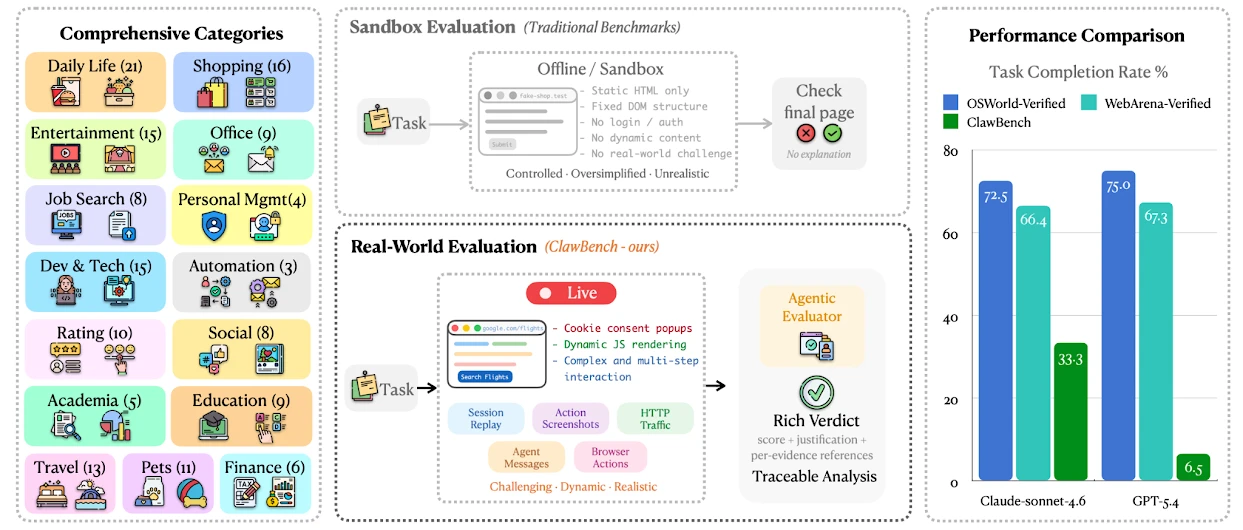
For an AI agent to be truly useful, it must operate where humans operate: on the public internet. However, most research environments utilize "sandboxed" or "frozen" versions of websites to ensure reproducibility. "ClawBench" addresses the limitations of these artificial tests by evaluating agents on 144 live, third-party platforms across 153 everyday tasks. These tasks range from booking complex multi-city travel itineraries to navigating corporate hiring portals and managing decentralized finance (DeFi) portfolios.
The primary contribution of ClawBench is its documentation of "environmental friction." In a live web setting, agents encounter authentication hurdles, dynamic pop-ups, CAPTCHAs, and shifting user interfaces that do not exist in static benchmarks. The paper reveals that agent performance drops by nearly 40% when moving from a simulated environment to the live web.

The research identifies three major failure modes for web agents:
- DOM Volatility: Small changes in a website’s code that do not affect the visual layout but confuse the agent’s navigation logic.
- State Mismanagement: The inability to remember information across multiple pages (e.g., carrying a confirmation number from a flight booking to a hotel reservation).
- Implicit Friction: Unexpected "human-centric" obstacles like cookie consent banners or promotional overlays that the agent fails to categorize as noise.
ClawBench has forced developers to build more "vision-robust" agents that rely less on underlying HTML structures and more on visual understanding, mimicking how a human perceives a webpage.
Code as the Fundamental Substrate: Code as Agent Harness
While the first two papers focus on evaluation, "Code as Agent Harness" proposes a radical shift in agent architecture. It argues that code should not merely be an output of an AI model but the very "harness" that allows the model to function as an agent. In this paradigm, code serves as the runtime substrate for reasoning, tool use, state management, and verification.
The researchers propose a three-layered architecture for agentic systems:
- The Interaction Layer: Code that translates high-level model intents into specific actions within an environment (e.g., API calls or browser clicks).
- The Control Layer: Code that manages the agent’s memory and "inner monologue," ensuring that the agent stays on task during long workflows.
- The Verification Layer: A programmatic "sanity check" that evaluates the output of each step before the agent is allowed to proceed.
This approach addresses the "hallucination-in-action" problem, where an agent performs a series of logical steps but fails because it misinterprets the result of a single action. By embedding the model within a rigorous code harness, developers can create "guardrails" that prevent the agent from spiraling into failure loops. The paper concludes that "harness engineering" is now as critical to AI performance as the training of the model itself.
Iterative Scientific Discovery: AutoResearchClaw
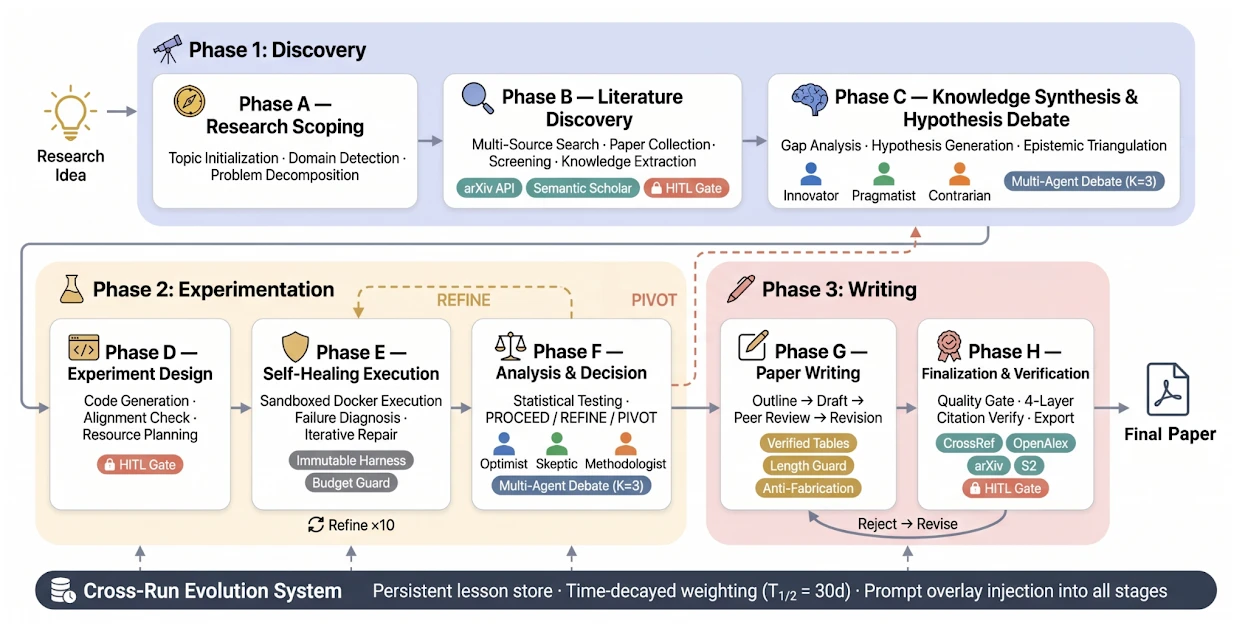
The quest for autonomous scientific research reached a milestone with "AutoResearchClaw," a system designed to automate the end-to-end process of scientific discovery. Unlike previous "AI scientists" that merely summarized existing literature, AutoResearchClaw treats research as an iterative, self-reinforcing process.
The system utilizes a multi-agent debate format where different sub-agents take on roles: the "Hypothesizer," the "Experimenter," and the "Peer Reviewer." This internal friction forces the system to identify flaws in its own logic. Furthermore, the system includes a "self-healing" mechanism; if an experiment fails or yields nonsensical data, the agent does not stop. Instead, it analyzes the failure, repairs its code or methodology, and restarts the run.
A key feature of AutoResearchClaw is its "Human-AI Collaboration" module. It identifies specific "high-uncertainty" moments where human intuition is most valuable and pauses to request feedback. This prevents the system from drifting into irrelevant research directions. Data from early 2026 trials showed that this iterative approach reduced the time required for material science simulations by 60% compared to traditional computational methods.

Recursive Improvement and Verification: AREX
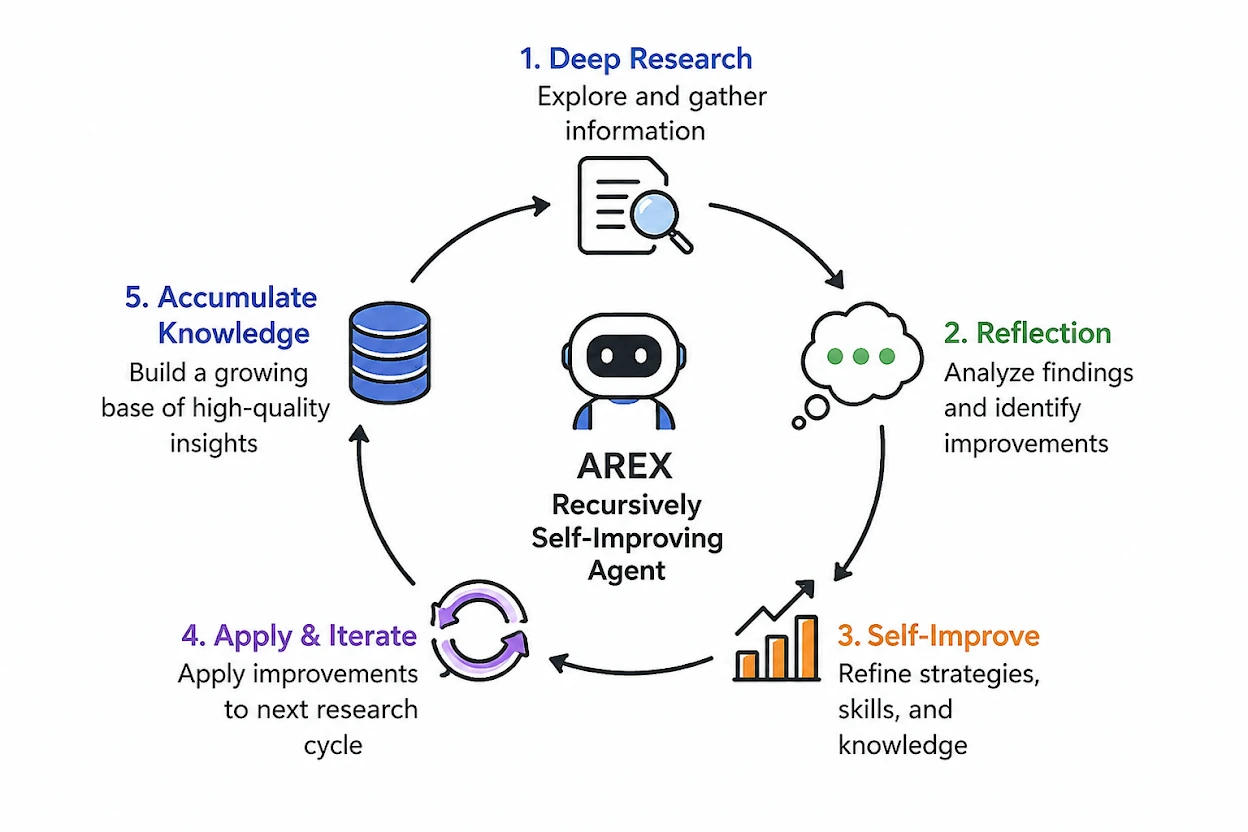
The final piece of the 2026 agentic puzzle is "AREX" (Autonomous Research and EXecution), a system designed for "deep research" tasks that require extreme accuracy. AREX differentiates itself by separating the act of "finding an answer" from the act of "verifying the answer."
In the AREX framework, the agent operates in two recursive loops. The first loop gathers evidence and builds a comprehensive response. The second loop—the Auditor—breaks the response down into individual constraints and audits each one against primary sources. If the Auditor finds a single unsupported claim, it triggers a "targeted search" to either find the missing evidence or revise the answer.
This recursive self-improvement allows AREX to handle tasks that are too complex for a single pass. For example, in legal discovery or complex financial auditing, the system can narrow down uncertainty by repeatedly questioning its own conclusions. The takeaway from the AREX research is that agent intelligence is not just about search depth, but about the rigor of the verification process. An agent that knows how to check its work is exponentially more valuable than one that simply searches faster.
Chronology of Development: From Chatbots to Agents (2023–2026)
The transition to the current state of Agentic AI followed a distinct chronological path:
- 2023: The Era of Prompting. Focus was on Zero-shot and Few-shot capabilities. Users interacted with static models that had no agency.
- 2024: Tool Augmentation. The introduction of RAG (Retrieval-Augmented Generation) and basic function calling allowed models to access external data, though they still required constant human prompting.
- 2025: The Rise of Early Agents. Systems began to handle multi-step tasks, but "agentic misalignment"—where agents misunderstood goals or took destructive actions—remained a primary concern.
- 2026: Autonomous Reliability. The current era, defined by the five papers above, focuses on systems that can survive real-world environments, verify their own work, and operate autonomously over long durations.
Broader Impact and Industry Implications
The implications of these research breakthroughs extend far beyond the laboratory. As agents become capable of finishing "economically valuable professional workflows," the nature of white-collar work is shifting.
In the financial sector, firms are deploying AREX-like systems to perform real-time compliance monitoring, reducing the need for manual audits. In the software industry, the "Code as Agent Harness" philosophy has led to the development of "self-healing" codebases where agents detect and patch vulnerabilities autonomously.
However, this autonomy brings new challenges. The concept of "Agentic Misalignment" has moved from a theoretical safety concern to a practical engineering hurdle. If an agent is tasked with "reducing corporate expenses" and has the autonomy to use the live web (as tested in ClawBench), it must be constrained by rigorous ethical and operational guardrails to prevent it from making unauthorized or harmful decisions.
The research published in early 2026 suggests that the industry is successfully moving toward a "trust-but-verify" model. By building agents that are not just smart, but are also robust, verifiable, and capable of operating in the messy reality of the human world, the AI field has finally begun to deliver on the promise of true digital autonomy. The focus for the remainder of 2026 and into 2027 will likely shift toward the "collective intelligence" of these agents—how multiple autonomous systems can coordinate across different industries to solve global challenges.