The Evolution of Precision Marketing on Meta Platforms

Facebook ad targeting, at its core, is a sophisticated system within Meta Ads Manager designed to pinpoint specific segments of this colossal user base. Unlike broad-brush advertising, it empowers advertisers to define audiences based on a rich tapestry of characteristics, including demographics, geographical location, stated interests, and historical interactions with a business. This granular control has evolved significantly over the years, moving from purely manual selection to increasingly sophisticated, AI-driven optimization. The underlying principle remains the same: to maximize return on investment (ROI) by minimizing wasted impressions and directing ad spend towards high-potential prospects.
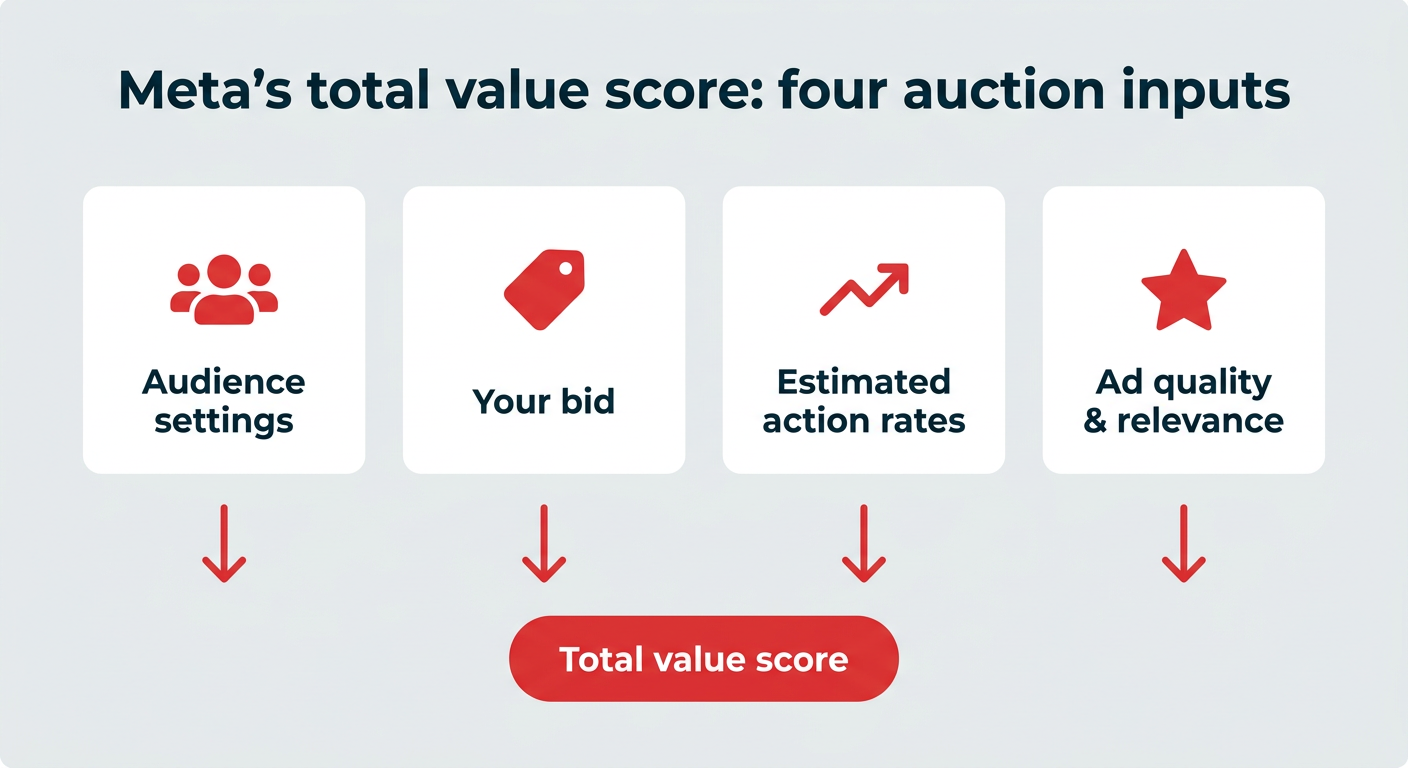
The mechanism powering this precision is Meta’s intricate ad auction. Rather than directly purchasing ad placements, advertisers define a pool of eligible users. Each available ad impression within this pool then enters an auction where Meta determines a winner based on a "total value score." This score is a composite of several critical inputs: the advertiser’s audience settings, the bid placed, estimated action rates (Meta’s prediction of how likely a user is to perform the desired action), and the overall quality and relevance of the ad itself. This dynamic system underscores a crucial takeaway for marketers: targeting settings are but one lever. A meticulously defined audience paired with uninspired creative can still underperform compared to a slightly broader audience complemented by highly engaging content, simply because Meta’s algorithm prioritizes the ultimate outcome (e.g., a conversion) over the initial targeting input. This algorithmic approach is particularly pertinent in 2026, especially as average ad prices across Meta’s platforms saw a 9% increase in 2025, according to Meta’s investor reports, making efficiency more critical than ever.

Key Targeting Pillars in 2026: A Deeper Dive
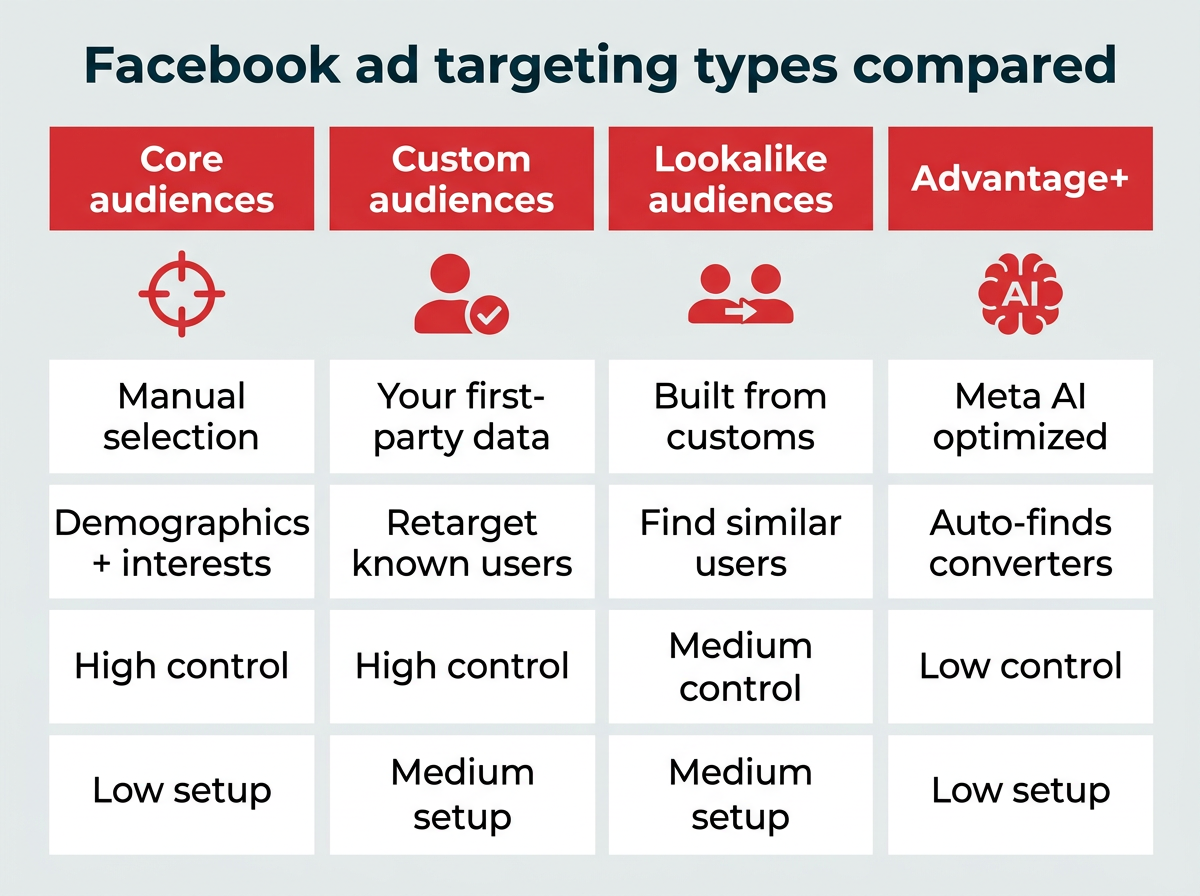
Meta offers four primary approaches to ad targeting, each serving distinct strategic objectives:
-
Core Audiences (Detailed Targeting): This is the traditional, manual method where advertisers construct an audience using Meta’s proprietary user data. Criteria are broadly categorized into demographics, interests, and behaviors.
- Demographics: Filters include age, gender, relationship status, education level, job titles, household income, parental status, and even life events like recent engagements or new jobs.
- Interests: Users can be targeted based on their stated hobbies, affinities, and the content they engage with, such as "fitness," "travel," "cooking," or specific brands and public figures they follow.
- Behaviors: This category leverages user actions, including shopping habits, device usage, travel frequency (e.g., "frequent international travelers"), and purchase history.
- Use Case: A luxury travel agency launching a new high-end cruise line might target individuals aged 45-65, located in affluent urban areas, with interests in "luxury travel," "yachting," and exhibiting "frequent international traveler" behaviors. This method allows for highly specific audience construction, ensuring ads reach individuals matching the ideal customer profile.
-
Custom Audiences: These audiences enable re-engagement with individuals who have already demonstrated a connection with a business. They are built using an advertiser’s first-party data. Sources include:

- Website visitors (via the Meta Pixel).
- Customer email lists (uploaded CRM data).
- App users.
- Offline activity (e.g., in-store purchases).
- Engagement with Meta content (e.g., video views, lead form submissions, Instagram interactions, Facebook page engagement, Shopping activity).
- Use Case: An e-commerce retailer can create a Custom Audience of users who added items to their cart but did not complete a purchase, then serve them targeted ads offering a discount or free shipping to encourage conversion. This retargeting strategy is known for its high conversion rates due to targeting "warm" leads.
-
Lookalike Audiences: Built upon Custom Audiences, Lookalike Audiences expand reach by finding new users who share similar characteristics with existing customers. Meta’s algorithms analyze the common traits of a source Custom Audience and identify broader groups of users who "look alike" but may not yet be familiar with the brand.
- The quality of a Lookalike Audience is directly tied to the quality and size of its source Custom Audience. Meta generally recommends a source of at least 1,000 people for optimal results, with larger, more homogeneous sources often yielding better performance.
- Value-based lookalikes represent an advanced application, weighting high-spending customers more heavily in the source audience to find new prospects with higher lifetime value potential.
- Use Case: A B2B SaaS company might create a Lookalike Audience from its current roster of enterprise clients to attract new leads from similar industries or companies with comparable profiles. In 2026, Meta increasingly treats lookalikes as a strong signal rather than a rigid boundary, especially within Advantage+ campaigns, allowing the system to expand beyond the lookalike if better-performing users are identified elsewhere.
-
Advantage+ Audience Targeting: This is Meta’s AI-powered system, representing a significant shift towards automated optimization. Instead of manual selection, Advantage+ leverages Meta’s sophisticated algorithms, conversion data, Pixel signals, and past ad interactions to dynamically identify the best audience.
- Meta’s AI continuously learns and adapts, leading to highly efficient ad delivery. Official Meta reports indicate that campaigns utilizing Advantage+ have seen a 13% lower median cost per product catalog sale, a 7% lower median cost per website conversion, and a 28% lower average cost per click, lead, or landing page view.
- While largely AI-driven, Advantage+ still allows for some guardrails, such as excluding specific age ranges or geographical locations. However, its effectiveness is maximized when given a broader starting audience, allowing the AI ample room for optimization.
- When to Use: Advantage+ is now the recommended default for most prospecting campaigns, particularly for e-commerce, lead generation, and app promotion. It thrives when reliable conversion tracking is in place and sufficient weekly conversion events allow the algorithm to learn effectively. Manual targeting remains crucial for niche products, highly regulated industries, or specific remarketing efforts where precise control is paramount. Marketers are encouraged to A/B test Advantage+ against their manual audience selections to determine optimal performance.
The Privacy Paradigm Shift: Adapting to New Realities
The landscape of digital advertising has been profoundly reshaped by privacy changes, particularly Apple’s iOS 14.5 App Tracking Transparency (ATT) update rolled out in 2021. This update granted users the explicit choice to opt out of app-level tracking, a decision taken by the vast majority, resulting in an industry-wide opt-in rate of just 35%. The consequence for Meta (and advertisers) has been a significant reduction in data received about users’ off-platform behavior, impacting the effectiveness of certain third-party interest and behavior targeting options. Furthermore, Meta itself has proactively removed sensitive targeting categories related to health, race, political affiliation, and religion to align with evolving privacy standards and societal expectations.
The practical implications for marketers in 2026 are clear:
- Reduced Effectiveness of Third-Party Data: Many behavior-based targeting options are less precise.
- Shorter Attribution Windows: Tracking conversions accurately across longer periods has become more challenging.
- Heightened Importance of First-Party Data: Businesses must prioritize collecting and leveraging their own customer data (e.g., CRM lists, website visitor data via Meta Pixel and Conversions API).
- Server-Side Tracking: Implementing the Conversions API alongside the Meta Pixel is crucial to mitigate browser restrictions and ensure robust data flow for retargeting and optimization.
- Creative as a Targeting Lever: With less data-driven targeting, the creative itself must attract the right audience.
- Embrace AI-Driven Optimization: Platforms like Advantage+ are Meta’s response to data limitations, using internal signals and on-platform behavior for optimization.
These shifts do not diminish the value of Facebook ad targeting but rather redefine the levers that matter most. Marketers must pivot from relying solely on granular data points to a more holistic approach that blends strong first-party data, compelling creative, and Meta’s powerful AI.
Strategic Imperatives for Marketers in 2026
Mastering Facebook ad targeting in 2026 requires a blend of foundational understanding and agile strategic execution. The following strategies are essential for maximizing campaign performance:
-
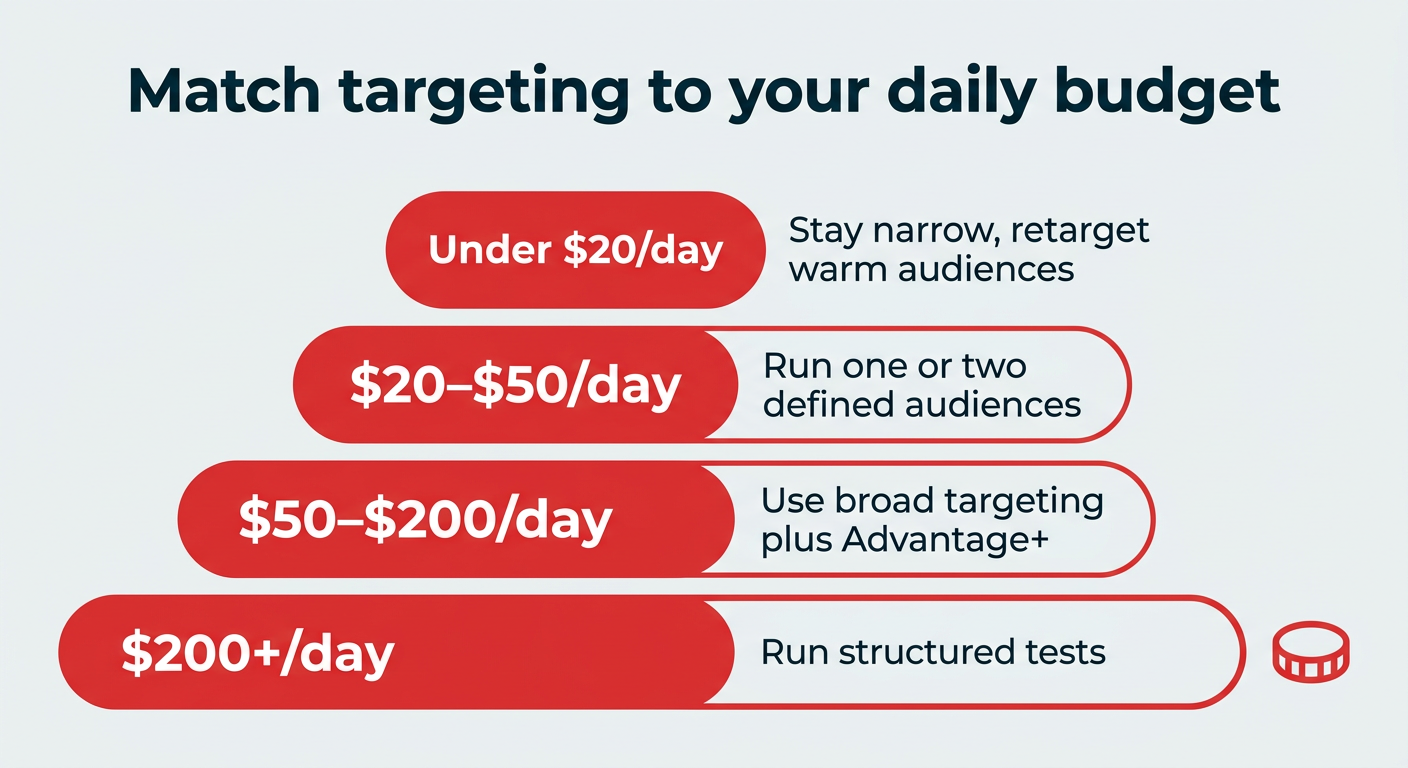
Matching Targeting to Budget: Resource allocation profoundly impacts targeting effectiveness.
- Limited Budgets (Under $20/day): Focus on highly specific, "warm" audiences like Custom Audiences (retargeting website visitors, customer lists) or hyper-narrowed Core Audiences. The goal is to maximize conversion rates from a small pool.
- Moderate Budgets ($20-$100/day): Allows for broader Lookalike Audiences or slightly expanded Core Audiences, giving Meta’s algorithm more data to optimize.
- Higher Budgets ($100+/day): Ideal for broad Advantage+ campaigns, where the AI has ample budget and data volume to learn and find the best converters across a wide spectrum.
- Rule of Thumb: Daily budget should ideally be at least two to three times the target cost per conversion to provide sufficient data for Meta’s algorithm to optimize effectively.
-
Strategic Use of Broad Targeting: Broad targeting, once seen as a last resort, is now a deliberate and often highly effective strategy, particularly with Advantage+ campaigns. By providing minimal constraints (e.g., only country and age range), advertisers empower Meta’s AI to leverage its vast data sets and machine learning capabilities to identify converters based on conversion data and creative signals. This approach works best when:

- You have a substantial budget to allow the AI to learn.
- Your conversion tracking (Meta Pixel, Conversions API) is robust.
- Your creative is highly compelling and effectively communicates your offer.
- You’re targeting a mass-market product or service.
- For niche products, limited budgets, or highly regulated industries, narrower targeting often remains preferable. Testing both broad and layered approaches is crucial.
-
Creative as a Primary Targeting Lever: With manual targeting options becoming more constrained, creative content has surged in importance as a targeting mechanism. Meta’s delivery system analyzes signals from imagery, copy, format, and initial engagement to find similar users. A visually distinctive ad for a specific product can effectively self-target the relevant audience, even without explicit interest targeting. Nielsen’s research highlights this, indicating that creative quality accounts for 56% of a campaign’s sales ROI. To leverage this:
- Develop varied creative assets that speak to different audience segments.
- Use compelling visuals and copy that clearly articulate your value proposition.
- Continuously A/B test different creative elements to identify top performers.
- Let the creative "do the work" of attracting the right audience within a broader or Advantage+ setting.
-
Advanced Retargeting with Custom Audiences: Retargeting remains one of the highest-impact strategies, converting warm leads who have already shown interest. Businesses should:

- Ensure the Meta Pixel and Conversions API are properly installed for robust website tracking.
- Create Custom Audiences based on specific actions (e.g., "website visitors in last 30 days," "users who viewed product X," "cart abandoners").
- Segment these audiences (e.g., exclude recent purchasers from promotional offers).
- Integrate CRM data to create Custom Audiences from existing customer lists, allowing for tailored cross-sell or upsell campaigns.
-
Competitor Audience Insights and Targeting: Meta Business Suite’s Audience Insights tool provides valuable intelligence on followers and potential audiences. By analyzing "Top Pages" that a target demographic already connects with, advertisers can identify competitors and affinity brands. While direct targeting of competitor followers as an "interest" can be hit-or-miss (some pages may not appear as targetable interests), the insights gained can inform more precise interest-based targeting or inspire Lookalike Audiences built from similar profiles.
-
Value-Based Lookalike Audiences: Moving beyond standard Lookalike Audiences, value-based lookalikes prioritize finding new prospects who resemble a business’s highest-spending customers. This involves uploading a customer list that includes a customer lifetime value (CLV) metric. Meta’s algorithm then weighs these higher-value customers more heavily when identifying common characteristics, leading to more profitable new customer acquisition.

-
Layered Detailed Targeting (Strategic Niche Campaigns): For specific promotions or highly niche products, layering multiple criteria within Core Audiences remains effective. Combining demographics (e.g., "divorced parents of toddlers working in management") with interests (e.g., "beach vacations") and behaviors (e.g., "frequent international travelers") can create hyper-focused segments. Crucially, "Narrow Audience" must be used to ensure an "AND" logic (e.g., Must match interest A AND behavior B), rather than an "OR" logic. Equally important are exclusions, removing existing customers from prospecting or filtering out demographics consistently failing to convert, thereby optimizing budget allocation.
-
Targeting Engaged Shoppers: A powerful, often overlooked option within detailed targeting is "Engaged Shoppers." This behavior-based criterion targets users who have clicked a "Shop Now" button on a Facebook ad within the last week. This is invaluable for reaching individuals who have already demonstrated a willingness to engage with commerce directly on Meta platforms, a behavior that contributed significantly to Meta’s advertising revenue growth from online commerce in 2025.

-
Monitoring and Fixing Audience Overlap: Audience overlap occurs when multiple ad sets are eligible to reach the same people, leading to internal bidding competition and fragmented data. Meta’s "Audiences" tool in Ads Manager provides an overlap reporting feature. Regular checks (e.g., monthly) are essential, as audience pools are dynamic. Addressing significant overlap by consolidating ad sets or using exclusions can prevent unnecessary cost increases and improve optimization.
-
Leveraging Ad Relevance Diagnostics: Meta provides three crucial ad relevance diagnostics:

- Quality Ranking: How your ad’s perceived quality compares to others targeting the same audience.
- Engagement Rate Ranking: How your ad’s expected engagement rate compares.
- Conversion Rate Ranking: How your ad’s expected conversion rate compares.
These metrics provide actionable insights into whether your ad resonates with your chosen audience. Low rankings indicate a mismatch, prompting adjustments to creative, audience targeting, or offer. Improving these scores often leads to lower costs and better performance.
Common Pitfalls to Avoid
Despite the sophisticated tools available, several common mistakes can derail even well-intentioned targeting efforts:

- Targeting Too Narrowly, Too Early: Restricting an audience excessively, especially with smaller budgets, starves Meta’s algorithm of the data needed for effective optimization.
- Ignoring Audience Overlap: Failing to monitor and address overlaps between ad sets leads to inflated costs and inefficient ad delivery.
- Skipping Exclusions: Not excluding irrelevant segments (e.g., existing customers from prospecting campaigns, recent purchasers from acquisition ads) results in wasted spend.
- Relying Solely on Interest Targeting: In the post-iOS 14.5 era, interest targeting is less precise. Over-reliance without combining it with other strategies (e.g., creative, first-party data) can limit effectiveness.
- Never Testing Advantage+: Given Meta’s strong push and reported results, neglecting to test Advantage+ campaigns can mean missing out on significant performance gains, especially for prospecting.
- Setting Audiences and Forgetting Them: The digital landscape is dynamic. Audiences evolve, competitors emerge, and privacy regulations shift. Regular review and optimization are crucial.
The Future of Facebook Ad Targeting and Leveraging Technology
In 2026, the trajectory of Facebook ad targeting is clearly towards greater automation, reliance on first-party data, and sophisticated AI. Marketers must become adept at providing Meta’s algorithms with the right signals (robust conversion tracking, compelling creative) and trust the system to find optimal audiences. The emphasis shifts from manually carving out minuscule segments to understanding broader behavioral patterns and allowing AI to execute the precision.

Platforms like Hootsuite Social OS are increasingly vital in this environment, connecting organic social activity with paid campaigns. By consolidating audience insights from everyday social conversations, businesses can gain deeper intelligence on competitor activity, audience sentiment, and trending topics. These insights, amplified by AI-powered tools like Lumen within Hootsuite, provide sharper inputs for building more effective Custom Audiences and informing creative strategies. Unified analytics across Facebook profiles allow marketers to identify organic content that resonates, providing a data-driven foundation before allocating ad spend. For enterprise teams, governance features and approval workflows ensure consistent messaging across diverse business units, preventing contradictory paid and organic efforts.
Ultimately, successful Facebook ad targeting in 2026 is about continuous adaptation, strategic testing, and a deep understanding of how Meta’s evolving platform interacts with user behavior and privacy considerations. It’s a blend of art and science, where the art of compelling creative meets the science of data-driven optimization.