

The global landscape of digital marketing and product development underwent a significant transformation in mid-2026 as Wingify officially transitioned into a unified Digital Experience Optimization (DXO) suite. This move follows the high-profile merger of two industry pioneers, VWO and AB Tasty, effectively consolidating their respective technologies into a single, comprehensive ecosystem. Operating under the unified Wingify brand, the platform now serves as a centralized hub for teams to build, test, personalize, and continuously improve digital experiences across websites, mobile applications, and backend services. The transition, which saw the primary user interface migrate to a new domain on June 13, 2026, represents one of the largest consolidations in the software-as-a-service (SaaS) optimization sector to date.
The Genesis of a DXO Powerhouse: A Chronological Overview
The path to the unified Wingify suite is rooted in over a decade of parallel innovation. VWO, founded by Paras Chopra in 2010, gained global recognition as one of the first easy-to-use A/B testing tools, eventually expanding into a full conversion rate optimization (CRO) platform. Simultaneously, AB Tasty, established in France in 2011 by Alix de Sagazan and Rémi Aubert, carved out a dominant position in the European and North American markets by focusing on sophisticated personalization and feature management.
By the early 2020s, the market for digital optimization began to shift away from isolated "point solutions" toward integrated platforms. Enterprises increasingly demanded a single source of truth for user data to avoid the fragmentation that occurs when using separate tools for testing, heatmaps, and personalization. The 2026 merger was the strategic culmination of this market demand. Following the announcement of the merger in early 2026, engineering teams from both organizations spent several quarters aligning data models and workflows. The transition to app.wingify.com in June 2026 marked the first major public-facing milestone of this integration, signaling the end of VWO and AB Tasty as standalone corporate entities and the beginning of their life as specialized modules within the Wingify suite.
Architectural Integration and the Unified Data Layer
At the core of the Wingify suite is a unified data and AI layer designed to eliminate the friction typically associated with multi-tool stacks. Historically, a marketing team might identify a friction point using a heatmap tool, export that data to an A/B testing tool, and then manually recreate segments in a personalization engine. Wingify’s architecture is built to automate this lifecycle.
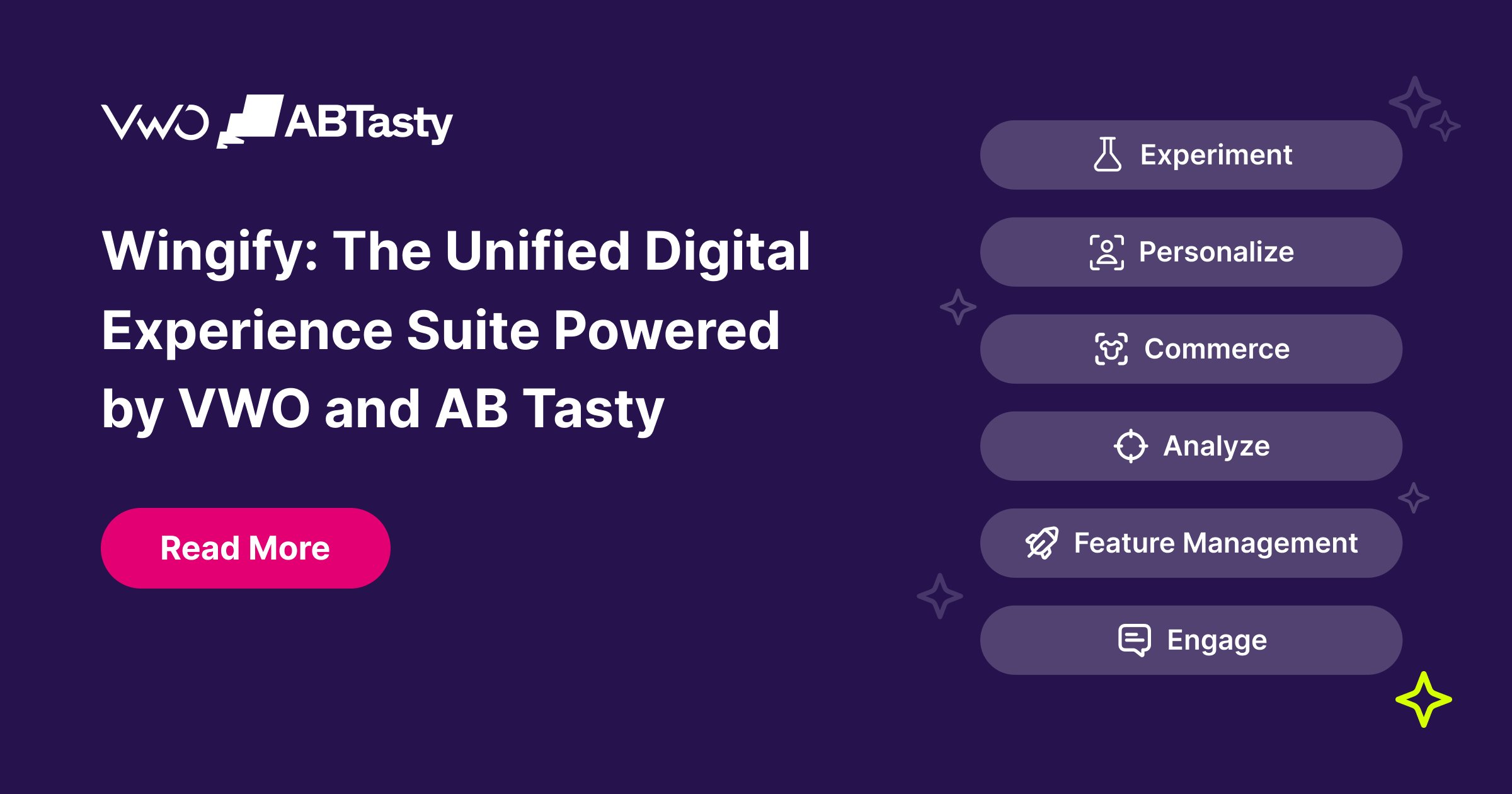
The suite is organized into seven primary capability areas: experimentation, personalization, feature management, behavioral insights, user surveys, commerce optimization, and artificial intelligence. By housing these capabilities under one roof, Wingify ensures that a single tracking snippet and a unified user profile govern every interaction. This prevents "data drift"—where different tools report different metrics for the same user—and allows for a more granular understanding of the customer journey. For instance, a user’s behavior captured in the "Insights" module can immediately trigger a "Personalization" campaign without the need for complex API integrations or data syncing.
Comprehensive Capabilities of the Wingify Suite
The unified suite combines the historical strengths of both VWO and AB Tasty to provide a 360-degree approach to digital optimization.
Experimentation and Feature Management
The experimentation layer remains a cornerstone of the platform, offering web, mobile, and server-side A/B testing. This allows product teams to test everything from UI changes to deep-stack algorithmic updates. Complementing this is the feature management module, which serves as a bridge between engineering and product management. Through progressive rollouts and "kill switches," developers can deploy code to production safely, enabling a small percentage of users to access a new feature before a full-scale launch. If performance metrics dip, the feature can be instantly retracted without a full code rollback.
Personalization and AI-Driven Targeting
Personalization in Wingify leans heavily on the legacy of AB Tasty, utilizing "Emotions AI" and adaptive customer experience (CX) tools. Unlike traditional A/B testing, which seeks a single winning version for all users, Wingify’s personalization engine identifies the best-performing experience for specific segments in real-time. This includes tailoring content based on a user’s emotional state, browsing history, or geographic location.
Commerce and Merchandising
For the e-commerce sector, the suite includes specialized commerce tools that unify product search, recommendations, and merchandising. By using a shared data layer, the platform ensures that if a product is "buried" in search results by a merchandiser, it is also reflected in the recommendations engine. AI-powered search handles natural language queries and misspellings, reducing search abandonment and increasing average order value (AOV).
Behavioral Insights and Diagnostic Tools
The suite includes qualitative tools such as session recordings, heatmaps, and on-site surveys. These are positioned not merely as reporting dashboards but as diagnostic instruments. They provide the "why" behind the "what," allowing teams to see exactly where users are clicking or dropping off before formulating an experiment hypothesis.
Wandz: The Role of Embedded Artificial Intelligence
A defining feature of the new Wingify suite is Wandz, a unified AI layer that replaces and expands upon previous assistants like VWO’s Copilot and AB Tasty’s Evi. Unlike general-purpose generative AI, Wandz is deeply embedded within the experimentation workflow. Because it has direct access to a company’s experiment configurations, audience definitions, and historical performance data, it can provide context-aware assistance that external AI tools cannot.
Wandz is capable of generating experiment hypotheses based on live traffic data, reviewing campaign configurations for potential errors before launch, and even adjusting website elements through an AI-driven visual editor. By interpreting natural language instructions, Wandz allows non-technical users to build complex campaigns, effectively lowering the barrier to entry for sophisticated digital optimization.
Technical Migration and Operational Continuity
The transition to the Wingify domain was executed with a focus on maintaining service continuity for thousands of global clients. While the branding and dashboard location changed, the underlying infrastructure—including REST APIs, tracking snippets (SmartCode), and mobile SDKs—was designed to remain backward compatible.
For existing VWO customers, the migration to app.wingify.com was largely automated, with Single Sign-On (SSO) and SAML configurations redirecting to the new domain. However, the company noted that security protocols such as Passkeys, which are domain-specific, required manual resetting by users. Similarly, IT departments were advised to update firewall allowlists to include the wingify.com domain to ensure the continued functionality of session recordings and other real-time features. Contracts, pricing structures, and support teams remained unchanged during the initial transition phase to provide stability for enterprise clients.
Market Implications and Competitive Landscape
The emergence of Wingify as a unified suite places it in direct competition with other "experience clouds" offered by giants such as Adobe, Oracle, and Optimizely. Industry analysts suggest that the Wingify merger reflects a broader trend toward "composable" yet unified platforms. By offering a suite that covers both the "low-code" needs of marketers and the "full-stack" needs of engineers, Wingify is positioning itself to capture a larger share of the enterprise market.
The primary advantage of this merger is the reduction of "vendor fatigue." Organizations are increasingly looking to consolidate their tech stacks to reduce costs and improve data security. A unified platform like Wingify mitigates the risks associated with data privacy compliance (such as GDPR and CCPA) because user data is processed through a single pipeline rather than being distributed across multiple third-party vendors.
Looking Ahead: The Future of Digital Optimization
As of mid-2026, Wingify continues to operate with a roadmap focused on deeper integration. While the immediate focus has been on branding and domain consolidation, future phases are expected to include a more seamless blending of the VWO and AB Tasty engineering cores. The goal is a truly "headless" optimization engine where the same logic can be applied across any digital touchpoint, from an IoT device to a traditional web browser.
The merger of VWO and AB Tasty into Wingify marks the end of an era of fragmented optimization tools and the beginning of a more holistic approach to the digital customer journey. For product managers, marketers, and engineers, the unified suite offers a streamlined path from data-driven insight to executed experiment, promising a more agile and efficient way to drive digital growth in an increasingly competitive global market. Organizations looking to leverage these new capabilities can access the suite through the new centralized portal, where the combined heritage of two industry leaders now operates as a single, powerful entity.







