

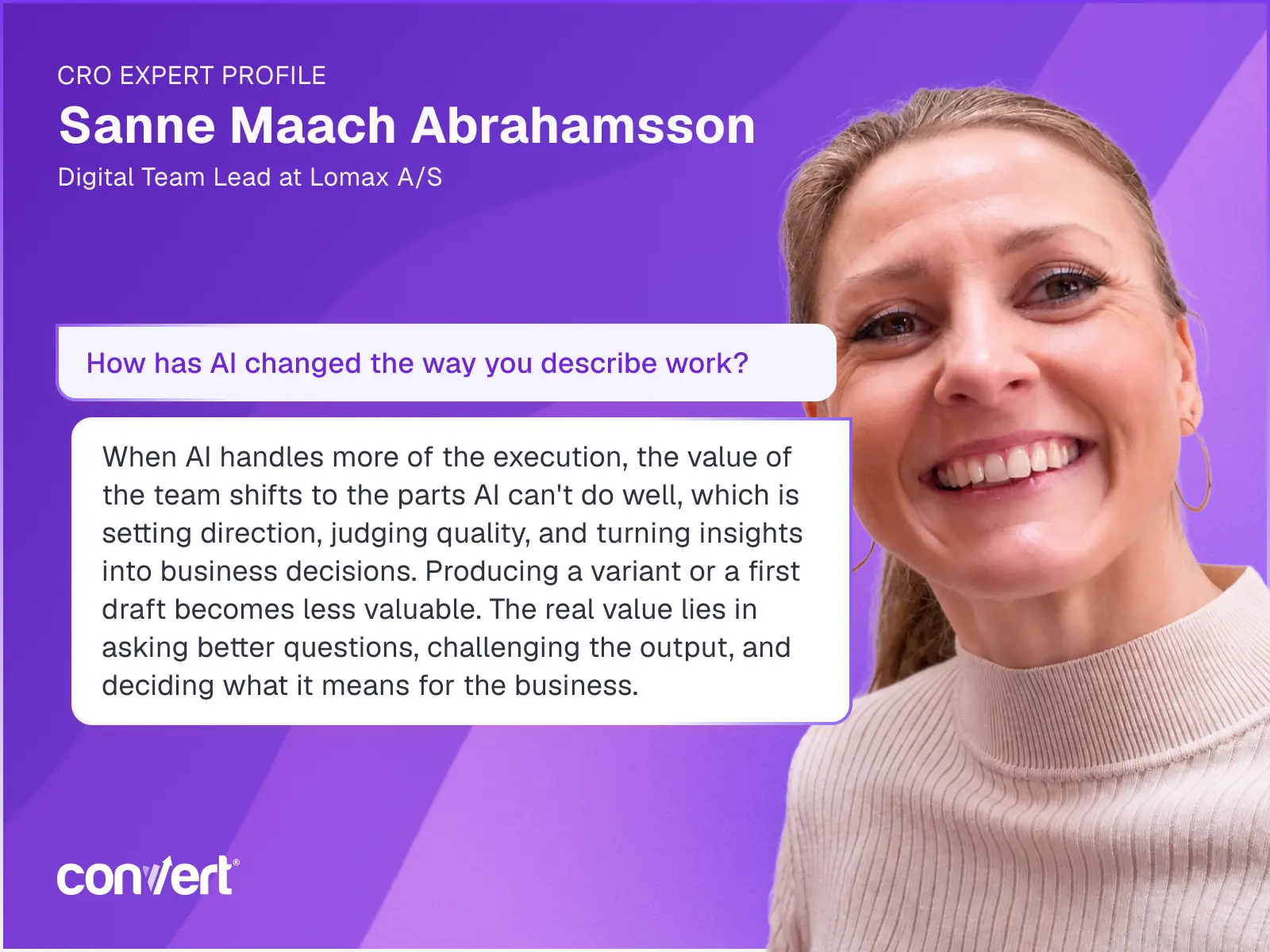
The digital commerce landscape is currently undergoing a transformative shift as organizations move away from gut-feeling decision-making toward rigorous, evidence-based experimentation. At the forefront of this evolution is Sanne Maach Abrahamsson, the Digital Team Lead at Lomax A/S, one of Denmark’s leading office supply retailers. In a comprehensive analysis of the current state of Conversion Rate Optimization (CRO), Abrahamsson highlights a critical transition in the industry: the move from mere execution to high-level strategic judgment, fueled by the integration of artificial intelligence and the preservation of institutional knowledge.
The Accidental Path to Optimization
The journey into the world of optimization for many industry leaders is rarely linear. For Abrahamsson, the entry into CRO was a product of organizational necessity and professional curiosity. Transitioning from a background in finance and interaction design, she was tasked with introducing CRO as a formal discipline at Lomax A/S at a time when e-commerce was a relatively new frontier for her. This cross-disciplinary background proved to be a significant advantage. The analytical rigour of finance, combined with the user-centric principles of interaction design, allowed her to view digital experimentation not just as a technical hurdle, but as a commercial imperative.

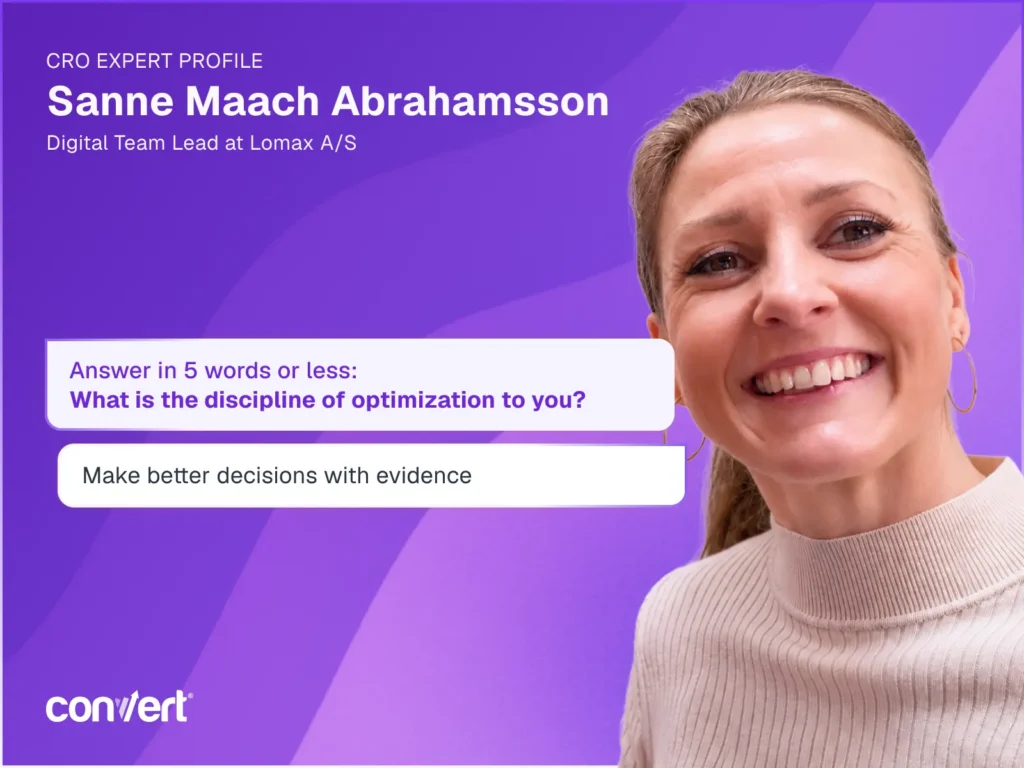
"Make better decisions with evidence," Abrahamsson states, distilling the complex discipline of optimization into a five-word mantra. This philosophy reflects a broader trend in the e-commerce sector, where the "HiPPO" (Highest Paid Person’s Opinion) is increasingly being replaced by data-driven validation. For Lomax, a company founded in 1962 that has successfully navigated the transition from traditional catalog sales to a dominant B2B e-commerce platform, this shift has been vital for maintaining market relevance in a competitive European landscape.
The Infrastructure of Learning: Beyond the Test Result
One of the most significant challenges in modern experimentation is the ephemeral nature of data. Many organizations fall into the trap of running tests in silos, where results are buried in outdated slide decks or project management tickets. Abrahamsson argues that the true value of experimentation lies not in the individual test, but in the creation of a "shared organizational memory."
To combat knowledge decay, Lomax A/S has invested heavily in a learning infrastructure using Airtable as a single source of truth. This database serves as a central repository for user research, customer insights, and historical experiment results. By connecting these disparate data points, the team can identify long-term patterns in customer behavior rather than reacting to isolated fluctuations.

The integration of AI, specifically through tools like Claude, has further enhanced this process. By connecting AI models to their structured database, the team at Lomax can synthesize years of learnings in seconds. This allows for a compounding effect where every new experiment is built upon the foundation of all previous tests, ensuring that the organization does not repeat the same mistakes or fail to capitalize on proven psychological triggers.
Case Study: Preventing Costly Strategic Errors
In a professional environment often obsessed with "wins" and conversion lifts, Abrahamsson provides a sobering reminder that some of the most successful experiments are those that yield negative results. These tests serve as a protective barrier against expensive business mistakes.
A primary example involved a proposed third-party tool designed to automatically scrape YouTube and populate the Lomax webshop with product videos. On the surface, the business case was compelling: video content is known to increase engagement, and automating the process would save hundreds of human hours. Management was understandably eager to move forward based on a polished vendor demonstration.

However, controlled A/B testing revealed a different reality. The automated system introduced influencer content that didn’t align with the brand voice and included videos in languages irrelevant to the target audience. The result was a measurable drop in both conversion rates and average order value (AOV). By testing before committing to a long-term contract, Lomax avoided a significant financial and brand-equity drain. This case underscores the importance of the "experimentation first" mindset, particularly when evaluating "plug-and-play" AI solutions that promise effortless scaling.
The Nuance of AI in Content Creation
As AI becomes more integrated into the e-commerce workflow, the debate often centers on whether machines can replace human creativity. Abrahamsson’s team conducted a series of experiments comparing AI-generated product descriptions with those written by human copywriters. The results provided a nuanced view of where AI excels and where it falters.
On specific product pages, AI-generated descriptions outperformed human ones by providing clear, structured overviews that helped customers find technical specifications quickly. However, on category-level pages, the AI’s output was perceived as generic and lacked the creative "hook" necessary to guide users further down the funnel.
This experiment highlighted a crucial lesson for the industry: AI is not a binary "better or worse" solution. Its efficacy is highly dependent on the context of the user journey. Practitioners must move beyond the excitement of automation and focus on identifying the specific touchpoints where AI adds value versus where it introduces friction.
The Shifting Role of the Practitioner: From Execution to Judgment
The democratization of AI tools means that the technical barriers to running experiments are lower than ever. Tasks that once required specialized coding or hours of data cleaning can now be handled by AI agents. However, Abrahamsson warns that this leads to a "trap" where teams prioritize the quantity of tests over the quality of insights.
"The value moves away from execution and toward judgment," she explains. In this new era, the role of the CRO practitioner is to act as a guardian of quality and a director of strategy. As AI handles the repetitive tasks of variant production and initial data analysis, humans must focus on:
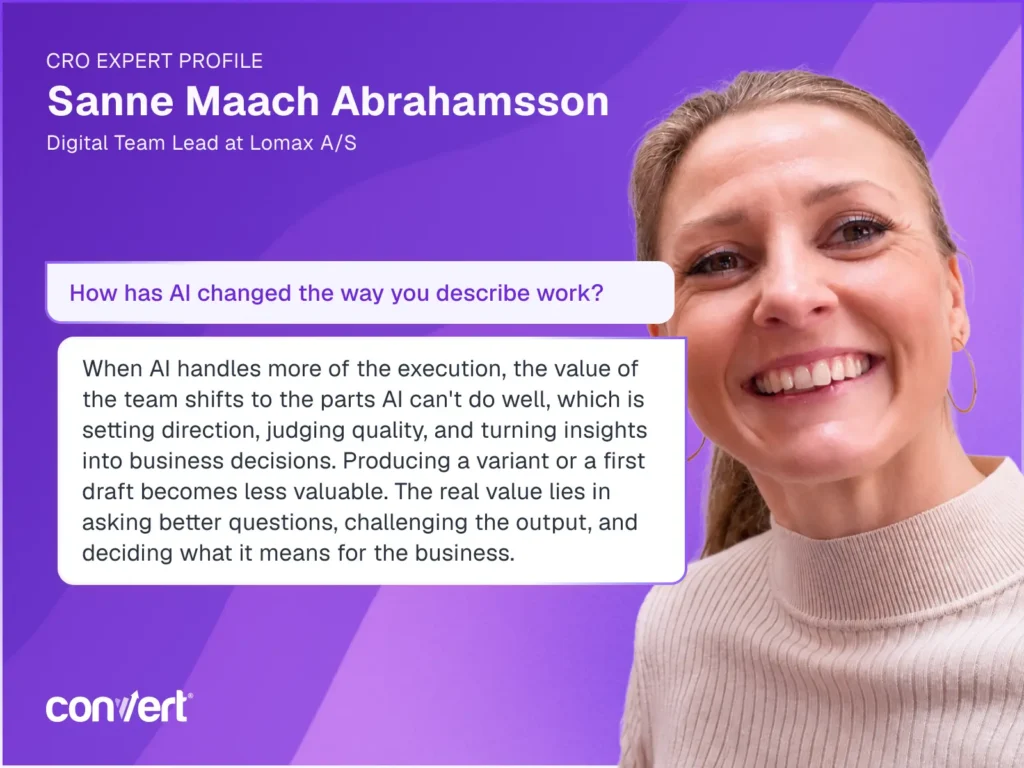
- Setting Direction: Asking the right questions that align with long-term business goals.
- Judging Quality: Ensuring that AI-generated outputs maintain brand integrity and user trust.
- Connecting Insights: Synthesizing data across different departments to drive holistic business decisions.
This shift requires a different skillset. Future leaders in the space will not be measured by the number of tests they launch, but by how much "smarter" they make their organization. The focus is shifting toward critical thinking and the ability to challenge the output of automated systems.
Broader Industry Implications and Future Outlook
The evolution of CRO at Lomax A/S reflects a broader trend across the global digital economy. According to recent industry reports, the global CRO market is expected to grow at a CAGR of over 10% through 2030, driven largely by the integration of AI and machine learning. As companies like Lomax demonstrate, the competitive advantage in this landscape belongs to those who can balance the speed of AI with the nuance of human experience.
The concept of leading "agents" alongside human team members is no longer science fiction. Abrahamsson envisions a future where her role as a leader involves managing a hybrid workforce. The fundamental principles of leadership—encouraging curiosity, maintaining quality standards, and providing clear direction—remain the same, whether the "employee" is a human or an algorithm.

For practitioners looking to adjust to this new reality, the message is clear: stop focusing on the "how" of execution and start mastering the "why" of strategy. The organizations that thrive will be those that view AI as an amplifier for human judgment rather than a replacement for it. By building robust learning infrastructures and prioritizing the prevention of mistakes as much as the pursuit of gains, companies can navigate the complexities of the modern digital market with confidence.
As the interview with Sanne Maach Abrahamsson concludes, it is evident that the field of optimization is entering its most sophisticated era yet. The noise of the digital world is louder than ever, but for those who live in the data and obsess over test design, the signals have never been clearer. The future of e-commerce is not just about who has the best algorithm, but who has the best system for learning from it.







