
 rifanmuazin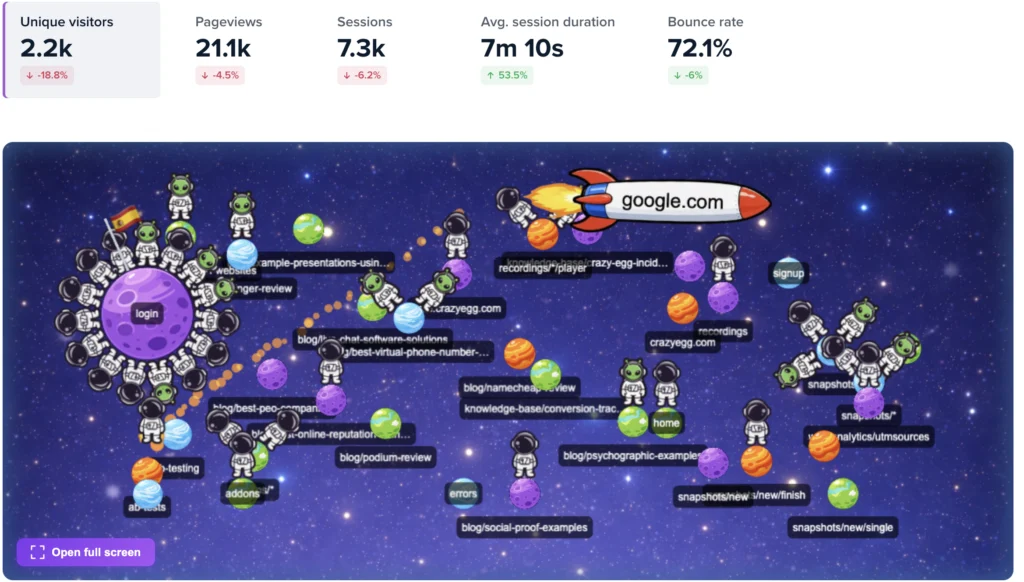
The digital optimization landscape has witnessed a significant shift with the introduction of the Astro Map, a real-time visualization tool integrated into the Crazy Egg Web Analytics suite. This new feature departs from traditional tabular data reporting, instead utilizing a gamified, celestial-themed interface to represent live visitor behavior on websites. By rendering active users as digital avatars—specifically astronauts and aliens—the tool provides site owners with an immediate, visual understanding of user flow, engagement, and friction points. This development marks a strategic move by Crazy Egg to democratize complex behavioral data, offering the feature at no additional cost to all users regardless of their subscription tier.
The Mechanics of Visualized Real-Time Analytics
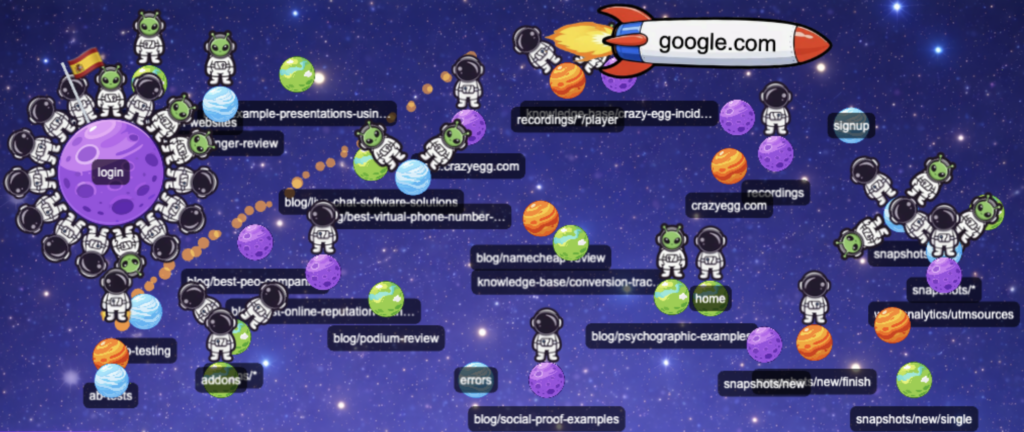
The Astro Map functions by translating raw server-side and client-side data into a dynamic visual environment. When a user selects the "Today" date range within the Crazy Egg interface, the standard analytics dashboard transitions into a live map. In this ecosystem, individual visitors are represented by character icons. These icons are not merely aesthetic; they are categorized based on their journey and status.
Visitors are grouped around "planets," which serve as visual metaphors for specific pages on the website. This grouping allows administrators to see at a glance which sections of their site are currently experiencing the highest density of traffic. The path to arrival is also visualized: when a visitor enters the site from an external source—such as a social media platform, a search engine, or a direct link—a "rocket" icon is displayed, signifying the referral source dropping the visitor onto the page.
Beyond simple presence, the Astro Map captures and displays intent through real-time event tracking. When a visitor performs a significant action, a speech bubble appears above their avatar. these triggers include:
- Page Visits: The initial landing on a specific URL.
- Scrolling Behavior: Indicating how deep into the content a user has ventured.
- Click Events: Engagement with links, buttons, or calls to action.
- Conversion Goals: The successful completion of a predefined objective, such as a newsletter sign-up or a purchase.
- Error Logs: Immediate notification if a user encounters a broken link or a technical glitch.
By clicking on an individual avatar, site owners can access a granular profile of that specific visitor. This profile includes the visitor’s geographic location, device type (mobile, desktop, or tablet), the specific referrer that brought them to the site, and a chronological log of their recent activity during the current session.
Historical Context and the Evolution of Crazy Egg
To understand the significance of the Astro Map, one must look at the trajectory of Crazy Egg since its inception. Founded in 2006 by entrepreneurs Neil Patel and Hiten Shah, Crazy Egg was a pioneer in the field of heatmapping technology. Before the widespread adoption of visual analytics, website owners were largely dependent on log files and early versions of Google Analytics, which focused heavily on numerical metrics like page views and bounce rates.
Crazy Egg disrupted this model by introducing "Snapshots," which provided visual overlays of where users clicked. Over the last two decades, the company has expanded its toolkit to include scroll maps, confetti reports, and A/B testing capabilities. The launch of the Astro Map represents the latest phase in this evolution: the transition from "post-mortem" analysis—looking at what happened yesterday or last week—to "live-stream" analysis.
This shift mirrors broader trends in the tech industry. As e-commerce and digital services become increasingly competitive, the window for responding to user issues has narrowed. If a checkout button breaks during a high-traffic sale, waiting for a weekly report is not an option. The Astro Map addresses this need for immediacy, providing a "war room" style view of digital operations.
Industry Trends and Supporting Data
The global web analytics market has seen exponential growth, valued at approximately $4.5 billion in 2022 and projected to reach over $15 billion by 2030, according to industry research reports. This growth is driven by the increasing complexity of the customer journey and the demand for actionable insights over raw data.
Market research indicates that visual data is processed 60,000 times faster by the human brain than text. This psychological fact underpins the design philosophy of the Astro Map. In a survey of digital marketers, over 70% reported that "data overload" was a significant barrier to effective decision-making. By converting numbers into a spatial map, Crazy Egg aims to reduce the cognitive load required to interpret site performance.
Furthermore, the rise of "Real-Time Enterprise" (RTE) strategies has forced software providers to prioritize low-latency data delivery. Standard analytics tools often have a processing lag ranging from a few minutes to several hours. The Astro Map’s instantaneous feedback loop aligns with the needs of agile marketing teams who require immediate validation of campaign launches or site updates.
Analysis of Implications for UX and Marketing
The introduction of a real-time, visual map has several implications for user experience (UX) designers and digital marketers. First, it humanizes the data. When a marketer sees a "dot" on a graph, it is an abstraction; when they see an "astronaut" stuck on a specific page planet, it evokes a different level of empathy and urgency regarding the user’s experience.
1. Immediate Friction Identification:
The "Error" trigger in the speech bubbles is perhaps the most pragmatically valuable aspect of the tool. In a traditional setup, identifying a localized error might require monitoring server logs or waiting for customer support tickets. With the Astro Map, a sudden cluster of error bubbles on a specific "planet" serves as an immediate visual alarm for the technical team.
2. Campaign Validation:
For social media managers and advertisers, the "rocket" referral visualization provides a live scoreboard. During a product launch or an influencer shout-out, teams can watch the influx of traffic in real-time, seeing exactly where those visitors land and whether they are "scrolling" or "clicking" as intended.
3. Enhanced Privacy Compliance:
As global regulations like GDPR (General Data Protection Regulation) and CCPA (California Consumer Privacy Act) become more stringent, the demand for anonymous yet insightful data has grown. The Astro Map provides high-level behavioral insights without necessarily requiring the tracking of personally identifiable information (PII). It focuses on the action and the environment rather than the specific identity of the human behind the screen.
Strategic Market Positioning
Crazy Egg’s decision to offer this tool for free across all plans is a calculated move in a competitive market. Major players like Google Analytics 4 (GA4) have moved toward a more complex, event-based tracking system that many small to medium-sized businesses find difficult to navigate. By offering a simplified, visual, and free alternative for real-time monitoring, Crazy Egg is positioning itself as the more accessible "human-centric" layer of the tech stack.
Competitors such as Hotjar and FullStory offer session recordings and heatmaps, but the specific "Astro Map" visualization is a unique differentiator. It bridges the gap between high-level analytics and granular session replays, providing a middle-ground view that is useful for quick check-ins by stakeholders who may not be data scientists.
Inferred Reactions from the Professional Community
While official statements from Crazy Egg emphasize the "fun" and "intuitive" nature of the tool, professional reactions from the UX and SEO communities suggest a more functional appreciation. Analysts have noted that the ability to see "where people get stuck" without crunching numbers is a significant time-saver for small business owners who wear multiple hats.
E-commerce managers, in particular, are expected to utilize the tool during high-stakes events like Black Friday or Cyber Monday. The ability to monitor the "health" of the checkout funnel through a visual map allows for real-time resource allocation—such as spinning up more server capacity or deploying a "live chat" intervention if a high volume of users is seen hovering on a payment page without converting.
Future Outlook and Technological Integration
The launch of the Astro Map is likely the beginning of a broader trend toward the "gamification" of business intelligence. As artificial intelligence and machine learning become more integrated into analytics, we can expect future iterations of such maps to include predictive elements—perhaps "ghost" astronauts showing where a user is likely to go next based on historical patterns.
Technologically, the rendering of hundreds or thousands of simultaneous avatars on a map requires significant front-end optimization. Crazy Egg’s ability to deliver this via a browser-based interface without significant lag suggests a robust backend architecture capable of handling high-velocity data streams.
In conclusion, the Astro Map is more than a whimsical update; it is a functional response to the increasing demand for real-time, visual, and accessible data. By removing the barrier of "number crunching," Crazy Egg is enabling a broader range of professionals to engage with their website’s performance data. As the digital economy continues to evolve, the ability to see one’s audience not as statistics, but as active participants in a digital journey, may become the new standard for web analytics. This feature reaffirms Crazy Egg’s long-standing commitment to making the web more "legible" for everyone, from independent bloggers to large-scale enterprise retailers.








