

The Growing Crisis of Digital Veracity
The context for this automation effort is rooted in a documented surge in misinformation. According to data from the Reuters Institute for the Study of Journalism, a significant portion of news consumers across global markets express concern over the authenticity of online information. The rise of generative artificial intelligence has exacerbated this issue, as LLMs are prone to "hallucinations"—instances where the AI generates confident but factually incorrect statements. Studies have indicated that hallucination rates in popular models can range from 3% to 10%, depending on the complexity of the prompt and the subject matter.

For professionals like Ali, the challenge is twofold: the desire to maintain a "second brain" of organized research often clashes with the reality of the creative process, where insights and claims frequently emerge during the writing phase rather than the research phase. This "writing-first" reality necessitates a retrospective fact-checking process that is traditionally time-consuming and labor-intensive. By leveraging n8n—an extensible workflow automation tool—Ali has constructed a system designed to reduce this friction without removing the essential element of human oversight.
Architectural Overview of the Fact-Checking Workflow
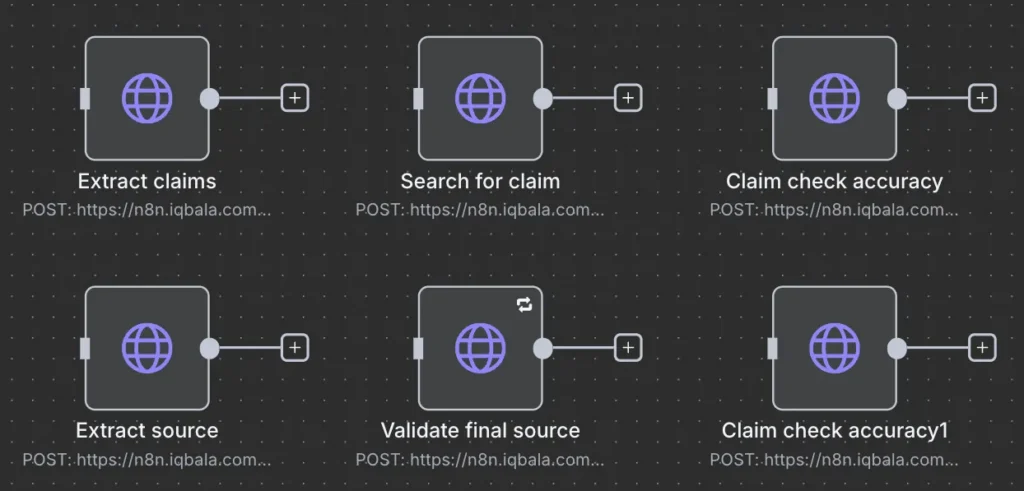
The workflow is structured as a series of interconnected "mini-APIs" or sub-workflows, rather than a single monolithic process. This modular approach allows for greater flexibility, easier debugging, and the potential for future integration into wider software ecosystems. The system operates through five primary stages: claim extraction, neural search, accuracy checking, source extraction, and trusted domain validation.

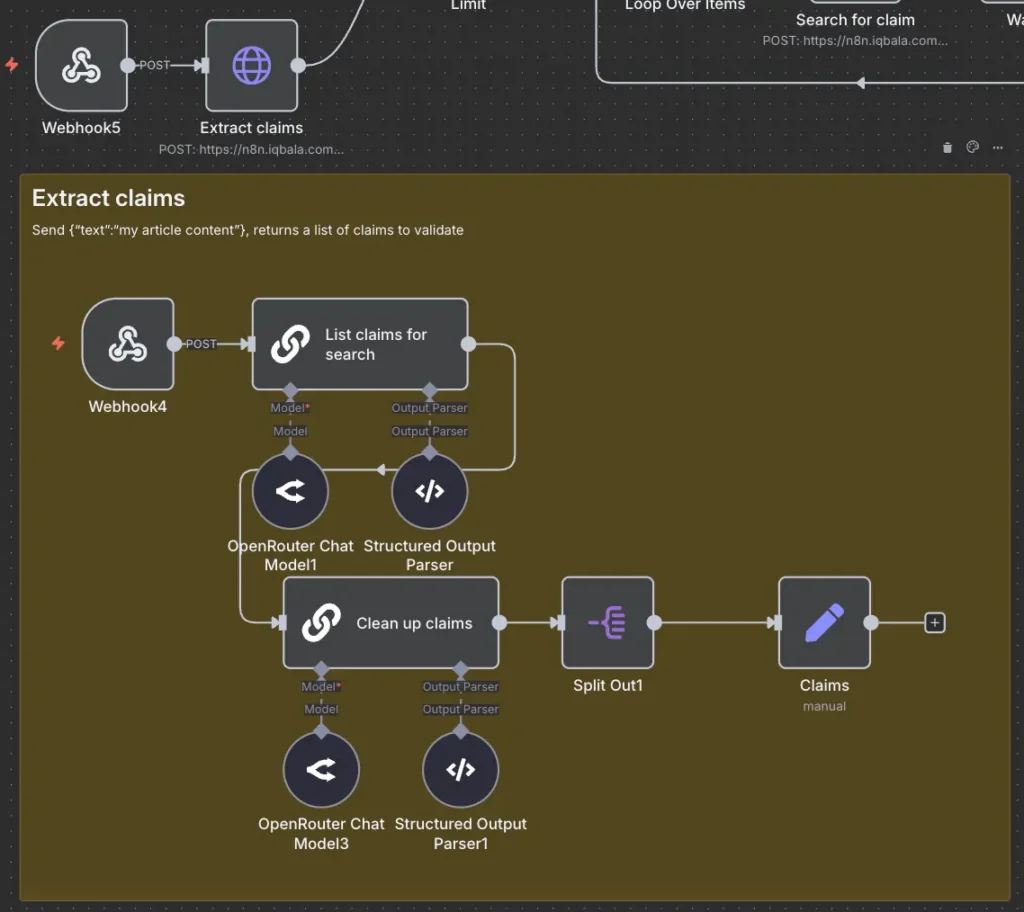
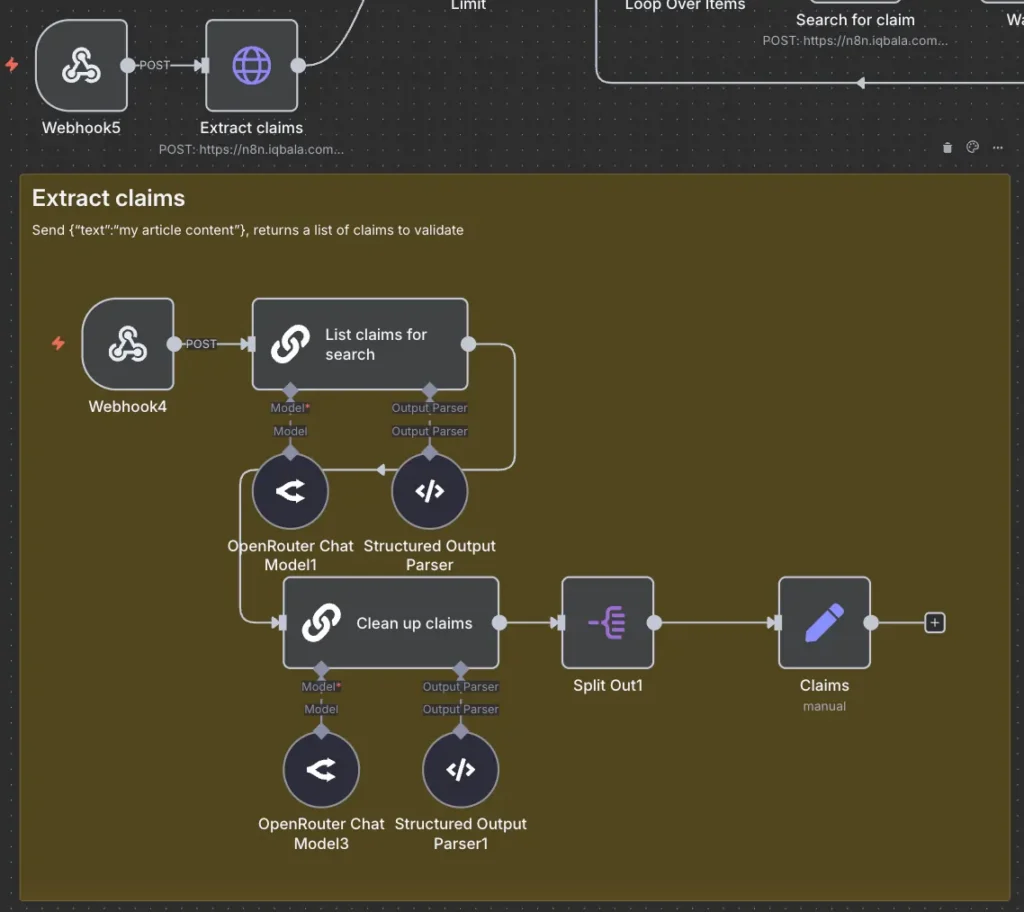
Stage 1: Atomic Claim Extraction and Self-Reflection
The process begins when a rough draft or a segment of text is fed into the system via a webhook. The first sub-workflow utilizes an AI node to parse the text and extract concise, atomic claims. To ensure the fidelity of this extraction, the system employs a "self-reflection" technique. This involves a second AI node that reviews the extracted claims against the original text to verify that no meaning was lost or altered during the distillation process. Research in AI prompt engineering suggests that self-reflection can significantly improve the accuracy of output by forcing the model to critique its own logic before finalizing a response.
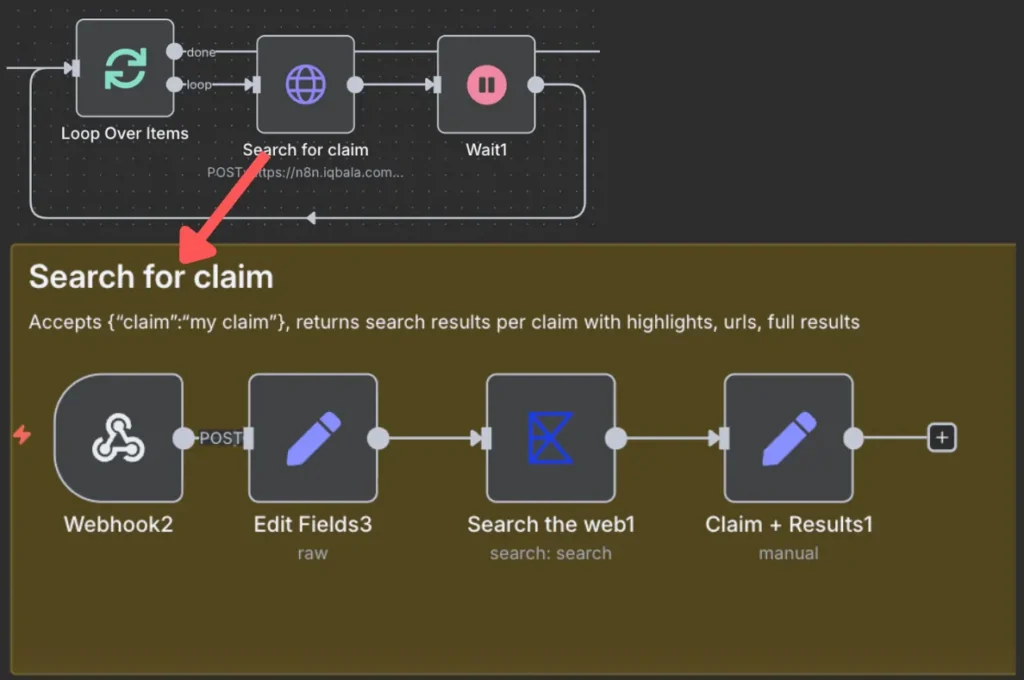
Stage 2: Neural Search via Exa
Once claims are isolated, the system must find external evidence. Traditional search engines often prioritize SEO-optimized content over factual density. To circumvent this, the workflow integrates Exa (formerly Metaphor), a neural search engine designed specifically for LLM applications. Exa uses embeddings to understand the semantic meaning of a query, returning results that are more relevant to the factual nature of the claim than a standard keyword search. Due to API rate limits on the free tier of Exa, Ali’s workflow incorporates a batching mechanism, processing claims in groups of ten with a deliberate one-second delay between batches to ensure system stability.

Stage 3: The "Best-of-Three" Accuracy Assessment
The core of the verification process lies in the "Claim Accuracy Check" sub-workflow. Each claim is paired with the "highlights" or snippets returned by the search engine. To mitigate the non-deterministic nature of AI, the system runs the accuracy check three times. This "best-of-three" approach is a common strategy in computational reliability; if the AI model validates a claim twice but invalidates it once, the system leans toward the majority consensus while flagging the inconsistency for human review. This stage determines whether a claim is likely "True" or requires "Validation False" status.
Stage 4: Source Concatenation and Refinement
If a claim passes the initial accuracy check, the system proceeds to extract and refine the source information. Using models like Google’s Gemma or Meta’s Llama 3.2, the workflow rewrites the source data to be as concise as possible. This ensures that the final output—typically a Google Spreadsheet—is not cluttered with irrelevant metadata, but instead provides a clear, direct reference for the author to cite.
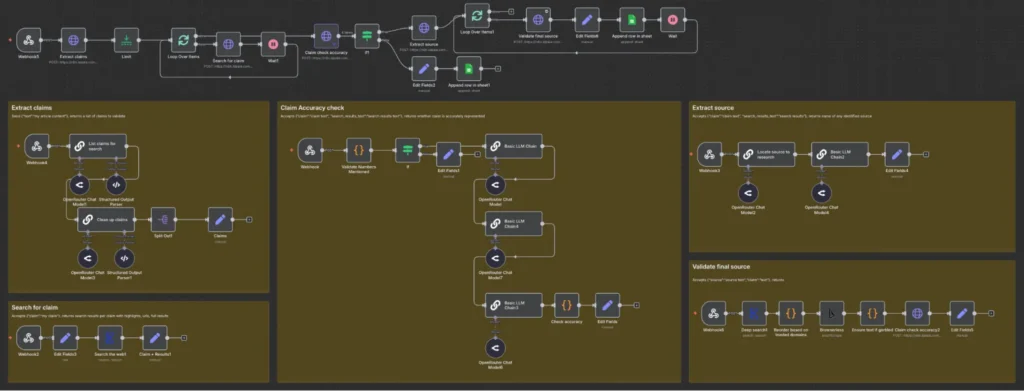
Stage 5: Deep-Dive Validation Against Trusted Domains
The final and most rigorous stage involves validating claims against primary sources. Recognizing that the internet is rife with "circular reporting" (where AI models train on other AI-generated errors), the workflow performs a deep-dive search restricted to a hardcoded list of trusted domains. These might include academic journals, government databases, or reputable news organizations.
This stage utilizes "Browserless," a headless browser service, to navigate to the actual web pages or PDFs identified in the search. By extracting the full page content rather than relying on search snippets, the system can perform a final, high-fidelity accuracy check. Because Browserless is resource-intensive and heavily rate-limited on free tiers, the workflow processes these deep dives one at a time, prioritizing accuracy over speed.
Technical Dependencies and Integration
The functionality of this system is contingent upon several third-party integrations, each serving a specific role in the data pipeline:
- n8n: The orchestration layer that connects various APIs and manages the logic of the workflow.
- Exa API: Provides the semantic search capabilities necessary to find high-quality evidence.
- Browserless: Enables the system to "read" the full text of primary sources, including complex formats like PDFs.
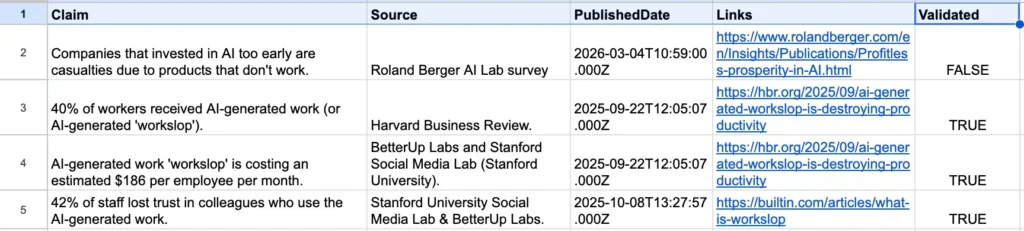
- Google Sheets: Serves as the final repository, where the data is organized into columns: Claim, Source, Published Date, Links, and Validated Status.
- LLMs (Gemma/Llama): Provide the reasoning capabilities for extraction and comparison.
Chronology of Development
The development of this workflow follows a logical progression from manual frustration to automated efficiency:
- Manual Phase: The author attempted to use "Second Brain" methodologies (such as Obsidian or Notion) to track facts during the research phase, finding it inconsistent with the actual writing process.
- Prototyping Phase: A basic n8n workflow was created to extract claims from drafts and run them through standard Google searches.
- Refinement Phase: Recognizing the limitations of standard search, Ali integrated Exa and implemented the "self-reflection" and "best-of-three" nodes to improve reliability.
- Optimization Phase: To manage costs and API limits, batching and rate-limiting loops were added, and the workflow was modularized into the current "mini-API" structure.
- Current Status: The tool is now a functional "human-in-the-loop" assistant that provides a pre-verified spreadsheet of claims, significantly reducing the time required for final article review.
Broader Impact and Implications for the Media Industry
The implications of Ali’s n8n workflow extend beyond individual content creation. In the broader context of the media industry, such tools represent the democratization of fact-checking technology. Historically, only large-scale newsrooms like The New York Times or The Washington Post had the resources to maintain dedicated fact-checking departments. By using low-code tools like n8n and affordable (or free-tier) APIs, independent journalists, small marketing teams, and corporate communications departments can implement a similar level of rigor.
Furthermore, this workflow highlights a shift in how humans interact with AI. Rather than using AI to generate content, it is being used to verify content. This "checker-and-balancer" role for AI is seen by many industry experts as a more ethical and sustainable use of the technology. It acknowledges that while AI is fast, it requires deterministic checks—such as code-based domain filtering and multi-pass validation—to be truly reliable.
Analysis of Limitations and Future Outlook
Despite its sophistication, the workflow is not an absolute arbiter of truth. As Ali notes, a "Validated: FALSE" result does not necessarily mean a claim is incorrect; it may simply mean the system could not find a reputable source within the programmed parameters. The "human-in-the-loop" remains a critical component. The author must still review the spreadsheet, check for context, and make the final editorial decision.
Looking forward, the transition of these workflows into unified API endpoints will likely be the next step in their evolution. This would allow the fact-checking engine to be integrated directly into text editors or Content Management Systems (CMS), providing real-time verification as a writer types. As neural search continues to improve and the cost of high-context LLMs decreases, the speed and accuracy of such systems are expected to reach a point where manual fact-checking becomes the exception rather than the rule for standard informational content.
In conclusion, the n8n fact-checking workflow is a pragmatic solution to a complex modern problem. It leverages the strengths of AI—speed and scale—while implementing structural safeguards to mitigate its weaknesses. For the modern writer, it offers a path toward maintaining high standards of accuracy in an increasingly fast-paced and often unreliable digital information environment.







