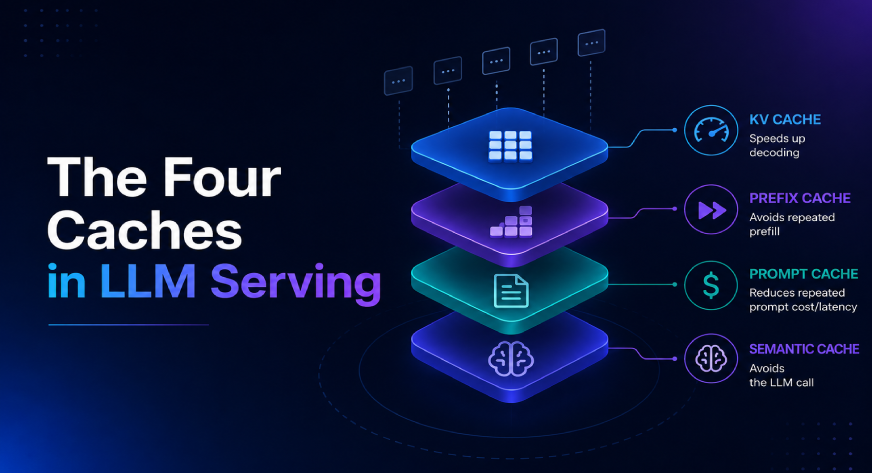
As Large Language Model (LLM) applications transition from experimental prototypes to enterprise-grade production systems, the focus of the artificial intelligence industry has shifted toward the dual challenges of inference latency and operational costs. Modern AI requests are no longer limited to short queries; they frequently involve massive context windows encompassing thousands or even millions of tokens. These inputs include intricate system instructions, multi-turn conversation histories, extensive retrieved documents for RAG (Retrieval-Augmented Generation), and complex tool definitions. Processing this redundant information for every single request represents a significant waste of computational power and time. To address these inefficiencies, the industry has developed a sophisticated hierarchy of caching techniques designed to "remember" previous computations. These techniques—KV caching, prefix caching, prompt caching, and semantic caching—operate at different layers of the serving stack, each offering unique benefits to developers and end-users.
The Evolution of LLM Optimization: A Brief Chronology
The necessity for caching emerged almost immediately after the introduction of the Transformer architecture in 2017. While the original "Attention is All You Need" paper focused on the training of models, the practical application of these models for inference revealed a bottleneck: autoregressive generation. By 2020, as GPT-3 reached 175 billion parameters, the community recognized that recomputing attention states for every new token was unsustainable.
In 2023, the introduction of PagedAttention by researchers at UC Berkeley—which led to the creation of the vLLM project—marked a turning point. This allowed for more flexible memory management, akin to virtual memory in operating systems. Following this, 2024 became the "Year of Prompt Caching," as major API providers like Anthropic, OpenAI, and DeepSeek introduced commercial features allowing developers to cache static parts of their prompts. Today, the landscape is defined by a multi-layered approach where memory efficiency is as critical as model accuracy.
1. KV Caching: The Foundational Layer of Generation
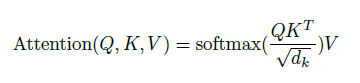
At the most fundamental level of LLM inference lies the Key-Value (KV) cache. Modern LLMs generate text autoregressively, meaning they produce one token at a time. For a model to generate the next word in a sentence, it must look back at all previous tokens to understand the context. This is achieved through the self-attention mechanism, which calculates Key (K) and Value (V) tensors for every token.
In a naive implementation without caching, if a model has generated ten tokens and needs to generate the eleventh, it would recompute the K and V tensors for the first ten tokens all over again. As the sequence length grows, this recomputation follows an $O(n^2)$ complexity, leading to an exponential increase in time and compute requirements. The KV cache solves this by storing the K and V tensors in the GPU’s high-bandwidth memory (HBM). During the "decoding phase," the model only computes the tensors for the single most recently generated token and appends them to the existing cache.
However, the KV cache is generally volatile and request-specific. It exists only for the duration of a single inference session. Once the request is completed, the memory is typically cleared to make room for the next user. While essential for speed within a single response, it does nothing to help when a new user asks a similar question.
2. Prefix Caching: Efficiency Across Concurrent Requests
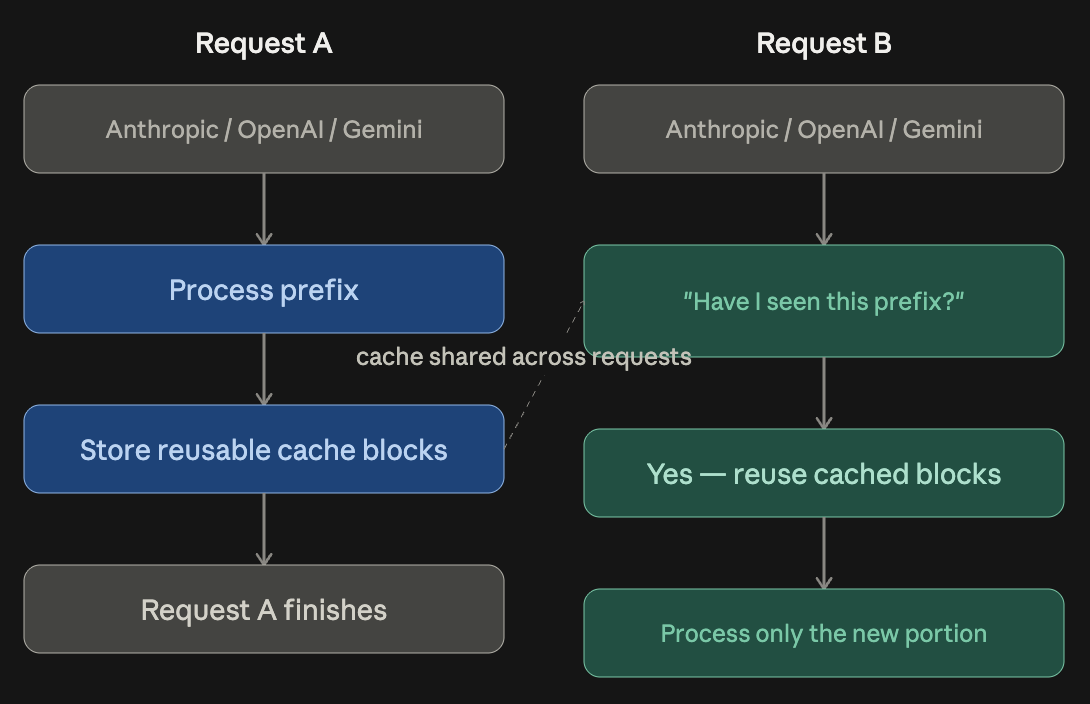
Prefix caching is an architectural optimization typically implemented in self-hosted inference engines like vLLM or NVIDIA TensorRT-LLM. It addresses a common scenario in enterprise applications: multiple different requests that share a common "prefix," such as a long system prompt or a set of company policies.
The Mechanics of Block-Based Hashing
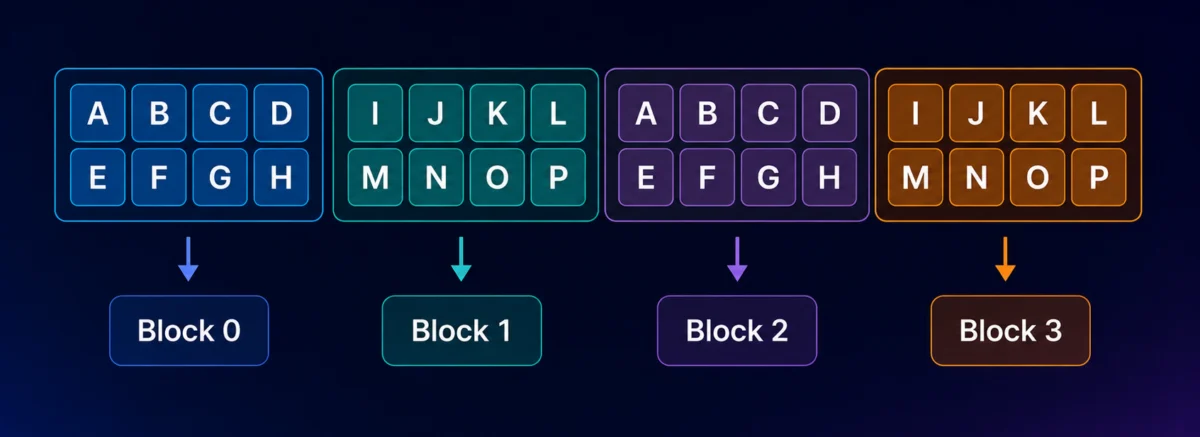
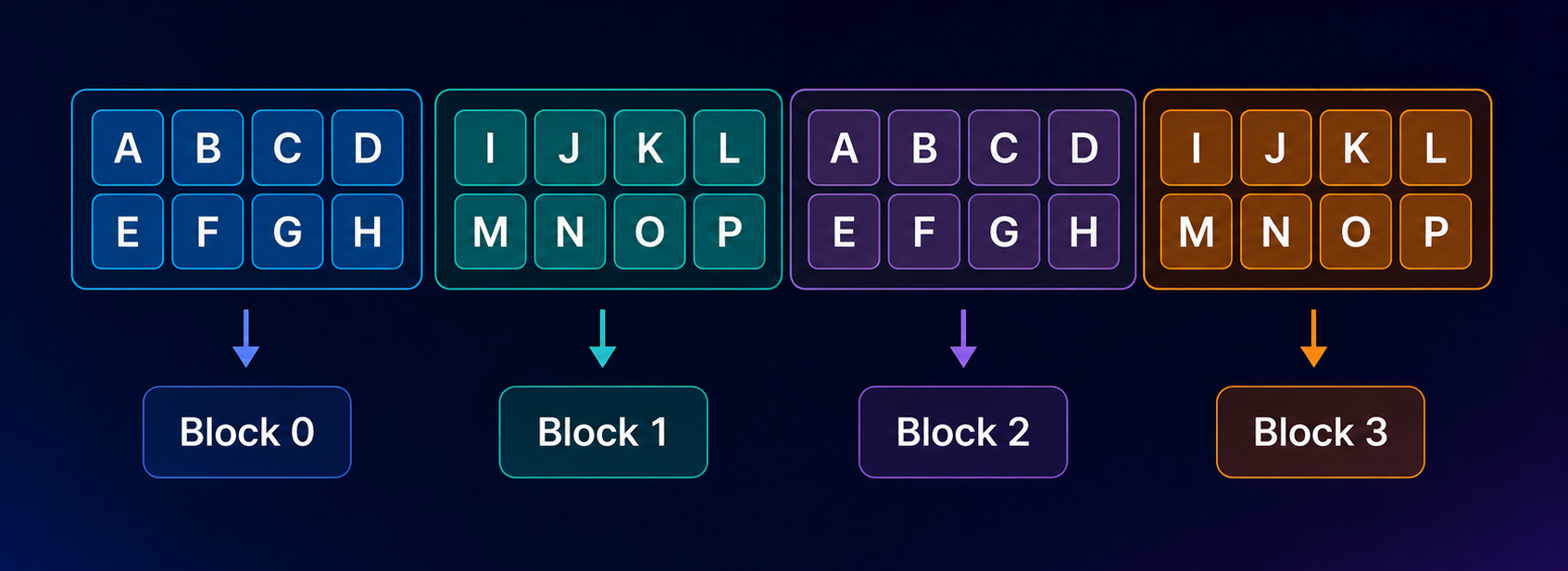
Prefix caching operates by dividing the input prompt into fixed-size blocks of tokens. The system generates a unique hash for each block based on its content and its specific position in the sequence. When a new request arrives, the engine checks its hash table to see if the KV states for those specific blocks have already been computed and stored in a global cache.
Consider a customer service bot where the first 1,000 tokens are always the same manual. Instead of every user’s request triggering a "prefill" phase for those 1,000 tokens, the engine identifies the match and immediately loads the pre-computed KV states. This reduces the "Time to First Token" (TTFT) significantly, as the model skips the most computationally intensive part of the process.
Memory Management and Eviction
Because GPU memory is a finite and expensive resource, prefix caches cannot grow indefinitely. Most modern engines employ a Least Recently Used (LRU) eviction policy. When the cache reaches its capacity, the blocks that have not been accessed for the longest period are discarded to make room for new data. This ensures that the most popular system prompts or documents remain "warm" and ready for immediate reuse.
3. Prompt Caching: The Provider-Managed Solution
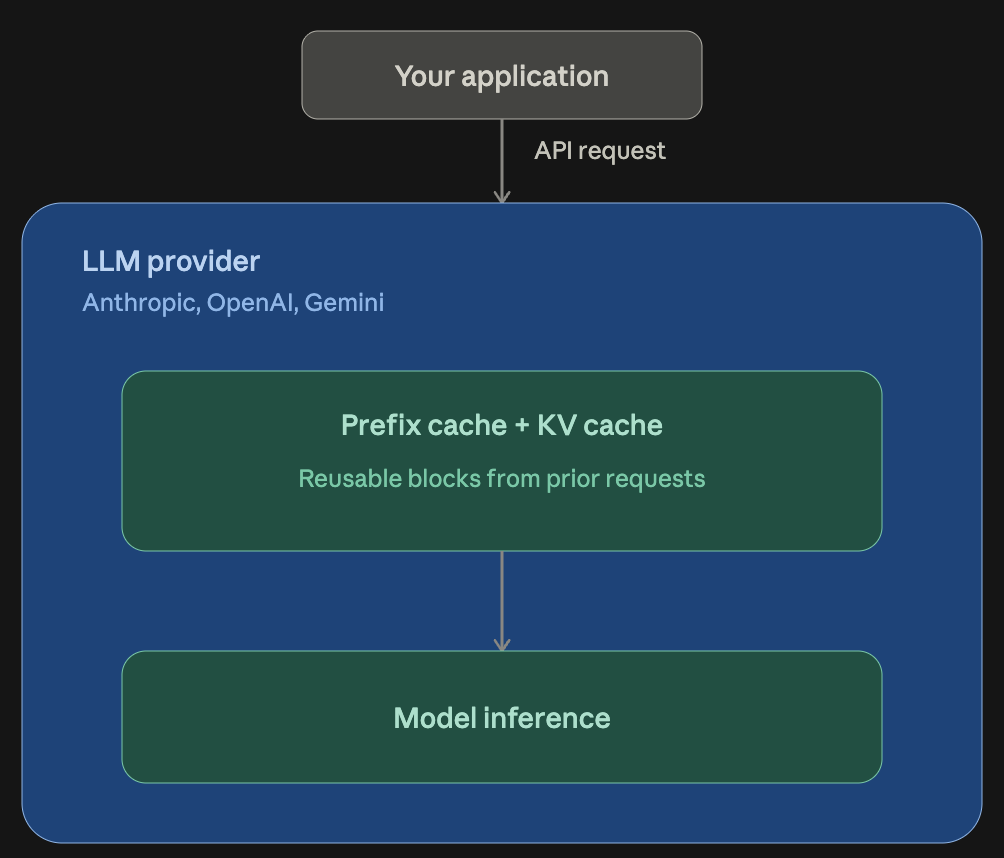
While prefix caching is used by those managing their own hardware, "Prompt Caching" has become the standard term for similar functionality offered by API providers. In this model, the provider (such as OpenAI, Google, or Anthropic) manages the infrastructure, and the developer simply flags which parts of the prompt should be cached.
Supporting Data: The Economics of Caching
The financial implications of prompt caching are profound. Most providers have adopted a pricing model that rewards the use of cached tokens. Below is an analysis of the current market rates as of late 2024:
| Provider | Model Example | Cache Hit Cost | Cache Write/Miss Cost |
|---|---|---|---|
| OpenAI | GPT-4o | ~50% Discount | Standard Rate |
| Anthropic | Claude 3.5 Sonnet | ~10% of Base Cost | ~1.25x Base Cost |
| DeepSeek | DeepSeek-V3 | ~0.01x Base Cost | Standard Rate |
| Gemini 1.5 Pro | Reduced Rate + Storage Fee | Standard Rate |
For applications with massive context—such as legal document analysis where a 100,000-token document is queried repeatedly—these discounts can reduce monthly API bills by over 80%. However, developers must ensure their prefixes are "stable." Adding a dynamic element like a timestamp or a unique user ID at the beginning of a prompt will change the hash and break the cache, forcing a full recomputation.
4. Semantic Caching: Avoiding the Model Entirely
Semantic caching represents a paradigm shift from the previous three methods. While KV, Prefix, and Prompt caching focus on speeding up the model’s work, semantic caching aims to avoid calling the model altogether.
Meaning Over Matching
Traditional text caching requires an exact string match. However, in natural language, two different strings can mean the same thing. For example, "How do I reset my password?" and "What are the steps for a password reset?" are semantically identical. A semantic cache uses vector embeddings to represent the "meaning" of a query as a point in high-dimensional space.
When a new query arrives, the system calculates its embedding and performs a similarity search against a database of previously answered questions (using tools like Redis, Milvus, or Pinecone). If the similarity score is above a certain threshold (e.g., 0.95), the system returns the cached answer immediately.
The Accuracy Trade-off
The primary risk of semantic caching is "false positives." If the threshold is set too low, the system might return an answer for a slightly different question, leading to hallucinations or outdated information. Consequently, semantic caches are best suited for static knowledge bases or FAQ-style bots rather than highly dynamic or personalized applications.
Broader Impact and Industry Implications
The implementation of these caching layers is fundamentally changing how AI products are built. By reducing the cost of processing long contexts, caching is enabling the "Long Context Era." Developers can now include entire codebases or books in their prompts without fearing a prohibitive bill for every follow-up question.
From a sustainability perspective, caching is a critical component of "Green AI." LLM inference is energy-intensive; by reusing computations, data centers can significantly reduce their carbon footprint per request. Furthermore, for the end-user, these optimizations translate to a more fluid, human-like interaction. The "typing" effect of an LLM becomes nearly instantaneous when the heavy lifting of context processing has been offloaded to a cache.
As we look toward the future, the next frontier is multimodal caching. With models now processing images, audio, and video, the need to cache "visual tokens" or "audio features" will become the next major hurdle. The principles established by KV and prefix caching will likely serve as the blueprint for these upcoming innovations, ensuring that as AI grows more capable, it also remains economically and computationally viable.
In conclusion, caching is not a single feature but a comprehensive strategy. By integrating KV caching for generation, prefix caching for shared infrastructure, prompt caching for API cost-reduction, and semantic caching for high-frequency queries, organizations can build AI systems that are both powerful and sustainable. The mantra for modern AI engineering is clear: do not pay—in time or money—for work that has already been done.