rifanmuazin
The landscape of artificial intelligence reached a significant milestone in April 2026 with the official release of Grok Voice Think Fast 1.0, a sophisticated voice agent developed by xAI that introduces full-duplex communication and integrated background reasoning. Distinguishing itself from traditional voice-to-text-to-voice pipelines, this model secured the premier position on the $tau$-voice Bench leaderboard immediately upon its debut. The release marks a departure from the latency-heavy interfaces of the past, offering a seamless, rational, and uninterrupted exchange that mimics human dialogue more closely than any predecessor in the generative AI era.
The Evolution of Voice Interaction: From Stepwise Processing to Unified Reasoning
To understand the impact of Grok Voice Think Fast 1.0, one must examine the limitations of previous voice AI architectures. Traditionally, voice assistants have operated through a fragmented three-step process: Speech-to-Text (STT), followed by Large Language Model (LLM) processing, and concluding with Text-to-Speech (TTS) synthesis. This serial execution created a perceptible lag, often referred to as the "uncanny valley" of conversation, where pauses lasted just long enough to disrupt the natural flow of human interaction.
xAI has addressed this bottleneck by unifying recognition, reasoning, and response into a single, continuous feedback loop. This "background reasoning" capability allows the model to process complex queries while simultaneously generating audio. Unlike older systems that required a user to stop speaking entirely before the AI began its computation, Grok Voice Think Fast 1.0 can navigate intricate logical problems in real-time. This full-duplex capability—meaning the system can send and receive data simultaneously—permits users to interrupt the AI, clarify points mid-sentence, or change the direction of a conversation without causing a system hang or a reset of the logic chain.
Technical Benchmarks and the Problem of "Confident Incorrectness"
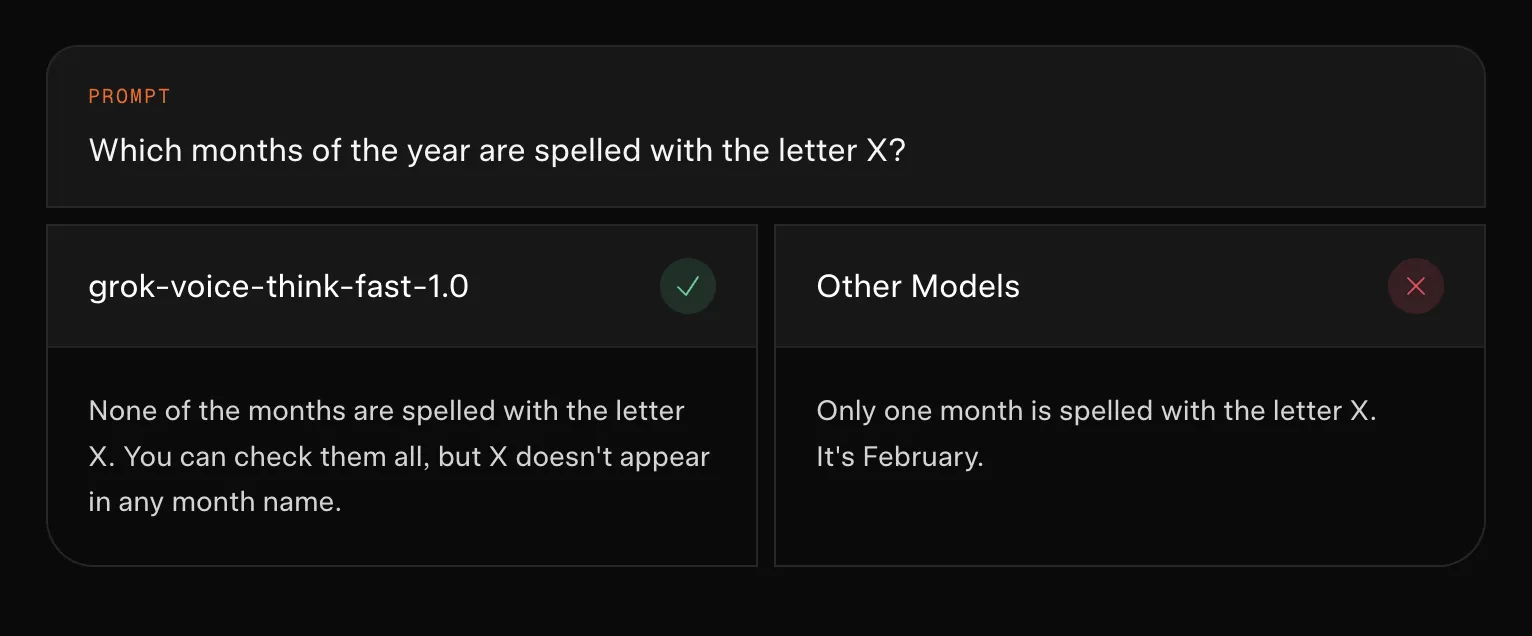
A critical challenge in conversational AI has been the tendency of models to prioritize speed over accuracy, leading to "hallucinations" or confidently delivered errors. During the xAI launch demonstration, developers highlighted a specific edge-case query: "What are the names of the months that are spelled with an ‘X’?"
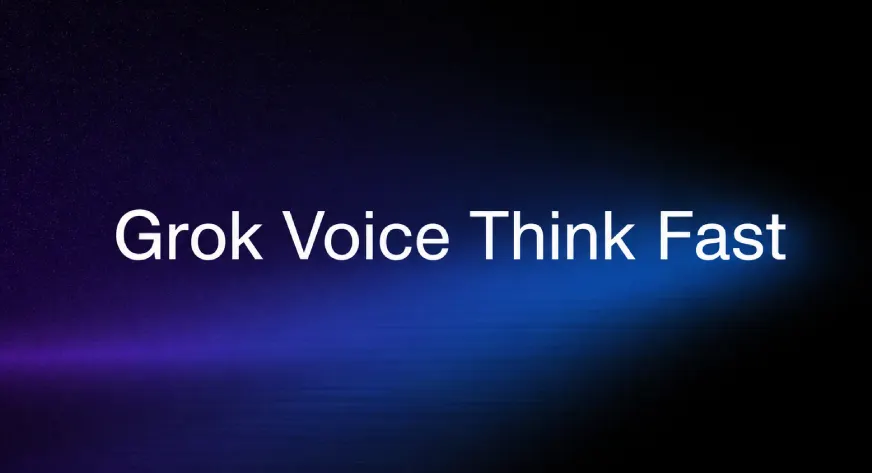
While competing models frequently responded with incorrect answers such as "February" or "Ex-september" due to phonetic processing errors or predictive text patterns, Grok Voice Think Fast 1.0 utilized its background reasoning to verify the data against a factual database before speaking. The model correctly identified that no month in the standard Gregorian calendar contains the letter ‘X’. For enterprise-level applications, where a single incorrect financial figure or product detail can jeopardize high-stakes negotiations, this shift from "fast-but-flawed" to "fast-and-accurate" represents a necessary evolution for commercial adoption.
A Chronology of xAI’s Development Path
The arrival of Grok Voice Think Fast 1.0 in April 2026 was the culmination of a rapid development cycle that began with the release of the initial Grok-1 model in late 2023. By mid-2025, with the launch of Grok-4, xAI had established a reputation for high-compute efficiency and reduced bias.
Throughout late 2025, xAI focused on infrastructure, utilizing the "Colossus" supercomputer cluster to train the multimodal components necessary for low-latency voice interaction. The $tau$-voice Bench leaderboard, which measures voice agents based on latency, emotional resonance, and logical consistency under pressure, became the primary target for the xAI engineering team. By the first quarter of 2026, internal testing showed that xAI had achieved a 50% reduction in response latency compared to the 2025 industry standard.
Economic Impact and Market Positioning: The Pricing Strategy
The commercial viability of voice agents is largely dictated by operational costs. xAI has entered the market with a pricing structure designed to undercut established competitors, specifically targeting OpenAI’s Realtime API.
| API Surface | Price | Primary Use Case |
|---|---|---|
| Voice Agent (grok-voice-think-fast-1.0) | $0.05/minute | Live conversations, real-time tool calling |
| Speech to Text: Batch | $0.10/hour | Transcription of pre-recorded files (25+ languages) |
| Speech to Text: Streaming | $0.20/hour | Real-time WebSocket transcription |
| Text to Speech | $4.20/1M characters | Content creation with 5 distinct voices |
In a practical application, a standard 10-minute customer support interaction utilizing Grok Voice Think Fast 1.0 would cost approximately $0.60, factoring in both the connection time and potential tool calls (such as checking a database or a web search). By comparison, industry analysts note that OpenAI’s equivalent services typically cost $0.10 per minute, placing xAI at exactly half the price point. Furthermore, xAI has maintained compatibility with the OpenAI Realtime specification, effectively lowering the barrier for developers to migrate existing workflows to the xAI ecosystem without requiring extensive code refactoring.
Strategic Applications in Enterprise and Career Development
The versatility of the Grok Voice Think Fast 1.0 model is best demonstrated through specialized "agentic" workflows. Unlike simple chatbots, these voice agents are designed to execute multi-step tasks autonomously.
Automated Sales and Enrollment
In the sales sector, xAI’s interface allows for the creation of agents that do more than just read scripts. A sales bot configured for a high-value program—such as the Agentic AI Pioneer Program—can be programmed to qualify prospects, handle objections with empathy, and direct users toward enrollment links. The background reasoning allows the agent to listen for "pain points" in a user’s speech—such as concerns about career growth or budget—and pivot its persuasive strategy in real-time.
Advanced Career Counseling
The model’s integration with live web search transforms it into a dynamic advisor. A career counseling agent can now access real-time job market data, salary trends, and certification requirements during a conversation. This removes the reliance on static training data, which often becomes obsolete within months in the fast-moving technology sector. By asking probing questions about a user’s education and constraints, the agent provides a personalized three-step action plan, moving beyond generic advice to provide actionable, data-backed guidance.
Industry Reactions and Market Implications
The release has prompted a flurry of reactions from tech analysts and industry leaders. Market observers suggest that the primary beneficiaries of this technology will be Business Process Outsourcing (BPO) firms and customer service centers. If a voice agent can resolve 70% of routine inquiries with the same level of nuance as a human representative but at a fraction of the cost, the economic shift for global service industries will be profound.
However, the rapid advancement of such realistic voice AI also raises concerns regarding security. Security experts have noted that the low-latency, high-accuracy nature of Grok Voice Think Fast 1.0 could be exploited for sophisticated social engineering or deepfake audio scams. In response, xAI has integrated safety protocols intended to prevent the cloning of unauthorized voices and the generation of deceptive content, though the efficacy of these measures remains a subject of ongoing debate among cybersecurity professionals.

Avoiding Common Pitfalls in Voice Agent Implementation
As developers begin integrating Grok Voice Think Fast 1.0 into their platforms, xAI has provided guidelines to maximize the model’s effectiveness. A common mistake is the use of overly rigid system prompts. Because the model is capable of reasoning, developers are encouraged to provide "objectives" rather than "scripts."
Another frequent error involves underestimating the power of tool-calling. By not enabling features like web search or API access, developers limit the agent to its internal knowledge base, which may not reflect current events. Lastly, xAI emphasizes the importance of "tone setting." The choice between the five available voice personas—Ara, Eve, Leo, Rex, and Sal—should be dictated by the specific context of the interaction, whether it be the authoritative tone required for a medical advisor or the friendly demeanor suitable for a sales assistant.
Conclusion: The Future of Agentic AI
Grok Voice Think Fast 1.0 represents a significant leap toward the realization of truly autonomous AI agents. By solving the latency and reasoning gaps that plagued earlier generations of voice technology, xAI has moved the industry closer to a future where AI does not just respond to questions but actively manages workflows.
For developers and enterprises, the message is clear: voice is no longer just an accessibility feature or a novelty interface. It has become a robust, cost-effective, and highly intelligent tool for business operations. As these agents continue to integrate more deeply with real-world APIs and live data, the boundary between human-led and AI-augmented services will continue to blur, ushering in a new era of digital interaction characterized by speed, accuracy, and unprecedented reasoning capabilities.