Retail media, a burgeoning advertising channel where brands pay to promote their products on e-commerce platforms and retailer websites, is experiencing explosive growth, projected to surpass $140 billion globally in 2024 and reaching an estimated $69.33 billion in the United States by 2026. While offering unprecedented proximity to purchase decisions and the potential for highly targeted campaigns, this powerful advertising ecosystem presents a complex value proposition. Its ultimate success hinges on whether it generates genuinely new demand for advertisers or merely shifts existing sales and associated margins, a critical distinction impacting both brands and the retailers who host these ads.
The foundational concept of retail media advertising is straightforward: retailers leverage their digital storefronts and customer data to offer advertising placements to brands. Amazon Sponsored Products stands as the most recognizable example, allowing sellers to pay for prominent visibility for their products directly within Amazon’s search results and product pages. However, the value generated by this advertising model is not uniform. For advertisers, the ideal scenario involves retail media campaigns that create incremental sales – purchases that would not have occurred without the advertising investment. In such cases, the advertising expenditure contributes to genuine business growth and increased profitability.
Conversely, a significant concern within the industry is that retail media can inadvertently cannibalize existing sales. This occurs when advertising spend merely influences a purchase that was already highly probable, effectively rerouting a sale that would have happened organically. In this dynamic, the retailer benefits by capturing advertising revenue, while the advertiser might incur additional costs without a corresponding increase in overall sales volume or profit. This potential for margin erosion, particularly when sales are not incremental, has been highlighted in academic research and industry analyses, raising questions about the true return on investment for many brands participating in the retail media space.
The Rapid Ascent of Retail Media
The trajectory of retail media advertising is nothing short of remarkable. A comprehensive paper published in the Journal of Retailing in 2025 estimated global retail media spending at over $140 billion for 2024, with the United States accounting for a substantial $54 billion of that figure. Looking ahead, eMarketer’s forecasts paint an even more robust picture, projecting U.S. retail media ad spend to reach $69.33 billion in 2026. This represents a significant year-over-year increase of 17.9% from 2025, underscoring the accelerating adoption and investment in this advertising channel. This surge is fueled by several factors, including the increasing dominance of e-commerce, the wealth of first-party data that retailers possess about consumer behavior, and the desire of brands to reach consumers at critical moments in their shopping journeys.
The timeline of retail media’s evolution can be traced back to early sponsored product listings on major e-commerce platforms. What began as a relatively simple way for sellers to gain visibility has since blossomed into a sophisticated ecosystem offering a wide array of ad formats, targeting capabilities, and measurement tools. Major retailers like Walmart, Target, and Kroger have all launched their own retail media networks, transforming their digital properties into powerful advertising platforms. This trend has also extended to grocery delivery services and even direct-to-consumer brands with significant online presences, further diversifying the retail media landscape.
Navigating the Retail Media Landscape: A Dual Role
E-commerce companies and brands can engage with the retail media market from two distinct vantage points: as advertisers and as publishers. For merchants operating on large marketplaces such as Amazon, Walmart, or other third-party platforms, the primary engagement is often as an advertiser. In this capacity, they utilize retail media tools to enhance their product visibility, drive traffic to their listings, and ultimately convert more shoppers into buyers. The ability to place ads directly alongside product search results or on category pages offers an unparalleled advantage in capturing consumer attention when purchase intent is at its peak.
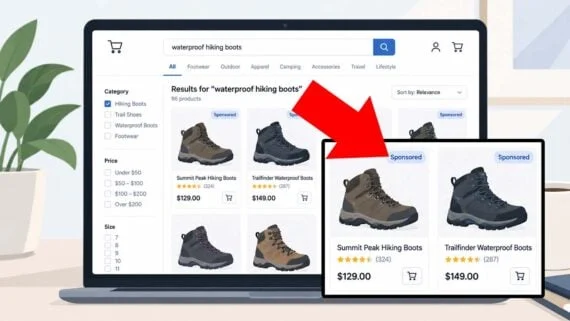
For instance, a brand selling outdoor gear might advertise its "waterproof hiking boots" on a major e-commerce site. A shopper actively searching for this specific product demonstrates a clear intent to purchase. Placing an advertisement for these boots directly within those search results ensures the brand is visible at the precise moment the consumer is ready to make a decision, significantly increasing the likelihood of a conversion.
However, the same companies can also participate as publishers. A brand with its own e-commerce website can transform its own digital storefront into an advertising channel. This involves selling ad placements on its site and potentially leveraging its email list to promote products or services. This dual role allows retailers and brands to not only advertise on external platforms but also to monetize their own digital assets and customer relationships. This creates a closed-loop advertising system where data can be shared and utilized more effectively across both buying and selling activities.
The Crucial Metric: Value Creation vs. Margin Shifting
The true measure of success in retail media advertising lies in its ability to create incremental value for advertisers. Consider a scenario where a brand invests $1,000 in a retail media campaign and, as a direct result, generates $5,000 in sales that it would not have otherwise achieved. If these incremental sales contribute $1,500 in gross profit (before advertising costs), then the campaign has effectively generated a net benefit of $500 ($1,500 profit – $1,000 ad spend). This is a clear instance of value creation, where the advertising investment has directly contributed to business growth and profitability.
The economic implications shift dramatically when the attributed sales would have occurred irrespective of the advertising expenditure. Imagine a marketplace where a seller consistently ranks well organically for certain keywords. If the marketplace then introduces more sponsored placements, and competitors begin bidding for these spots, the original seller might find itself compelled to spend money on advertising simply to maintain its previous organic visibility and sales. If a seller now has to spend $5 on advertising to secure a $50 sale that it previously achieved without that expense, the advertising has not created new value for the seller; instead, it has become an added cost of doing business. In such cases, while the marketplace garnoys advertising revenue, the advertiser’s profitability may stagnate or even decline.

This concern is not merely theoretical. The Journal of Retailing report, among other industry analyses, has voiced apprehensions that retail media can diminish advertisers’ margins when the sales attributed to these campaigns are not truly incremental. The ease with which sales can be attributed to advertising on these platforms can mask underlying issues of efficiency and genuine demand generation.
The Peril of Lowered Profitability for Retailers
Beyond the advertiser’s perspective, retail media advertising also presents potential risks for the retailers acting as publishers. The introduction of sponsored placements, while an attractive revenue stream, can inadvertently undermine a retailer’s own profitability and customer experience if not managed carefully.
Consider a retailer whose category page consistently generates $100,000 in monthly merchandise sales, yielding a gross profit of $30,000. If a supplier agrees to pay $3,000 per month for a prominent advertising placement on this page, it might seem like a straightforward increase in margins, bringing the total to $33,000. However, the situation becomes more complex if the sponsored placement displaces the retailer’s own direct conversions. For example, if the highly visible sponsored product takes sales away from the retailer’s own branded or generic offerings, the gross profit from product sales might fall from $30,000 to $28,000. In this scenario, the retailer has collected $3,000 in media revenue, but the overall gain to its bottom line is only $1,000 ($28,000 product profit + $3,000 media revenue – $30,000 original product profit).
The situation can be even more detrimental. If the sponsored placement leads to a significant drop in direct conversions, causing the gross profit from product sales to plummet to $26,000, then the $3,000 in retail media revenue actually lowers the retailer’s overall margin by $1,000 ($26,000 product profit + $3,000 media revenue – $30,000 original product profit). In essence, advertising revenue has increased, but the underlying business performance has declined.
This risk extends beyond individual product placements. An excessive number of sponsored products, irrelevant recommendations, or poorly integrated advertising units can degrade the overall shopping experience. Such an environment can make a website harder to navigate, erode customer trust, and ultimately lead to reduced conversion rates over time. The long-term consequences of a compromised user experience can far outweigh the short-term gains from advertising revenue.
Measuring True Impact: Beyond Return on Ad Spend
For advertisers operating on large marketplaces, relying solely on metrics like Return on Ad Spend (ROAS) can be misleading. An advertiser achieving an $8 return for every $1 spent on advertising might still not be generating incremental value if those $8 in sales would have materialized organically. The critical question for advertisers is not just how much revenue advertising generates, but whether that advertising changed the outcome. Did it bring in new customers? Did it drive sales that would have otherwise gone to a competitor?
To accurately assess the incremental impact of retail media campaigns, sophisticated advertisers often employ rigorous methodologies. These include randomized controlled experiments (A/B testing), advanced marketing mix modeling (MMM), geo-testing, and incrementality studies. These methods aim to isolate the true effect of advertising by comparing the performance of exposed groups to control groups that did not see the ads.
Smaller companies, while perhaps lacking the resources for complex statistical models, can adopt simpler yet effective approaches. These might involve closely monitoring new-customer acquisition rates driven by campaigns, tracking organic sales performance during and after advertising periods, and analyzing sales trends in periods with and without specific advertising initiatives. The goal is to gain insight into whether the advertising expenditure is genuinely expanding the customer base and driving additional revenue, rather than simply influencing existing purchasing patterns.
The Verdict: Incremental Value is Key
Ultimately, retail media is neither an inherent win nor an automatic loss. Its success is contingent on its ability to deliver genuine value to both sides of the transaction. For advertisers, retail media is a winning strategy if it demonstrably creates profitable new demand – sales that would not have occurred otherwise. If, however, it merely adds cost to conversions that were already likely, it represents a loss of efficiency and profitability.
Similarly, for retailer-publishers, retail media adds value only when it results in a higher net margin. This means the advertising revenue generated must exceed any potential erosion in direct product sales profit and the costs associated with managing the advertising platform. The distinction between creating incremental value and simply shifting existing revenue is paramount for both advertisers seeking effective marketing channels and retailers aiming to build sustainable and profitable businesses. This nuanced understanding is crucial for navigating the complex and rapidly evolving retail media landscape.