X, the social media platform formerly known as Twitter, has significantly enhanced its "Under the Hood" transparency features, providing users with unprecedented insight into how local legal compliance can impact the visibility and reach of their posts and profiles. This move represents a further step in the company’s stated commitment to increased openness regarding content moderation and algorithmic processes, aiming to demystify instances where content may be restricted or accounts penalized due to adherence to various national and regional laws. The expansion directly addresses long-standing user concerns about opaque content limitations, often referred to as "shadowbanning," and offers a clearer understanding of the forces shaping digital discourse across different jurisdictions.
Background to X’s Transparency Drive
The journey towards greater transparency at X has been a prominent theme since Elon Musk’s acquisition of the platform in late 2022. Musk frequently articulated a vision centered on "free speech absolutism" and a radical commitment to transparency, which he argued was lacking under previous management. This philosophy first manifested publicly through the controversial "Twitter Files," a series of internal documents released to select journalists. These files purported to expose past content moderation practices, including decisions related to specific accounts and controversial topics, aiming to shed light on what Musk characterized as politically motivated censorship. While the "Twitter Files" generated considerable debate and polarized opinions, they laid the groundwork for a broader platform-wide initiative to make internal workings more visible to users.
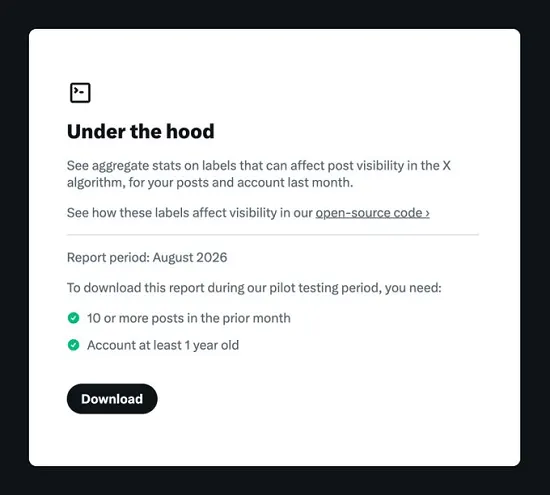
Prior to the latest update, the platform launched its initial "Under the Hood" update last month. This foundational release provided users with a simplified reporting function, enabling them to directly view any penalties or restrictions that had been applied to their specific posts or accounts. This initial phase was well-received by many users who had previously felt their content was being suppressed without explanation. It offered a crucial first step in allowing individuals to understand if their content had been demoted, labeled, or otherwise impacted by X’s internal policies, moving away from the often-speculative realm of "shadowbanning" accusations. The primary goal was to offer clarity on how X’s source code functions and how its moderation policies translated into real-world impacts on user engagement and visibility.
The Evolution: Local Laws and Global Content
The current expansion builds upon this foundation by introducing a critical new layer of transparency: the impact of government-required content filtering. As X explained, "We’ve expanded Under The Hood after seeing people’s appreciation of more transparency into government-required content filtering. In addition to showing labels applied to your account and posts in the prior month, Under The Hood now shows if your account or posts had their visibility limited because of required compliance with local law(s). For example, you can see if any of your posts were withheld in a country following a legal demand – and which country."
This specific focus on legal demands from governments is highly significant in the complex landscape of global content moderation. Social media platforms, by their very nature, operate across borders, yet they are simultaneously subject to the diverse and often conflicting laws of individual nations. What is considered protected speech in one country might be deemed illegal hate speech, defamation, or a violation of national security in another. For instance, Holocaust denial is illegal in Germany but protected under free speech laws in the United States. Similarly, content critical of a particular government might be permissible in many democracies but prohibited in authoritarian regimes.
Platforms like X routinely receive thousands of legal demands from governments worldwide to remove content, restrict access to certain accounts, or provide user data. According to X’s own Transparency Report (latest available data, though this varies by reporting period and platform), in the latter half of 2022, Twitter (now X) received over 50,000 legal demands from governments, impacting a substantial number of accounts and pieces of content. While specific numbers for the current period under X are not yet fully available, the trend across major social media platforms indicates a consistent increase in such demands globally. For example, Meta (Facebook, Instagram) reported restricting over 117,000 pieces of content based on local law in the first half of 2023, while Google (YouTube) reported over 54,000 removal requests in the same period. This illustrates the immense pressure platforms face to comply with local regulations, often leading to geo-blocking content (making it inaccessible in specific countries) or outright removal.
Implications for Users and Creators
The expanded data insights are poised to significantly alleviate concerns around "shadowbanning" by providing concrete, verifiable reasons for content restrictions. For an average user, this means they can now ascertain whether their post simply failed to gain traction, or if its reach was deliberately curtailed due to a specific moderation action or, crucially, a government directive. This level of granular detail was previously unavailable and often led to frustration and distrust.
For content creators, particularly those participating in X’s creator monetization program, this transparency is invaluable. Understanding the precise factors influencing post reach and performance is directly tied to their ability to earn revenue. If a creator’s content is being geo-blocked in a significant market due to local laws, they can adjust their content strategy or messaging to better navigate these restrictions. This insight empowers creators to optimize their presence on the platform, fostering a more predictable environment for their digital livelihoods. Without this clarity, creators might mistakenly attribute reduced engagement to algorithmic bias or a lack of audience interest, when the real cause could be a legal injunction in a key demographic region.
Digital rights advocates and civil liberties organizations have long called for greater transparency from social media companies regarding government requests. Organizations like Access Now and the Electronic Frontier Foundation (EFF) consistently highlight the importance of platforms informing users when their content is taken down or restricted due to legal demands. This new feature from X aligns with these advocacy efforts, allowing users to understand when their freedom of expression is being curtailed not by platform policy alone, but by external governmental pressures. This distinction is critical for public discourse and holding governments accountable for their censorship efforts.
Implementation and Accessibility
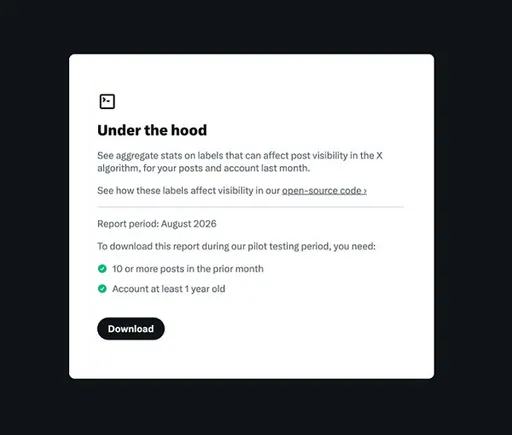
X has outlined specific criteria for accessing these expanded insights. The new transparency feature will be available for all accounts that are at least one year old and have posted more than 10 times in the previous month. These requirements likely aim to ensure that the data is provided to active, established users, while potentially filtering out inactive or newly created accounts that might not have a significant history of moderation actions. The interface is expected to be integrated directly into the existing "Under the Hood" section of a user’s account settings, offering a streamlined way to review historical data on post and account performance, including any labels or restrictions applied.
The Broader Context: Navigating a Fragmented Digital World
The expansion of X’s transparency tools comes at a time when the regulatory landscape for social media platforms is becoming increasingly complex and fragmented. Nations worldwide are enacting their own digital services laws, data privacy regulations, and content moderation guidelines. Examples include the European Union’s Digital Services Act (DSA), which mandates increased transparency from platforms regarding content moderation decisions and algorithmic amplification; India’s IT Rules, which place significant obligations on platforms to remove content deemed unlawful; and various national laws in countries like Turkey, Russia, and Vietnam that often demand the removal of content critical of the government or state institutions.
This global patchwork of regulations creates a difficult balancing act for platforms. On one hand, they face pressure from governments to comply with local laws to avoid fines, bans, or other penalties. On the other hand, they face scrutiny from users and civil society groups who advocate for free expression and resist what they perceive as undue censorship. X’s approach seeks to navigate this by being transparent about when and where content is restricted due to legal demands, effectively shifting some of the burden of understanding these restrictions onto the user, but also providing the tools to do so.
This move could be seen as an attempt by X to enhance its credibility and demonstrate its commitment to user rights within the bounds of legal compliance. By explicitly stating that a post was "withheld in a country following a legal demand – and which country," X provides users with verifiable information that can be used to understand the broader geopolitical context of content moderation. This contrasts sharply with previous eras where such actions were often opaque, leading to widespread speculation and accusations of arbitrary censorship.
Potential Challenges and Future Outlook
While the expansion of "Under the Hood" is a positive step, it is not without potential challenges. The sheer volume and complexity of legal demands from various governments mean that X will need robust systems to accurately track and report these actions. Users will also need to interpret this information, understanding that a restriction due to "local law" does not necessarily imply wrongdoing on their part, but rather reflects the legal framework of a particular jurisdiction.
Moreover, the line between legitimate legal demands and politically motivated censorship can sometimes be blurry, particularly in countries with less robust democratic institutions. While X’s transparency allows users to see the restriction and the country, it doesn’t necessarily provide an immediate avenue for appeal against the government’s legal demand itself. However, it empowers users with information that can be used in advocacy efforts or legal challenges within their own countries.
In conclusion, X’s latest expansion of its "Under the Hood" features marks a significant evolution in platform transparency. By providing granular insights into how local legal compliance impacts content visibility, X is empowering its users, particularly creators, with crucial information that was previously obscured. This initiative not only addresses long-standing user concerns about opaque content moderation but also positions X as a leader in navigating the complex interplay between global digital platforms, diverse national laws, and the fundamental right to freedom of expression in an increasingly regulated online world. The success of this initiative will largely depend on X’s consistent commitment to accuracy and the continued evolution of these tools to meet the demands of a dynamic global digital environment.