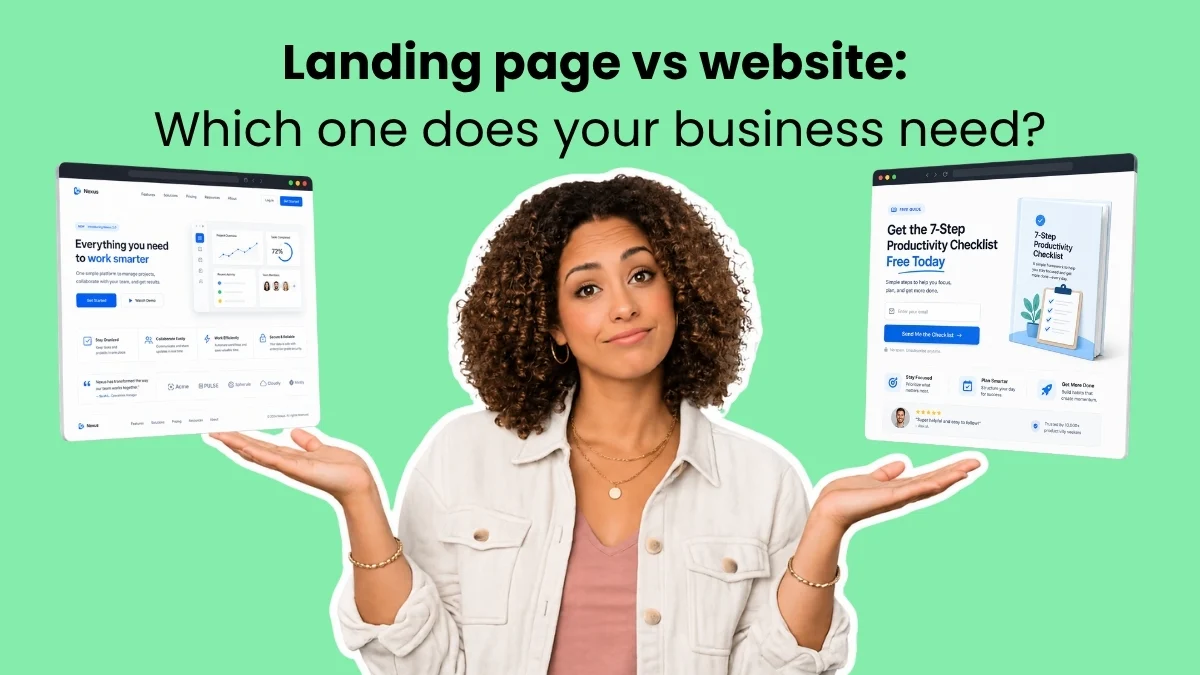
For countless entrepreneurs and small business owners embarking on their digital journey, the fundamental questions persist: "Do I truly need a comprehensive website? What specific functions does a landing page serve? And is it ever necessary to leverage both?" These inquiries reflect a common dilemma in an increasingly complex online ecosystem, where establishing a robust and effective digital footprint is paramount for immediate success and sustained growth. Crafting a compelling online presence is not merely about existing on the internet; it is about strategically positioning a business to engage its target audience, communicate its value, and drive specific actions. This detailed analysis will delineate the inherent similarities and critical distinctions between landing pages and websites, provide a framework for discerning the optimal choice for various business scenarios, and offer insights into best practices for their implementation.
Defining the Core Pillars of Digital Presence
At the heart of the debate lie two distinct, yet often complementary, digital assets: the website and the landing page. While both serve as online interfaces for businesses, their design, purpose, and operational mechanics diverge significantly. Understanding these foundational definitions is the first step towards a strategic deployment of digital resources.
The Comprehensive Digital Hub: Understanding Websites
A website, in its traditional form, is a multifaceted digital presence typically comprising five or more interconnected web pages. It acts as a central repository for all information pertinent to a business, offering a broad canvas for brand storytelling, detailed product or service descriptions, and extensive customer engagement. Standard components often include a homepage, an "About Us" section detailing the company’s mission and history, dedicated pages for products or services, a contact page, and frequently, a blog or resources section. For e-commerce businesses, a website naturally expands to include product catalogs, shopping carts, and customer account management.
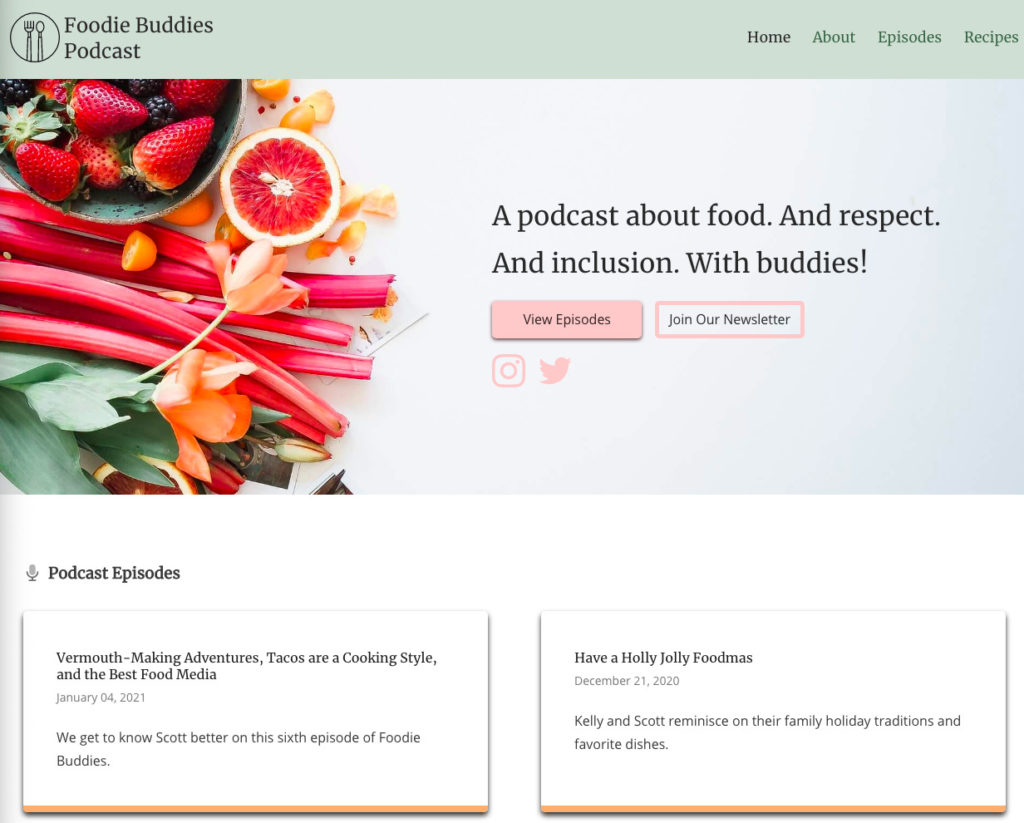
The overarching goal of a website is exploration and education. Visitors are encouraged to browse freely, delve into various sections, gather comprehensive information, find answers to diverse questions, and gradually build familiarity and trust with the business over time. It functions as a digital storefront, brochure, customer service desk, and content library rolled into one. This completeness, however, comes with inherent costs. Websites demand considerable investments in time for initial design and development, financial resources for hosting, domain registration, and potentially professional design services, and ongoing effort for content updates, security maintenance, and search engine optimization (SEO). For instance, a well-developed small business website can range from a few hundred to several thousand dollars, with monthly maintenance fees adding to the operational budget. The "Foodie Buddies" podcast website serves as an excellent illustration, allowing visitors to seamlessly navigate to learn about the hosts, access the latest episodes, explore recipes, and engage with community forums, all from a single, integrated platform.
The Focused Conversion Engine: Demystifying Landing Pages
In stark contrast, a landing page is a standalone web page meticulously designed with one singular goal and a precisely defined call to action (CTA). Unlike a website, it intentionally limits navigation, eschewing menus, internal links to other sections, or extraneous information that might distract the visitor. The design philosophy is minimalist and direct: a visitor "lands" on the page, consumes the concentrated content, and is then prompted to take a specific, predetermined action or depart.
Common objectives for landing pages include capturing email addresses for lead generation (e.g., through a newsletter signup or a free resource download), facilitating the sale of a single product or service, registering attendees for a webinar or event, or serving as a centralized link directory for social media profiles. Because every element on the page is meticulously crafted to guide the visitor towards this one action, landing pages typically exhibit significantly higher conversion rates than general website pages. The absence of choice simplifies the user journey, eliminating decision fatigue and maximizing the likelihood of conversion. Industry benchmarks suggest that well-optimized landing pages can achieve conversion rates ranging from 5% to 15%, and sometimes much higher for specific campaigns, whereas average website conversion rates across all pages tend to be lower, often in the 2-3% range. This stark difference underscores the power of focus in digital marketing. The "Foodie Buddies" podcast, for example, might complement its website with a dedicated landing page acting as a "link in bio" directory on social media. This single link efficiently directs followers to specific episodes, merchandise, or a newsletter signup, streamlining the user experience and driving targeted actions from platforms where broad navigation is impractical.
The Evolution of Digital Presence: A Chronology
The journey of online business presence has evolved dramatically, influencing the strategic roles of websites and landing pages.
- Early Internet (1990s – Early 2000s): The initial phase saw the rise of static websites, primarily serving as online brochures. Businesses established a basic digital footprint, often with limited interactivity, focusing on providing company information and contact details. Development was highly technical, requiring specialized coding skills.
- The Rise of Content Management Systems (Mid-2000s): Platforms like WordPress democratized website creation, allowing non-technical users to build and manage dynamic, multi-page websites. This era emphasized content marketing, blogging, and establishing a broad informational hub to attract organic search traffic. Websites became more complex, incorporating e-commerce functionalities, forums, and diverse content types.
- The Mobile Revolution and Marketing Automation (Late 2000s – Early 2010s): With the advent of smartphones, responsive design became crucial. Concurrently, the growth of email marketing and marketing automation platforms highlighted the need for efficient lead capture. This period saw the formalization of landing pages as a distinct tool, specifically designed to convert visitors from targeted advertising campaigns (e.g., Google Ads, social media ads) into leads or customers, recognizing that a busy homepage was often too distracting for campaign-specific goals.
- Data-Driven Optimization and Specialization (Mid-2010s – Present): The focus shifted towards data analytics, A/B testing, and highly personalized marketing. Landing page builders became more sophisticated, offering drag-and-drop interfaces, integrated analytics, and seamless connections with CRM and email marketing systems. The understanding solidified that while a website builds brand authority and provides comprehensive information, landing pages are the workhorses for specific, measurable campaign objectives. The distinction between a broad informational hub and a targeted conversion funnel became sharper, with businesses often employing both in an integrated strategy. The ongoing development of AI-powered content creation tools further streamlines the development of both, making it easier for even small businesses to craft compelling digital assets.
Supporting Data and Market Dynamics
The strategic choice between a landing page and a website is often informed by hard data and prevailing market trends.
- Conversion Efficacy: As previously noted, landing pages consistently outperform general website pages in conversion rates. Studies by various marketing analytics firms often report average landing page conversion rates between 5% and 15%, with top performers reaching over 20%. In contrast, the average conversion rate for a typical website homepage across all industries often hovers between 2-4%. This significant difference highlights the efficiency of a focused approach when the goal is a specific action.
- Small Business Growth: The number of small businesses establishing an online presence continues to surge globally. Data from various economic reports indicates that over 70% of small businesses now have a website or an active social media presence. However, merely existing online is insufficient; efficacy is key. For new ventures or those with limited resources, a landing page offers a rapid, low-cost entry point into performance-based digital marketing.
- Cost and Time Investment: The financial and time commitment varies drastically. A basic professional website can cost anywhere from $500 to $5,000 for initial setup, with complex e-commerce or custom-designed sites reaching tens of thousands. Ongoing hosting, domain, security, and maintenance fees can range from $50 to $500+ per month. Conversely, many landing page builders are either free as part of email marketing platforms (like AWeber) or offered at a low monthly subscription, often under $50, encompassing hosting and SSL certificates. The time to launch a website can span weeks or months, involving designers, developers, and extensive content creation, while a well-crafted landing page can be designed and published in a matter of hours or even minutes using intuitive drag-and-drop interfaces. This agility is invaluable for businesses needing to quickly test market interest or launch time-sensitive campaigns.
- Mobile Responsiveness: With mobile devices accounting for over half of global web traffic, ensuring a responsive design is critical for both. However, the streamlined nature of landing pages often makes them inherently more mobile-friendly, loading faster and providing a clearer user experience on smaller screens due to their singular focus and minimal content.
Strategic Application: When to Use Which
The decision matrix for deploying a landing page versus a website hinges on specific business objectives, available resources, and the stage of business development.
When a Landing Page Excels:
A landing page is the optimal choice when the objective demands laser focus and immediate action.
- Targeted Advertising Campaigns: When running paid ads on platforms like Google, Facebook, or Instagram, directing traffic to a specific landing page tailored to the ad’s message dramatically improves conversion rates. For example, an ad for a "free e-book on digital marketing" should lead directly to a landing page where users can download the e-book in exchange for their email, rather than a general website homepage.
- Lead Magnet Promotion: Offering a free resource (e-book, checklist, webinar registration) to collect email addresses is a core lead generation strategy. A landing page dedicated solely to promoting and delivering this lead magnet minimizes distractions and maximizes sign-ups.
- Single Product or Service Launches: For businesses introducing a new product, a limited-time offer, or a specific service, a landing page provides a clear, concise platform for communicating value and driving sales without the clutter of a full catalog.
- Market Validation and A/B Testing: Entrepreneurs can rapidly test new ideas, product concepts, or pricing strategies by creating a landing page, driving traffic to it, and analyzing conversion data, all before investing heavily in full-scale development.
- Social Media Bio Links: Platforms like Instagram and TikTok limit profile links. A "link in bio" landing page acts as a directory, allowing users to choose from multiple important links (latest blog post, product page, signup form, podcast episode).
- Event Registrations: For webinars, workshops, or in-person events, a dedicated landing page streamlines the registration process, provides all necessary information, and features a clear call to action.
When a Website Becomes Indispensable:
A website becomes the preferred, and often necessary, digital asset when a business has depth, requires broad informational coverage, and aims for long-term brand building and organic reach.
- Multi-Product or Service Businesses: Companies offering a wide array of products or diverse service packages require multiple pages to adequately showcase each offering, provide detailed specifications, and facilitate complex purchasing decisions.
- Content Marketing and SEO Strategy: A blog, resource library, or extensive FAQ section hosted on a website is crucial for building long-term search visibility. Regular, high-quality content helps a business rank for relevant keywords, attracting organic traffic month after month—a feat a single landing page rarely achieves on its own.
- Building Brand Authority and Trust: A comprehensive website lends credibility and professionalism. It allows for a detailed "About Us" section, team bios, testimonials, case studies, and a clear articulation of brand values, all contributing to a robust brand image.
- Customer Support and Resources: Websites can host extensive knowledge bases, FAQs, customer portals, and support contact forms, serving as a primary hub for customer assistance.
- Complex E-commerce Operations: Businesses with large inventories, varied product categories, and integrated payment/shipping solutions require the robust infrastructure of an e-commerce website.
The Synergy: A Holistic Approach
Crucially, the choice is not always an "either/or" proposition. Many successful businesses leverage both websites and landing pages in a powerful symbiotic relationship. Even with a fully developed website, landing pages remain essential for targeted conversion work. For instance, an established e-commerce brand might direct its paid advertising traffic for a specific seasonal sale to a dedicated landing page designed to convert that specific offer, rather than its busy homepage. This strategy ensures that visitors from a particular campaign see exactly what they’re looking for, maximizing the conversion potential of marketing spend. The homepage serves as the brand’s enduring digital identity, while landing pages act as dynamic, campaign-specific conversion engines.
Expert Perspectives and Broader Implications
Digital marketing strategists consistently emphasize that the fundamental choice between a landing page and a website, or their combined use, hinges entirely on the business’s immediate objectives and long-term vision. "For startups and solo entrepreneurs, beginning with a high-converting landing page is often the most pragmatic and cost-effective entry point," states a prominent digital consultant. "It allows for rapid market testing and lead generation without the overheads of a full website. As the business scales and its offerings diversify, a comprehensive website naturally becomes the next logical step."
The proliferation of user-friendly landing page builders and website platforms has significantly democratized online business. Tools like AWeber, which bundle landing page creation with email marketing, hosting, and even AI content generation, have lowered the barrier to entry for countless entrepreneurs. This accessibility empowers individuals and small teams to establish a professional online presence without needing extensive technical expertise or large budgets.
The broader implication is a shift in digital marketing toward greater precision and measurability. Landing pages force marketers to define a singular goal and track its conversion, fostering a more data-driven approach. This focus on conversion optimization, coupled with the brand-building capabilities of a full website, creates a potent digital strategy for navigating the competitive online landscape. As AI continues to advance, we can expect even more sophisticated tools that assist in optimizing both landing page copy and website content, making digital presence management more efficient and effective.
A Decision Framework for Businesses
To conclude, businesses should ask themselves four critical questions to guide their decision:
- What is the primary action I want visitors to take? If the answer is one specific, measurable action (e.g., sign up, buy now, download), a landing page is likely the more efficient tool. If the goal is broad exploration, information gathering, and brand immersion, a website is necessary.
- What are my current resources in terms of time, budget, and expertise? If these are limited, starting with a landing page offers a faster, more affordable, and less complex path to getting online and generating results. A website can be built incrementally as resources grow.
- Am I testing a new idea, product, or market? Validate concepts with a landing page first. It provides quick feedback on market interest before committing significant resources to a full website or product development.
- Does my business offer enough unique content or diverse products/services to justify multiple pages? If padding pages just to fill space, or if the core offering is singular, a landing page will be more effective and less resource-intensive.
Can a business thrive solely on landing pages?
The answer is a resounding yes, particularly for creators, coaches, and many solo businesses. By utilizing a series of interconnected landing pages – one for email sign-ups, another to sell a digital product, and a third as a social media link hub – a business can effectively operate without a traditional multi-page website. The crucial element making this strategy viable is robust email marketing. Landing pages capture the subscriber, and subsequent email campaigns handle the educational content, trust-building, promotional offers, and ongoing engagement that a website would typically provide. In this model, the email list becomes the primary business asset, with landing pages serving as highly efficient "front doors" for various entry points into the customer journey.
Ultimately, the choice between a landing page and a website, or their integrated use, is a strategic one. It is not about inherent superiority but about aligning the digital tool with specific business objectives. For many new ventures, starting lean and focused with a landing page offers a powerful, cost-effective entry point, with a comprehensive website becoming a natural progression as the business matures and its offerings expand. The modern digital landscape demands both flexibility and precision, and understanding the distinct strengths of landing pages and websites is fundamental to building a successful online presence.