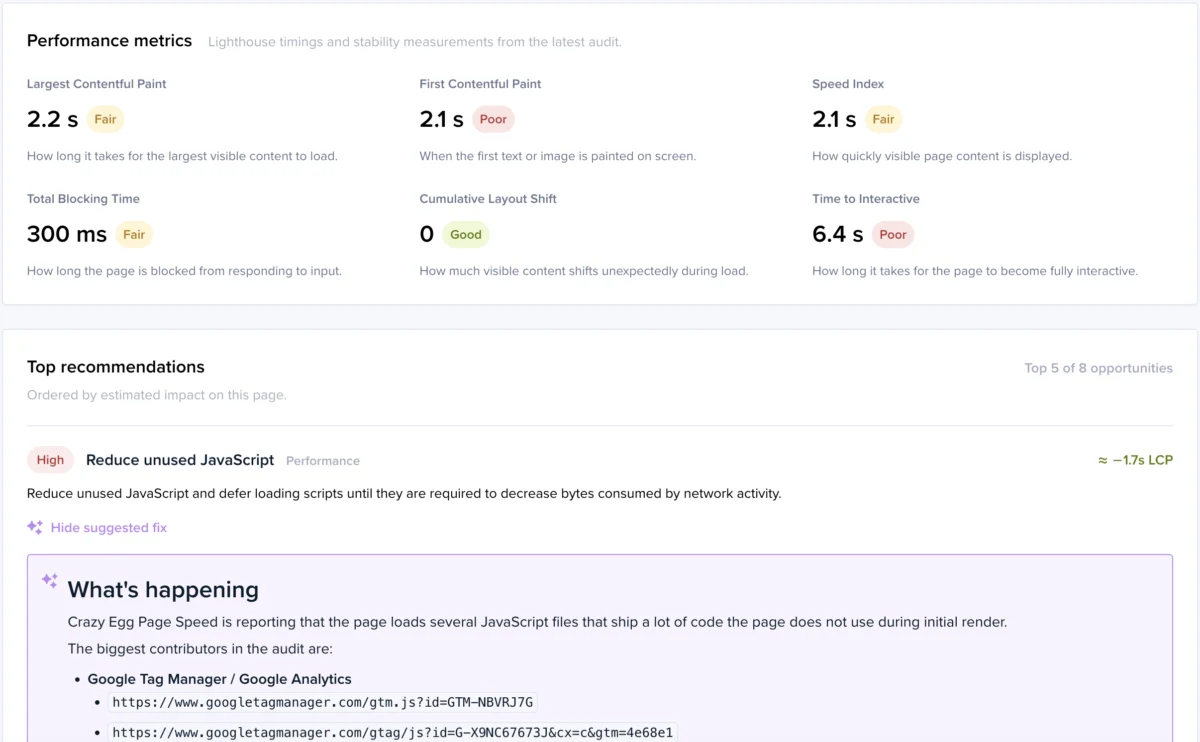
Crazy Egg, a pioneer in user behavior analytics and website optimization, has announced the launch of its latest tool, Page Speed Audits. This new feature is designed to address one of the most persistent challenges in digital marketing: the technical barrier to improving website load times. By offering daily scans and, crucially, automatically generated code to fix performance bottlenecks, the platform aims to democratize high-level site optimization for businesses of all sizes. The tool is being released as a 100% free service, requiring no installation of the standard Crazy Egg tracking script to function, marking a significant shift in the company’s product strategy toward accessible, utility-driven SEO tools.
The Evolution of Web Performance Standards
The release of Page Speed Audits comes at a critical juncture for the digital economy. For years, page load speed has been a secondary concern for many webmasters, often overshadowed by aesthetic design and content volume. However, the landscape shifted dramatically with Google’s introduction of Core Web Vitals—a set of specific factors that Google considers important in a webpage’s overall user experience. These metrics, including Largest Contentful Paint (LCP), First Input Delay (FID), and Cumulative Layout Shift (CLS), now directly influence search engine rankings.
In the current environment, slow-loading websites do more than just frustrate users; they are actively penalized by modern algorithms. This applies not only to traditional Search Engine Optimization (SEO) but also to the burgeoning field of Answer Engine Optimization (AEO). As AI-driven search engines like Perplexity, ChatGPT, and Google’s Search Generative Experience (SGE) become more prevalent, they prioritize "crawlable" and high-performance sites to feed their large language models. A site that loads slowly or contains inefficient code is less likely to be cited as a primary source by these AI agents, leading to a loss in "answer" visibility.
Bridging the Gap Between Diagnosis and Implementation
The primary innovation of Crazy Egg’s Page Speed Audits lies in its "remediation-first" approach. While legacy tools such as Google PageSpeed Insights or GTmetrix provide comprehensive data on what is wrong with a website, they often leave non-technical users with a list of daunting problems they lack the coding skills to fix.
Crazy Egg’s new system scans every element of a webpage—including images, video embeds, and third-party scripts—to identify the specific "bloat" causing delays. Once the scan is complete, the tool prioritizes changes based on their potential impact on speed. Most notably, the platform generates the specific lines of code required to implement these fixes. Users can simply copy and paste the provided code into their site’s header, footer, or CSS files to resolve issues that would otherwise require hours of developer time.
Technical Capabilities and Features
The Page Speed Audits tool offers a suite of features designed for continuous monitoring and rapid deployment:
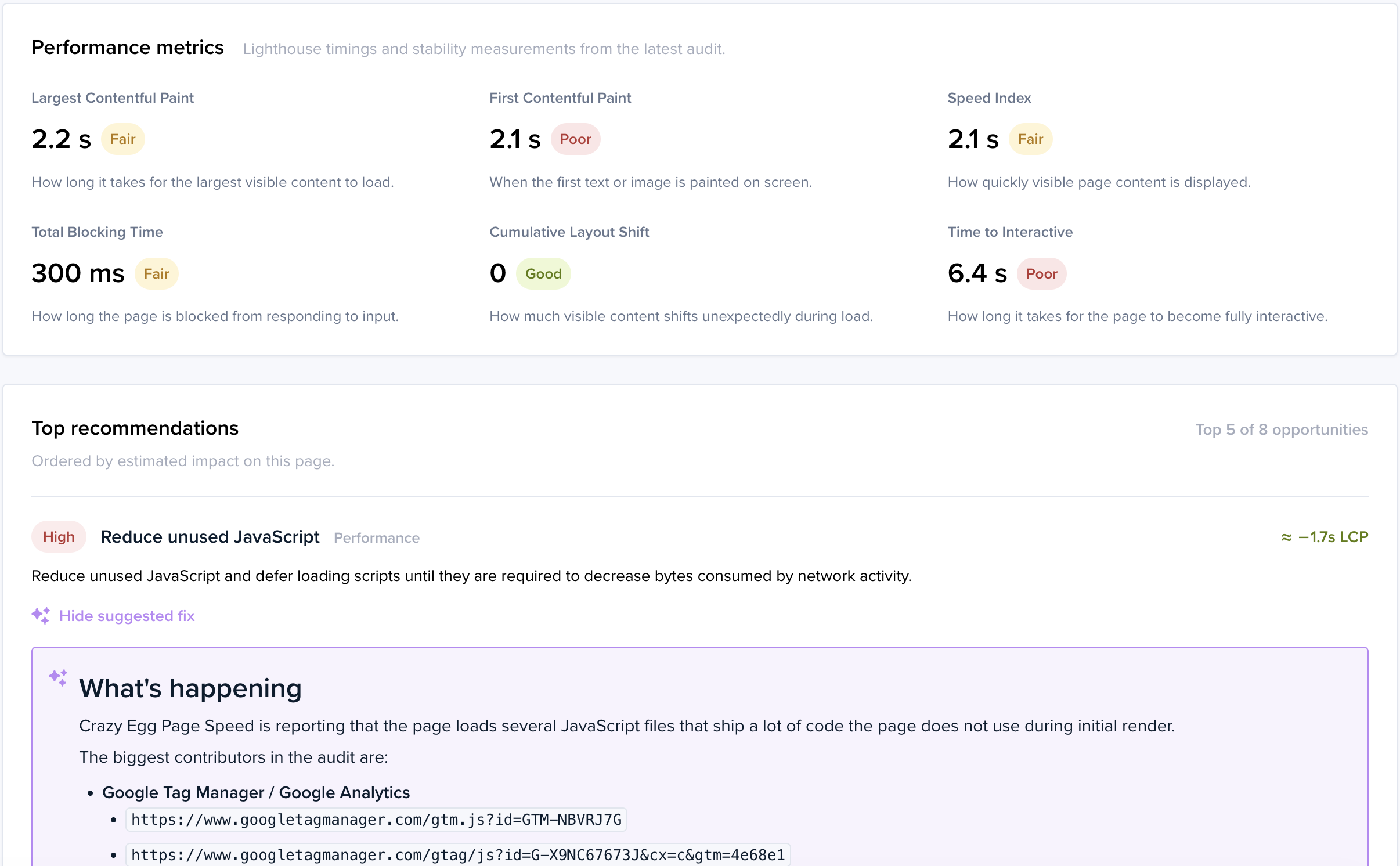
- Daily Automated Scanning: Unlike manual tools that provide a single snapshot in time, Crazy Egg’s audits run daily. This ensures that new content uploads, plugin updates, or script changes are immediately evaluated for their impact on performance.
- Granular Asset Analysis: The tool identifies specific "heavy" assets. For example, if a high-resolution hero image is slowing down the Largest Contentful Paint, the audit will not only flag the image but suggest the exact dimensions and compression levels needed.
- Code Generation for Optimization: The tool provides snippets for advanced optimization techniques, such as:
- Lazy Loading: Ensuring images and videos only load when they enter the user’s viewport.
- Script Deferral: Moving non-essential JavaScript to load after the main content, preventing "render-blocking."
- Minification: Providing minified versions of CSS and JavaScript files to reduce file size.
- Unlimited URL Tracking: In a move to capture market share from paid SEO suites, Crazy Egg allows users to track an unlimited number of URLs within the free tier. This is particularly beneficial for e-commerce sites with thousands of product pages.
Data-Driven Justification for Speed Optimization
The business case for using tools like Page Speed Audits is backed by a decade of industry data. Research from Akamai and Google has consistently shown that even millisecond improvements in load time have a direct correlation with the bottom line.
- Conversion Rates: According to a study by Portent, a site that loads in 1 second has a conversion rate 3x higher than a site that loads in 5 seconds.
- Bounce Rates: Google’s data indicates that as page load time goes from 1 second to 3 seconds, the probability of a bounce (the visitor leaving immediately) increases by 32%. At 5 seconds, that probability jumps to 90%.
- Mobile User Behavior: With over 50% of global web traffic originating from mobile devices—often on slower 4G or 5G networks—the weight of a webpage is more critical than ever. Heavy sites consume user data and battery life, leading to poor brand perception.
By automating the fix for these issues, Crazy Egg is targeting the "implementation gap"—the space between knowing a site is slow and actually having the resources to make it fast.
A Strategic Move in the Growth Marketing Space
Stephen Ngo, Director of Growth Marketing at Crazy Egg, emphasized the tool’s role in the broader marketing funnel. Ngo, who has previously led growth initiatives at Nira, Paddle, and ProfitWell, understands that user retention begins with the very first "hit" on a server.
"Slow-loading websites turn off impatient visitors," Ngo noted in the product announcement. "They drive traffic away before a single person even looks at your pages."
Industry analysts suggest that by offering this tool for free and without the requirement of installing the Crazy Egg snippet, the company is utilizing a "freemium utility" strategy. This builds trust with webmasters and IT professionals who may eventually upgrade to Crazy Egg’s premium heatmapping, recordings, and A/B testing features once their foundational site speed is stabilized.
Timeline and Accessibility
The rollout of Page Speed Audits is effective as of August 20, 2026. The feature is located within the main Crazy Egg dashboard under a dedicated "Page Speed" menu.
Chronology of the Launch:

- Internal Beta: Early 2026 – Selected Crazy Egg enterprise clients tested the automated code generation features.
- Feature Integration: June 2026 – The auditing engine was integrated with Crazy Egg’s existing SEO analysis suite.
- Public Launch: August 20, 2026 – Global release to all users, including those on free plans.
To access the audits, users are directed to click the "Page Speed" button on the sidebar of their dashboard and select "Add New Page." The process is designed to be frictionless, requiring only the URL of the page to be analyzed.
Broader Implications for the Future of Web Development
The move toward automated code generation for performance fixes signals a broader trend in web development: the shift toward AI-assisted maintenance. As websites become increasingly complex, relying on manual audits and hand-coded optimizations is becoming unsustainable for many small to medium-sized enterprises (SMEs).
Tools like Crazy Egg’s Page Speed Audits represent a transition toward "self-healing" websites, where the software identifies a degradation in performance and provides a ready-made cure. While this does not replace the need for skilled developers for complex architectural changes, it removes the "low-hanging fruit" of performance issues—such as unoptimized images and bloated scripts—from their to-do lists.
Furthermore, as the industry moves toward AEO, the technical health of a website is becoming synonymous with its "findability." If a site is too slow for an AI bot to parse efficiently, it effectively ceases to exist in the next generation of search results. By providing a free, high-utility tool to combat this, Crazy Egg is positioning itself as an essential infrastructure provider in the modern SEO ecosystem.
In conclusion, Page Speed Audits by Crazy Egg addresses the dual pressure of user expectation and algorithmic rigor. By providing not just the "what" but the "how" through automatically generated code, Crazy Egg has lowered the barrier to entry for high-performance web development, ensuring that speed is no longer a luxury reserved for companies with large engineering budgets.