

The digital economy has reached a critical juncture where the sheer volume of data collected by enterprises often outpaces their ability to act upon it, leading to what industry analysts describe as a "coordination failure" within marketing and product teams. To address this widening gap, Wingify has announced the launch of a comprehensive, unified Digital Experience Optimization (DXO) suite that merges the capabilities of VWO and AB Tasty. This strategic integration combines two of the market’s most established platforms in experimentation, personalization, and feature management into a single, cohesive ecosystem designed to provide a shared view of the customer journey. By eliminating the need for a manual "translation layer" between disparate tools, the new suite aims to transform optimization from a series of disconnected experiments into a continuous, compounding competitive advantage for global brands.
The Hidden Cost of Fragmented Optimization Strategies
In the current MarTech landscape, most digital businesses operate with a surplus of tools but a deficit of clarity. While teams are equipped with sophisticated instruments for A/B testing, heatmaps, and AI-driven personalization, these solutions often exist as isolated islands of data. The result is a systemic inefficiency where data does not travel freely across the organization. When a product team ships a new feature, they frequently lack a reliable, integrated mechanism to determine if that feature actually contributed to the bottom line. Simultaneously, personalization tools may be active, but without a shared data foundation, they often fail to target the correct audience segments with the necessary precision.
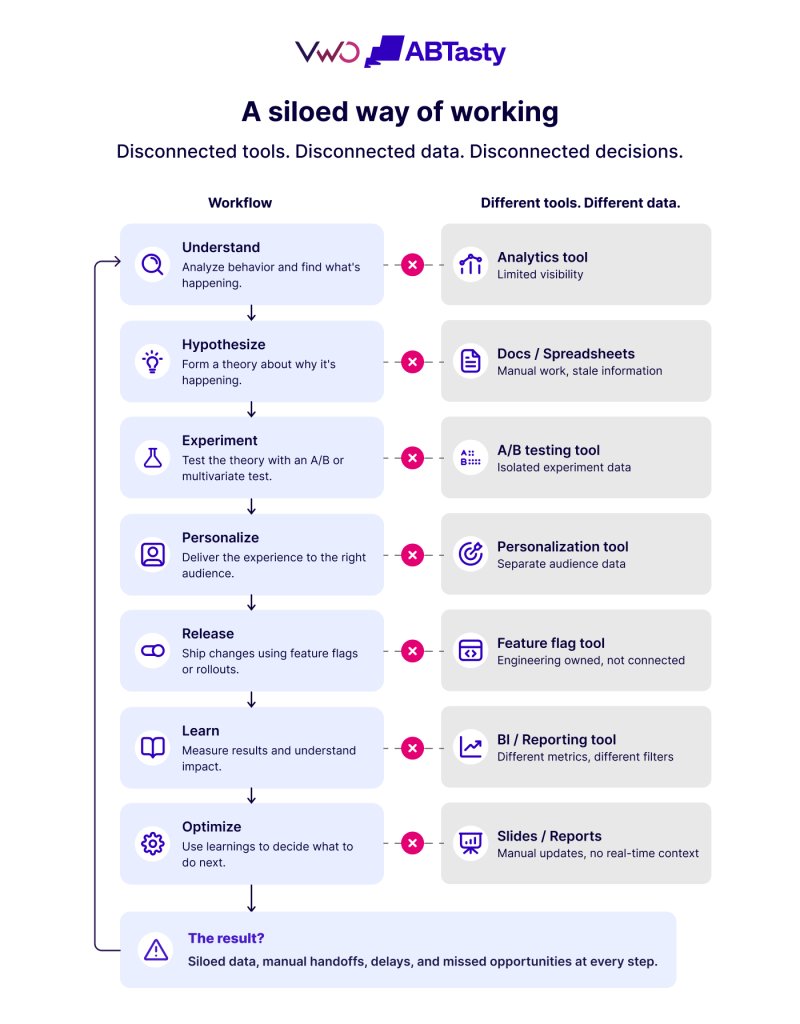
This fragmentation manifests most visibly in the "hand-off" process. In a traditional siloed environment, an insight derived from a session recording must be manually interpreted and moved into a testing tool. Once a test concludes, the results must be exported and re-uploaded into a personalization engine. Each of these manual steps introduces interpretation errors and significant delays. By the time a data-backed hypothesis is finally converted into a live customer experience, the market window or consumer behavior that triggered the initial insight may have already shifted. Wingify’s unified suite is engineered to resolve these friction points by ensuring that every feature feeds directly into the next, allowing insights to evolve into hypotheses and experiments automatically.
Resolving the Crisis of Audience Drift and Conflicting Metrics
One of the most persistent challenges for modern digital marketing teams is "audience drift." This occurs when a specific customer segment—for instance, "returning users who abandoned a high-value cart"—is defined differently across various platforms. Because each point solution may use slightly different tracking parameters or update frequencies, a segment that exists in an analytics tool may not perfectly align with the same segment in an experimentation tool.
When metrics conflict, teams spend more time reconciling data in spreadsheets than they do optimizing the user experience. One department may report a successful lift in conversions, while another observes a decline in long-term retention, with neither able to see the full picture. Wingify addresses this by establishing a single, unified data layer. By sharing a consistent definition of audiences and success metrics across experimentation, personalization, and analytics, the suite ensures that every team member is looking at the same "source of truth." This alignment allows organizations to move from defensive data reconciliation to offensive experience optimization.
The Evolution of Wingify: A Chronology of Integration
The formation of the unified Wingify suite represents a significant milestone in the evolution of the conversion rate optimization (CRO) and digital experience industries. VWO, founded by Paras Chopra over a decade ago, established itself as a pioneer in the experimentation space, focusing on behavioral insights and robust A/B testing. Conversely, AB Tasty rose to prominence by specializing in sophisticated personalization, AI-driven targeting, and server-side feature management.
The timeline of this integration reflects a broader trend in the software-as-a-service (SaaS) industry toward consolidation. As enterprises grew weary of "tool fatigue" and the overhead of managing dozens of vendor relationships, the demand for a "single pane of glass" became undeniable. Wingify’s decision to merge these two powerhouses into one workflow was driven by the realization that experimentation and personalization are not two separate activities, but two halves of the same continuous loop. The integration process involved unifying the underlying data architectures of both platforms, ensuring that the depth of VWO’s behavioral analytics could inform the precision of AB Tasty’s delivery mechanisms without any data loss during the transition.
Wandz: The Intelligence Layer Driving the Continuous Loop
At the heart of the new Wingify suite is Wandz, an embedded AI layer that represents a significant leap forward from general-purpose AI tools. While external AI models like ChatGPT are useful for brainstorming, they lack the specific context of a company’s live experiments, historical rollout data, and unique audience segments. Wandz solves this "context gap" by living directly inside the optimization workflow. It unifies the capabilities previously offered through VWO’s Copilot and AB Tasty’s Evi, providing a singular intelligence engine that has access to the entire suite’s data.
The business value of Wandz is quantified through four primary vectors of efficiency:
- Accelerated Hypothesis Generation: Rather than requiring growth teams to spend days manually analyzing heatmaps and session recordings, Wandz can identify behavioral patterns and suggest high-probability test ideas in minutes.
- Error Mitigation in Launch Sequences: Before a new experiment or feature rollout goes live, the AI reviews the configuration, traffic splits, and targeting parameters. By flagging potential misconfigurations before they reach the customer, Wandz prevents the "expensive lessons" associated with flawed data collection.
- Natural Language Result Interpretation: Wandz allows non-technical stakeholders to query complex data sets using plain English. A marketing manager can ask, "How did the checkout experiment perform for mobile users in Europe compared to North America?" and receive an immediate, data-backed answer.
- Streamlined Campaign Execution: Through a natural-language AI Editor, teams can modify site elements and campaign settings dynamically, significantly reducing the "time-to-live" for new initiatives.
Governance and Security in the Enterprise Environment
As organizations scale their optimization efforts across multiple brands, regions, and departments, governance becomes a critical concern. In a fragmented ecosystem, every additional tool represents a new security surface that must be individually configured and audited. This leads to a "patchwork" of permissions that increases the risk of compliance failures.
Wingify’s unified suite simplifies this administrative burden by providing a single permission model and a consolidated audit trail. For enterprise organizations operating under strict regulatory frameworks such as GDPR or CCPA, having a unified view of how customer data is being used for personalization and experimentation is not just a convenience—it is a requirement for risk management. The suite’s centralized governance ensures that global brand standards are maintained while still allowing regional teams the flexibility to innovate within their specific markets.
Strategic Implications for the Future of MarTech
The launch of Wingify’s unified suite signals a shift in the industry from "growth hacking"—often characterized by sporadic, high-effort tests—to "systemic optimization." In this new model, the "Understand → Hypothesize → Experiment → Personalize → Release → Learn" cycle becomes an automated heartbeat of the business.
Industry analysts suggest that the primary differentiator for digital businesses in the coming years will not be the amount of data they possess, but the velocity at which they can turn that data into a better customer experience. By removing the technical and organizational barriers that previously broke the chain of optimization, Wingify is positioning itself as the foundational infrastructure for this high-velocity future. The integration of VWO and AB Tasty suggests that the era of the "point solution" is drawing to a close, replaced by integrated platforms that prioritize connectivity and AI-driven context over isolated functionality.
For businesses currently struggling with stagnant conversion rates or fragmented customer insights, the move toward a unified suite offers a path to compounding returns. As each experiment feeds into the next personalization campaign, and each personalization campaign informs the next feature release, the organization builds a deeper, more accurate understanding of its customers. In a marketplace where customer expectations are higher than ever, the ability to act with confidence and speed is the ultimate competitive advantage. Wingify has invited interested organizations to experience this new paradigm firsthand through a demonstration of the integrated suite, marking the beginning of a new chapter in digital experience optimization.







