On June 3, 2026, AWeber, a long-standing player in the email marketing sector, officially launched its innovative AI Signup Form Builder, marking a significant departure from traditional template-based design. This new tool promises to transform how businesses, particularly small and medium-sized enterprises (SMEs), create and deploy subscriber forms, moving from a laborious customization process to an intuitive, AI-driven generation model tailored specifically to individual brand needs and marketing objectives.
For years, the creation of effective signup forms has presented a persistent challenge for marketers. The conventional approach typically involves selecting a pre-designed template from a gallery and then undertaking extensive manual adjustments. This process, often described as working "backward," entails hours spent tweaking fields, rewriting headlines, aligning color schemes, and reorganizing layouts to achieve a semblance of brand consistency. Far from being a shortcut, templates frequently evolve into time sinks, demanding significant effort to transform a generic design into something truly representative of a business’s unique identity and specific offer.
The Inherent Limitations of Traditional Templates
The fundamental flaw of template-based systems lies in their very design philosophy: they are built for broad applicability. While this ensures a baseline functionality, it inherently compromises their suitability for individual, highly specific business contexts. A template’s generic headline, default field set, and layout are optimized for no one in particular, leading to a disconnect between the default offering and a business’s precise requirements.
Consider a scenario where a business offers a specialized "free five-day email course on dog training." A generic template might default to the uninspired call-to-action, "Subscribe to our newsletter." This mismatch in messaging immediately dilutes the offer’s appeal and can significantly impact conversion rates. Similarly, a template might include three fields when only one is necessary, or impose a two-column layout that clashes with a brand’s minimalist aesthetic. This "gap" between the template’s default state and the desired final form necessitates considerable manual intervention—involving copywriting, design decisions, and field logic adjustments. By the time a form genuinely reflects the brand and its offer, the customization effort often exceeds the time it might have taken to construct a bespoke form from scratch, given a clear initial prompt.
Furthermore, templates can inadvertently stifle creativity and strategic thinking. Marketers are often anchored by the existing structure, adapting their content and design around someone else’s framework rather than conceptualizing a form purely from their audience’s perspective and their specific marketing goals. This can lead to forms that are functional but lack the distinctiveness and persuasive power required in an increasingly competitive digital landscape.

A New Paradigm: AI-Powered Form Generation
AWeber’s AI Signup Form Builder represents a paradigm shift, fundamentally altering the starting point of form creation. Instead of browsing a gallery of pre-existing designs, users now begin with their specific needs and objectives. The tool offers three core methods for generating forms, each designed to streamline the process and deliver highly relevant outputs from the outset:
-
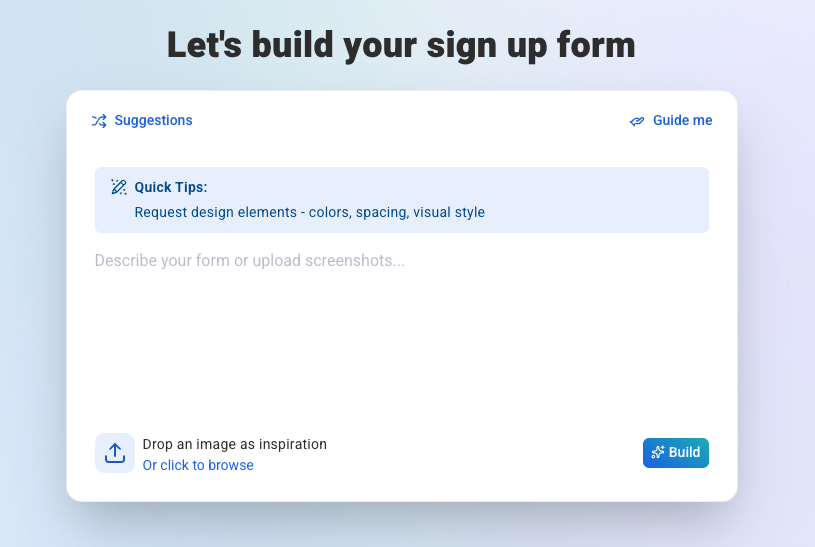
Describe It: Users can articulate their requirements in plain language, such as, "A simple one-field form for a free guide on meal planning for busy parents." The AI then intelligently generates a form with a relevant headline, appropriate fields, and copy that perfectly aligns with the described offer and target audience. This method eliminates the need for generic placeholders and ensures instant contextual relevance.
-
Upload a Screenshot: Recognizing that inspiration often strikes from observing successful designs, AWeber’s AI builder allows users to upload screenshots of forms they admire from anywhere online. The AI analyzes the design’s layout and structural cues, then produces a customized version that incorporates these aesthetic elements while adapting them to the user’s specific brand guidelines and content. This provides a creative shortcut, leveraging inspiration without resorting to direct imitation or tedious manual reconstruction.
-
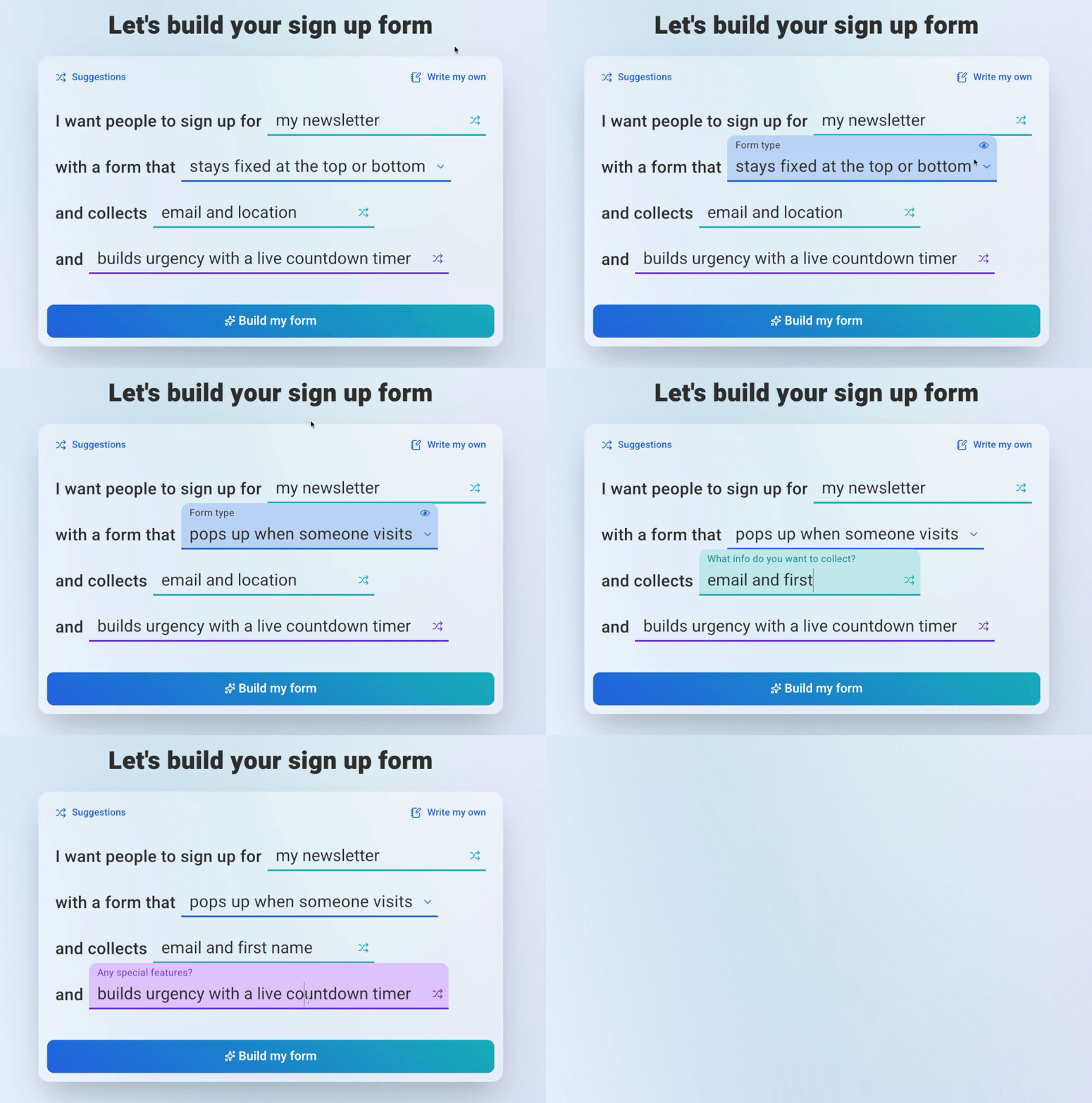
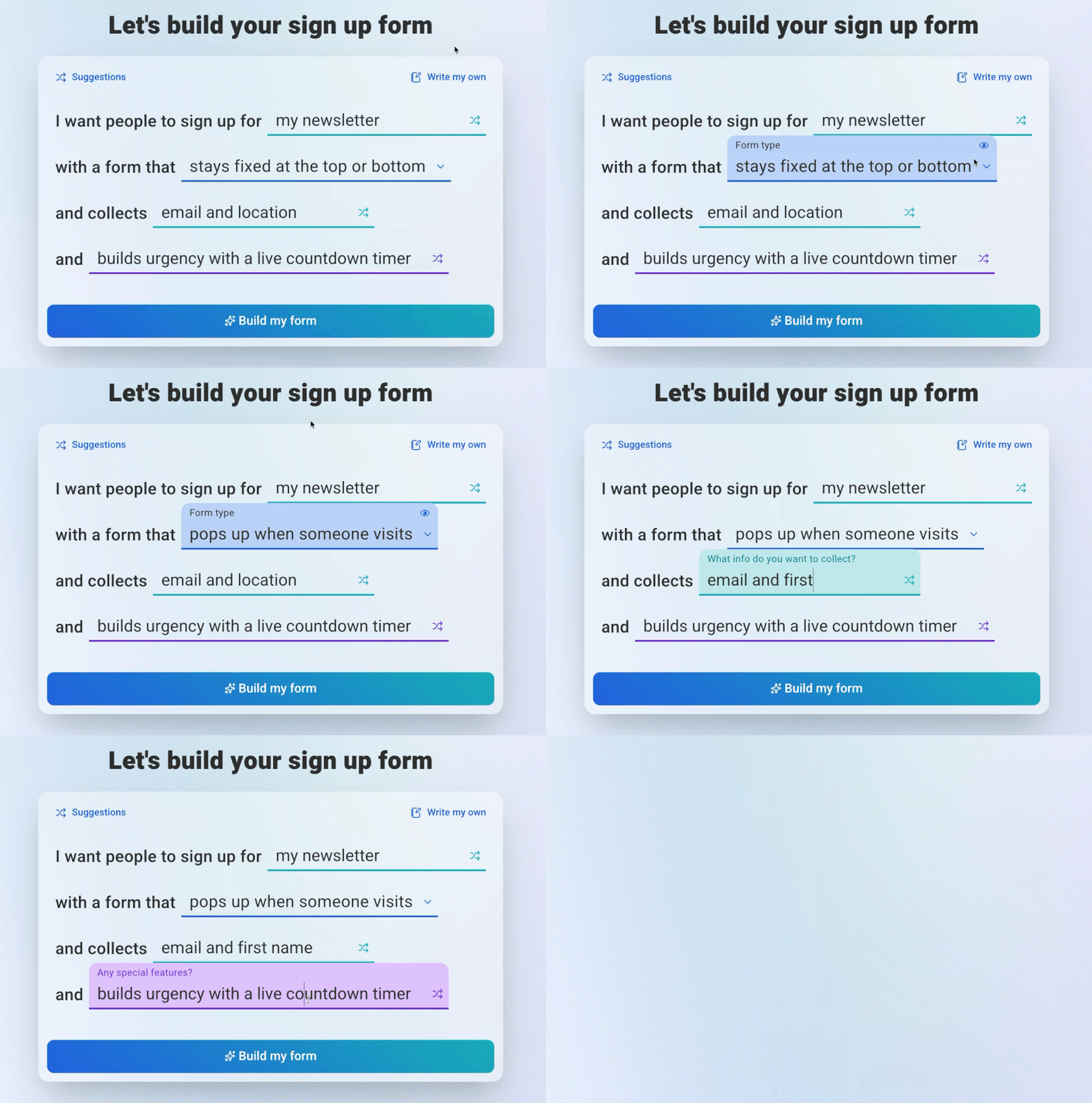
Use Guided Prompts: For users who prefer a more structured approach, the builder offers a series of guided prompts. By answering a few targeted questions about their audience, offer, and marketing goals, the AI assembles a form based on these precise inputs. This method ensures that the generated form is a direct reflection of the user’s strategic intentions.
Following the initial generation, the refinement process also leverages AI’s conversational capabilities. Users can issue commands in plain language—such as "shorten the headline," "add a checkbox for terms and conditions," or "change the button text to ‘Get My Guide Now’"—and the form updates instantaneously, eliminating the need to navigate complex settings panels or field editors. This conversational interface significantly accelerates the iterative design process, allowing marketers to focus on content and strategy rather than technical execution.
Supporting Data and Industry Context: The Growing Demand for Personalization
The introduction of AI-powered form builders like AWeber’s is timely, aligning with broader trends in digital marketing emphasizing personalization and efficiency. Industry reports consistently highlight the diminishing returns of generic marketing efforts. A study by Accenture, for example, found that 91% of consumers are more likely to shop with brands that provide offers and recommendations that are relevant to them. Similarly, personalized calls-to-action have been shown to convert 202% better than generic CTAs, according to HubSpot. This data underscores the critical importance of forms that are not only aesthetically pleasing but also deeply aligned with specific offers and audience segments.
Furthermore, the demand for marketing automation and AI-driven tools is experiencing exponential growth. The global AI in marketing market size was valued at billions of dollars in recent years and is projected to grow at a compound annual growth rate (CAGR) exceeding 25% over the next decade. This growth is driven by businesses seeking to optimize their workflows, enhance customer experiences, and improve return on investment (ROI) in an increasingly complex digital ecosystem. Small businesses, often constrained by limited resources and marketing teams, stand to benefit immensely from tools that democratize sophisticated marketing capabilities, previously accessible only to larger enterprises.
Traditional form building can be a significant time sink. Estimates suggest that marketers spend an average of 1-3 hours customizing a single form template to fit their brand and offer. For businesses that require multiple forms for various campaigns, products, or lead magnets, this can quickly accumulate into dozens of hours per month. AI builders, by generating bespoke forms in minutes, directly address this efficiency gap, freeing up valuable time for strategic planning and other critical business activities.
A Brief Chronology of Form Development
The evolution of web forms traces a path from basic HTML structures to today’s AI-driven solutions:
- Early Internet (1990s): Simple HTML forms, often hand-coded, with minimal styling.
- Emergence of CMS & WYSIWYG Editors (2000s): Content Management Systems like WordPress began offering plugins and built-in tools for form creation, allowing non-developers to build forms using visual interfaces.
- Drag-and-Drop Builders (2010s): Dedicated form builders and email marketing platforms introduced intuitive drag-and-drop interfaces, significantly simplifying the design process and offering extensive template libraries. This marked a major leap in accessibility and customization.
- Mobile Responsiveness & Advanced Features (Mid-2010s): Focus shifted to responsive designs, conditional logic, multi-step forms, and integrations with CRM systems.
- AI Integration (2020s onwards): The latest frontier, leveraging artificial intelligence to automate form generation, personalize content, and optimize performance based on user input and behavioral data. AWeber’s AI Signup Form Builder stands at the forefront of this new wave.
Implications for Businesses and Marketers
The launch of AWeber’s AI Signup Form Builder carries significant implications across the digital marketing landscape:
- Empowering Small Businesses: For SMEs with limited design resources or technical expertise, this tool levels the playing field. They can now create highly professional, conversion-optimized forms that resonate with their specific audience without investing heavily in design software or agency fees. This democratization of advanced marketing tools is crucial for competitive growth.
- Enhanced Marketing Efficiency: Marketers can drastically reduce the time spent on repetitive design tasks. This allows them to allocate more resources to strategic thinking, A/B testing, audience segmentation, and campaign optimization—areas where human insight remains indispensable. The speed and quality of AI-generated forms, as demonstrated by AWeber’s comparisons with traditional drag-and-drop builders, are indeed "unmatched."
- True Brand Alignment: By starting with a description of the business and its offer, the AI ensures that the form’s headline, fields, and copy are inherently aligned with the brand’s voice and value proposition. This eliminates the common issue of generic forms that feel disconnected from the rest of a brand’s digital presence.
- Improved Conversion Rates: Personalized and contextually relevant forms are proven to yield higher conversion rates. By removing the friction of generic messaging and irrelevant fields, businesses can expect to see more qualified leads and subscribers.
- Shifting Skillsets for Marketers: The role of the marketer evolves from a manual designer to a strategic prompt engineer. Understanding how to articulate needs effectively to an AI, and how to refine its outputs, becomes a crucial skill.
- Competitive Pressure: AWeber’s innovation is likely to spur other email marketing platforms and form builders to accelerate their own AI integration, leading to a more dynamic and technologically advanced market beneficial for all users.
Sean Tinney, a content marketer at AWeber, whose insights were central to the product’s unveiling, underscored the fundamental flaw of traditional templates. "Every template ships with a generic headline, a default field set, and a layout optimized for nobody in particular," Tinney noted, highlighting the inefficiency inherent in a "one-size-fits-all" approach in an era demanding "one-to-one" marketing. He emphasized that the AI builder fundamentally changes this dynamic, stating, "The form is generated from your inputs. That means the headline matches your offer, the field count matches your ask, and the copy sounds like your brand rather than a product demo." This shift, according to Tinney, is critical for achieving authentic and effective digital engagement.
The Enduring Value of Inspiration
While templates as a starting point for creation are becoming obsolete, their value as sources of inspiration remains. If a form catches a marketer’s eye, whether for its layout, call-to-action, or field structure, that observation is still valuable. AWeber’s AI Signup Form Builder cleverly integrates this by allowing users to upload screenshots of inspiring designs. The AI can then extract the structural and aesthetic cues from that image and apply them to a newly generated form, customized for the user’s specific business. This allows marketers to leverage creative inspiration without the pitfalls of imitation or the arduous task of manual reconstruction. It’s a creative shortcut that avoids brand mismatch, ensuring the final output is uniquely tailored.
Building the Future of Digital Engagement
The introduction of AWeber’s AI Signup Form Builder signals a significant leap forward in the capabilities of marketing technology. It offers businesses the unprecedented ability to create highly personalized, conversion-optimized signup forms in minutes, not hours. By simply describing an offer or providing inspiration, users can bypass the frustrations of generic templates and immediately deploy forms that truly resonate with their audience. The result is not just a form, but a strategic asset designed to attract relevant subscribers who are ready to engage with a brand’s specific welcome email campaigns and subsequent communications.
This advancement is poised to redefine efficiency and effectiveness in list building, making sophisticated, personalized marketing accessible to a broader range of businesses. The era of generic "subscribe to our newsletter" is rapidly being replaced by intelligent, context-aware engagement, driven by the power of artificial intelligence.