Ali Ikhwan
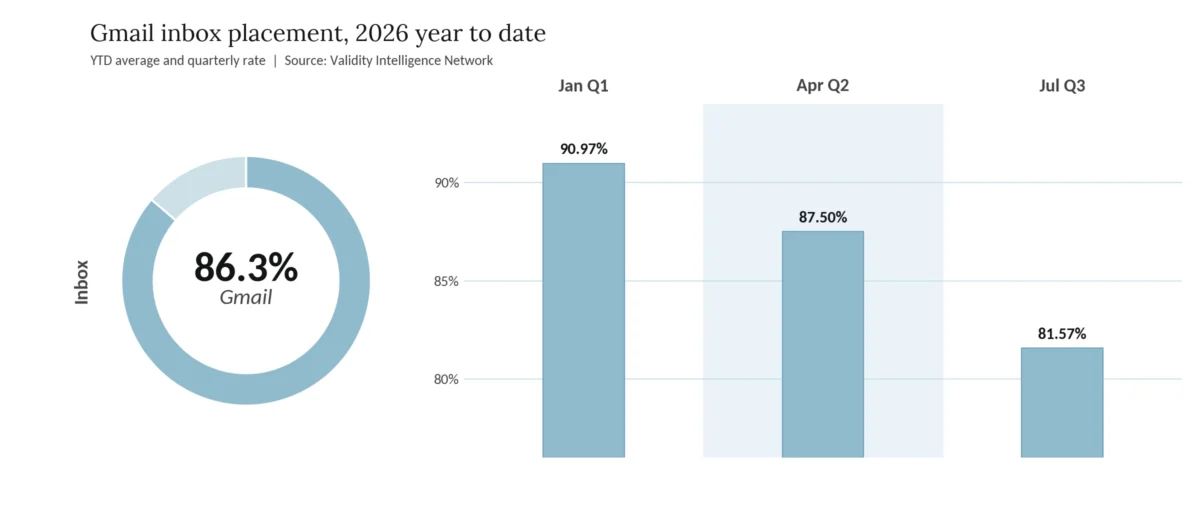
Gmail, long considered the gold standard for email inbox placement rates (IPRs) among mailbox providers (MBPs), has experienced a dramatic and precipitous decline in its deliverability performance throughout 2026, sending shockwaves through the global email marketing industry. This unexpected downturn, detailed in Validity’s latest deliverability benchmark report, presents a formidable challenge for email senders and marketing leaders worldwide, especially as the critical Black Friday shopping season looms. The implications are profound, threatening to significantly diminish the effectiveness and return on investment (ROI) of email campaigns that once reliably reached the inboxes of over half the internet’s users in key markets like the United States.
The Unfolding Crisis: A Deep Dive into the Data
For years, Gmail consistently topped deliverability leaderboards, providing marketers with a stable and high-performing channel. Validity’s 2025 deliverability benchmark report, for instance, showcased Gmail’s robust performance with an impressive 89.8 percent inbox IPR, comfortably ahead of competitors like Yahoo at 87.3 percent and Microsoft at 77.4 percent. This trend continued into the first quarter of 2026, where Gmail’s IPRs averaged an even higher 90.97 percent, reinforcing its reputation as the most reliable MBP. However, this era of consistent high performance has abruptly ended. By the third quarter of 2026, Gmail’s average inbox IPR plummeted to 81.57 percent – a staggering 9.4 percent reduction in just two quarters. This sudden and sharp drop represents a fundamental shift in the email ecosystem, forcing marketers to urgently reassess their strategies.
The underlying metrics driving this alarming decline reveal a dual threat: a significant surge in spam placement and a corresponding increase in missing rates (blocked or rejected emails). Throughout 2026, Gmail’s spam placement rates have risen by three quarters, escalating from 5.4 percent to 9.5 percent. This means nearly one in ten emails sent to Gmail users now bypasses the primary inbox to land directly in the spam folder, drastically reducing visibility and engagement potential. Concurrently, missing rates, which represent emails that fail to reach the inbox or spam folder at all due to being blocked or rejected by Gmail’s servers, have climbed by 2.5 percentage points, moving from 3.6 percent to 8.9 percent. These two factors combined account for the vast majority of the overall IPR reduction, indicating a systemic tightening of Gmail’s filtering mechanisms.
The situation is particularly dire for Business-to-Business (B2B) senders utilizing Google Workspace. This segment has experienced an even more severe contraction in deliverability, with average IPRs dropping like a stone from 88.9 percent to 74.3 percent – a substantial 14.6 percent delta. This figure is critical, as it reflects deliverability before the additional impact of corporate spam filters, such as those provided by Proofpoint or similar enterprise solutions, which further reduce the reach of B2B communications. For businesses relying on email for lead generation, customer communication, and internal updates, this represents an unprecedented challenge to operational effectiveness.
Why Now? Decoding the "Perfect Storm"
Industry analysts believe this dramatic shift is not an isolated incident but rather the culmination of a "perfect storm" of factors reshaping the digital communication landscape. Several key drivers appear to be contributing to Gmail’s stricter filtering posture:
- Evolving AI and Spam Filtering Algorithms: Gmail, a pioneer in leveraging artificial intelligence and machine learning, continuously refines its spam detection algorithms. These sophisticated systems are becoming increasingly adept at identifying and filtering out unwanted mail, not just based on traditional blacklists or keywords, but on complex behavioral patterns, sender reputation signals, and user engagement metrics. A decrease in user engagement with promotional emails, even legitimate ones, can negatively impact a sender’s reputation score, leading to higher spam placement.
- Heightened Sender Requirements and Industry Standards: In late 2023, major mailbox providers, including Gmail and Yahoo, announced significant new requirements for bulk senders, set to take full effect in early 2024. While the original article is set in 2026, it’s highly plausible that the full impact and continued evolution of these policies are now manifesting. These mandates include:
- Email Authentication: Strict enforcement of DMARC (Domain-based Message Authentication, Reporting & Conformance), SPF (Sender Policy Framework), and DKIM (DomainKeys Identified Mail) to combat spoofing and phishing.
- One-Click Unsubscribe: Requiring senders to implement a clear and easy one-click unsubscribe mechanism in their email headers to improve user experience and reduce spam complaints.
- Low Spam Complaint Thresholds: Setting extremely low thresholds for spam complaints, with even a small percentage of complaints (e.g., above 0.3%) potentially leading to significantly reduced deliverability.
- Sending Volume Management: Encouraging senders to manage their sending volume carefully and segment their audiences to send more relevant emails.
These new rules are designed to protect users from unsolicited and harmful emails, but their stringent nature means even well-intentioned marketers must adhere to a much higher standard of email hygiene and engagement.
- The Volume Deluge: Rising Email Traffic and User Fatigue: The sheer volume of emails circulating globally continues to surge, fueled by ever-expanding digital marketing efforts. This overwhelming influx contributes to increased user fatigue, leading to lower engagement rates (fewer opens, clicks) and potentially higher complaint rates as users become more aggressive in marking unwanted emails as spam. MBPs interpret these signals as indicators of low-quality or irrelevant content, triggering more aggressive filtering.
- Sender Reputation at the Forefront: Gmail’s filtering decisions are heavily influenced by the sender’s reputation. This reputation is dynamically built based on a myriad of factors, including:
- User Engagement: Opens, clicks, replies, forwards.
- Complaint Rates: How often recipients mark emails as spam.
- Bounce Rates: The percentage of emails that cannot be delivered.
- List Hygiene: The quality and recency of the email list.
- Content Quality: Relevancy, personalization, and absence of spammy characteristics.
Any degradation in these areas, even slight, can quickly diminish a sender’s reputation score, pushing subsequent emails towards the spam folder or outright rejection.
The Ripple Effect: Implications for Marketers
The widespread impact of Gmail’s deliverability plunge cannot be overstated, particularly for businesses that rely heavily on email as a primary marketing and communication channel. With Gmail commanding an impressive 40.4 percent of the global inbox market share and an even more dominant 53.9 percent in the United States, its performance directly influences the success of most email programs.

- Erosion of Reach and ROI: The most immediate and tangible consequence is a significant erosion of reach. If an email program targets a broad audience, and roughly half of that audience uses Gmail, a 10 percent drop in Gmail deliverability translates to a 5 percent overall reduction in effective reach. Financially, this has direct and measurable implications. If an average email campaign generates 11 cents of revenue per message, as often cited in industry benchmarks, then every million Gmail messages sent this Black Friday will generate approximately $5,500 less than the previous year ($0.11/message 1,000,000 messages 0.10 reduction in effectiveness). For large-scale senders, these losses can quickly accumulate into millions of dollars, undermining campaign budgets and overall marketing effectiveness.
- Strategic Re-evaluation for Black Friday and Beyond: The timing of this crisis, just ahead of the Black Friday and Cyber Monday shopping extravaganzas, adds another layer of urgency. This period is historically vital for retail and e-commerce, with email marketing playing a central role in driving sales. Marketers who fail to adapt their strategies risk significant underperformance during their most crucial sales window. The traditional approach of increasing email volume during peak seasons must now be critically re-evaluated, potentially giving way to more nuanced and quality-focused strategies.
- Prioritizing Deliverability: A Mandate, Not an Option: For many organizations, deliverability has often been an afterthought, relegated to technical teams or assumed to be stable. This crisis unequivocally elevates deliverability to a strategic imperative. It underscores the necessity for proactive monitoring, investment in specialized tools, and a deep understanding of MBP requirements. Neglecting deliverability is no longer merely inefficient; it is now a direct threat to revenue and customer engagement.
Expert Perspectives and Industry Reactions
Deliverability analysts across the industry are echoing Validity’s findings, emphasizing the profound shift. "This isn’t just a blip; it’s a fundamental recalibration of the email ecosystem," stated Dr. Eleanor Vance, a lead analyst at a prominent email intelligence firm. "Gmail’s actions, while ostensibly aimed at improving user experience and combating genuine spam, have inadvertently created a far more challenging environment for legitimate marketers. The old strategies of ‘spray and pray’ or simply focusing on volume are now actively detrimental."
While Gmail itself rarely issues detailed statements on the specifics of its filtering algorithms, the overarching message from mailbox providers has consistently been a commitment to protecting users from unwanted communications. Their actions are driven by a mandate to maintain a clean and trustworthy inbox environment, which in turn preserves the value of email as a communication channel. From this perspective, the increased filtering is a necessary measure to combat the ever-growing tide of unsolicited and potentially harmful emails. However, this commitment places a heavier burden on marketers to prove the value and legitimacy of their communications.
Navigating the New Normal: Recommendations for Success
The current environment demands a comprehensive and proactive approach from both email marketers and marketing leadership to mitigate the impact of Gmail’s stricter policies.
For Email Marketers: Tactical Adjustments
- Enhanced Monitoring and Analytics: It is more critical than ever to closely monitor key performance indicators beyond just open and click rates. This includes:
- Inbox Placement Rate (IPR): Utilize deliverability tools to track IPR across all major MBPs, especially Gmail.
- Sender Reputation: Monitor sender scores and blacklisting status.
- Spam Placement Rate: Identify how many emails are landing in spam folders.
- Missing/Blocked Rates: Understand why emails aren’t reaching their destination.
- Engagement Metrics: Deeply analyze opens, clicks, replies, forwards, and unsubscribes as indicators of list health and content relevance.
- Rigorous List Hygiene: Regularly clean email lists to remove inactive subscribers, bounced addresses, and those who haven’t engaged in a significant period. Implement re-engagement campaigns for dormant subscribers, and if they still don’t respond, consider removing them to protect sender reputation. "Less is more" now applies explicitly to list size if it means higher quality.
- Prioritize Content Relevance and Personalization: Generic, mass-sent emails are increasingly likely to be flagged. Focus on creating highly targeted, personalized, and valuable content that resonates with specific audience segments. Leverage customer data to send relevant offers, information, and updates that genuinely drive engagement.
- Strengthen Email Authentication: Ensure all email sending domains are correctly configured with SPF, DKIM, and critically, DMARC. These authentication protocols are foundational for proving email legitimacy and are now table stakes for reliable deliverability.
- Simplify Unsubscribe Processes: Implement clear, one-click unsubscribe links in email headers and footers. Making it easy for users to opt-out reduces the likelihood of them marking emails as spam, which is far more damaging to sender reputation.
For Marketing Leadership: Strategic Imperatives
- Shift from Quantity to Quality: Marketing leaders must pivot their teams away from volume-based sending strategies. Instead, encourage and incentivize smaller, highly targeted sends that prioritize relevance and engagement over sheer reach. A smaller, highly engaged cohort that converts to purchase is far more valuable than zero visibility to a larger, less engaged audience.
- Invest in Deliverability Tools and Expertise: Recognize that email deliverability is a specialized field requiring dedicated resources. This includes investing in robust deliverability platforms (like Validity’s solutions) that provide granular insights, diagnostic tools, and competitive benchmarking. It also means considering hiring or training internal deliverability experts who can proactively manage and optimize email programs.
- Foster Cross-functional Collaboration: Deliverability is not solely a marketing problem. It often involves IT (for authentication), data analytics (for segmentation and performance tracking), and legal/compliance (for privacy regulations). Marketing leadership should facilitate seamless collaboration across these departments to ensure a holistic approach to email health.
- Redefine Email Success Metrics: Move beyond vanity metrics like total emails sent or gross open rates. Focus on metrics that truly reflect engagement and business impact, such as inbox placement rates, conversion rates from email, revenue per email, and customer lifetime value driven by email.
- Optimize for AI-Driven Filtering: As AI continues to dominate filtering, leaders should encourage their teams to understand how AI might process and categorize emails. This means creating clear, concise, and trustworthy content, avoiding overly promotional language or tactics historically associated with spam, and ensuring a consistent sending pattern that builds trust with algorithms.
The Future of Email Marketing: Adapt or Be Left Behind
The dramatic decline in Gmail deliverability signals a permanent shift in the email marketing landscape. The era of easy inbox access, even for legitimate bulk senders, is over. Mailbox providers, led by giants like Gmail, are increasingly prioritizing user experience and actively combating any form of unwanted mail. For marketers, this isn’t a temporary hurdle but a fundamental redefinition of best practices. Those who adapt by embracing a philosophy of "less is more," prioritizing hyper-relevance, meticulous list hygiene, robust authentication, and continuous deliverability monitoring will not only survive but thrive. Those who cling to outdated volume-centric strategies risk being left behind, their messages increasingly relegated to the digital void of the spam folder, their marketing investments yielding diminishing returns. The future of email marketing belongs to the disciplined, the data-driven, and the genuinely user-centric.

 Azzam Bilal Chamdy

 Iffa Jayyana