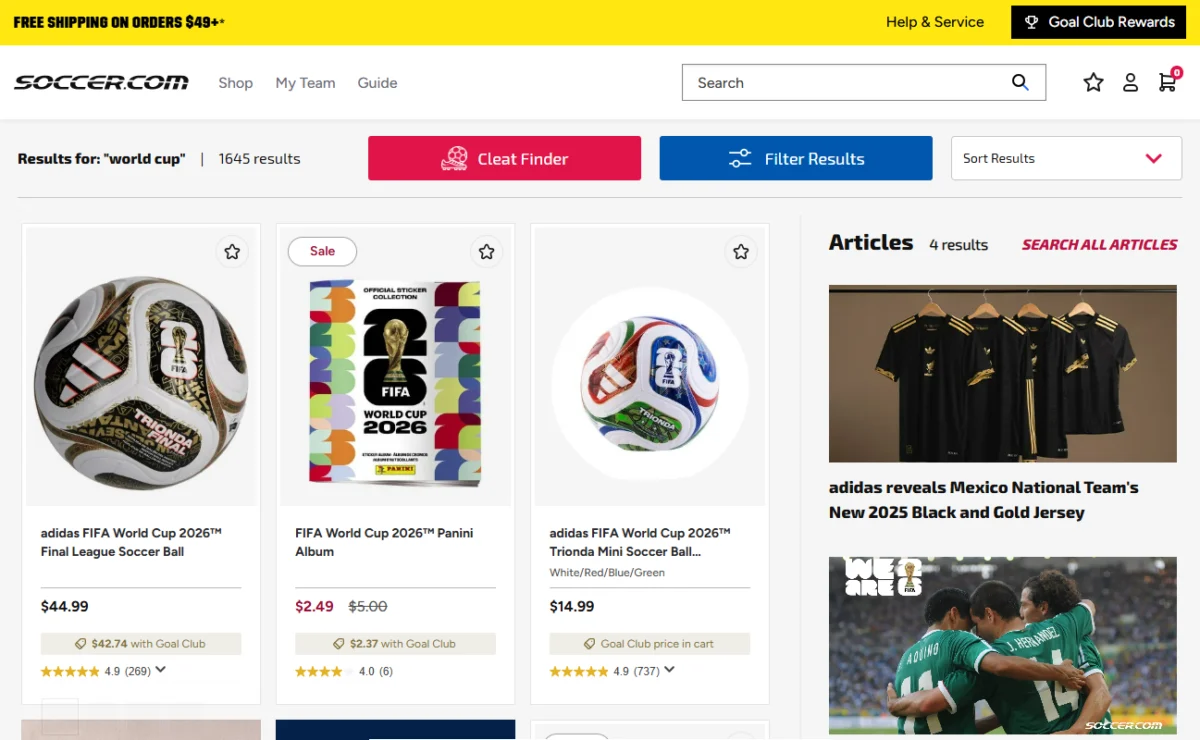
Web-only merchant Soccer.com has experienced a dramatic surge in sales, significantly outperforming previous years in the crucial months leading up to, during, and immediately following the highly anticipated 2026 World Cup. The online retailer, a prominent player in the global soccer merchandise market, saw its revenue skyrocket, driven primarily by an insatiable demand for fan gear and a strategic approach to product launches and inventory management.
Billy Lalor, director of consumer merchandising at Soccer.com, detailed the impressive growth trajectory. "From March 1st until the World Cup’s Group Stage commenced in the second week of June, we observed a substantial 40% year-over-year increase in revenue," Lalor stated. This figure aligns closely with the company’s proactive planning and sales projections heading into the quadrennial international football tournament. He further elaborated that the "large majority" of this initial growth was directly attributable to the fan gear sector, a category that encompasses popular items such as national team jerseys. Lalor noted that "early adopters get particularly fired up about these products," indicating a strong early interest in team apparel.
Beyond the dominant fan gear category, other product segments within Soccer.com’s offerings also experienced healthy growth, with increases hovering around the 10% mark. However, the fan space truly exploded, with specific items witnessing "strong triple-digit" growth, approximating a remarkable 300% year-over-year increase. This substantial uplift in the fan gear category is intrinsically linked to the product release cycle. Lalor clarified that the March 1st starting point for this metric was chosen deliberately, as it marked the month when the majority of on-field product lines – including the official match jerseys worn by national teams – were launched. This strategic timing allowed Soccer.com to capture the initial wave of fan enthusiasm and purchasing intent.
As the tournament progressed, the impact on Soccer.com’s sales became even more pronounced. Lalor reported that during the World Cup itself, the fan space product growth surged to an astounding "more than 900% year over year." This extraordinary figure underscores the immense consumer engagement and purchasing power unleashed by the global spectacle. The overall business at Soccer.com experienced a comparable explosion, growing by an impressive 260% year over year during the entire duration of the World Cup, which concluded on July 19th.
The aftermath of the tournament also proved to be a fertile ground for continued sales momentum. From the event’s conclusion through mid-August, Soccer.com’s business maintained a robust 30% year-over-year growth rate. Lalor attributed a significant portion of this sustained success to the celebratory purchases following Spain’s victory in the 2026 World Cup. "Coming out of the event, you’ve got a lot of fans coming in," Lalor explained. "Some of them are still buying teams other than Spain, but Spain winners’ jerseys drove a big number. And while we had great sell-through, there’s still, of course, always going to be stuff that you have to move through afterwards." This indicates a strategic approach to managing post-event inventory and capitalizing on residual excitement.
Lalor characterized major tournament events like the World Cup as "absolutely massive" for Soccer.com’s business model. He further noted that while the World Cup stands as the pinnacle of these events, other significant tournaments such as the European Championships and the Copa America also contribute meaningfully to spikes in traffic and sales. These continental championships, which typically occur in the second year between World Cups, create what Lalor describes as "a mini World Cup" effect for the retailer. Collectively, the demand generated by the European Championships and Copa America often accounts for approximately 30% to 40% of the traffic and sales volume that the World Cup brings to Soccer.com.
The online retailer is currently navigating the "bell curve" of the World Cup-induced peak, meaning sales are gradually returning to more normalized levels, albeit with a continued elevated baseline. This phenomenon is consistent with past World Cup cycles, where post-tournament excitement often translates into a sustained uplift in sales. Beyond the major international tournaments, Soccer.com also experiences other significant seasonal peaks. These include the periods when young soccer players are preparing for their school or club team seasons, and the ubiquitous holiday shopping season, which traditionally sees a surge in consumer spending across most retail sectors.
Strategic Planning for Peak Demand: A Data-Driven Approach
Soccer.com’s ability to effectively capitalize on these peak demand periods is rooted in a highly data-driven operational strategy. "It’s very data-driven, of course," Lalor emphasized. "Our merchants do have to make judgments about what products are coming to market versus the attractiveness of the comparable products in seasons past. We don’t just take the data from seasons past and plug it in, but we do start with it. And we have a lot of data." This indicates a sophisticated forecasting model that leverages historical performance while also incorporating forward-looking insights.
The company’s planning extends beyond simple historical averages. Soccer.com actively analyzes recent trends, rather than relying solely on a three-year average for particular product groups or time periods. Their forecasting horizon stretches "farther out than six or seven months," allowing for more comprehensive strategic planning and inventory procurement. These trend analyses are crucial for making proactive forecasting adjustments. By understanding emerging consumer preferences and market dynamics, Soccer.com can strategically adjust its buying strategies to ensure it possesses the "right amount of what its consumers want at the time they want it."
A pivotal factor in Soccer.com’s inventory and merchandising strategy is the product innovation cycle, particularly within the footwear sector. Lalor highlighted that major sports apparel brands like Adidas and Nike typically refresh their product lines on an 18-month to two-year cycle. This is when these brands introduce significant "newness and innovation within a product silo." He contrasted this with more minor, cosmetic updates that might occur quarterly or annually, stating, "That’s always a big consideration versus every quarter or 12 months, they’re going to give some slight changes to the product, cosmetic changes to sort of freshen up the attention to it." The staggered release schedules of these major product innovations, where brands do not update their offerings simultaneously, also create further opportunities for Soccer.com. Lalor noted that when executed effectively, these staggered releases can generate "another spike in interest and sales in a way that is outside of sort of normal cycles of growth." This indicates a keen understanding of the interplay between brand product cycles and consumer purchasing behavior.
The Global Context of the 2026 World Cup
The 2026 FIFA World Cup, co-hosted by the United States, Canada, and Mexico, represented a significant global sporting and cultural event. The tournament, which ran from June 11 to July 19, 2026, brought together national teams from across the globe, captivating billions of viewers worldwide. The massive viewership and widespread enthusiasm for international football directly translate into increased demand for related merchandise, making it a critical period for retailers like Soccer.com. The event’s location also heightened interest among North American consumers, a key market for online sports apparel retailers. The World Cup is not merely a sporting competition; it is a global phenomenon that drives significant economic activity, particularly within the sports merchandise sector. The tournament’s broad appeal transcends national borders, fostering a shared passion for the game that directly fuels consumer spending.
The strategic timing of new product releases, especially for national team jerseys, is a well-established practice in the sports merchandising industry. Brands and retailers alike aim to align their product launches with the anticipation leading up to major tournaments. This allows them to capture the initial wave of fan excitement and solidify their market presence before and during the event. Soccer.com’s success demonstrates their adeptness at leveraging these critical product launch windows. The "early adopters" Lalor mentioned are often the most passionate fans, eager to display their allegiance and be among the first to own the latest team apparel. This initial surge in sales sets a positive tone for the entire tournament period.
The sustained growth observed post-tournament, particularly in the wake of Spain’s victory, highlights the enduring impact of a successful national team. Championship wins generate a secondary wave of demand as fans celebrate their team’s achievement. This often includes a surge in purchases of championship-specific merchandise, such as winner’s jerseys and commemorative items. Retailers that can accurately forecast and stock these items are well-positioned to capitalize on this post-victory fervor. Soccer.com’s ability to manage inventory effectively, ensuring they have products available even after the initial sell-through, is a testament to their robust supply chain and inventory management capabilities.
The recognition of continental tournaments like the European Championships and Copa America as significant revenue drivers, even when dwarfed by the World Cup, underscores Soccer.com’s comprehensive market understanding. These events, while smaller in global scale, command intense regional interest and loyalty, creating consistent demand cycles throughout the year. The "mini World Cup" effect they generate provides valuable, albeit smaller, boosts to revenue and customer engagement, helping to smooth out sales fluctuations between the quadrennial World Cup events. This diversified approach to capitalizing on major footballing events allows Soccer.com to maintain a more stable and predictable growth trajectory.
The mention of Soccer.com’s data-driven approach and its reliance on sophisticated forecasting models points to a modern retail strategy. In today’s competitive e-commerce landscape, understanding consumer behavior, predicting demand, and optimizing inventory are paramount. The company’s commitment to analyzing recent trends, looking beyond historical averages, and planning well in advance demonstrates a proactive and agile business model. This is crucial in a market where consumer preferences can shift rapidly, influenced by team performance, player transfers, and emerging fashion trends.
The emphasis on product innovation cycles, particularly from major brands like Adidas and Nike, further illustrates Soccer.com’s strategic alignment with the broader sports apparel industry. By understanding when new footwear and apparel technologies are introduced, the company can better anticipate consumer interest and ensure it has the latest offerings available. The staggered nature of these product launches, as highlighted by Lalor, presents an opportunity for retailers to create sustained excitement and sales throughout the product lifecycle. This nuanced understanding of brand strategies and product development cycles allows Soccer.com to remain at the forefront of the market.
In conclusion, Soccer.com’s remarkable sales performance in the lead-up to, during, and after the 2026 World Cup is a clear indicator of a well-executed business strategy. By leveraging deep market insights, a data-driven approach to forecasting, and a keen understanding of consumer behavior, the web-only merchant has successfully transformed a global sporting event into a significant commercial success. Their ability to anticipate demand, manage inventory effectively, and capitalize on product innovation cycles positions them as a formidable player in the online soccer merchandise market. The ongoing impact of major football tournaments, coupled with strategic retail planning, continues to be a powerful engine for growth in the digital commerce space.

 Raul Delapena Setiawan
 Ammar Sabilarrohman