Thinking Machines Lab has officially launched Inkling, a massive 975-billion-parameter multimodal foundation model that marks a significant shift in the landscape of open-weights artificial intelligence. Released on July 15, 2026, under the permissive Apache 2.0 license, Inkling is designed to move beyond the industry’s traditional obsession with benchmark scores, focusing instead on providing a highly customizable backbone for agentic AI, complex multimodal reasoning, and domain-specific enterprise applications. By combining a Sparse Mixture-of-Experts (MoE) architecture with a massive 1-million-token context window, the model offers a sophisticated balance between high-capacity intelligence and operational efficiency.
The unveiling of Inkling represents the first major foundation-model effort from Thinking Machines Lab, a research entity that has prioritized "open-weights" accessibility over the "black box" API models favored by several industry incumbents. The model is capable of natively processing text, images, and audio, and it is specifically engineered to support tool-use and autonomous agent workflows. With 41 billion active parameters per token, Inkling achieves the performance characteristics of a trillion-parameter dense model while maintaining a more manageable computational footprint during inference.

Architectural Innovations: The MoE Backbone and Hybrid Attention
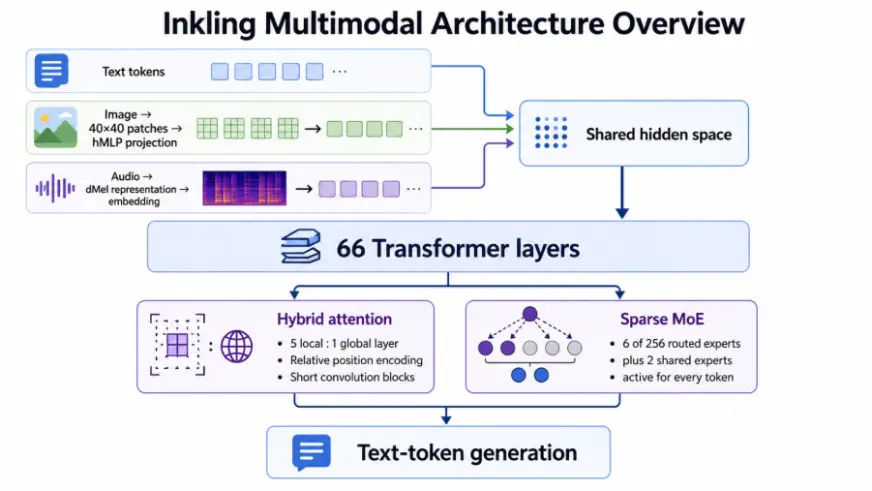
At the heart of Inkling is a 66-layer, decoder-only Transformer architecture utilizing a sophisticated Sparse Mixture-of-Experts design. This configuration features 256 routed experts and two shared experts per layer. During the processing of any single token, the model’s router activates six routed experts alongside the two shared experts, which remain active across all computations. This routing mechanism utilizes sigmoid-based scoring and an auxiliary-loss-free load balancing system, a method that ensures even distribution of labor across the expert network without sacrificing the specialized knowledge stored within specific subsets of parameters.
The architectural design draws inspiration from the DeepSeek-V3 MoE framework but introduces several proprietary enhancements. One of the most notable features is the hybrid attention mechanism. Inkling utilizes five sliding-window attention layers followed by a global attention layer. This periodic alternation allows the model to maintain local coherence and reduce computational overhead for nearby tokens while ensuring that information can still be exchanged across the entire 1-million-token context window every sixth layer.
Furthermore, Thinking Machines Lab has opted for learned relative positional representations rather than the more common Rotary Positional Embeddings (RoPE). According to the lab’s technical report, this approach provides superior extrapolation capabilities for long-context sequences, allowing the model to maintain accuracy even when dealing with documents or audio files that approach the million-token limit. To capture short-range patterns more effectively, the model also incorporates short convolutional layers, which work in tandem with the attention heads to process localized data features before they are integrated into the broader transformer layers.
Training Methodology and Computational Scale
The training of Inkling was a massive undertaking, utilizing a corpus of 45 trillion tokens. This dataset was curated from a diverse array of sources, including public web data, licensed third-party repositories, and a significant volume of synthetic and augmented data. The training process involved rigorous cleaning, deduplication, and safety filtering to ensure the model’s reliability in professional environments.
In terms of optimization, Thinking Machines Lab employed a hybrid strategy. They utilized AdamW for standard weight updates and a 4-bit NormalFloat (NVFP4) quantization-aware training process for the specialized versions of the model. A unique aspect of their optimization was the coupling of weight decay to the square of the learning rate, a technique designed to stabilize weight magnitudes across the vast training horizon.
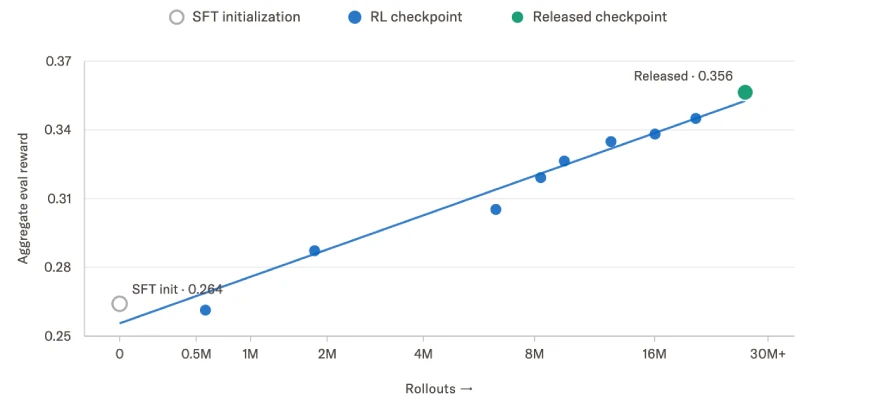
The training hardware consisted of NVIDIA GB300 NVL72 systems, representing the cutting edge of AI infrastructure in 2026. This hardware allowed the lab to scale its reinforcement learning (RL) efforts to unprecedented levels. Following an initial Supervised Fine-Tuning (SFT) phase—which utilized synthetic data generated by models such as Kimi K2.5—the lab transitioned to large-scale asynchronous RL. Over 30 million rollouts were conducted, focusing on mathematical reasoning, coding, and safety. This intensive RL phase saw the model’s held-out aggregate reasoning reward increase from 0.264 to 0.356, a log-linear growth that underscores the efficacy of their training pipeline.
Multimodal Capabilities and Native Processing
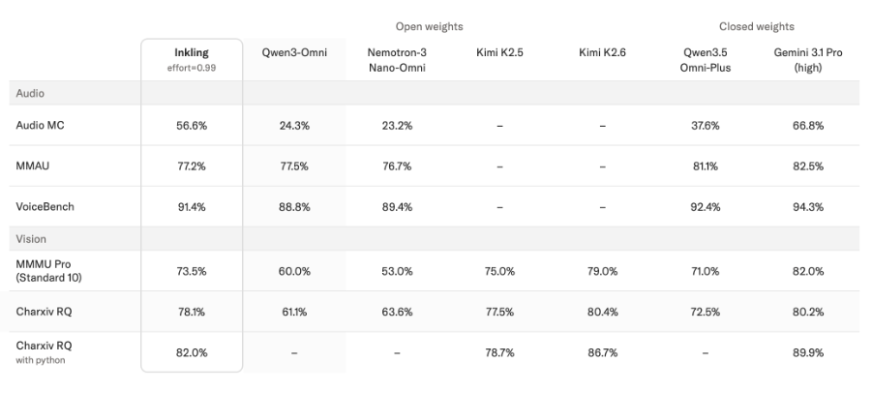
Unlike many models that rely on external encoders or "wrappers" for different modalities, Inkling handles text, images, and audio natively within the same decoder framework.
- Text: Processed via standard autoregressive tokenization.
- Images: The model splits images into 40×40 patches, which are then encoded using a four-layer hierarchical Multi-Layer Perceptron (MLP). It supports resolutions ranging from 40 to 4096 pixels, making it adept at analyzing everything from small icons to high-resolution architectural blueprints.
- Audio: Audio data is converted into discretized mel-spectrogram (dMel) embeddings. Inkling is optimized for 16 kHz WAV audio but supports formats like MP3 and FLAC, with the ability to process continuous recordings of up to 20 minutes.
- Video: While video data was included in the pretraining phase, Thinking Machines Lab notes that out-of-the-box video reasoning is currently in a "preview" state, recommending that users fine-tune the model for specific video-based production tasks.
The Tinker Platform and Self-Fine-Tuning
One of the most innovative aspects of the Inkling ecosystem is the introduction of the "Tinker" platform, which facilitates "self-fine-tuning." During the launch demonstration, Inkling showcased its ability to act as its own developer. When tasked with becoming a specialized "lipogram assistant" (an AI that avoids specific letters), the model used a coding-agent workflow to generate its own training data, write the fine-tuning scripts, execute the training via Tinker, and then evaluate the resulting checkpoint.
This "agentic" approach to model improvement suggests a future where AI systems can be tailored to hyper-specific tasks with minimal human engineering. It is important to note that the model does not autonomously change its weights during a standard conversation; rather, it uses its tool-calling and coding abilities to manage a formal fine-tuning pipeline on behalf of the user.
Performance Benchmarks and Safety Analysis
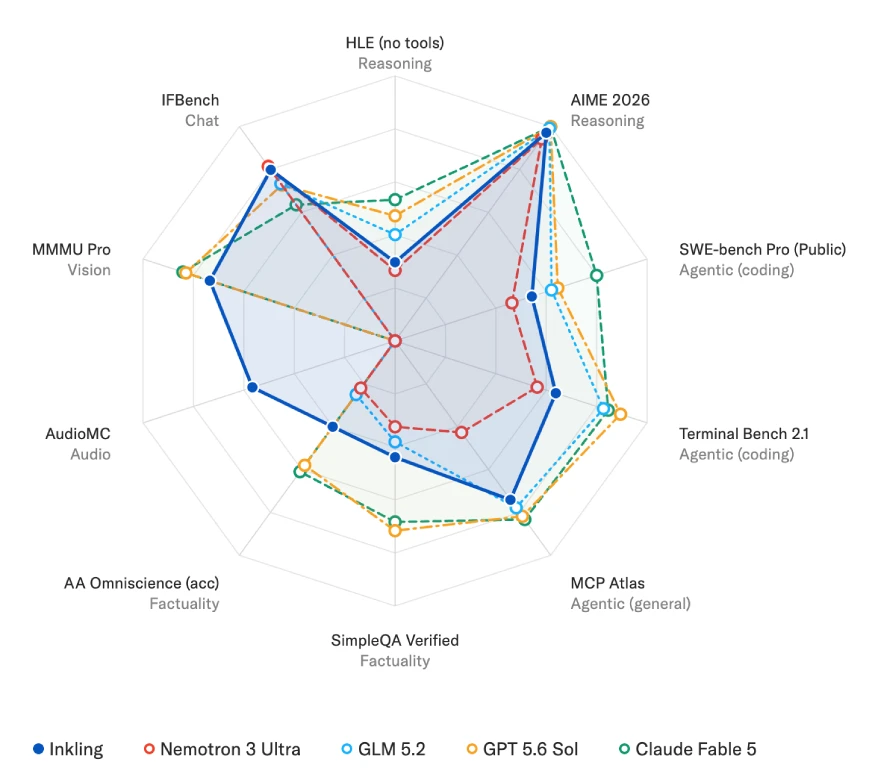
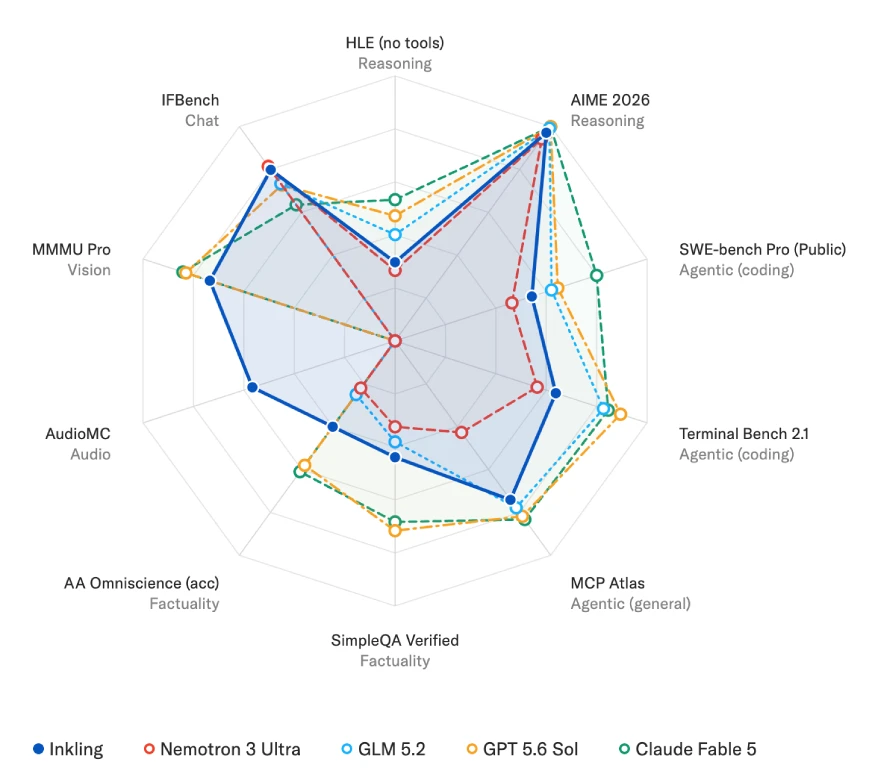
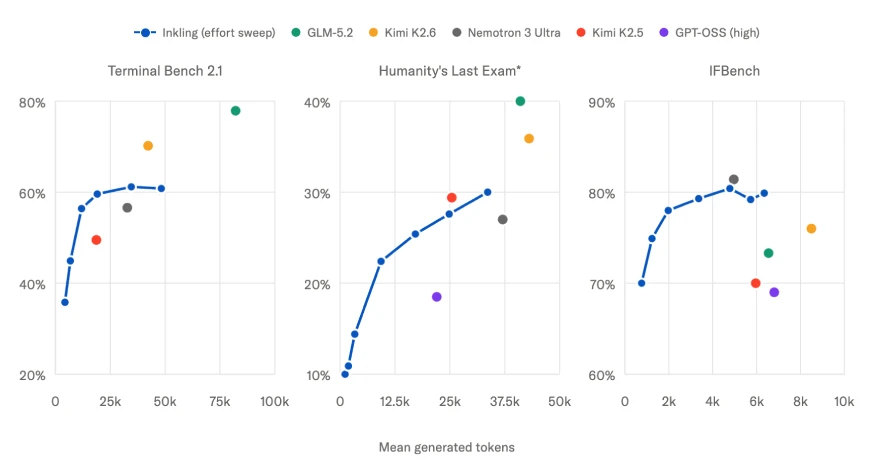
Inkling’s performance profile is that of a "balanced generalist." On the AIME 2026 mathematics benchmark and the GPQA Diamond science benchmark, Inkling showed competitive results, particularly when allowed higher "reasoning effort" settings. Developers can adjust the model’s thinking budget; higher effort levels generally lead to better accuracy on complex logic tasks, though the lab notes diminishing returns at extremely high token budgets.
In coding tasks, Inkling excels at repository-level interactions and multi-step terminal workflows. While it may not yet consistently beat the most advanced proprietary models on benchmarks like SWE-bench Pro, its open-weights nature allows it to be integrated into local development environments where data privacy is paramount.
Safety remains a core focus. Thinking Machines Lab evaluated Inkling against adversarial prompts, cyber-risk scenarios, and manipulation attempts. While the model demonstrates a high refusal rate for harmful requests, the lab warned that like all open-weights models, Inkling’s safety guardrails can be modified through fine-tuning. Therefore, they recommend that enterprise deployments include external moderation layers and sandboxed tool execution environments.
Deployment, Pricing, and Hardware Requirements
The deployment of a 975-billion-parameter model presents significant infrastructure challenges. The standard BF16 (16-bit) checkpoint requires approximately 2 terabytes of VRAM, necessitating multi-node GPU clusters. However, the NVFP4 version is optimized for NVIDIA Blackwell hardware, reducing the VRAM requirement to roughly 600 GB.
For those without massive on-premise clusters, Thinking Machines Lab has partnered with several hosted providers, including Together AI, Fireworks, Modal, Databricks, and Baseten. These integrations allow developers to access Inkling via standard APIs or deploy fine-tuned versions in serverless environments.
Additionally, a preview of "Inkling-Small" was announced. This 276-billion-parameter model (with 12 billion active parameters) aims to offer similar reasoning capabilities to the larger model but with significantly lower latency and hardware requirements, making it a more practical choice for real-time applications and edge computing.
Industry Implications and Broader Impact
The release of Inkling signals a new era in the "open versus closed" AI debate. By providing a model of this scale under an Apache 2.0 license, Thinking Machines Lab is challenging the dominance of closed-source giants. This move democratizes access to "frontier-class" reasoning and multimodal capabilities, allowing organizations to build proprietary systems without the risks of vendor lock-in or data leakage associated with API-only models.
Industry analysts suggest that Inkling’s real value lies in its flexibility. "The significance isn’t just the 975 billion parameters," noted one independent AI researcher. "It’s the fact that a company can now take a model of this caliber, fine-tune it on their own private legal or medical data, and run it on their own hardware. That is a game-changer for high-security industries."
As the AI field moves toward agentic systems—AI that can use tools and make decisions autonomously—Inkling’s native support for tool-calling and its 1-million-token context window position it as a leading candidate for the next generation of digital assistants and automated workflows. Whether it becomes the industry standard remains to be seen, but its arrival certainly raises the bar for what is expected from the open-weights community.