The landscape of digital marketing and user experience has undergone a radical transformation over the last decade, shifting from static storefronts to dynamic, data-driven ecosystems. At the center of this evolution is the discipline of Conversion Rate Optimization (CRO), a field that balances rigorous statistical analysis with an empathetic understanding of human behavior. Recently, the industry has turned its attention to Katie Faulkner, an Optimisation Strategist at FORJ Digital, who was named the latest winner of the "SpeakUp to Uplevel" competition. This annual initiative, organized by Convert.com in partnership with the Women in Experimentation (WE) community, seeks to amplify diverse voices in a field traditionally dominated by technical silos. Faulkner’s rise within the industry offers a window into the changing methodologies of experimentation, the integration of artificial intelligence, and the growing importance of the "human behind the click."
The Strategic Path to Optimization
Faulkner’s entry into the world of CRO was not the result of a linear academic pursuit but rather what she describes as a "happy accident." Her professional background, which spans the disparate fields of science, data analysis, fine art, and customer service, provided a unique foundation for the multi-faceted demands of optimization. While working at a local agency, Faulkner was encouraged to explore CRO as a means of synthesizing these threads. The transition highlights a broader trend in the technology sector: the increasing value of "T-shaped" professionals who possess deep expertise in one area—such as data—while maintaining a broad understanding of related disciplines like psychology and design.

Since joining FORJ Digital, Faulkner has focused on the intersection of complex business models and user journey simplification. Her work emphasizes that optimization is not merely about moving buttons or changing colors, but about solving fundamental points of friction within the customer journey. This perspective aligns with current industry data suggesting that high-maturity experimentation programs—those that integrate qualitative insights with quantitative testing—see a significantly higher return on investment than those focusing on superficial changes.
The Role of Artificial Intelligence as a Collaborative Agent
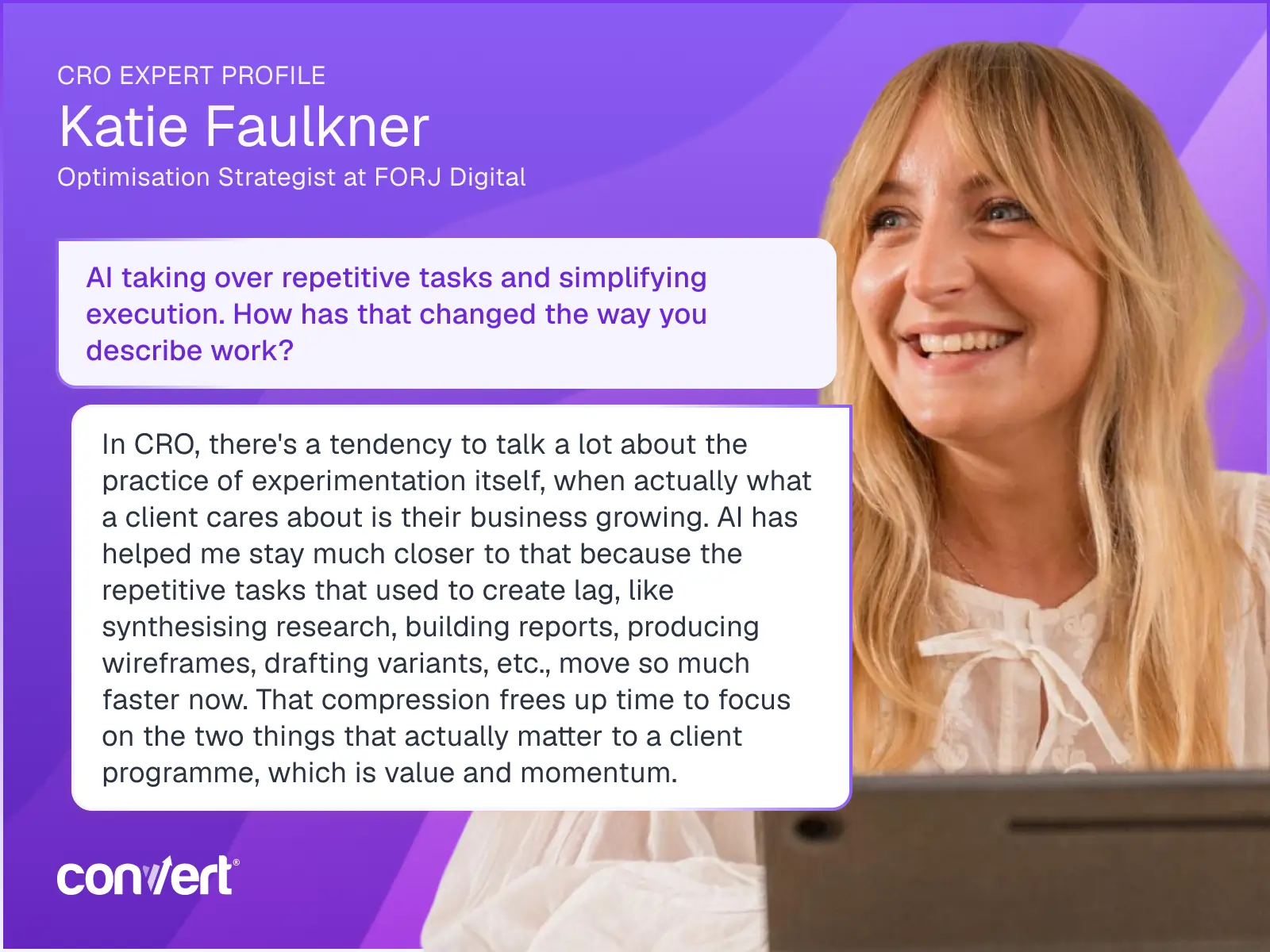
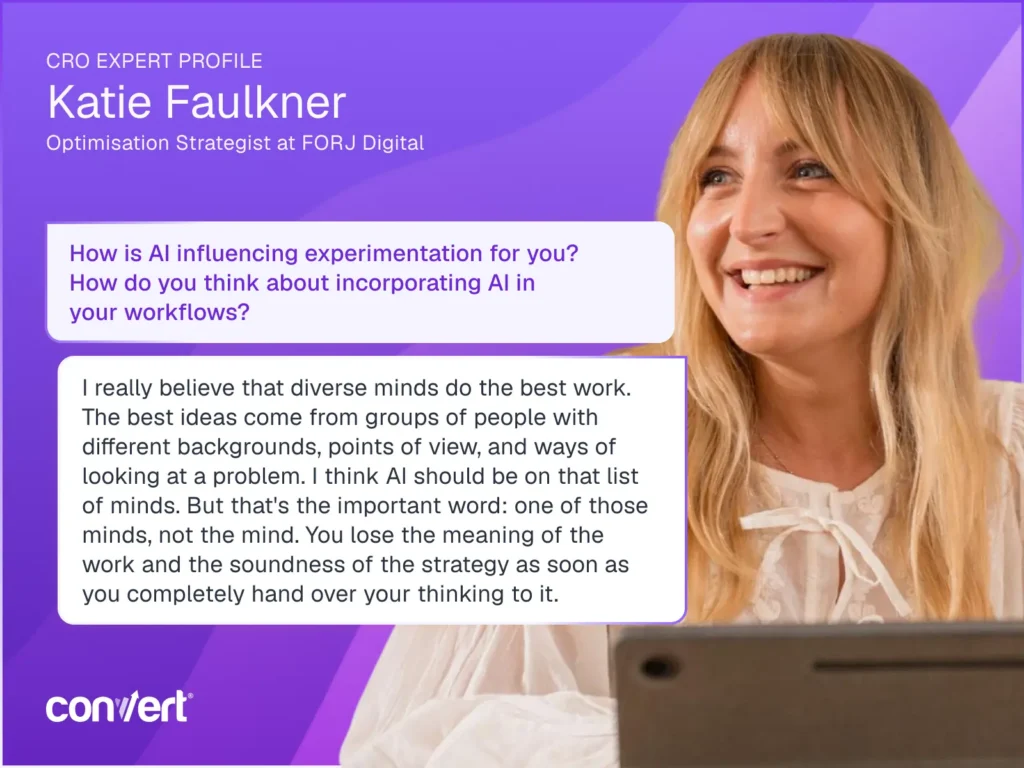
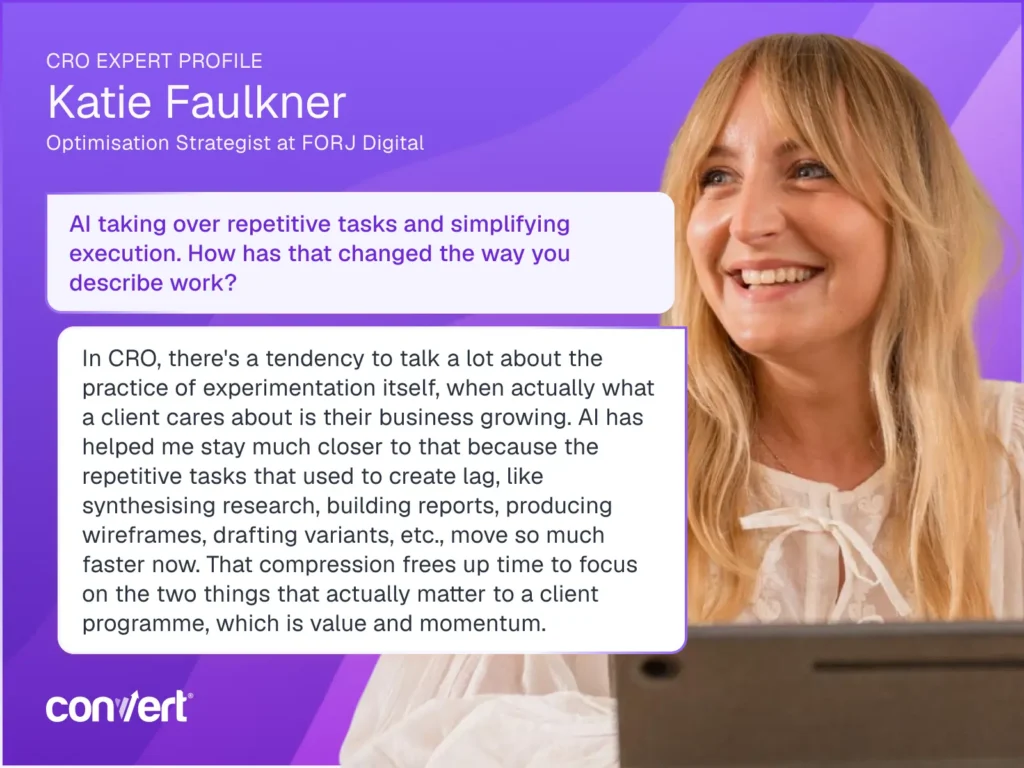
A central theme in Faulkner’s recent work and industry commentary is the pragmatic application of Artificial Intelligence (AI). While much of the public discourse surrounding AI focuses on the potential for automation to replace human workers, Faulkner advocates for a "co-pilot" or "colleague" model. In her workflow at FORJ Digital, AI agents are tasked with labor-intensive duties such as synthesizing raw qualitative data, generating initial report drafts, and translating research insights into low-fidelity wireframes.
This shift in execution has profound implications for the speed of experimentation. Traditionally, the lag between identifying a user pain point and deploying a test could span weeks. By utilizing AI to compress the production cycle, optimization teams can maintain "momentum"—a key metric for client satisfaction and program health. However, Faulkner maintains a cautious stance on total automation. She argues that the soundness of a strategy is compromised the moment human oversight is removed. In her view, AI provides a "diverse mind" to the brainstorming process, offering angles or design directions that might escape human bias, yet it remains one part of a larger, human-led team.

Chronology of Innovation: From Transactional to Relational Design
The evolution of Faulkner’s experimentation playbook can be traced through several high-impact projects that illustrate the shift from transactional web design to honest, helpful user experiences. One notable example involves the development of a budget planner for an amusement park. The park faced a recurring issue: visitors often felt a loss of trust when "hidden" or unexpected costs surfaced during their physical visit.
Faulkner’s solution was to move the "honesty" up the funnel. By creating a dynamic budget planner during the online booking process, the experience transitioned from a simple ticket sale to a consultative service. This intervention addressed the psychological gap between consumer expectations and reality, ultimately bolstering long-term brand loyalty.
Following this trajectory, Faulkner has explored the concept of "conversational journeys." These are digital experiences modeled after high-performing retail assistants who listen, ask clarifying questions, and guide users through complex product catalogs. This approach reduces cognitive load—the mental effort required to complete a task—which is a primary driver of cart abandonment in e-commerce.
Supporting Data and Industry Benchmarks
The strategies championed by Faulkner are supported by broader industry trends. According to 2024 industry reports on the state of experimentation, companies that run more than 20 tests per month are twice as likely to report "significant" revenue growth compared to those running fewer than five. Furthermore, the integration of behavioral signals—such as detecting "rage clicking" or unusual scrolling patterns—into real-time testing has become a hallmark of advanced CRO.
Faulkner points to several industry leaders as benchmarks for this type of creative experimentation:
- AO.com: The retailer utilizes behavioral triggers, such as displaying a comparison pop-up when a user copies a product serial number, anticipating the user’s intent to price-match or research elsewhere.
- Charlotte Tilbury: The brand’s "shade finder" tool solves a traditional brick-and-mortar problem (color matching makeup) through digital diagnostic tools, effectively reducing the barrier to online purchase.
- Sézane: By organizing Product Listing Pages (PLPs) by color rather than price or popularity, the luxury brand mimics the experience of browsing a boutique, turning a functional task into a discovery-based experience.
These examples reinforce Faulkner’s assertion that the most effective experiments are those that recognize the user as a "real person with worries and needs," rather than a data point in a funnel.
The Future of the Modular Web
Looking toward 2026 and beyond, Faulkner envisions a shift where experimentation moves beyond the confines of testing platforms and becomes an inherent part of the web’s architecture. She predicts the rise of "modular web pages" that do not load as fixed templates. Instead, these pages will assemble themselves in real-time based on a user’s past behavior, current intent signals, and predictive AI modeling.
In this future, the "page" is a permanent experiment, invisibly adjusting its layout, messaging, and functionality to serve the individual user. While this level of personalization offers immense potential for conversion, it also presents challenges regarding data privacy and the need for ethical "guardrails." Faulkner emphasizes that practitioners must remain "curious instead of confident," acknowledging that the technology is currently moving faster than the regulatory and ethical frameworks governing its use.
Broader Impact: Representation and Visibility in Tech
Faulkner’s recognition by Women in Experimentation highlights an ongoing effort to address the gender gap within the data and optimization sectors. The "SpeakUp to Uplevel" competition is specifically designed to provide a platform for women to share their expertise, countering the "imposter syndrome" that Faulkner admits has occasionally affected her own career.
Her success serves as a case study in "credible visibility." Rather than focusing on high-volume self-promotion, Faulkner’s approach to building a professional brand centers on authenticity and deep thinking. She advocates for a "sit back and think" methodology, suggesting that the quality of one’s contribution in meetings or at conferences is more important than the speed or volume of their speech. This perspective is particularly resonant in a field that often prizes rapid-fire execution over strategic contemplation.
Analysis of Implications for the CRO Industry
The insights provided by Faulkner suggest a fundamental rebranding of the CRO profession. For years, optimization was described through its process: A/B testing, multivariate testing, and heatmapping. However, as AI simplifies the execution of these tasks, the value proposition is shifting toward business impact.
The "compression of production" mentioned by Faulkner means that agencies and internal teams must now justify their presence through strategic foresight and the ability to drive "momentum." When the technical barriers to running a test are lowered, the competitive advantage shifts to those who can formulate the most daring and insightful hypotheses.

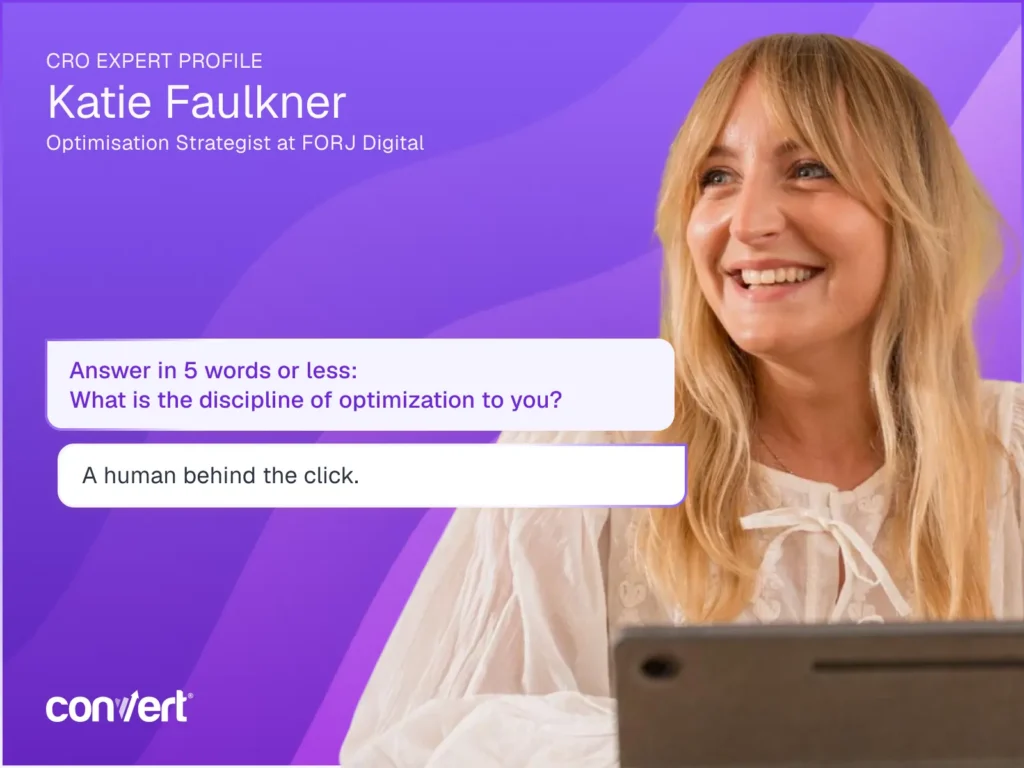
Furthermore, the emphasis on the "human behind the click" suggests a move away from aggressive "dark patterns"—manipulative design choices intended to trick users into converting—toward a model of "radical honesty." As consumers become more digitally literate, they are increasingly likely to reward brands that provide transparency and genuine utility, such as the amusement park budget planner.
Conclusion
The interview with Katie Faulkner underscores a pivotal moment for digital experimentation. As the discipline matures, it is moving away from being a purely technical function and toward becoming a core strategic pillar of business growth. The integration of AI as a collaborative partner, the focus on psychological journey-mapping, and the commitment to building authentic professional communities are all indicators of a healthy, evolving industry. Faulkner’s journey from a generalist with a background in art and science to an award-winning strategist serves as a reminder that the most effective digital experiences are those built on a foundation of human empathy and strategic depth. In the coming years, the success of conversion rate optimization will likely depend not on who has the best algorithm, but on who best understands the complex, often unpredictable human being on the other side of the screen.