rifanmuazin
Google has officially expanded its generative artificial intelligence portfolio with the introduction of Gemini 3.5 Flash, a model engineered to balance high-tier frontier intelligence with the rapid execution speeds required for modern enterprise and developer workflows. Positioned as a direct response to the increasing demand for low-latency, high-throughput AI, Gemini 3.5 Flash serves as the vanguard for the Gemini 3.5 family, with a more robust “Pro” variant scheduled for release in the coming month. Unlike previous iterations that focused primarily on conversational depth, the 3.5 Flash model is specifically optimized for “agentic” tasks—processes where the AI acts as an autonomous or semi-autonomous agent capable of planning, executing multi-step instructions, and managing complex coding environments.
The release of Gemini 3.5 Flash marks a significant pivot in Google DeepMind’s strategy, moving toward a “performance-first” architecture. While large language models (LLMs) have historically faced a trade-off between reasoning quality and response time, the Flash series seeks to eliminate this friction. By prioritizing long-horizon task handling and multimodal reasoning—the ability to process text, code, images, and video simultaneously—Google aims to capture the market for real-time applications such as live customer support, rapid prototyping, and automated software engineering.
Technical Specifications and Core Capabilities
Gemini 3.5 Flash is built upon a transformer-based architecture that has been refined for efficiency. A hallmark of the Flash series is its ability to maintain a massive context window while significantly reducing the time to first token. This allows the model to digest vast amounts of data—such as hundreds of pages of documentation or hours of video—and provide actionable insights in seconds.
The “agentic” nature of the model is perhaps its most defining feature. In the context of AI, “agentic workflows” refer to the model’s ability to utilize “subagents” or specialized tools to complete a goal. For example, if tasked with building a financial report, Gemini 3.5 Flash can theoretically deploy one subagent to scrape data, another to perform calculations, and a third to format the final document into a user interface (UI). This collaborative approach reduces the cognitive load on the primary model and increases the accuracy of complex, multi-stage outputs.
Furthermore, the model excels in richer UI generation. Developers are increasingly moving away from static templates toward generative interfaces that adapt to user needs in real-time. Gemini 3.5 Flash supports this shift by providing high-speed code generation that can render functional frontends almost instantaneously. This capability is paired with enhanced multimodal reasoning, allowing the model to “understand” visual elements and translate them into functional code or descriptive analysis with higher precision than its predecessors.
The Evolution of Google’s AI: A Chronological Context
To understand the significance of Gemini 3.5 Flash, one must look at the rapid timeline of Google’s AI development over the past two years. Following the initial launch of Bard, Google transitioned its focus to the Gemini era, starting with Gemini 1.0. This was followed quickly by Gemini 1.5 Pro, which introduced the industry-leading one-million-token context window.
The jump to version 3.5, bypassing a widespread 2.0 or 3.0 release for the Flash series, suggests a strategic alignment with industry nomenclature and a leap in underlying capability. Competitors like OpenAI and Anthropic have recently shifted toward “incremental” versioning (such as GPT-4o and Claude 3.5 Sonnet) to signal major architectural optimizations without requiring a total overhaul of the model’s training data. Google’s adoption of the 3.5 moniker reflects a similar maturity, indicating that the model has reached a new plateau of reliability and speed.
The timeline for the 3.5 series rollout is aggressive. With Gemini 3.5 Flash now available across consumer, developer, and enterprise platforms via the Gemini API and Google AI Studio, the company has set the stage for the Pro version. The upcoming Gemini 3.5 Pro is expected to provide the “heavy lifting” reasoning capabilities that Flash sacrifices for speed, creating a two-tiered ecosystem where Flash handles the “doing” and Pro handles the “thinking.”

Hands-On Performance: Prototyping and Logic
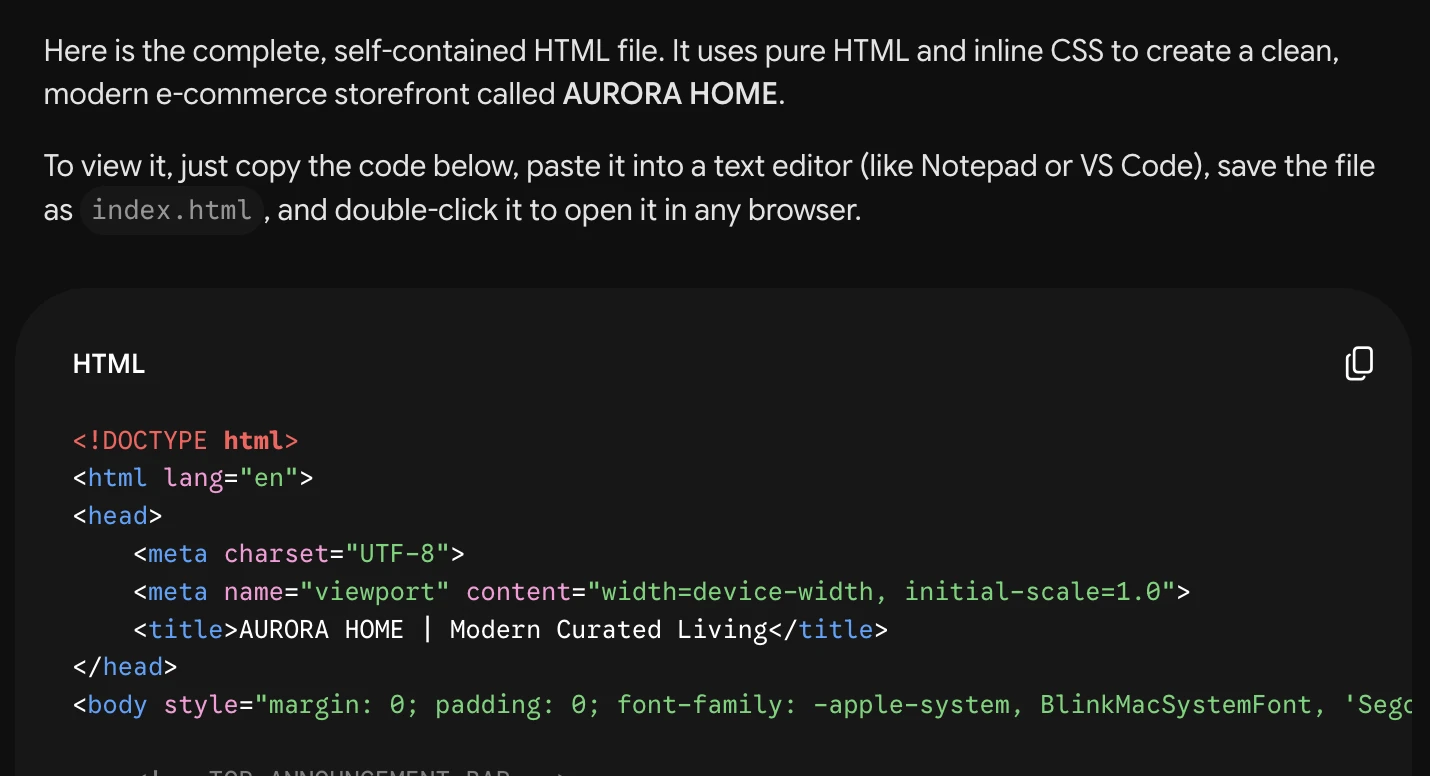
Early testing of Gemini 3.5 Flash reveals a model that prioritizes momentum. In prototyping scenarios, such as generating a modern e-commerce frontend using only HTML and inline CSS, the model demonstrated the ability to produce a visually coherent and functional layout in under 10 seconds. While the output occasionally lacked functional depth—missing specific images or having non-operational buttons—the speed of delivery allows for a “fail-fast” development cycle. Developers can generate dozens of iterations in the time it previously took to generate one, making it an ideal tool for brainstorming and wireframing.
The model also addresses long-standing “logic traps” that have plagued LLMs for years. A notable example is the “car wash problem,” a trick question that asks whether a user should walk or drive to a car wash located 50 meters away. Historically, AI models struggled with this, often suggesting walking because of the short distance, failing to realize that the object of the task—the car—must be present at the destination. Gemini 3.5 Flash correctly identifies the necessity of driving the vehicle to the facility, showcasing an improved grasp of spatial logic and real-world physics.
In terms of visual processing, the model has shown a refined ability to explain and demonstrate complex technical concepts. When asked to demonstrate how an image decays due to repeated JPEG compression, the model not only explained the theory of lossy compression but also generated a visual gradient showing the “generational loss” from a clear original to a highly pixelated 20th-generation copy. This level of multimodal explanation is critical for educational tools and technical documentation.

Accessibility and Integration
Google has ensured that Gemini 3.5 Flash is widely accessible, though it remains a closed-weights model. Access is primarily through the Gemini API and Google’s enterprise-grade platforms. For developers who require local execution or open-source flexibility, Google points toward Gemma 4, its lightweight open-model family.
The decision to keep the 3.5 Flash weights proprietary is likely a move to protect the specific architectural “shortcuts” that allow for its high-speed performance. However, by offering a robust API, Google is encouraging a transition where the model serves as the “brain” for third-party applications. The integration with Google Cloud’s Vertex AI platform further suggests that the model is being positioned as a backbone for corporate automation, where data privacy and low latency are the primary requirements.
Comparative Analysis: Flash vs. Pro vs. The Competition
In the current AI landscape, Gemini 3.5 Flash competes directly with OpenAI’s GPT-4o mini and Anthropic’s Claude 3 Haiku. These “small-but-mighty” models are becoming the preferred choice for developers because they are significantly cheaper to run and faster to respond than their “Pro” or “Ultra” counterparts.

The “Flash” model’s performance is defined by its “Time to First Token” (TTFT). In various stress tests, Gemini 3.5 Flash consistently started responding in under 10 seconds, even for complex prompts. While the “Pro” variant (expected next month) will likely outperform Flash in high-stakes reasoning, such as legal analysis or complex mathematical proofs, the Flash model is superior for high-volume tasks like sentiment analysis, transcript summarization, and basic code debugging.
Industry analysts suggest that the “Flash” category of models may eventually see higher adoption rates than “Pro” models due to the sheer volume of “micro-tasks” in the digital economy. A model that is 90% as smart as a human but 1,000% faster is often more valuable to a business than a model that is 100% as smart but operates at human speed.
Broader Implications and Future Outlook
The launch of Gemini 3.5 Flash is more than just a product update; it is a signal of the “agentic” future of computing. As AI models become faster and more capable of interacting with UIs and subagents, the way humans interact with software is poised to change. Instead of manually navigating menus, users will likely describe an outcome, and models like Gemini 3.5 Flash will execute the necessary steps across multiple applications in the background.

However, the speed of these models also raises questions about accuracy and “hallucination at scale.” When a model can generate thousands of words or lines of code in seconds, the human ability to verify that output becomes a bottleneck. Google’s focus on “grounding” and multimodal reasoning is an attempt to mitigate these risks, but the “Flash” nature of the model means that quality control will remain a responsibility of the end-user or the developer.
Looking forward, the tech industry is awaiting the release of Gemini 3.5 Pro. If Flash represents the “reflexes” of Google’s AI, Pro will represent its “intellect.” The synergy between these two models—one for speed and one for depth—could provide Google with the most versatile AI stack on the market. Furthermore, technologies like Google’s TurboQuant, which aims to reduce model memory usage by half, suggest that these models will soon become even more efficient, potentially moving from the cloud to high-end edge devices.
In conclusion, Gemini 3.5 Flash is a robust entry into the high-speed AI market. It successfully demonstrates that “fast” does not necessarily mean “simple.” With its ability to solve tricky logic problems, generate functional code prototypes, and process multimodal data with minimal latency, it sets a high bar for the “Flash” category of AI models. As the Pro variant looms on the horizon, the AI race continues to accelerate, with Google firmly positioned as a leader in both raw intelligence and practical, real-world execution.