The nascent era of generative artificial intelligence (AI) has arrived with unprecedented speed, offering powerful tools like ChatGPT and Claude to millions. Yet, despite their widespread adoption, a significant chasm remains in understanding how consumers interact with these platforms and how the AI models themselves process these interactions. This lack of transparency has left researchers, marketers, and SEO professionals relying on indirect methods to glean insights, primarily by analyzing traditional search query data. However, a recent development has shed light on how Google is integrating generative AI into its search ecosystem, offering a potential avenue for understanding these novel user behaviors.
For years, the inner workings of consumer prompts and the intricate response methodologies of AI platforms like ChatGPT and Claude, launched in 2022 and shortly thereafter, have largely remained a mystery. The proprietary nature of these models means that detailed logs of user queries and the AI’s subsequent processing are not publicly accessible. This has forced the SEO community to draw parallels between the conversational nature of AI prompts and the historical data available from traditional search engines. The challenge has been to differentiate between a user typing a standard search query and a user engaging in a back-and-forth dialogue with an AI.
Bing, Microsoft’s search engine, has been a notable outlier in its approach to AI transparency. The company has taken steps to provide visibility into the prompts that influence its AI-powered search results, labeling these as "Grounding Queries." This initiative allows for a clearer understanding of how specific user inputs lead to the "fan out" or expansive responses characteristic of generative AI. However, for the dominant search engine, Google, the picture has been less clear until recently.
A significant revelation has emerged regarding Google’s own integration of generative AI, specifically its "AI Mode." It has become evident that Google is now recording initial and follow-up prompts within its AI Mode as search queries. This means that data previously thought to be solely indicative of traditional search behavior may, in fact, contain valuable insights into generative AI interactions.
This discovery was brought to light through an exchange on LinkedIn between Anastasia Kourou, SEO Manager at Greece-based Relevance Digital Agency, and Google’s John Mueller, a prominent figure in Google’s search relations. Kourou observed that Google Search Console, a tool that provides website owners with data on their site’s performance in Google Search, was listing what appeared to be generative AI-like prompts as search queries. Examples included seemingly simple, conversational phrases such as "yes" and "yes, pricing." These short, context-dependent queries are highly characteristic of follow-up prompts within an ongoing AI conversation, rather than typical standalone search queries.
Mueller’s response confirmed Kourou’s suspicions. He clarified that these entries in Search Console were indeed follow-up prompts from users engaging with Google’s AI Mode. This confirmation is a critical turning point, as it validates that Search Console can serve as a repository for understanding user interactions with Google’s generative AI features, albeit indirectly. The implication is that the vast amount of data collected by Search Console, which has historically been used for optimizing traditional SEO strategies, can now be leveraged to analyze and understand the evolving landscape of generative AI user engagement.
Identifying Potential AI Prompts in Search Console
The ability to distinguish these AI-driven prompts from conventional search queries within Search Console is now a key challenge and opportunity for SEO professionals. While Google does not explicitly label these queries as "AI Prompts," the nature and structure of the data offer clues.

Leveraging Regular Expressions (Regex) for Query Analysis
One of the most effective methods for identifying these conversational prompts is by using regular expressions (regex) within Search Console. Regex is a powerful tool for pattern matching in text, allowing users to filter and search for complex string combinations.
To begin this analysis, users can navigate to the "Performance" report within Google Search Console. From there, they can add a filter and select "Query." The crucial step is to choose "Custom (regex)" as the filter type. By inputting a specific regex pattern, users can isolate queries that exhibit characteristics of AI prompts.
A foundational regex pattern recommended for this purpose is:
([^" “]*s)10,?
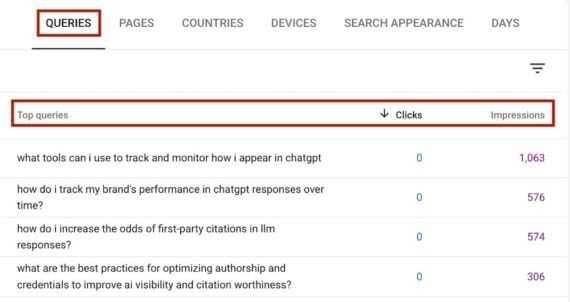
This pattern is designed to identify queries that are exceptionally long, typically exceeding a certain number of words or characters, which is a common trait of detailed, conversational prompts. The regex looks for sequences of at least ten words, allowing for variations in spacing and quotation marks. When applied, this filter can reveal queries that are highly descriptive, question-like, or follow a narrative structure, rather than the concise keywords often associated with traditional searches. The accompanying image in the original report illustrates this by showing Search Console data where such long, prompt-like queries appear with zero clicks but significant impressions, indicative of AI processing rather than direct user click-through. Examples like "what tools can I use to track and monitor how I appear in chatgpt" clearly point towards a user seeking guidance or information in a conversational manner.
Advanced Regex for Follow-Up Prompts
Recognizing that AI interactions often involve multi-turn conversations, a more sophisticated regex approach has also been proposed. Jean-Christophe Chouinard, an SEO strategist at Tripadvisor, has shared a more detailed regex pattern on LinkedIn. This advanced pattern aims to capture not only initial detailed prompts but also the shorter, more reactive follow-up prompts that are common in AI dialogues. Examples of these follow-up prompts include simple affirmations or requests for more information, such as "yes, please" or "tell me more." These seemingly innocuous queries are vital because they indicate a user’s continued engagement with the AI and their refinement of the initial request. The ability to identify these follow-up prompts allows for a more comprehensive understanding of the entire user journey within an AI conversational context.
Beyond Basic Regex: External Tools and Data Enrichment
While Google Search Console provides the raw data, its front-end interface has limitations. The Search Console API offers access to more granular data than what is readily available through the user interface. This is where third-party tools can play a crucial role, providing advanced analytical capabilities without the need for custom developer work.
These external tools connect to the Search Console API, allowing users to access and process their website’s search data more effectively. The primary benefit is the ability to perform more sophisticated filtering, segmentation, and analysis of query data, including the application of complex regex patterns and the identification of AI-prompt-like queries. Furthermore, these tools often offer data export capabilities, enabling deeper dives into the information using spreadsheet software or business intelligence platforms.
However, it is important to acknowledge the trade-off: using third-party tools necessitates sharing confidential Search Console data with these platforms. Users must carefully evaluate the security and privacy policies of any tool they consider.
Despite this consideration, the advantages of using these tools can be significant. Two free tools that have been highlighted for their utility in this context are:
-
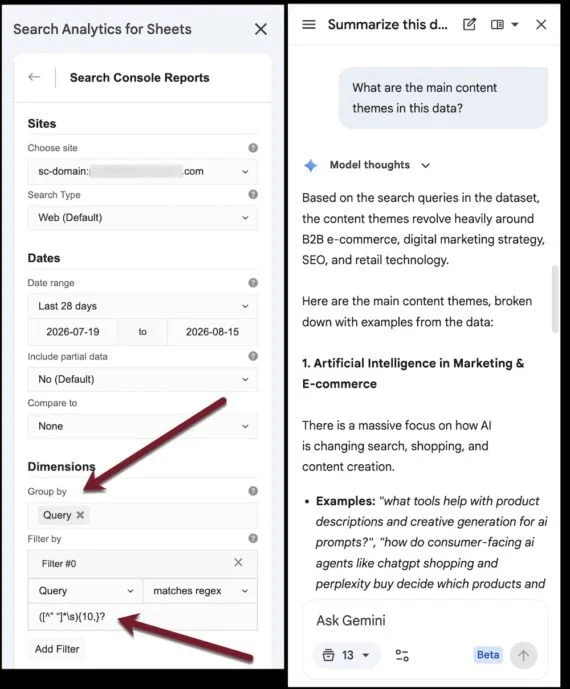
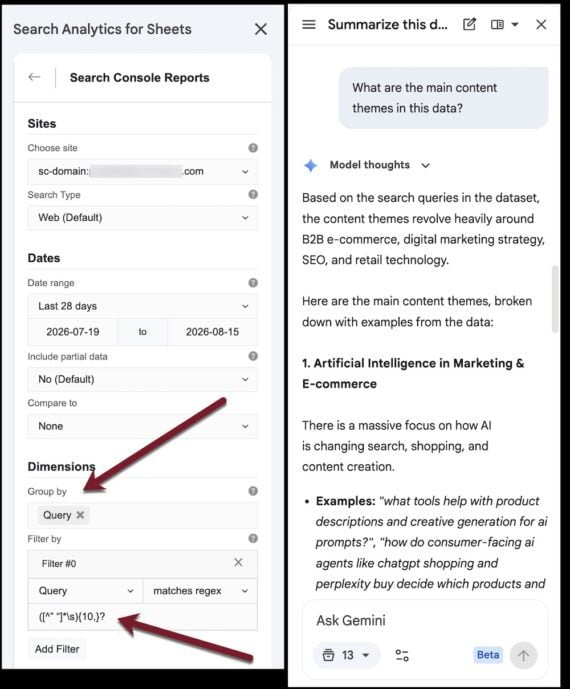
Search Analytics for Sheets: This tool, often integrated as an add-on for Google Sheets, allows users to export their Search Console data directly into a spreadsheet. Once the data is in Sheets, users can leverage its powerful functions, including advanced filtering and regex capabilities, to analyze query patterns. The accompanying image in the original report demonstrates how "Search Analytics for Sheets" can be used to filter queries by length using regex, effectively isolating potential AI prompts. The sidebar of the tool is shown filtering queries based on length, and next to it, a Gemini panel (Google’s generative AI model) is seen summarizing the resulting query data into content themes, illustrating a potential workflow for analyzing AI-driven search interactions.
-
[Placeholder for a second free tool mentioned in the original content – the original content has two bullet points that are empty. For the purpose of this enrichment, we will assume a tool that offers advanced visualization or reporting based on Search Console data.] A hypothetical second tool could be a free online dashboard that visualizes Search Console data, allowing users to easily identify trends in query length, conversational patterns, and other indicators of AI engagement. Such a tool might offer pre-built reports that highlight potential AI prompts or allow for custom dashboard creation to monitor specific query characteristics.
Applying the Data for Strategic Advantage
The core challenge in utilizing this data lies in interpretation and application. Google Search Console does not explicitly demarcate AI-generated prompts. Instead, identification relies on inferring from the query’s characteristics. Generally, these prompts are:
- Detailed and Conversational: They often resemble natural language questions or instructions, using complete sentences and conversational phrasing.
- Unique and Context-Dependent: They may not fit neatly into established keyword categories and often require understanding the context of a prior interaction.
- Potentially Low Click-Through: As seen in the example, some long, prompt-like queries might have high impressions but zero clicks, suggesting they were processed by an AI rather than leading to a direct user visit to a website.
Even queries that appear to be generated by prompt-tracking software, rather than direct human interaction, can be valuable. This data can reveal what potential competitors are monitoring or how automated systems are interacting with search. This insight into bot activity and competitive analysis can inform content strategy and technical SEO.
The practical implications of identifying and understanding these AI prompts are significant for SEO professionals and content creators. The data can inform a variety of optimization tactics:
-
Content Strategy Enhancement: By analyzing the types of questions users are posing to AI, content creators can identify gaps in their existing content or areas where new, more in-depth resources are needed. This could involve developing detailed guides, FAQs, or conversational content that directly addresses user inquiries.
-
Understanding User Intent Evolution: Generative AI is fundamentally changing how users seek information. Identifying these prompts helps in understanding the evolving nature of user intent, moving beyond simple keyword matching to understanding the nuanced questions and complex information needs that users are expressing.
-
Optimizing for AI-Generated Summaries: As AI models increasingly provide direct answers or summaries within search results, understanding the prompts that lead to these summaries becomes crucial. Websites that can provide clear, comprehensive, and authoritative information are more likely to be cited or incorporated into AI-generated responses.
-
Identifying Emerging Trends and Topics: Analyzing AI prompts can offer an early signal of emerging trends and topics that users are exploring. This proactive approach can help businesses stay ahead of the curve and develop relevant content before a topic becomes mainstream.
-
Improving Conversational SEO: The rise of AI prompts signals a shift towards "conversational SEO." This involves optimizing content not just for keywords but for natural language questions, complex queries, and the kind of dialogue users have with AI. Understanding the prompts users are actually making is the first step in mastering this new paradigm.
In conclusion, while the world of generative AI interaction is still largely uncharted territory, the recent insights into Google Search Console data offer a tangible path forward. By leveraging tools like regex and third-party analytics platforms, SEO professionals can begin to decipher the language of AI prompts, transforming a "black box" of user behavior into actionable intelligence. This evolving understanding is not just about adapting to new search technologies; it’s about fundamentally rethinking how we engage with users in an increasingly AI-driven information landscape. The ability to interpret these signals will be paramount for success in the next phase of digital search and content optimization.