

The evolution of modern software development has shifted the focus from massive, high-risk "big bang" releases to a more granular, controlled, and continuous delivery model where feature flags play a central role. While many engineering teams utilize feature flags as a basic "one-way door"—a simple toggle to turn a feature on or off—this baseline approach often fails to capture the strategic value of feature management. In the current competitive landscape, the difference between simply using flags and using them as a sophisticated delivery system can determine a company’s ability to innovate without compromising system stability.
Feature flagging, at its core, is the practice of decoupling a code deployment from a feature release. This allows developers to push code to production while keeping the functionality hidden from users until the business is ready. However, without a rigorous framework for managing these flags, organizations frequently encounter "flag debt," performance bottlenecks, and operational confusion. To bridge the gap between basic usage and professional-grade feature management, industry experts have identified eight critical best practices that cover the entire lifecycle of a flag, from its initial creation to its eventual decommissioning.
The Strategic Categorization of Flag Types
The lifecycle of a feature flag must begin with a clear definition of its purpose and lifespan. Many organizations fall into the trap of treating all flags as permanent fixtures, leading to a codebase cluttered with dead conditionals that no developer wants to touch for fear of breaking a legacy system. Journalistic analysis of DevOps trends suggests that "zombie flags"—those left in the code long after their utility has expired—account for a significant portion of technical debt in mature SaaS companies.
To combat this, teams must separate flag types from day one. Temporary flags, such as those used for a specific feature rollout or an A/B test, should be treated as ephemeral. These flags require a designated owner and a predefined expiration date. Conversely, permanent flags serve long-term operational needs, such as managing access to premium tiers or maintaining "maintenance mode" switches. By naming flags with clear intent—using identifiers like checkout_v2_rollout instead of the ambiguous new_checkout—and assigning metadata like "removal date" at the point of creation, teams can maintain a clean, navigable codebase.
Pre-Deployment Definition of Rollback Conditions
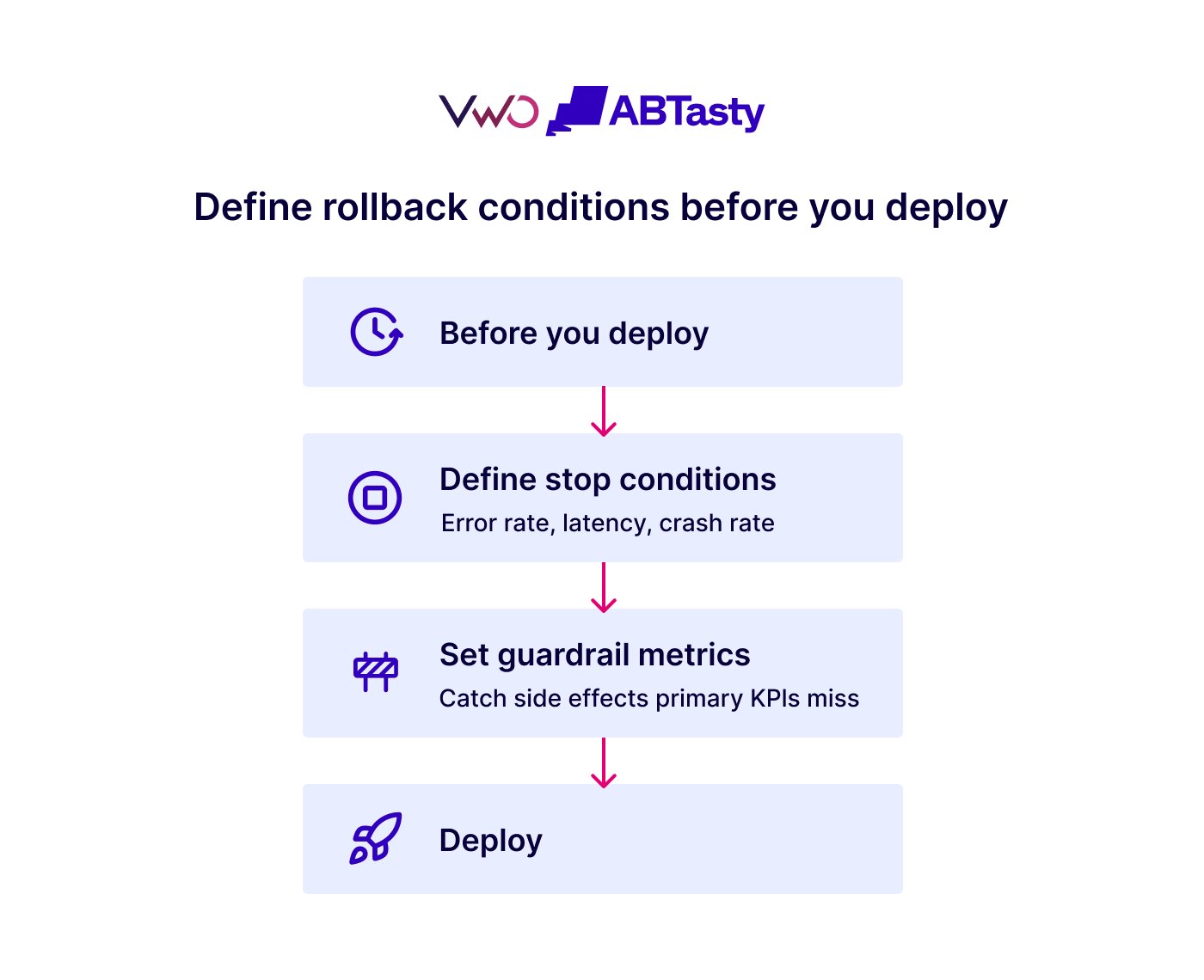
In a high-pressure production environment, the decision to roll back a feature is often made in a state of crisis. When an incident occurs, the absence of clear, pre-defined criteria leads to internal debates and delayed reactions, which can exacerbate user dissatisfaction and revenue loss. A professional journalistic approach to incident management highlights that the most resilient teams define their "stop conditions" before the first line of code is ever exposed to a user.
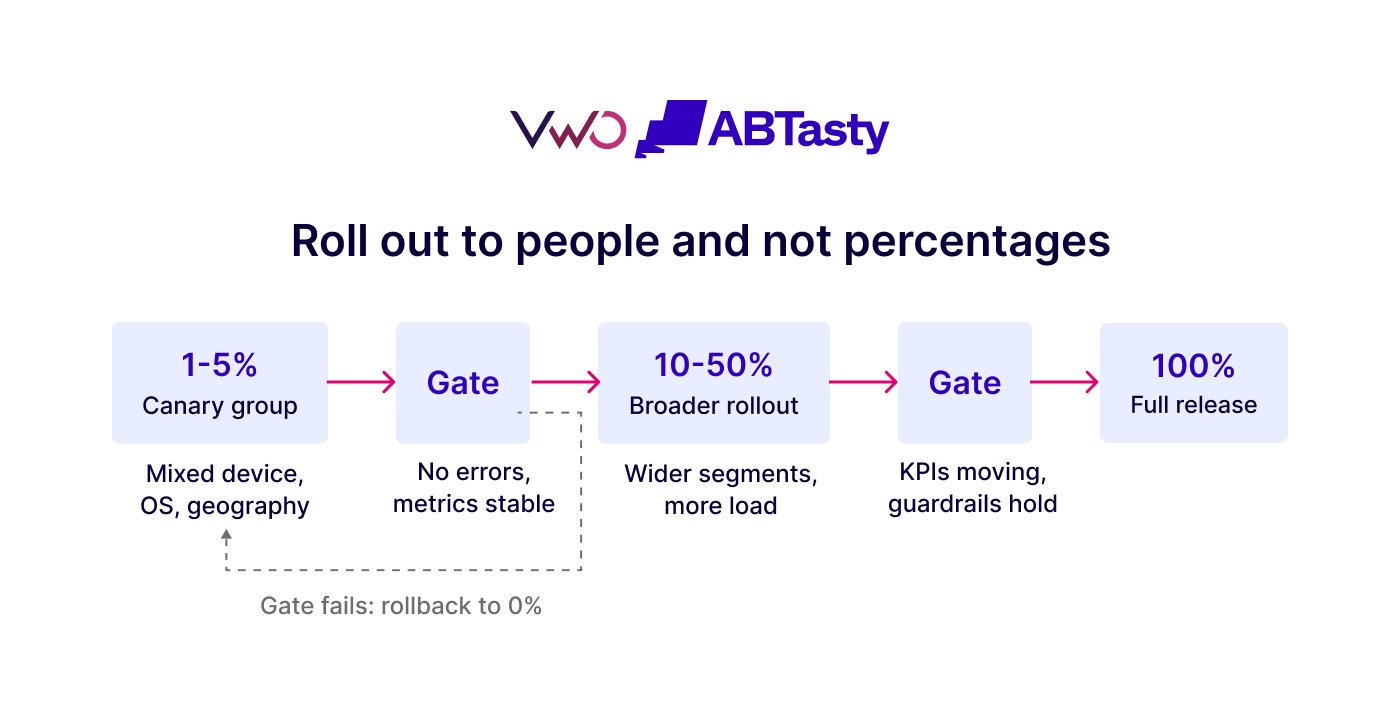
A robust rollback strategy involves setting specific, quantifiable thresholds. For example, a team might decide that if the 95th percentile (P95) of page load latency increases by more than 200 milliseconds, or if the checkout error rate exceeds 0.5%, the flag must be immediately disabled. Beyond these primary Key Performance Indicators (KPIs), developers must also monitor "guardrail metrics." These are secondary signals—such as CPU utilization or memory leaks—that may not immediately affect the user experience but indicate long-term instability. Establishing these parameters beforehand transforms a reactive "panic" into a logical, automated response.
Precision Targeting: Moving Beyond Percentages
The industry is moving away from simple percentage-based rollouts, which can often provide a false sense of security. A "10% rollout" is only as good as the diversity of the sample group. If a 10% slice accidentally includes only high-speed fiber users on the latest hardware, the engineering team will miss critical bugs affecting mobile users on 3G networks or older operating systems.
The best practice is to roll out to specific cohorts defined by custom attributes. By passing context such as planType, appVersion, locale, and deviceModel through a Software Development Kit (SDK), teams can ensure their "canary" group is a representative microcosm of the entire user base. Furthermore, sophisticated feature management involves managing dependencies between flags. If a new user interface (Flag B) requires a specific backend service (Flag A) to function, the rollout rules should be linked to prevent a "split-brain" scenario where the front end tries to call a non-existent API.
Kill Switches as Critical Infrastructure
While all feature flags can technically act as toggles, a "Kill Switch" is a specialized category of flag that should be treated with the same reverence as database backups or security protocols. A kill switch provides an instantaneous way to disable a failing feature across 100% of the user base. However, a kill switch that has never been tested is a liability.
Journalistic investigations into major tech outages often reveal that "safety" mechanisms failed because they were never exercised in a production-like environment. Best practices dictate that teams should perform "fire drills" to ensure that flipping a kill switch actually stops the offending logic without causing collateral damage. Crucially, a kill switch must cover the full "blast radius" of a feature. If a new checkout flow involves three different microservices, the kill switch must be architected to handle the UI, the payment processor, and the inventory update logic simultaneously to avoid leaving the system in an inconsistent state.
The Rise of Automated Rollout Logic
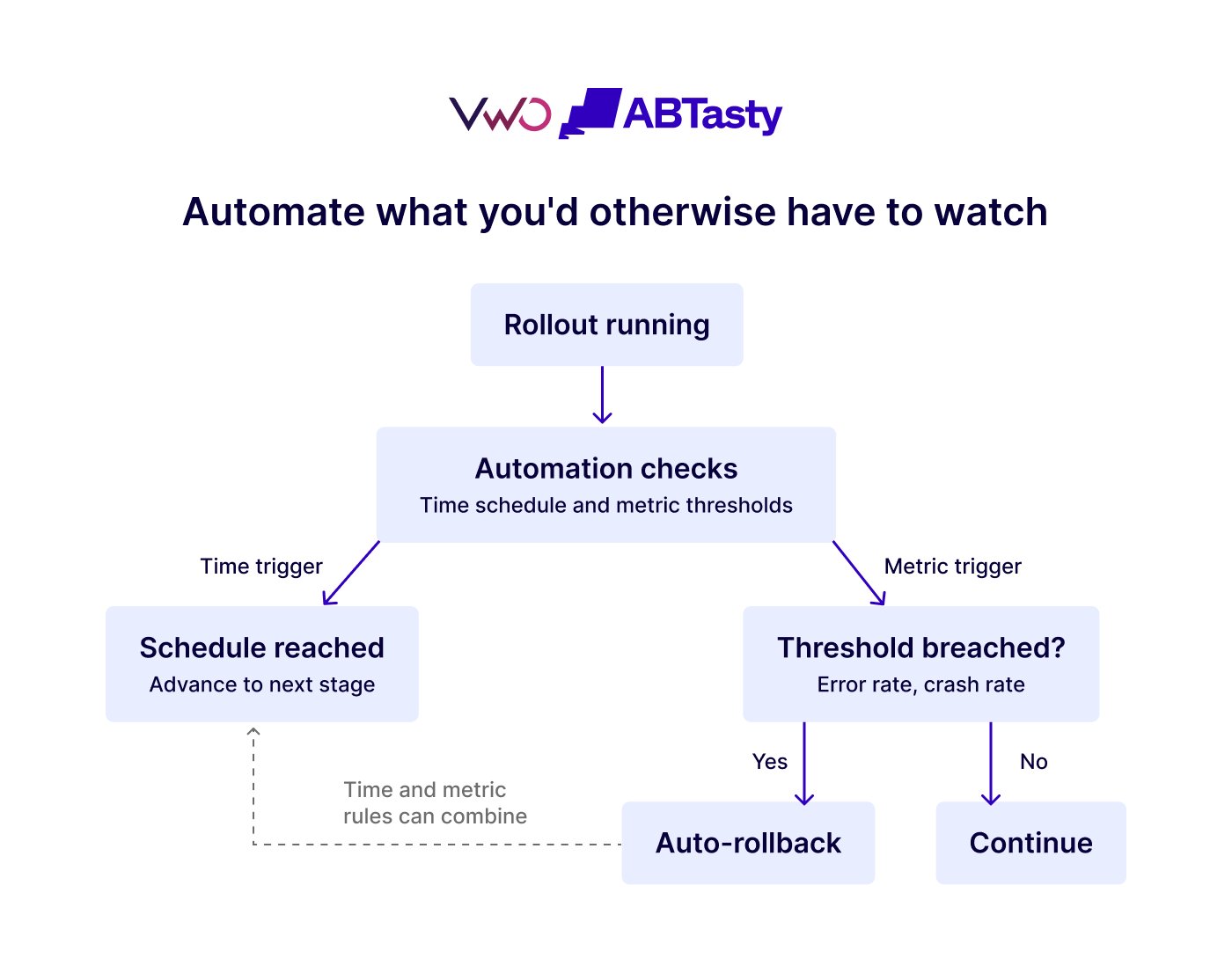
Manual intervention is a significant bottleneck in the continuous delivery pipeline. If a rollout requires a developer to manually adjust a slider at 3:00 AM on a Saturday, the system is prone to human error and delay. Automation is the solution to this dependency, manifesting in two primary forms: time-based and metric-based.
Time-based automation allows for a scheduled progression, where a feature might move from 1% to 10% to 50% over a 48-hour window without manual input. Metric-based automation, however, represents the pinnacle of feature management maturity. In this model, the system is integrated with observability tools; if the feature meets its success criteria and stays below its error thresholds, the rollout advances automatically. If a threshold is breached, the system triggers an automatic rollback. This "self-healing" approach minimizes the gap between the onset of a problem and its resolution, shifting the burden from human monitors to intelligent systems.
Environment-Based Access Control and Governance
As organizations scale, the risk of an unauthorized or accidental flag change in production increases. A common mistake is applying a universal access model across all environments. In a professional setting, the development and staging environments should be optimized for speed and autonomy, while the production environment requires strict governance.
Role-Based Access Control (RBAC) and approval workflows are essential for production flags. This means that while a junior developer might have the authority to toggle a flag in the "dev" environment, a change in "production" might require a "four-eyes" review—where a second authorized person must approve the change. Additionally, maintaining a comprehensive activity log is vital for auditability. Knowing exactly who changed a flag, what the previous state was, and when the change occurred allows for rapid troubleshooting during post-mortem analyses.
Dual-Front Monitoring: Stability and Value
Monitoring a flagged feature is a two-dimensional task. The first dimension is stability: is the feature breaking the system? The second is value: is the feature achieving its intended business goal? Many teams focus solely on the former, assuming that if nothing crashes, the release is a success.
To monitor stability, teams must segment their error logs by flag variation. This allows developers to see if a spike in 500-errors is coming specifically from the "New Feature" group or if it is a general system issue. Once stability is confirmed, the focus shifts to value validation. By defining a primary success metric—such as conversion rate, revenue per user, or API latency—before the rollout, the team can use data to decide whether to scale the feature to 100% or "kill" it. This data-driven approach removes the "gut feeling" from product management and ensures that only high-performing features remain in the codebase.
Transforming Flags into Experimental Variables
The final stage of feature flagging maturity is the transition from "release management" to "feature experimentation." A feature flag is essentially a controlled split of traffic, which is the fundamental requirement for an A/B test. By treating every new feature as an experiment, organizations can test multiple variations of a backend algorithm, a pricing model, or a UI flow simultaneously.
This approach applies to more than just cosmetic changes. For instance, a team could use flags to test two different database query strategies to see which one handles high load more efficiently. By tying these variations to business outcomes, every flag becomes a source of empirical learning. This methodology fosters a culture of "build-measure-learn," where the goal is not just to ship code, but to discover what truly drives value for the user and the business.
Implementing Best Practices via VWO Feature Experimentation
Adopting these eight practices requires more than just a change in mindset; it requires a robust technical platform. VWO Feature Experimentation is designed to facilitate this transition by providing an integrated environment for managing the full flag lifecycle.
The platform allows engineering teams to integrate an SDK once, after which product and growth teams can manage targeting, rollout rules, and experiments directly from a centralized dashboard. This decoupling of roles reduces the "engineering tax" on feature releases. Furthermore, VWO supports complex JSON variables, enabling teams to change dynamic behavior—such as pricing logic or algorithm parameters—without a code redeployment.
One of the standout features of the VWO platform is its ability to connect flag states to full-funnel business outcomes. While many tools only track immediate clicks, VWO monitors the impact from the initial ad click down to final revenue, providing a holistic view of a feature’s performance. Additionally, the introduction of the MCP (Model Context Protocol) server allows teams to manage flags through natural language prompts via AI assistants, further lowering the barrier to sophisticated feature management.
In conclusion, the strategic use of feature flags is a cornerstone of modern, high-velocity software engineering. By categorizing flags, defining rollbacks, targeting precisely, and leveraging automation, organizations can significantly reduce the risks associated with deployment. When these practices are combined with a powerful experimentation platform like VWO, feature flags evolve from simple on/off switches into a powerful engine for data-driven innovation and operational excellence. The future of software delivery is not just about moving fast, but about moving fast with the control and confidence that only professional-grade feature flagging can provide.







