Siti Muinah
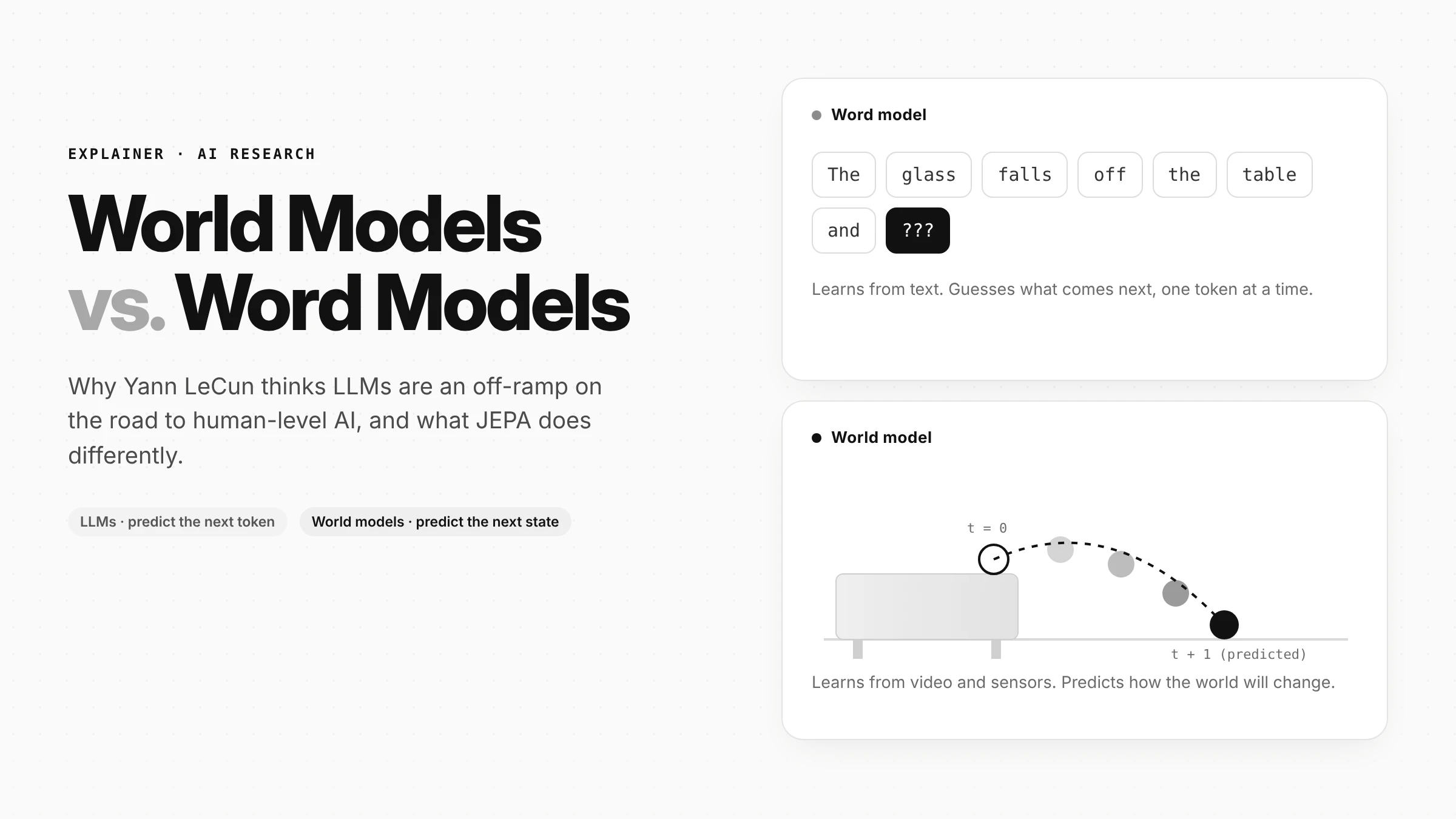
The divergence between a machine’s ability to describe the physical world and its capacity to interact with it remains one of the most significant hurdles in modern computer science. While a contemporary large language model (LLM) can provide an anatomically and physically correct description of a glass falling from a table and shattering, the most advanced robotic systems still struggle to perform the basic physical coordination required to prevent such an accident. This discrepancy—the gap between linguistic representation and physical understanding—is the central focus of Yann LeCun, Meta’s former Chief AI Scientist and a Turing Award winner. LeCun has consistently argued that the current trajectory of artificial intelligence, dominated by auto-regressive LLMs like GPT-4 and Llama 3, is fundamentally incapable of achieving human-level intelligence through scaling alone. Instead, he proposes a shift toward "world models" and a new technical framework known as the Joint Embedding Predictive Architecture (JEPA).
The Philosophical and Technical Critique of LLMs
LeCun’s skepticism regarding the future of LLMs is not a dismissal of their utility but a critique of their architecture as a path to Artificial General Intelligence (AGI). His argument is built upon four primary deficiencies: the limitations of text-based data, the absence of true reasoning, the lack of persistent memory, and the inability to plan for future outcomes.

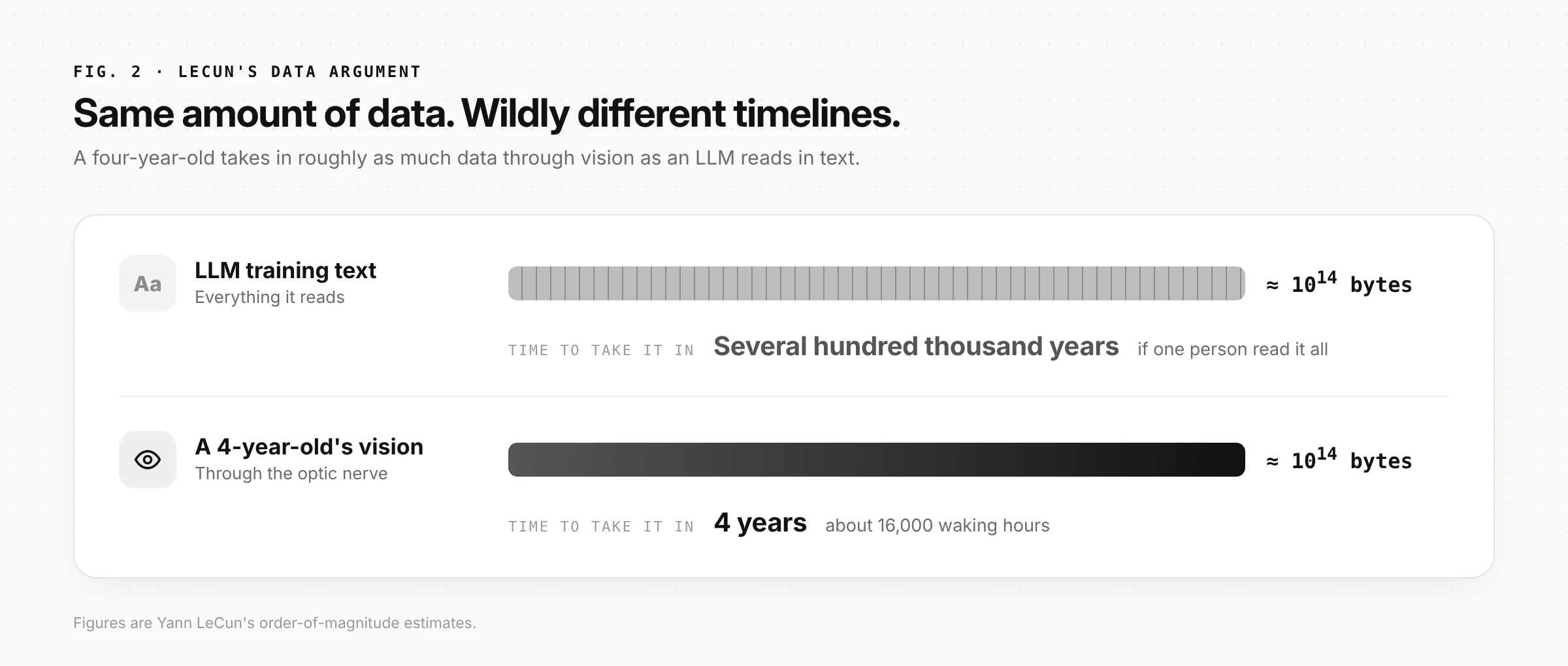
The most prominent of these critiques involves the "density" of data. An LLM is typically trained on approximately 10^14 bytes of text, a volume of information so vast that a human would require hundreds of thousands of years to read it. Conversely, a four-year-old child has been awake for roughly 16,000 hours. During this time, the child’s visual system has transmitted a comparable volume of data to the brain—not in the form of discrete text tokens, but as a continuous, high-dimensional, and messy stream of sensory information. The child learns the laws of physics, cause-and-effect, and spatial relationships through observation and interaction, whereas the LLM only learns what humans have bothered to document in writing.
Furthermore, LeCun draws on the work of psychologist Daniel Kahneman to distinguish between "System 1" and "System 2" thinking. LLMs, which generate one token at a time in a reactive, probabilistic manner, function similarly to System 1: fast, instinctive, and emotional. True intelligence requires System 2: slow, deliberate, and logical reasoning. While some newer models use "chain-of-thought" processing to simulate reasoning, LeCun argues they are still merely searching through linguistic patterns rather than navigating a mental model of the world.
Defining the World Model
A world model is a conceptual and mathematical framework that allows an AI to perceive the environment and answer the question: "If I take this action, what will happen next?" Humans utilize world models instinctively. When playing catch, a person does not solve differential equations to calculate a ball’s trajectory; they have a trained internal model that estimates where the ball will land based on its current velocity and path.
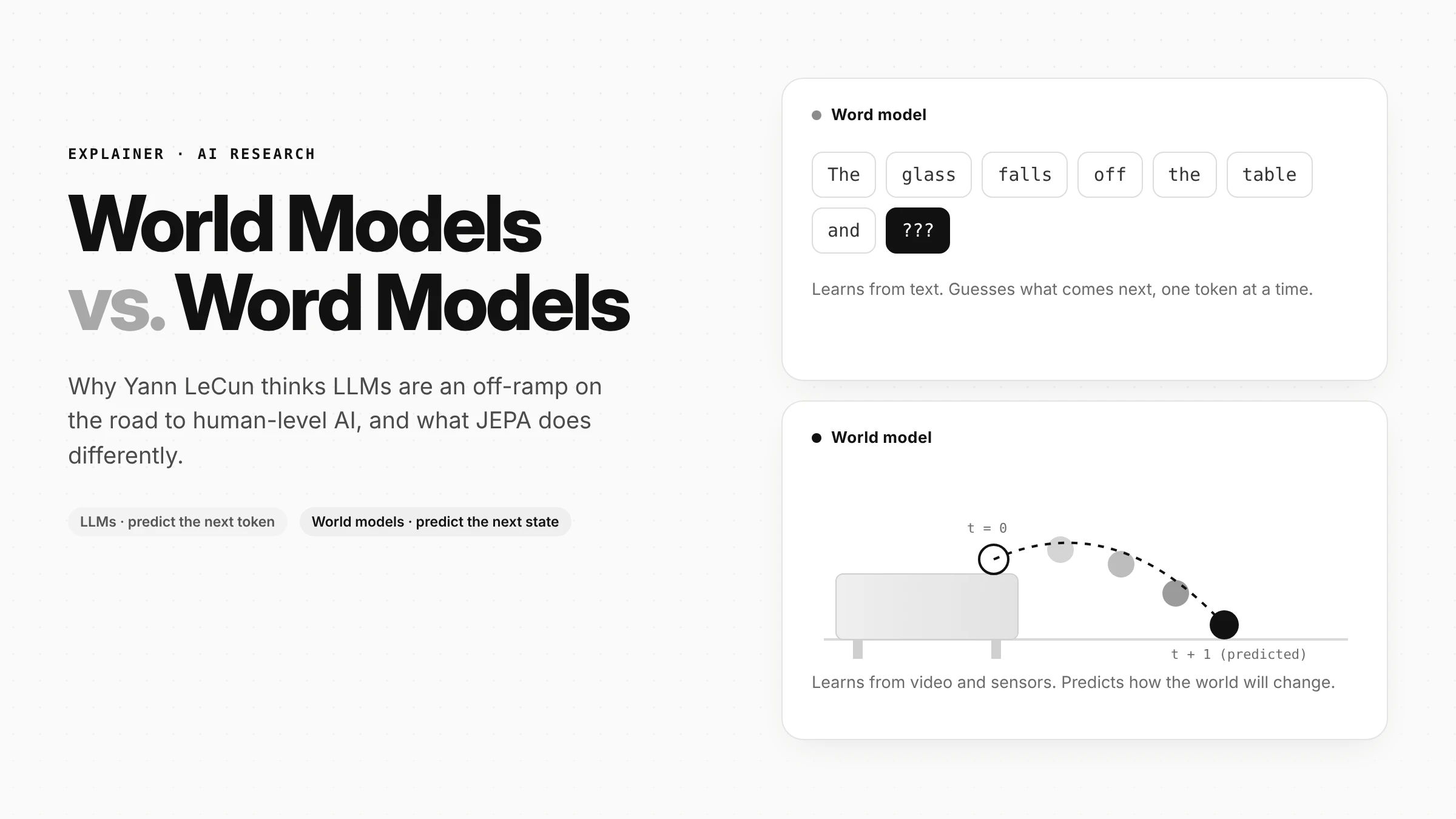
In AI, the goal is to replicate this internal simulator. Unlike a "word model," which predicts the next most likely word in a sequence, a "world model" predicts the next state of the environment. This distinction is vital for robotics. An abstract task such as "prepare breakfast" can be broken down into a list of instructions by an LLM, but a robot equipped with a world model can simulate those actions internally, identify potential failures—such as a cabinet being too high or a carton being empty—and adjust its plan before moving a single mechanical joint.
The Problem of the "Blurry Future"
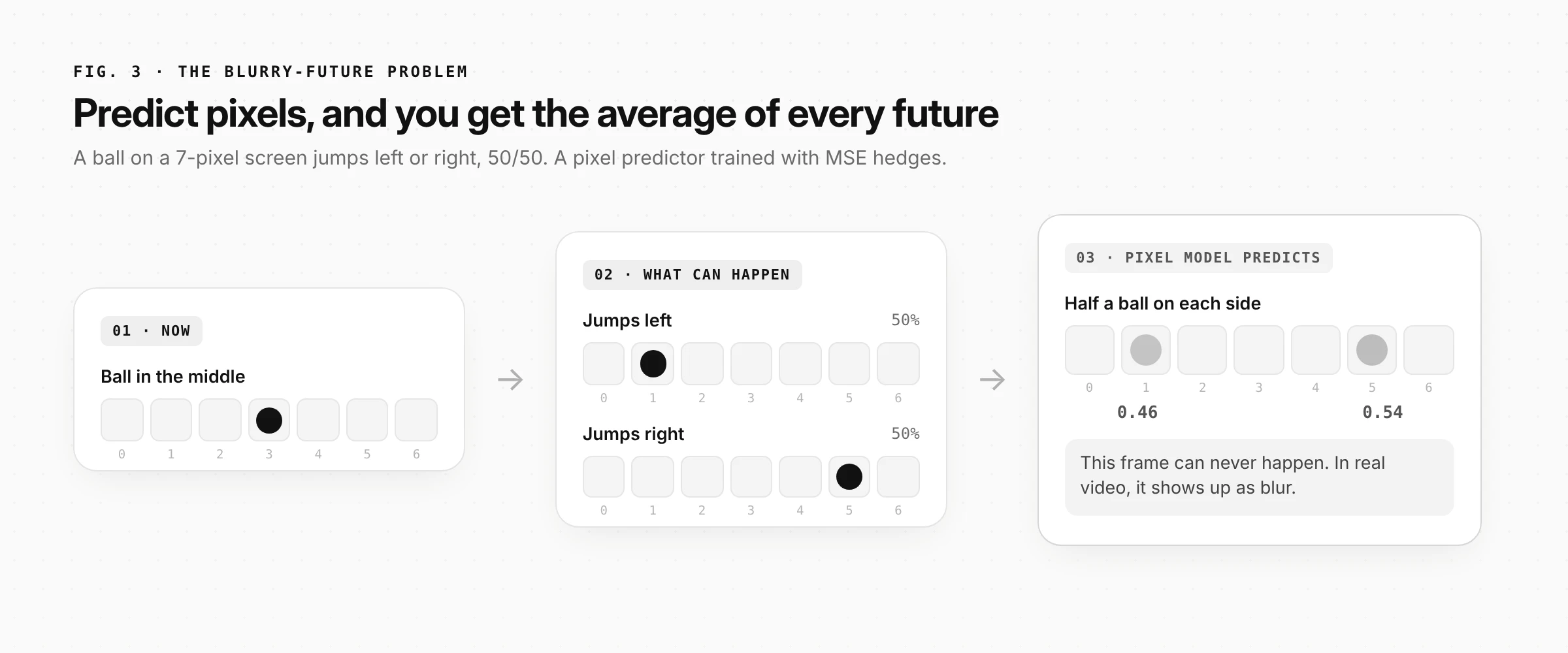
A major technical challenge in building world models has been the "blurry future" problem associated with video prediction. In the past, researchers attempted to train world models by having them predict the next frame in a video (pixel prediction). However, because the future is inherently uncertain, these models often produced blurred images.
If a model is asked to predict the position of a falling pen, and the pen could fall in any direction, a pixel-based predictor will average all possible outcomes, resulting in a ghostly, smeared image of a pen falling in every direction at once. This occurs because the model is attempting to predict every minute detail, including irrelevant background noise like moving leaves or shifting shadows. This computational "noise" prevents the model from focusing on the essential physics of the scene.
JEPA: A Shift to Latent Space
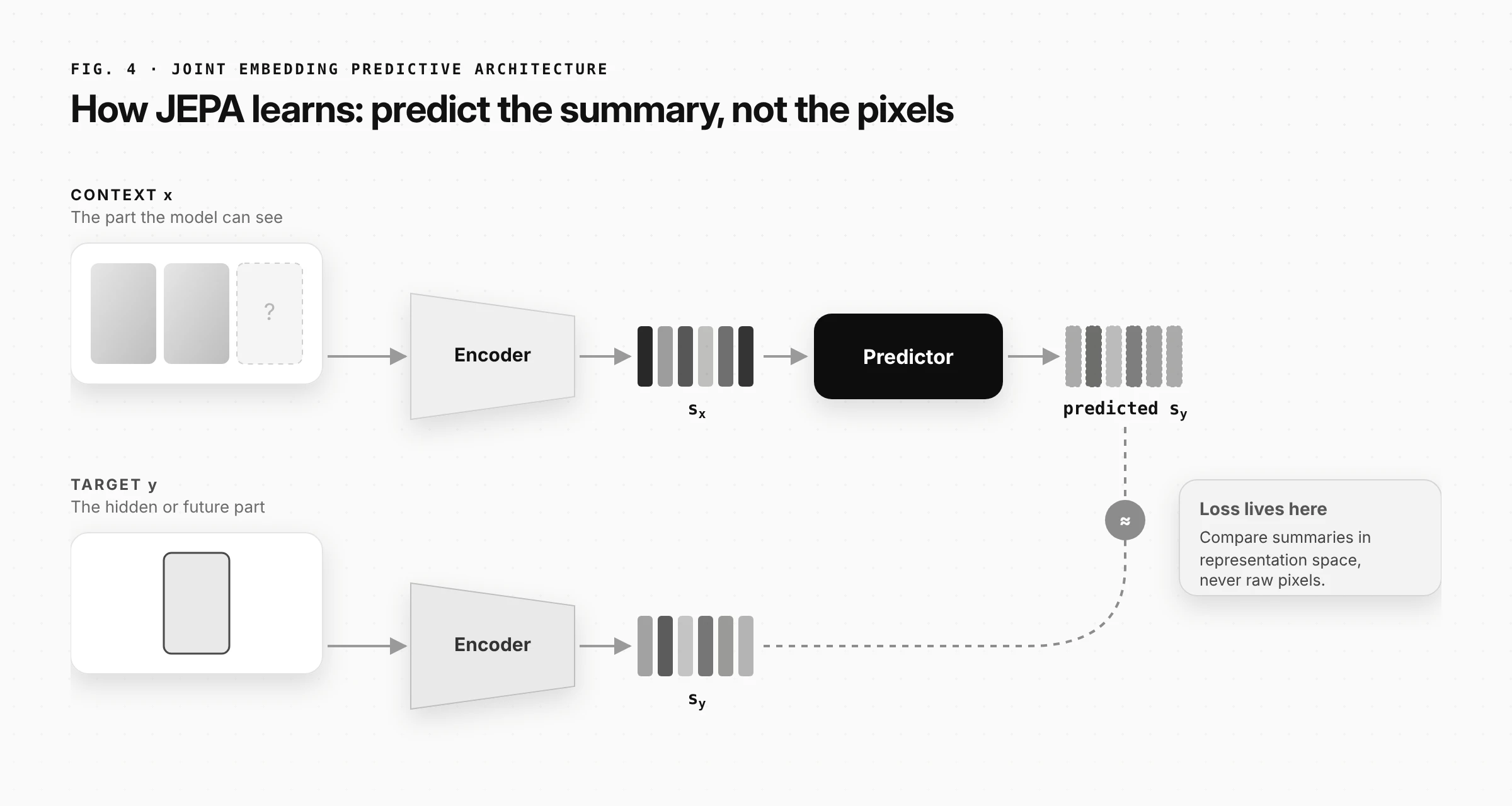
To solve the blurry future problem, LeCun introduced the Joint Embedding Predictive Architecture (JEPA). The core innovation of JEPA is that it abandons pixel-level prediction in favor of prediction in "latent space" or abstract representation space.
JEPA functions through a three-step process. First, an encoder transforms the input (such as a video frame) into an abstract representation, stripping away irrelevant details. Second, a predictor forecasts the next state within this abstract space. Finally, the model is trained to match its prediction with the actual future state’s representation.
By predicting in latent space, the model does not need to account for every individual pixel. If a ball moves from the center of a screen to either the left or the right, a JEPA-based model learns to predict that "the ball has moved a certain distance," rather than trying to guess the exact pixel coordinates and background textures. This allows the AI to ignore unpredictable, non-essential information and focus on the structural laws of the environment.
Chronology of JEPA Development and Real-World Application
The development of world models at Meta’s Fundamental AI Research (FAIR) team has followed a clear chronological progression:
- 2022: Yann LeCun publishes "A Path Towards Autonomous Machine Intelligence," laying the theoretical groundwork for JEPA and world models.
- 2023 (I-JEPA): Meta releases the Image-Joint Embedding Predictive Architecture. This model demonstrated that AI could learn to understand the structure of images by predicting missing pieces of an image in latent space, outperforming traditional methods that relied on heavy data augmentation.
- Early 2024 (V-JEPA): The architecture is expanded to video. V-JEPA learned to understand physical interactions by watching large quantities of unlabeled video, recognizing how objects move and interact over time.
- Late 2024 (V-JEPA 2): Meta introduces an "action-aware" layer to the architecture. Trained on the DROID dataset—which contains 62 hours of robotic interaction footage—V-JEPA 2 was deployed on Franka robot arms.
The results of the V-JEPA 2 trials were significant. The robot arms were able to perform "pick-and-place" tasks in environments they had never encountered before, using only a "goal image" as an instruction. This "zero-shot" capability suggests that world models can allow robots to generalize their learning, moving away from the need for thousands of hours of task-specific demonstrations.
Industry Reactions and the Rise of AMI Labs
The shift toward world models has sparked a divide in the AI community. Critics, including researchers at OpenAI and Google DeepMind, argue that LLMs are not a dead end but a foundation. They suggest that as LLMs are trained on more multimodal data (video, audio, and sensor data), they will naturally develop emergent world models. This "scaling hypothesis" posits that if you give a transformer-based model enough data, it will eventually understand physics through the statistical correlations found in video.
LeCun, however, remains unconvinced that transformers are the optimal architecture for this task. His conviction led to a significant career shift. In November 2025, LeCun announced his departure from Meta to lead a new venture: AMI Labs (Advanced Machine Intelligence).
Launched in March 2026, AMI Labs represents one of the most ambitious bets in the history of the AI industry. The startup, headquartered in Paris with satellite offices in New York and Montreal, raised a staggering $1.03 billion in seed funding. This round gave the company a $3.5 billion pre-money valuation, making it the largest seed round ever recorded in Europe. Led by CEO Alexandre LeBrun, AMI Labs operates on the core thesis that "reality is not tokenized." The company aims to apply JEPA-style world models to robotics, industrial control, healthcare, and wearable technology.
Broader Implications and Moravec’s Paradox
The pursuit of world models is essentially an attempt to solve Moravec’s Paradox. This principle in AI and robotics states that high-level reasoning (like playing chess or passing a bar exam) requires very little computation, while low-level sensorimotor skills (like walking or stacking blocks) require enormous computational resources.
The success of LLMs has proven that machines can master human language and abstract logic. However, the "cat-level intelligence" that LeCun often references—the ability of a biological creature to navigate a complex, 3D environment with agility and foresight—remains elusive for silicon-based systems.
If world models succeed, the implications for the global economy are profound. In manufacturing, robots could be deployed in "lights-out" factories that require zero human intervention and can adapt to new product designs instantly. In healthcare, autonomous systems could navigate the complex, unpredictable environment of a hospital to assist in surgery or patient care.
Conclusion
The debate between auto-regressive LLMs and world models is more than a technical disagreement; it is a fundamental question about the nature of intelligence. While LLMs have revolutionized how humans interact with information, Yann LeCun’s work suggests they are missing the physical grounding necessary for true autonomy. By focusing on abstract representations and predictive architectures like JEPA, the next generation of AI may finally bridge the gap between knowing the world and existing within it. Whether the massive financial bet placed on AMI Labs will pay off remains to be seen, but the shift toward world models marks a definitive new chapter in the quest for artificial general intelligence.


 Nana Wu