Nana Muazin

The landscape of retail and digital marketing continues to shift toward a creator-centric model, with recent data indicating that influencer partnerships are now a cornerstone of successful holiday sales strategies. As the industry looks toward Black Friday 2026, which is scheduled for November 27, marketing professionals are increasingly relying on long-term planning cycles and data-driven insights to navigate the most competitive shopping period of the year. Recent analysis of approximately 508,000 Black Friday-related posts by United States creators reveals a complex ecosystem where platform choice, creator size, and posting frequency directly impact return on investment (ROI).
The findings, derived from a broader global study of 1.2 million creator posts, suggest that the "creator season" begins significantly earlier than the traditional shopping window. Worldwide, Instagram posts mentioning Black Friday began doubling by late October and reached a ten-fold increase by the first week of November. This trend underscores a critical shift: Black Friday is no longer a single-day event but a multi-week narrative driven by social media personalities.
Strategic Chronology: The Seven Phases of Creator Campaign Management
Successful Black Friday campaigns in 2026 will require a structured approach starting at least three months in advance. Industry experts have identified a seven-phase timeline that aligns creator outreach with consumer psychological readiness.
Phase 1: Strategic Planning (August to September)
The initial phase focuses on defining performance-driven Key Performance Indicators (KPIs). For the 2026 season, brands are advised to prioritize discount code redemptions, cost per acquisition (CPA), and new customer acquisition over vanity metrics such as likes or impressions. Market data shows that TikTok engagement remains relatively flat throughout the week of Black Friday, whereas Instagram experiences a massive surge on the day itself. Consequently, planners should allocate TikTok content for the "hype" phase and Instagram content for the final conversion push.
Phase 2: Creator Selection (Late September to October)
The selection process has evolved from simple follower counts to audience alignment. Analysts recommend reviewing a creator’s last 20 posts to gauge audience intent; comments inquiring about shipping, sizing, or availability are leading indicators of a "buying" audience.
Phase 3: Outreach and Relationship Building (Mid to Late October)
The outreach window is narrow. Data suggests that 46% of Instagram and 64% of TikTok Black Friday content is published before the actual week of the sale. Securing contracts by mid-October is essential to ensure creators have sufficient time to integrate products into their content schedules.
Phase 4: Contracting and Briefing (Late October to Mid-November)
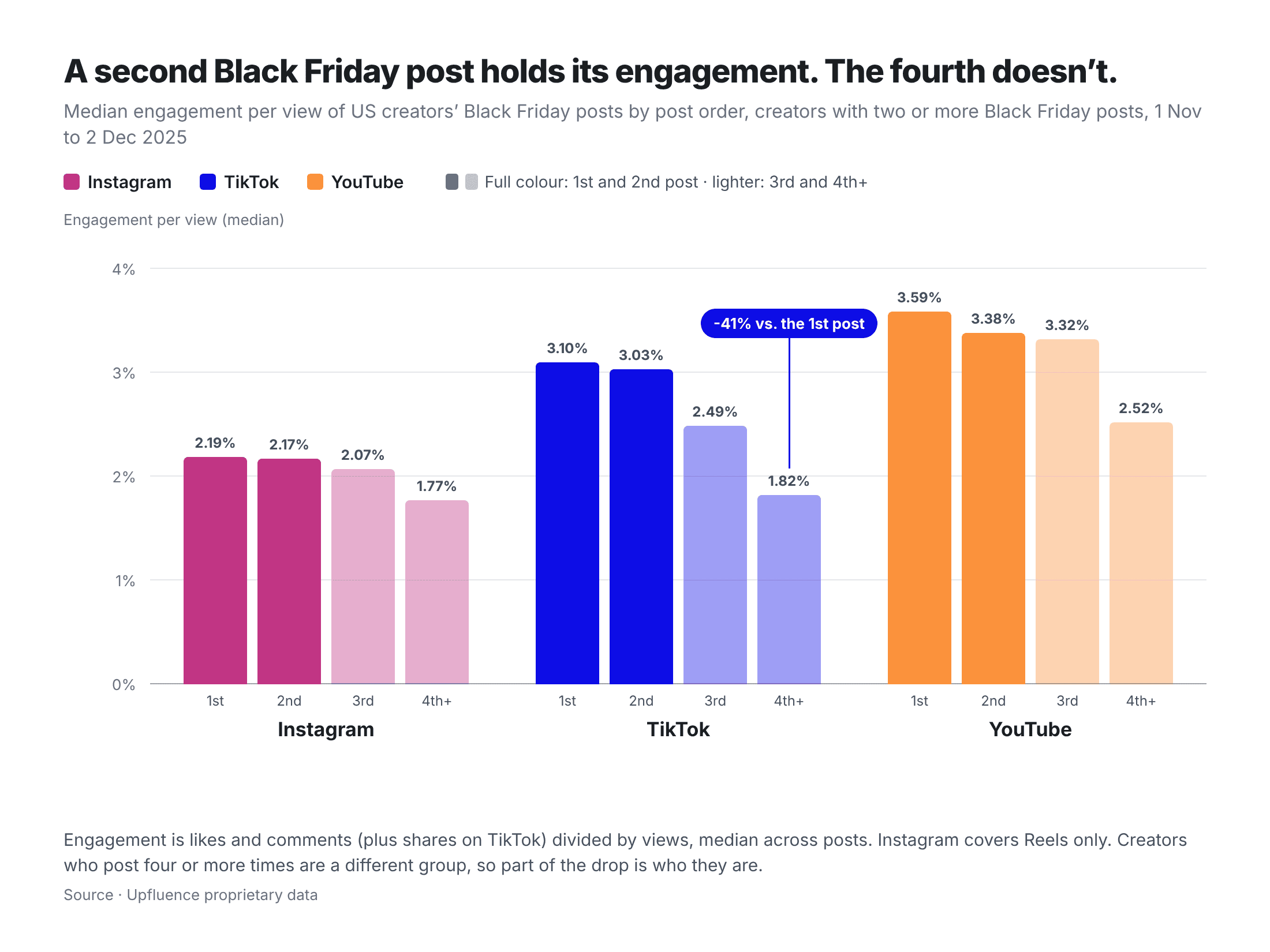
A common pitfall in previous seasons was the reliance on a single post per creator. Statistical analysis shows that 60% of Instagram creators posted only once about Black Friday in 2025. However, the data reveals that a second post maintains nearly identical engagement levels (2.2% on Instagram and 3.0% on TikTok), suggesting that multi-post contracts offer better value without fatiguing the audience.
Phase 5: Approval and Compliance (Mid-November)
This phase involves rigorous quality control. Brands must verify that tracking links and discount codes are functional and that all legal disclosures are prominently placed.
Phase 6: Campaign Execution (Black Friday Week)
The "Go Live" phase is the most volatile. On Black Friday itself, post volume typically doubles compared to the preceding Wednesday. Monitoring real-time inventory is crucial during this period; if a product sells out, creators must be briefed immediately to pivot to alternative offers.
Phase 7: The Post-Mortem (Early December)
The final phase involves a granular analysis of ROI, including the cost of gifted products. High-performing creators should be identified for long-term "ambassador" roles to secure lower rates for the following year.
Data-Driven Insights: Platform and Creator Dynamics
The effectiveness of a campaign is heavily dependent on matching the product category with the correct platform and creator tier. The 2025 data highlights a stark contrast between Instagram and YouTube performance.
On Instagram, "nano" and "micro" influencers (1,000 to 10,000 followers) consistently outperformed larger accounts in engagement. In the fashion sector, these small accounts achieved a 3.37% engagement rate per view, compared to just 2.43% for "mega" influencers with over 100,000 followers. This pattern was mirrored in the beauty and tech sectors, where smaller, niche creators maintained higher levels of trust and interaction.
Conversely, YouTube rewards scale. Channels with 100,000 to 1 million subscribers led the market in fashion, beauty, home, and tech categories. The smallest YouTube channels trailed in every metric, suggesting that the platform’s search-driven nature favors established authorities with high production values.
Category Performance Benchmarks (Median Engagement per View)
| Product Category | Instagram (1K-10K) | Instagram (100K-1M) | YouTube (100K-1M) |
|---|---|---|---|
| Fashion | 3.37% | 2.43% | 4.35% |
| Beauty | 3.07% | 1.88% | 4.80% |
| Fitness | 2.38% | 2.14% | 4.05% |
| Tech | 2.61% | 1.85% | 3.71% |
The Impact of Product Seeding and Shoppable Content
Product seeding—the practice of sending physical products to creators—has proven to be one of the most effective levers for increasing engagement. Black Friday posts that were explicitly labeled as "gifted" earned a 4.73% engagement rate on Instagram, more than double the platform average of 2.10%. On YouTube, gifted content saw a 5.03% engagement rate against a 3.15% average. Despite this, only 1 in 140 Instagram posts utilized this strategy, representing a significant missed opportunity for brands.
Furthermore, the rise of "social commerce" is most evident on TikTok. The study found that 69.5% of TikTok Black Friday posts worldwide included a shoppable link or TikTok Shop integration. In contrast, only 10.9% of Instagram posts featured direct shopping links in the caption, highlighting a fundamental difference in how audiences interact with the two platforms.
Regulatory Compliance and the Disclosure Gap
A significant concern for the 2026 season is the lack of transparency in creator disclosures. Under Federal Trade Commission (FTC) guidelines, creators are required to clearly disclose paid or gifted relationships. However, the analysis of the 2025 season revealed a substantial "disclosure gap."
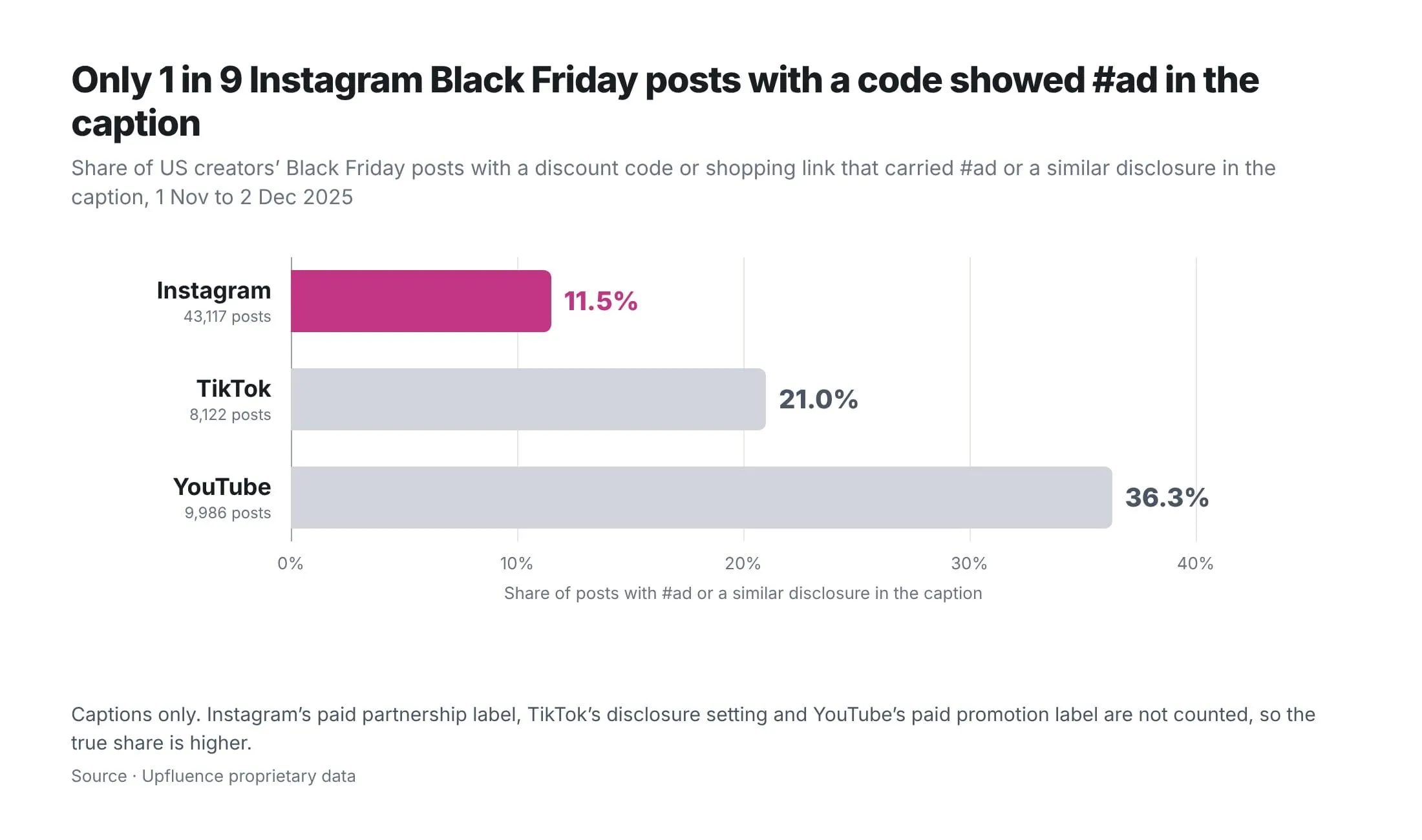
Only 11.5% of Instagram Black Friday posts containing a discount code or shopping link used an explicit caption disclosure such as #ad or #sponsored. TikTok performed slightly better at 21%, while YouTube led the industry with a 36% disclosure rate. While platform-level labels (such as Instagram’s "Paid Partnership" tag) account for some of this, caption disclosures remain a legal requirement and a trust-building factor for consumers. Market analysts predict that as the FTC ramps up enforcement, brands that fail to mandate #ad in the first line of creator captions may face both legal and reputational risks.
Implications for the 2026 Retail Season
The data suggests that the "Cyber Monday" phenomenon is losing its luster relative to Black Friday. In the 2025 season, Cyber Monday generated less than 25% of the creator post volume seen on Black Friday. This suggests that consumer fatigue sets in early, and brands that wait until after the weekend to launch their primary influencer push may find the market already saturated and the audience’s budget exhausted.
For marketing teams, the implications are clear: the contract is the most powerful tool for ensuring campaign success. By writing specific post counts, platform-specific strategies, and strict disclosure requirements into creator agreements by October, brands can mitigate the chaos of the November rush. As creator marketing continues to mature, the brands that succeed in 2026 will be those that treat influencers not as mere advertising vehicles, but as strategic partners in a long-form retail narrative.


 Jia Lissa