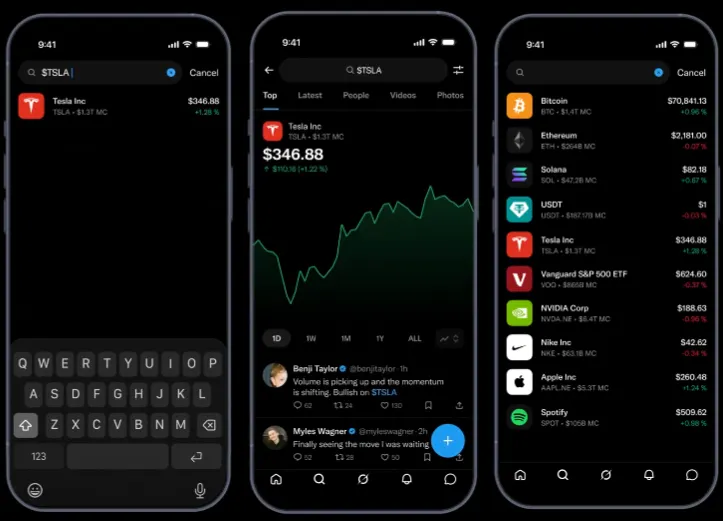
X, the platform formerly known as Twitter, has taken a significant stride toward transforming into an "everything app" by enabling users in the United States to directly engage in stock and cryptocurrency trading within the application. This expansion, facilitated through the newly launched Cashtag Partner Program, allows users to tap on existing Cashtag listings and seamlessly connect to partner trading platforms to buy or sell financial assets. The move underscores CEO Elon Musk’s long-held ambition to integrate comprehensive financial services into the social media platform, aiming to create a holistic digital ecosystem.
The Cashtag Evolution: A Chronology of Financial Integration
The integration of financial trading capabilities marks a pivotal moment in X’s strategic pivot towards broader financial services. The foundation for this initiative was laid months ago with the evolution of X’s Cashtag functionality. Initially, Cashtags, denoted by a dollar sign preceding a ticker symbol (e.g., $TSLA), served primarily as a means to categorize and track discussions around specific stocks or cryptocurrencies. Tapping on a Cashtag would typically lead to a search results page showing related posts.
A significant update arrived in April, enhancing the utility of Cashtags by embedding real-time market information directly within the platform. This meant that when users clicked on a Cashtag, they were presented with relevant stock codes, market data, and potentially charts, offering a quick snapshot of a company’s or asset’s performance. This initial enhancement provided users with context and data without requiring them to leave the X environment, bridging the gap between social commentary and financial information.
The latest iteration, the Cashtag Partner Program, now builds directly on this foundation. Instead of merely displaying market information, users can now "tap through" these listings to access their accounts on integrated partner trading platforms. This direct link transforms X from a discussion forum for financial topics into a potential launchpad for actual trading activity. At its launch, X has confirmed partnerships with several prominent brokerage and cryptocurrency platforms, including Interactive Brokers, Moomoo, Gemini, Kraken, and Coinbase. These partnerships are crucial as X itself does not hold the necessary licenses to operate as a brokerage; instead, it acts as an aggregator and facilitator, directing users to regulated financial entities.
This latest development is not an isolated incident but rather a logical progression in X’s broader strategy. For several months, X has been diligently working towards securing money transmitter licenses across various U.S. states, a prerequisite for handling payments. The platform already facilitates payments for creators in the U.S., allowing them to receive payouts directly within the app. This payments infrastructure is widely seen as the foundational layer for more complex financial services, including banking, lending, and investment tools, all envisioned under Musk’s "everything app" umbrella.
Elon Musk’s "Everything App" Vision: A Deeper Dive
The integration of in-stream trading is a concrete manifestation of Elon Musk’s long-articulated vision for X to become an "everything app," akin to China’s WeChat. Since acquiring Twitter in October 2022, Musk has consistently emphasized his intent to transform the platform into a comprehensive digital utility that encompasses social networking, news consumption, entertainment, and, critically, financial services. This concept is rooted in Musk’s early career experiences, particularly his involvement with X.com, which later merged with Confinity to form PayPal. His ambition for X is to re-imagine that original vision on a much grander scale, integrating diverse functionalities into a single, seamless user experience.
The "everything app" model, popularized by WeChat in China, demonstrates how a single platform can become indispensable by centralizing various aspects of daily life. WeChat users can chat, share content, order food, hail taxis, pay bills, and even invest, all without leaving the app. Musk believes that such an integrated platform fosters greater user engagement, increases time spent on the app, and unlocks vast new revenue streams beyond traditional advertising. For X, financial services are seen as a cornerstone of this strategy, offering a pathway to diversified revenue through transaction fees, premium services, and potentially even direct financial products in the future.
Musk’s ultimate aspiration, as he has frequently hinted, is for X to potentially rival or even replace traditional banks as users’ primary financial partner. This is an extremely ambitious goal that would require overcoming significant regulatory hurdles, building immense user trust, and developing a robust, secure, and highly scalable financial infrastructure. The move into stock and crypto trading, while still reliant on third-party partners, represents a crucial step in testing the waters and gradually habituating users to the idea of conducting sensitive financial activities within the X ecosystem.
Mechanism of the New Program and User Experience
The Cashtag Partner Program is designed for ease of access and integration into the existing X user flow. When a user encounters a Cashtag in a post – whether it’s $AAPL for Apple stock or $BTC for Bitcoin – they can tap on it. This action will now present an option to "Trade" or "Buy/Sell," alongside the existing market information. Upon selecting this option, the user will be seamlessly directed to one of X’s partner brokerage or cryptocurrency exchange platforms.
For instance, a user discussing the latest earnings report for a company like Tesla ($TSLA) might see the Cashtag in the conversation. Tapping it could bring up real-time stock data, and then offer a direct link to Interactive Brokers or Moomoo to execute a trade. Similarly, discussions around cryptocurrency trends might lead users directly to Gemini, Kraken, or Coinbase to buy or sell digital assets. This integration aims to capitalize on the immediacy of social media discussions, allowing users to move from market sentiment and news directly to action without navigating away from the platform.
The convenience factor is a key selling point. In a fast-paced market where news and sentiment can drive rapid price movements, reducing the friction between information consumption and trade execution could be highly appealing to active traders and investors. The program is currently live only in the U.S., indicating a phased rollout that likely accounts for regulatory complexities and market readiness in different regions. The initial selection of partners represents a mix of established brokerages (Interactive Brokers), growing fintech platforms (Moomoo), and leading cryptocurrency exchanges (Gemini, Kraken, Coinbase), providing users with a range of options depending on their investment preferences.
Market Context and Supporting Data
The launch of X’s Cashtag Partner Program comes at a time of significant growth and evolution in both retail investing and the broader fintech landscape. The COVID-19 pandemic catalyzed a boom in retail trading, with millions of new individual investors entering the market, often driven by accessible online brokerage platforms and social media-fueled trends (e.g., "meme stocks" like GameStop). Data from various financial institutions showed a substantial increase in new brokerage accounts opened in 2020 and 2021, with many younger investors preferring mobile-first trading experiences. This demographic is also heavily present on social media platforms like X.
Furthermore, the cryptocurrency market, despite its volatility, has seen a dramatic increase in adoption over the past few years. Global cryptocurrency market capitalization has, at times, exceeded trillions of dollars, with millions of users worldwide engaging in crypto trading and investment. Platforms like Coinbase and Binance have amassed massive user bases, demonstrating a strong appetite for digital asset management.
Social media’s influence on financial markets is undeniable. Discussions on platforms like X (and Reddit’s WallStreetBets) have demonstrably moved markets, created viral investment trends, and influenced individual trading decisions. A study by the National Bureau of Economic Research, for example, found a correlation between social media sentiment and stock returns, particularly for small-cap stocks. By directly integrating trading capabilities, X is attempting to formalize and monetize this existing dynamic, positioning itself as a central hub where market discourse directly translates into market action.
The global fintech market is projected to continue its rapid expansion, driven by digital transformation, increasing mobile penetration, and demand for convenient financial services. Reports suggest the market could grow from hundreds of billions to trillions of dollars in the coming years. Platforms that can seamlessly integrate various financial functions stand to capture a significant share of this growth. X’s move places it in direct competition not only with traditional social media giants but also with established fintech players and aspiring "super apps" like PayPal, which has also been expanding its financial offerings.
Potential Implications and Analysis
The implications of X’s deeper foray into financial services are multi-faceted, affecting the platform itself, its users, partner companies, and the broader regulatory environment.

-
For X: This initiative opens significant new revenue streams. X could earn referral fees from partner brokerages for every new user acquired or a share of transaction fees. Beyond direct revenue, integrating financial services is expected to dramatically increase user engagement and time spent on the platform, making X more central to users’ daily routines. This increased engagement can, in turn, drive advertising revenue and enhance the value proposition for premium subscriptions. It also provides X with a unique selling point against competitors in the social media space, differentiating it as a platform for both communication and commerce. Furthermore, the data generated from user interactions with financial content and trading prompts could offer valuable insights into market sentiment and user behavior, though privacy concerns would need careful management.
-
For Users: The primary benefit for users is convenience. The ability to move directly from discussing a stock or crypto to trading it removes friction and saves time. For active traders or those who rely on real-time news for investment decisions, this integrated workflow could be highly appealing. However, there are also potential downsides. The immediacy of trading on a social media platform could encourage impulsive decisions, driven by speculative trends or misinformation rather than thorough research. The emotional nature of social media could exacerbate "fear of missing out" (FOMO) and lead to suboptimal investment choices. Users must also be acutely aware of privacy implications, understanding how their financial data might be handled and shared between X and its partners.
-
For Partner Brokers: The program offers a substantial opportunity for brokerages and crypto exchanges to expand their customer base. X’s massive user network provides a direct pipeline to potential new clients, particularly those who are already engaged in financial discussions online. This could reduce customer acquisition costs and increase market share for the participating partners. It also allows them to tap into a younger, digitally native demographic that might be less inclined to seek out traditional financial institutions.
-
Regulatory Landscape: The integration of financial trading into a social media platform introduces complex regulatory challenges. Financial markets are heavily regulated by bodies like the Securities and Exchange Commission (SEC) for stocks and FINRA for broker-dealers, while the cryptocurrency space faces an evolving patchwork of regulations. Concerns typically revolve around:
- Consumer Protection: Ensuring users understand the risks involved in trading, preventing fraud, and protecting vulnerable investors.
- Market Manipulation: The potential for coordinated pump-and-dump schemes or other forms of market manipulation to be facilitated through social media discussions linked directly to trading.
- Data Security and Privacy: Safeguarding sensitive financial information and ensuring compliance with data protection laws like GDPR (for international users, if expanded) and various U.S. state privacy laws.
- Know Your Customer (KYC) and Anti-Money Laundering (AML): Ensuring that financial transactions comply with regulations designed to prevent illicit financial activities, a responsibility that ultimately falls on the partner brokerages but where X’s platform design could play a facilitating role.
- Compliance Burden: X itself will need to ensure its platform design does not inadvertently lead to non-compliance for its partners, and may face scrutiny regarding its role in facilitating regulated activities.
Financial analysts have generally acknowledged the strategic importance of this move for X’s long-term "everything app" vision. However, many also express skepticism regarding the significant operational, regulatory, and trust-building hurdles that X must overcome. The platform’s recent controversies, particularly around content moderation and data security, could make it challenging to build the level of trust required for users to confidently entrust their finances to an integrated X ecosystem. The idea of X potentially "replacing banks" is seen as a distant and highly ambitious goal, given the deeply entrenched nature of traditional financial institutions and the regulatory moats that protect them.
Challenges and Future Outlook
Despite the significant potential, X’s journey to becoming a financial powerhouse is fraught with challenges. Regulatory scrutiny will undoubtedly intensify as X expands its financial offerings. Different jurisdictions have varying and often stringent rules for financial services, making global expansion a complex endeavor. Moreover, the dynamic and often contentious nature of public discourse on X, combined with concerns about misinformation, could pose a unique risk to financial partners who value brand safety and regulatory compliance above all else. A single instance of market manipulation facilitated through X, or a significant data breach, could severely damage user trust and invite heavy penalties.
Competition from established fintech players like PayPal, Square (Block), and even traditional banks expanding their digital offerings is fierce. These entities have spent years building robust infrastructure, regulatory compliance frameworks, and user trust in financial services. X, while having a massive user base, is still relatively new to this specific domain. The success of the Cashtag Partner Program, and X’s broader financial ambitions, will hinge on several factors: its ability to attract and retain more reputable financial partners, its commitment to robust security and data privacy, its navigation of complex regulatory landscapes, and critically, its success in building and maintaining user trust.
Looking ahead, if successful, the Cashtag Partner Program could be a stepping stone towards X offering even more sophisticated financial services. One could envision integrated portfolio tracking, financial advisory tools, direct lending options, or even proprietary investment products in the future. However, each step will require careful execution, significant investment in technology and compliance, and a continuous effort to reassure users and regulators of the platform’s reliability and security. The current move to enable in-stream trading is a bold declaration of intent, signaling X’s unwavering commitment to its transformation into an "everything app" where social interaction and financial activity converge. The coming years will reveal whether this ambitious vision can truly materialize and reshape the landscape of digital finance.