

The landscape of digital marketing for small and medium-sized businesses (SMBs) is in constant flux, with platforms continually evolving to meet diverse needs. For many years, Mailchimp held a near-mythical status as the undisputed champion for affordable, user-friendly, and e-commerce-friendly email marketing. However, this perception is increasingly becoming outdated as a new generation of integrated platforms, notably Wix Email Marketing, challenge its dominance. This shift compels businesses to re-evaluate their choices, moving beyond legacy assumptions to consider which tool truly aligns with their operational workflow and growth aspirations.
This article delves into a detailed comparison of Wix Email Marketing and Mailchimp, dissecting their offerings across critical dimensions such as pricing, features, integrations, deliverability, and customer support. The objective is not merely to list functionalities but to provide a journalistic analysis of their strategic positioning and implications for businesses at various stages of development. The fundamental question guiding this comparison is not which platform boasts the most features, but rather which solution optimally supports a business’s current operations and offers the necessary scalability for future expansion.
A Historical Perspective: From Niche Tool to Integrated Powerhouse
Email marketing has been a cornerstone of digital strategy since the internet’s early commercialization, evolving from simple newsletters to sophisticated automated campaigns. In this trajectory, Mailchimp emerged as a trailblazer. Launched in 2001, it capitalized on the growing need for accessible email communication, particularly for SMBs and startups. Its distinctive branding, intuitive drag-and-drop editor, and generous freemium model quickly made it a household name, democratizing email marketing for millions. Mailchimp’s focus remained squarely on email, gradually adding advanced automation, A/B testing, and robust analytics, solidifying its position as a specialist in the field.
Wix, on the other hand, began its journey in 2006 as a pioneering website builder, empowering individuals and small businesses to create professional online presences without coding knowledge. Over the years, Wix strategically expanded its ecosystem, integrating a comprehensive suite of business tools, including e-commerce functionalities, customer relationship management (CRM), and crucially, marketing automation. Wix Email Marketing is a natural extension of this “all-in-one” philosophy, designed for users who already manage their website and often their entire online business through the Wix platform. This integration aims to streamline operations, allowing businesses to manage their digital presence from a single dashboard, thereby reducing the complexity and cost associated with disparate tools.
The current market reflects a tension between specialized “best-of-breed” solutions and integrated “all-in-one” platforms. Businesses must weigh the depth of functionality offered by a specialist against the convenience and synergy of a unified ecosystem. This evolving dynamic is at the heart of the Wix vs. Mailchimp debate, making the choice a strategic decision rather than a mere feature checklist comparison.
Pricing Models: A Fundamental Divergence in Cost Structure
One of the most significant differentiating factors between Wix Email Marketing and Mailchimp lies in their pricing structures, which cater to distinct business models and growth philosophies.
Wix’s Flat-Rate Advantage:
Wix Email Marketing employs a flat-rate pricing model, where costs are determined by a monthly email allowance rather than the number of contacts. This approach is highly appealing to businesses prioritizing predictable expenses and a straightforward cost structure.
- Free Plan: Offers a limited allowance of 200 emails per month, suitable for very small-scale initial campaigns or website announcements.
- Essentials Plan: Priced at approximately $10/month (paid yearly), providing 500 emails/month.
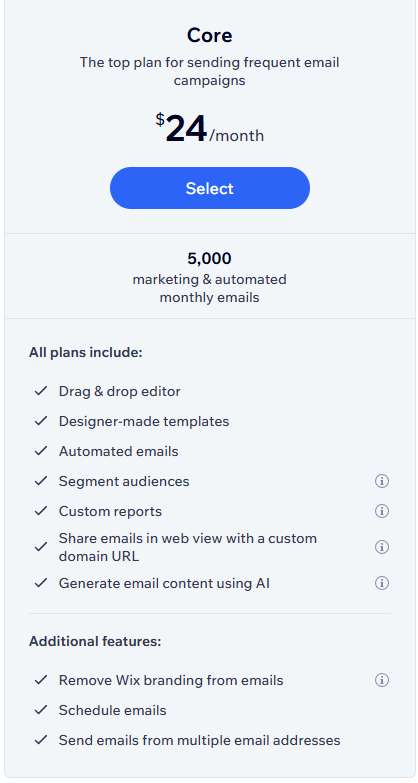
- Core Plan: At around $24/month (paid yearly), it allows 5,000 emails/month and supports emails from multiple addresses.
- Advanced Plan: For $49/month (paid yearly), businesses can send up to 1,000,000 emails/month, also with multi-sender support.
These plans typically include features like a drag-and-drop editor, current templates, basic automations, segmentation, and reports. A key benefit is the transparency: businesses know exactly what they will pay each month, regardless of how rapidly their contact list grows, provided they stay within their email sending limits. This model is particularly attractive for website-first customers whose email sending needs are tied to site activity rather than an aggressively expanding subscriber base. Industry reports suggest that early-stage SMBs often favor predictable monthly costs, making Wix’s model a strong contender for budget-conscious entrepreneurs. Furthermore, Wix offers a 14-day money-back guarantee across all its paid plans, providing a safety net for new users.
Mailchimp’s Contact-Based Escalation:
Mailchimp’s pricing model is fundamentally different, based on the number of contacts a business maintains in its audience list. As the subscriber list expands, so does the monthly bill. This structure can offer greater flexibility for sending numerous campaigns to a smaller list but becomes more expensive as the list grows, potentially leading to higher variable costs and overage charges if limits are exceeded.
- Free Plan: Now significantly tighter than in its heyday, it covers up to 250 contacts and 500 sends per month, offering basic email campaign creation and a limited set of features.
- Essentials Plan: Starting around $13/month, it includes up to 5,000 emails/month and three user seats, adding features like A/B testing and 24/7 email/chat support.
- Standard Plan: Around $20/month, it increases email sends to 6,000/month and offers five user seats, alongside more advanced automation and segmentation.
- Premium Plan: Starting at $350/month (with an introductory discount), this tier is designed for large enterprises, offering 150,000 emails/month, unlimited seats, phone support, and advanced analytics.
Mailchimp’s contact-based model is well-suited for businesses that prioritize advanced features and expect their email marketing efforts to become increasingly sophisticated and data-driven. However, the escalating costs as contact lists grow can be a significant consideration, especially for businesses with high churn rates or those still in the early stages of list building. The potential for overage charges means actual costs can exceed advertised prices, requiring careful budget management. While Mailchimp offers a two-week trial for its Essentials and Standard plans, the Premium tier lacks a trial period.
Strategic Implications for Budgeting:
The choice between these two pricing philosophies hinges on a business’s primary growth driver and financial predictability needs. Wix offers simplicity and cost stability, ideal for those whose email marketing is an integrated component of their Wix-powered online presence. Mailchimp provides greater feature depth but demands a more dynamic budgeting approach, suitable for businesses whose core growth strategy is heavily reliant on an expanding email list and advanced campaign optimization.
Feature Set Analysis: Depth vs. Integration
The core functionality of sending email campaigns is present in both platforms, but the depth, flexibility, and scope of their feature sets diverge significantly.
Email Editor and Templates:
Both Wix and Mailchimp utilize drag-and-drop editors, facilitating intuitive content creation. Wix’s editor is tightly integrated with its website builder workflow, making it familiar and efficient for existing Wix users. Its template library, while functional, offers around two dozen options, providing a good starting point but potentially limiting for highly diverse campaign types. Mailchimp, conversely, boasts a more mature and versatile editor, particularly on its paid plans, offering over 130 pre-built templates and options for custom-coded designs. This provides greater creative control and flexibility for marketers who require diverse layouts and brand-specific aesthetics across a multitude of campaigns.
Marketing Automation Capabilities:
Automation is crucial for personalized and timely customer engagement. Wix has made strides in this area, offering a range of site-connected automations:
- Abandoned cart reminders
- Follow-ups for form submissions
- Purchase follow-ups
- Welcome emails
These automations are effective for basic lifecycle messaging, integrating seamlessly with Wix’s e-commerce and site data.
Mailchimp, however, provides a significantly deeper stack of marketing automation flows. Its capabilities extend to:
- Welcome series
- Abandoned cart recovery (with more granular control)
- Purchase follow-ups
- Win-back campaigns
- Transactional emails
- Behavioral automations based on site activity, email engagement, and purchase history.
This allows for more complex, multi-step customer journeys, tailored sequences, and advanced conditional logic, making it ideal for businesses with sophisticated lead nurturing and retention strategies. The ability to build intricate automation paths is a key differentiator for Mailchimp.
Advanced Testing and Segmentation:
This is an area where Mailchimp holds a distinct advantage.
- A/B Testing: Mailchimp includes robust A/B testing across its paid plans, allowing marketers to optimize subject lines, send times, creative elements, and calls to action. Higher tiers even offer multivariate testing for simultaneous optimization of multiple campaign variables. Industry research consistently shows that A/B testing can lead to a 15-20% improvement in conversion rates for optimized elements.
- Segmentation: While Wix offers advanced segmentation based on contact attributes and site activity (e.g., abandoned carts in the last 30 days, custom conditions), Mailchimp goes further. It provides predictive segmentation, advanced customer segmentation tools on higher plans, and built-in audience management that tracks campaign engagement, purchase behavior, and app usage. This depth enables hyper-personalization, targeting specific customer groups with highly relevant content based on their likelihood to purchase or engage.
Wix, by contrast, currently lacks A/B testing capabilities for email marketing campaigns, a significant limitation for businesses focused on data-driven optimization. Its segmentation, while functional, does not reach the predictive and granular level offered by Mailchimp.
Data-Driven Decisions:
For businesses serious about optimizing their email marketing ROI, Mailchimp’s comprehensive feature set—especially in automation, testing, and advanced segmentation—provides the tools necessary to move beyond basic sending to sophisticated, data-driven campaign management. This makes it a safer long-term investment for companies expecting their marketing needs to grow in complexity.
Ecosystem Integration: The Reach of Your Marketing Tools
The extent and nature of integrations represent another critical divergence, reflecting each platform’s core philosophy.
Wix’s Unified Environment:
Wix Email Marketing thrives within the Wix ecosystem. Its integrations are primarily internal, designed to create a seamless, all-in-one experience for businesses already operating on the Wix website builder. Key integrations include:
- Wix Stores: Direct connection for e-commerce, enabling abandoned cart automations and purchase follow-ups.
- Wix CRM: Centralized contact management and segmentation based on customer data within the Wix platform.
- Wix Analytics: Unified reporting on website performance and email campaign metrics.
- Wix Chat, Forms, and other business apps: All work together to create a cohesive digital presence.
This tight integration means less time spent connecting disparate tools and managing data transfers, offering a streamlined workflow. For a business seeking to minimize moving parts and manage its entire digital footprint from a single dashboard, Wix’s integrated approach is a compelling advantage. Analysts often suggest that Wix’s strategy is to capture businesses seeking simplicity and a unified digital presence, leveraging its strong website builder base.
Mailchimp’s Extensive Third-Party Network:
Mailchimp, as a specialized email marketing platform, boasts a vastly broader and deeper integration ecosystem. With over 300 direct integrations and an extensive app directory, it offers unparalleled connectivity to a wide array of third-party tools. This includes:
- Major e-commerce platforms: Shopify, Magento, WooCommerce, BigCommerce, etc.
- CRM systems: Salesforce, HubSpot, Zoho CRM, and many others.
- Social media platforms: Facebook, Instagram, Twitter.
- Payment gateways, analytics tools, project management software, and more.
This extensive network provides immense flexibility for businesses that utilize a “best-of-breed” tech stack, preferring to select the top tools for each specific function. For companies that operate across multiple e-commerce platforms, manage complex customer data in external CRMs, or leverage a diverse set of marketing and operational tools, Mailchimp’s open ecosystem is indispensable. It ensures that email marketing efforts can be seamlessly connected to virtually any other business process or data source. Mailchimp continues to position itself as the robust, scalable email marketing specialist, catering to companies whose marketing needs will deepen over time and require extensive interoperability.
The “Best-of-Breed” vs. “All-in-One” Debate:
The choice here reflects a strategic decision about a business’s overall technology architecture. Wix is ideal for those who value the simplicity and efficiency of a single, integrated platform. Mailchimp is superior for businesses that require the flexibility to connect with a diverse array of specialized tools, enabling them to build a highly customized and powerful marketing infrastructure.
Deliverability: Ensuring Your Message Reaches the Inbox
Deliverability, though often overlooked, is arguably the most critical aspect of email marketing. An email campaign, no matter how well-designed or targeted, is useless if it fails to reach the recipient’s inbox, instead landing in spam folders or being blocked entirely.
Wix Email Marketing:
Wix provides foundational insights into deliverability. Its help center offers guidance on best practices for sender reputation and email engagement, aiming to educate users on how to maximize inbox placement. The platform’s dashboard displays key metrics such as delivery rates, bounce rates, spam complaints, open rates, and click-through rates. While this data is essential for monitoring campaign health, Wix’s product is relatively lighter on advanced deliverability tooling or proactive features to manage sender reputation beyond basic guidance.
Mailchimp:
Mailchimp places a much more explicit and proactive emphasis on deliverability. It publishes extensive dedicated resources, articles, and guides on how sender reputation impacts inbox placement and provides actionable advice for improving it. Critically, Mailchimp claims a deliverability rate of 99% or higher, a significant assertion that underscores its commitment to ensuring emails reach their intended audience. This high deliverability rate is often achieved through sophisticated internal algorithms, proactive monitoring of blacklists, and strong relationships with internet service providers (ISPs). Furthermore, Mailchimp integrates deliverability best practices into its segmentation and audience management guidance, empowering users with tools and insights to maintain a healthy sending reputation over time. For example, its audience insights often highlight less engaged subscribers, prompting users to re-engage or clean their lists, which directly impacts deliverability. Email industry benchmarks suggest average deliverability rates hover around 85-90%, making Mailchimp’s stated 99%+ a significant competitive claim that reflects its specialized focus.
Implications for Campaign Effectiveness:
For businesses sending more than just a few simple email campaigns each month, Mailchimp’s deeper focus on deliverability offers a significant advantage. Its robust infrastructure and proactive guidance are crucial for maximizing the return on investment from email marketing efforts, ensuring that valuable messages consistently land in the primary inbox.
Customer Support: A Cornerstone for User Experience
The quality and accessibility of customer support can significantly impact a business’s experience with any digital platform, particularly for SMBs that may not have dedicated technical staff.
Wix Email Marketing:
Wix excels in making support readily available across all its plans, emphasizing a customer-first approach. Its help center is extensive, offering a wealth of self-service articles and tutorials. Crucially, Wix’s contact page often includes live chat access, and many support articles provide options for direct assistance. The company explicitly states that 24/7 customer care is included across all its paid plans, with options for live chat and callback support. This consistent access to support, irrespective of the plan tier, is a considerable advantage for small business owners who are simultaneously managing their website, store operations, and marketing campaigns, making it easier to resolve issues without waiting for an upgrade. Access to responsive customer support is frequently cited as a top priority for small business owners, particularly when navigating complex digital tools.
Mailchimp:
Mailchimp’s support model is tiered, becoming more comprehensive as users upgrade to higher-priced plans.
- Free Plan: Includes email support for the first 30 days only, after which support is primarily self-service through the knowledge base.
- Essentials and Standard Plans: Offer 24/7 email and chat support, providing more immediate assistance for paid users.
- Premium Plan: Adds phone support and priority assistance, along with dedicated onboarding sessions, catering to larger teams with complex needs.
This tiered approach means that users on lower-cost or free plans may find support less accessible, which can be a point of friction for new users or those still evaluating the platform. While Mailchimp’s premium support is robust, its initial offerings are less forgiving for those needing extensive guidance before committing to a higher-tier plan.
The Verdict on Support:
From a customer-first standpoint, Wix delivers a stronger overall support experience by making comprehensive assistance available to a wider range of customers without requiring an upgrade. While Mailchimp offers superior premium support, its more restrictive free and lower-tier support can be a drawback for many small businesses.
The Verdict: Tailoring the Solution to Business Needs
After a comprehensive analysis, the choice between Wix Email Marketing and Mailchimp is not about a universally superior platform, but rather about the best fit for specific business needs and growth trajectories.
Wix Email Marketing is the stronger choice for businesses that:
- Already operate their website and business within the Wix ecosystem.
- Prioritize an all-in-one, integrated solution for simplicity and streamlined management.
- Value predictable, flat-rate pricing based on email volume rather than contact list size.
- Require consistent 24/7 customer support across all paid plans.
- Have foundational email marketing needs (welcome emails, abandoned carts, basic promotions) without requiring deep automation or extensive A/B testing.
Mailchimp emerges as the overall winner for businesses that:
- Require a powerful, specialized email marketing platform with deep feature sets.
- Need advanced marketing automation flows for complex customer journeys, behavioral targeting, and transactional emails.
- Prioritize robust A/B and multivariate testing capabilities for continuous campaign optimization.
- Demand sophisticated segmentation tools, including predictive segmentation, for hyper-personalization.
- Operate with a diverse tech stack and require extensive third-party integrations (300+).
- Place a high premium on deliverability, leveraging a platform with proactive tools and a proven track record.
- Are prepared for a contact-based pricing model that scales with their subscriber list, and potentially invest in higher-tier plans for superior support and features.
Mailchimp’s comprehensive feature depth, advanced automation, superior testing capabilities, vast integration ecosystem, and proactive approach to deliverability collectively make it the more robust and scalable solution for businesses whose email marketing is a central, growing, and increasingly complex component of their revenue generation strategy. While Wix wins on pricing transparency and universal customer support, Mailchimp’s strengths lie in the areas that often matter most for driving significant marketing ROI and supporting long-term growth.
Looking Beyond: The Rise of Advanced E-commerce Marketing Platforms
The digital marketing landscape continues to evolve rapidly, pushing both Wix and Mailchimp to innovate. For businesses that find themselves outgrowing even Mailchimp’s capabilities, particularly in the e-commerce sector, platforms like Omnisend represent the next frontier. Omnisend, for example, integrates email and SMS marketing, alongside advanced features such as predictive AI for segmentation and product recommendations, forms AI for optimizing signup flows, and generative AI for campaign creation. It even offers MCP integration, allowing teams to query store data directly through advanced large language models like ChatGPT or Claude. This signifies a broader industry trend towards multi-channel engagement, AI-powered personalization, and deeper data intelligence. Omnisend’s paid-plan merchants, for instance, reported an average of $79 return per $1 spent in 2025, underscoring the potential of these advanced platforms.
Ultimately, the choice of an email marketing platform is a strategic investment. It requires a clear understanding of current operational needs, anticipated growth, and budgetary constraints. Whether opting for the integrated simplicity of Wix, the scalable power of Mailchimp, or the advanced capabilities of a specialized e-commerce platform like Omnisend, businesses must align their marketing technology with their overarching commercial objectives to thrive in an increasingly competitive digital marketplace.








