

In the modern e-commerce and Software-as-a-Service (SaaS) landscapes, quantitative analytics provide a comprehensive view of what is happening on a digital storefront, yet they consistently fail to explain why. A shopper may navigate to a product page, interact with various media elements, and scrutinize shipping policies only to exit the site without further action. Another may initiate the checkout process but abandon the transaction upon seeing the final tally. In the SaaS sector, a trial user might register for a service but never engage with its core features. While tools like Google Analytics or Mixpanel track these drop-offs with precision, the underlying motivations—the doubts, friction points, and unanswered questions—remain obscured. This is the gap that targeted customer feedback surveys are designed to bridge.
By transitioning from broad, generic inquiries to specific, context-aware surveying, businesses can transform qualitative feedback into actionable data for conversion rate optimization (CRO). The following analysis explores five distinct survey methodologies designed to diagnose specific conversion barriers and provide the insights necessary to refine the user experience and drive revenue growth.
The Crisis of Generic Feedback and the Shift to Contextual Surveying
The primary reason most customer surveys fail to yield useful results is a lack of specificity in timing and questioning. Standardized “How are we doing?” pop-ups often appear at inconvenient moments, leading to low response rates or vague feedback that lacks diagnostic value. Effective CRO-focused surveying requires a shift toward “moment-of-truth” interactions—capturing the user’s mindset at the exact point where a conversion decision is made or avoided.
Industry benchmarks suggest that the digital experience is currently underperforming across several sectors. According to research from Baymard Institute, approximately 52% of desktop e-commerce sites and 62% of mobile sites possess “mediocre” or poor product page user experiences (UX). When a shopper fails to add an item to their cart, it is rarely a matter of random chance; it is typically the result of an information gap.
Diagnosing Product Page Resistance: The “Pre-Cart” Friction
When traffic reaches a product page but fails to progress to the “add to cart” stage, the issue is frequently rooted in unresolved buyer anxiety. Market analysis indicates that shoppers typically hold back for five primary reasons: lack of clarity regarding product specifications, concerns over shipping costs or delivery timelines, uncertainty regarding compatibility or fit, a lack of trust in the brand, or the simple realization that the product does not meet their specific needs.
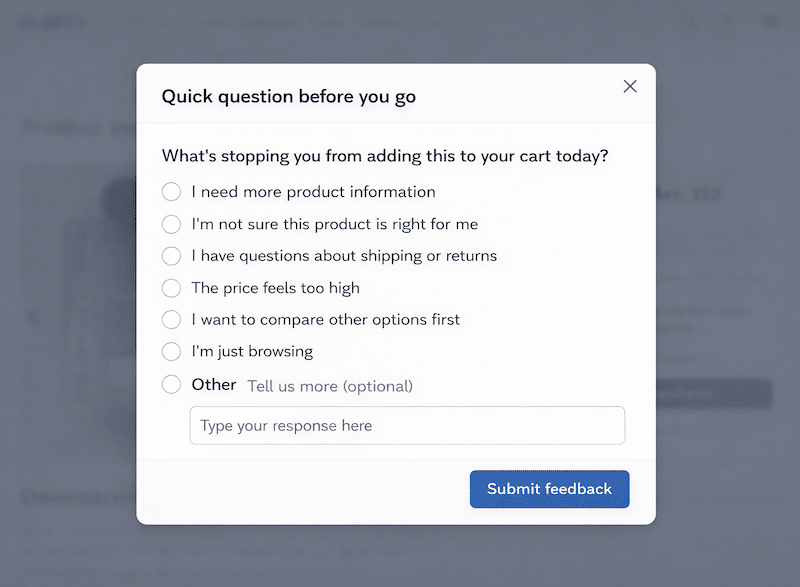
To address this, brands are increasingly adopting “exit-intent” surveys on product pages. Rather than asking for general feedback, the most effective question is: “What’s stopping you from adding this to your cart today?”
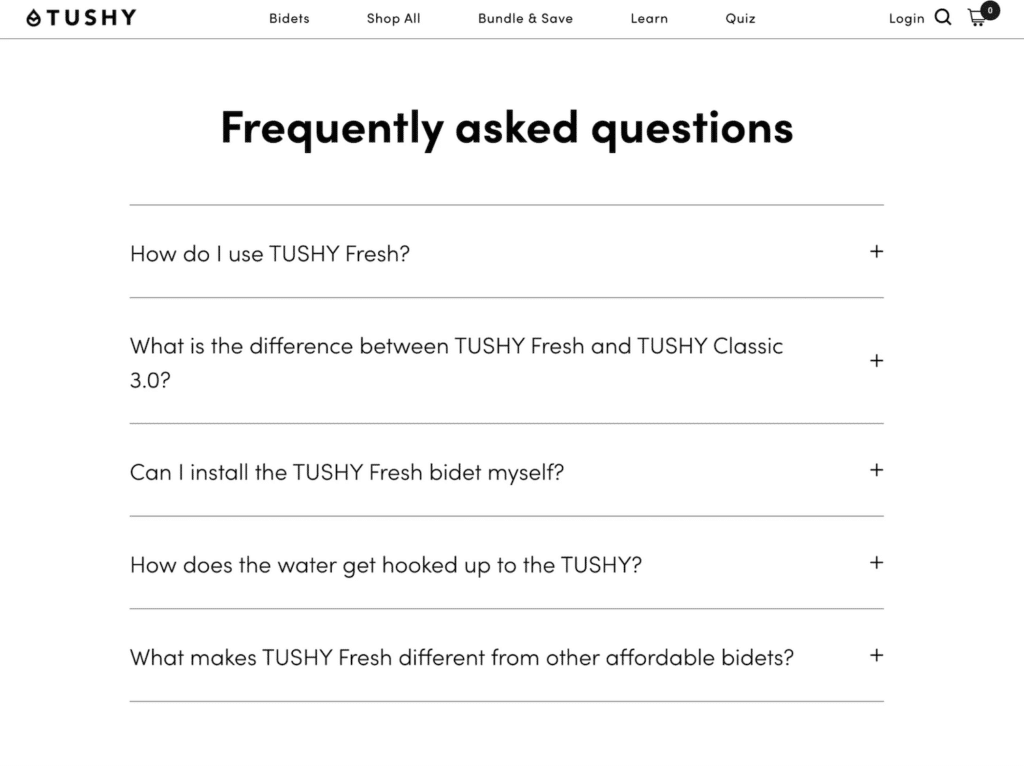
Data analysis of responses to this question typically reveals specific patterns. If users frequently cite “missing information,” the brand must improve its product descriptions or FAQ sections. If “shipping costs” are the primary deterrent, the business may need to reconsider its threshold for free shipping or display those costs earlier in the journey. Brands like TUSHY have successfully mitigated these issues by integrating comprehensive installation and compatibility FAQs directly onto the product page, preempting the questions that lead to abandonment.
The Checkout Abandonment Threshold
The transition from a product page to the checkout represents a significant increase in user intent. At this stage, the shopper is no longer merely browsing; they have expressed a concrete desire to purchase. Consequently, abandonment at this phase is particularly costly. Baymard’s 2024 benchmarks indicate an average cart abandonment rate of 70.19%, suggesting that over two-thirds of potential revenue is lost at the final hurdle.
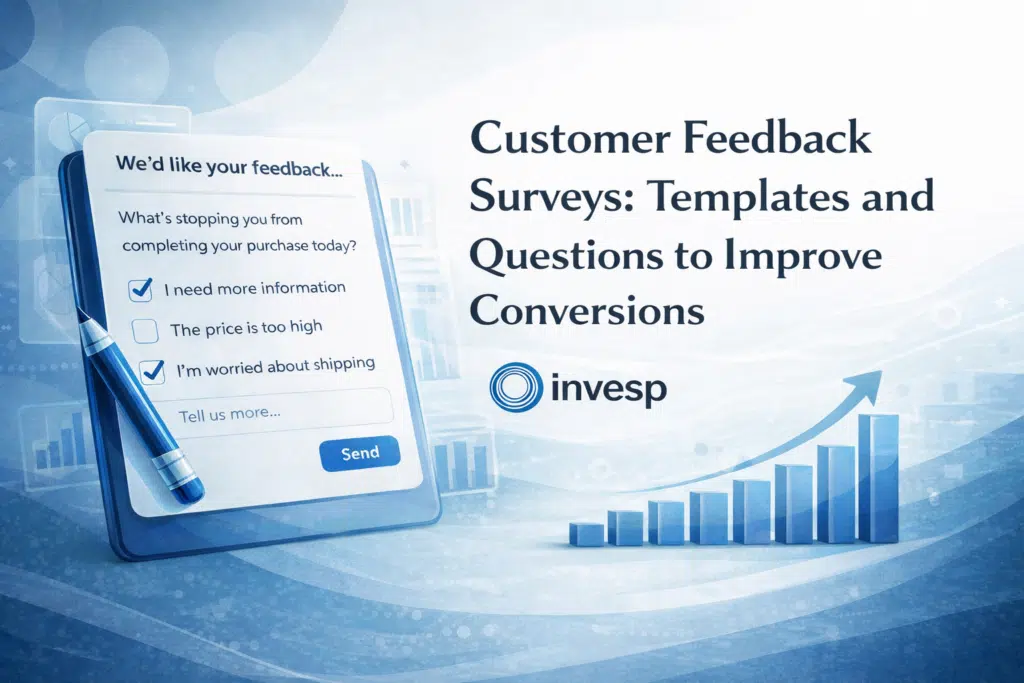
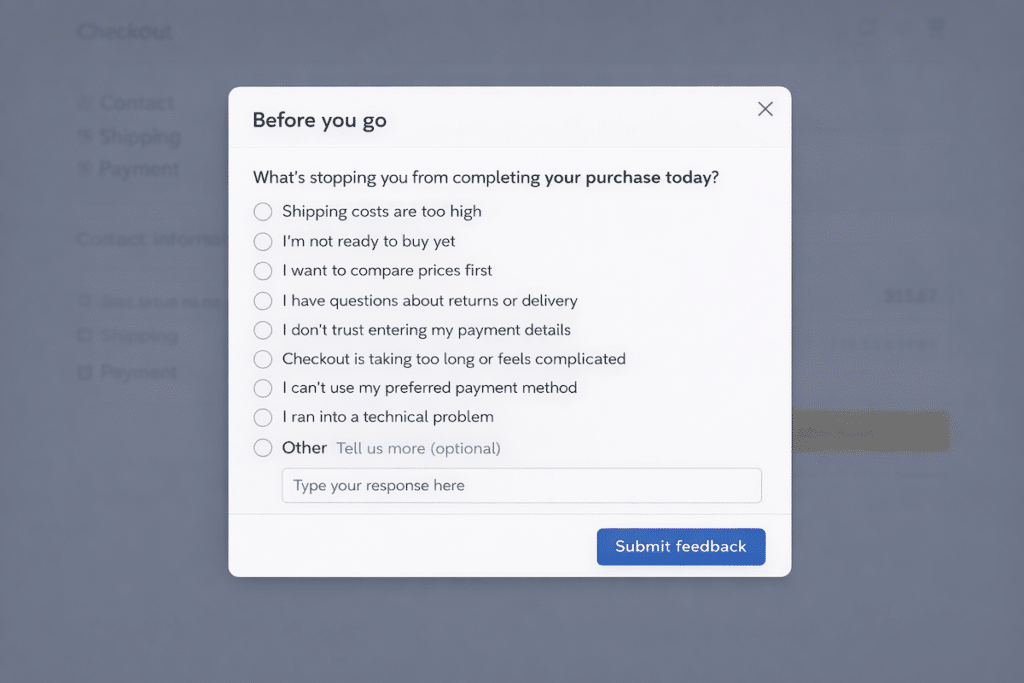
The causes of checkout drop-off are well-documented: unexpected costs (taxes, shipping, fees), the requirement to create a mandatory account, excessively long or complex checkout forms, and a lack of perceived security. When a user exits the checkout flow, a survey should be deployed to capture the specific friction point. The query “What’s stopping you from completing your purchase today?” allows brands to categorize lost sales into actionable buckets.
For instance, if “technical issues” are frequently reported, it signals a need for immediate QA testing on specific browsers or devices. If “shipping was too slow” is the dominant response, the logistics strategy requires revision. This direct feedback loop allows for rapid iteration of the checkout UI, moving beyond guesswork to evidence-based optimization.
Post-Purchase Attribution and the “Dark Social” Factor
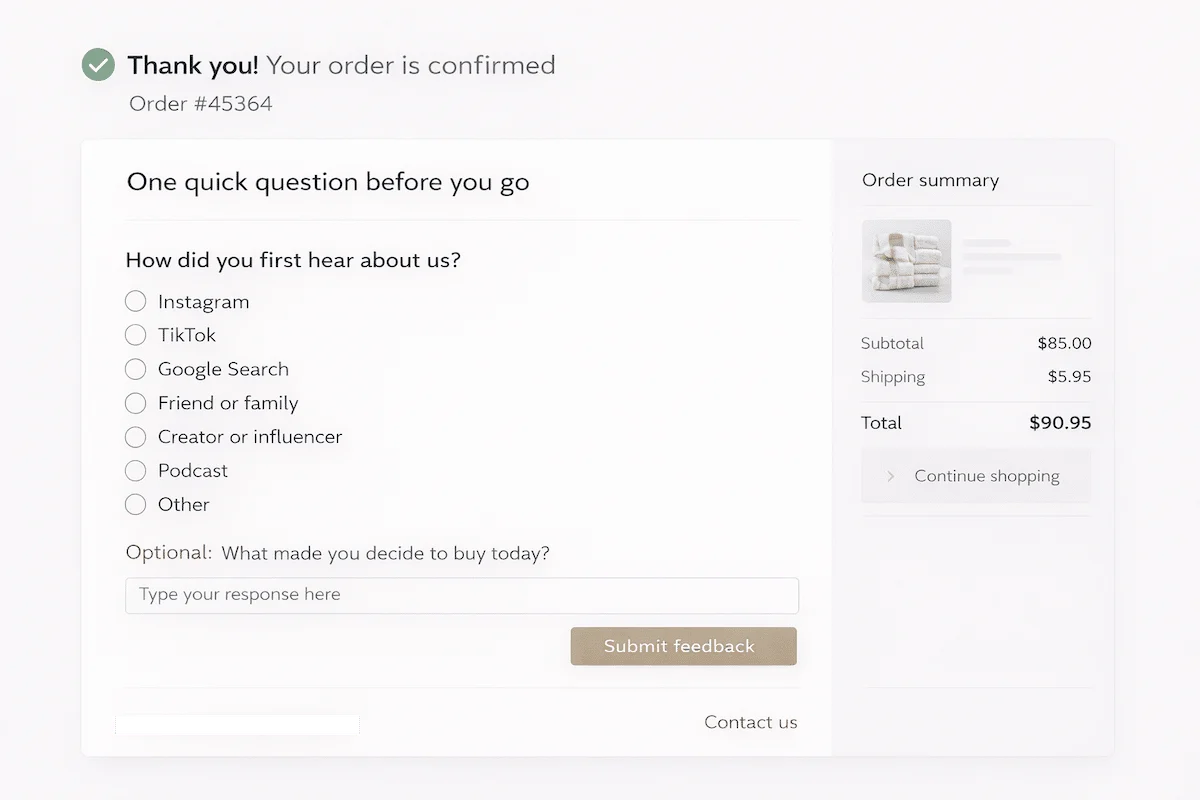
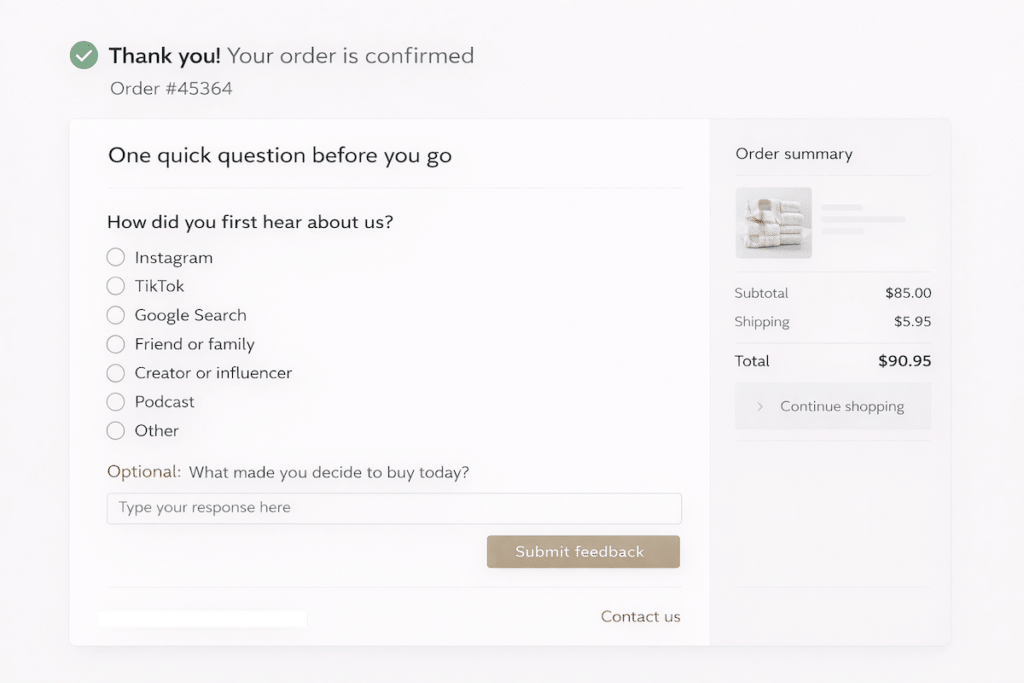
The period immediately following a successful transaction offers a unique window of opportunity. The customer’s motivation is at its peak, and their memory of the decision-making process is fresh. Post-purchase surveys are essential for understanding attribution—identifying which channels truly drive high-intent traffic.
Standard digital attribution models often struggle to account for “dark social” or offline influences, such as podcasts, word-of-mouth recommendations, or organic social media mentions. The “How did you first hear about us?” (HDYHAU) question serves as a vital check against automated analytics.
A notable case study is the brand Weezie, which utilized post-purchase surveys to discover that approximately 35% of its revenue originated from word-of-mouth referrals. This insight allowed the marketing team to validate their brand-building efforts and adjust their budgetary allocations away from overpriced paid search terms toward community-focused initiatives. Furthermore, asking “What made you decide to buy today?” can reveal the specific value propositions—such as a specific influencer’s review or a particular product feature—that finally tipped the scales in favor of a purchase.
The SaaS Activation Gap: Converting Trials to Active Users
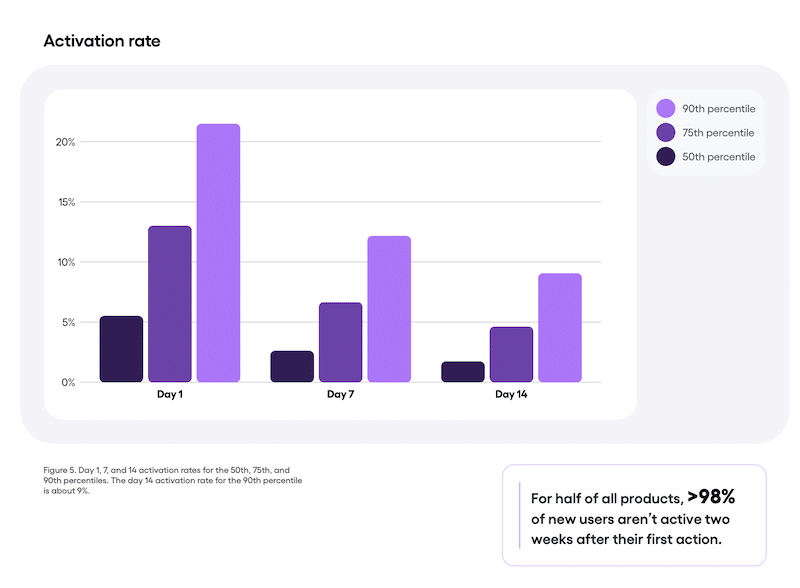
In the SaaS sector, the challenge is not just the initial sign-up, but the “activation” of the user. Research from Amplitude’s Product Benchmark Report reveals a stark reality: by the 14th day of a trial, the median product retains only 2% of its new users. Even top-tier products rarely exceed a 9% retention rate at this stage.
This “activation gap” occurs when users sign up but fail to reach the “Aha!” moment—the point where they realize the product’s value. When a user logs in but remains inactive, a survey asking “What’s stopping you from getting started today?” can identify whether the barrier is a complex setup process, a lack of clear documentation, or a mismatch between marketing promises and product reality.
If users report that they “don’t know what to do first,” the solution lies in improving the onboarding flow with tooltips or guided tours. If they state they “don’t have time right now,” the marketing team might implement a more robust email nurture sequence to bring them back when they are ready.
Managing Churn and the Economics of Returns
The final stage of the customer lifecycle—retention—is where long-term profitability is established. However, post-purchase dissatisfaction leads to returns and cancellations, which are increasingly expensive for retailers. The National Retail Federation (NRF) projected that 16.9% of total retail sales would be returned in 2024, with online return rates expected to climb to 19.3% in 2025.
Returns and cancellations are typically driven by an “expectation mismatch.” This could involve poor fit, product damage, or a realization that the ongoing cost of a subscription does not justify the value. A targeted survey during the return or cancellation process—asking for the “main reason” for the decision—provides the data necessary to reduce future churn.
For example, if “poor fit” is the primary driver of returns in apparel, the brand should invest in better sizing charts or virtual fitting tools. If “too expensive” is the reason for subscription cancellation, the business might experiment with lower-tier pricing models or “pause” options rather than losing the customer entirely.
Principles of Effective Survey Design
To ensure that customer feedback remains a high-quality source of data, organizations must adhere to several core principles of survey design:
- Low Friction: Use multiple-choice questions to minimize the effort required from the user. An optional text field can be provided for those who wish to offer more detail, but the primary data should be easy to categorize.
- Specific Timing: Trigger surveys based on specific behaviors, such as exit intent, time on page, or the completion of a specific action.
- Neutral Language: Avoid leading questions. Instead of asking “How much did you enjoy our easy checkout?”, ask “How would you describe your experience with our checkout process?”
- Single Objective: Each survey should aim to solve one specific problem. Attempting to gather demographic data, attribution data, and UX feedback in a single pop-up will inevitably lead to survey fatigue and lower response quality.
Conclusion: Turning Qualitative Feedback into Quantitative Growth
The integration of specific customer feedback surveys into a CRO strategy allows businesses to move beyond the “what” of analytics to the “why” of human behavior. By diagnosing the specific friction points at the product page, checkout, and post-purchase stages, companies can create a more seamless user experience.
As privacy regulations and the deprecation of third-party cookies continue to reshape the digital landscape, this “zero-party data”—information intentionally and proactively shared by the customer—becomes an invaluable asset. Organizations that master the art of asking the right question at the right time will be better positioned to optimize their conversion funnels, reduce the cost of acquisition, and foster long-term customer loyalty in an increasingly competitive market.







