

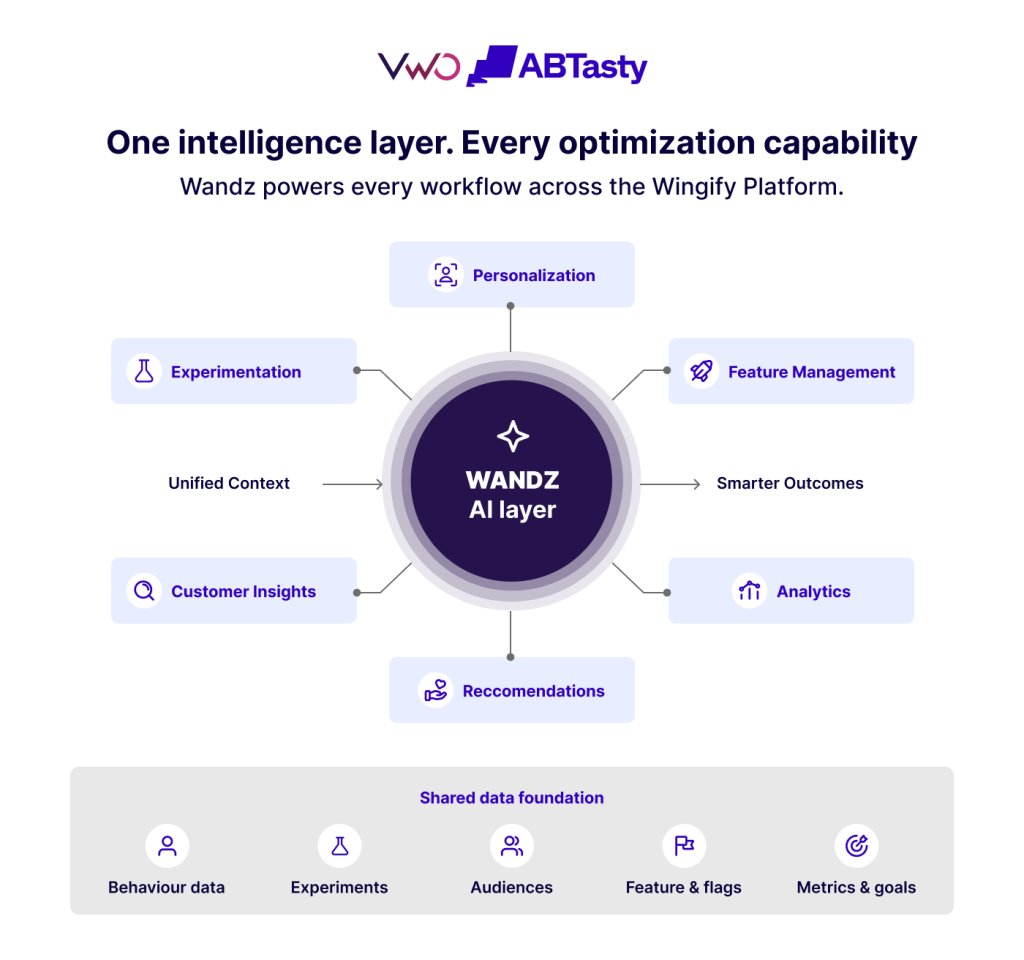
Wingify, a global leader in experience optimization, has officially launched Wandz, a sophisticated, embedded artificial intelligence layer designed to serve as the central intelligence core for its expanding suite of products. Integrated directly into the workflows of VWO and AB Tasty, Wandz represents a strategic consolidation of AI capabilities, moving beyond the traditional chatbot model to provide an agentic, context-aware system that operates across experimentation, personalization, feature management, and customer insight modules. By embedding intelligence where data resides, Wingify aims to eliminate the friction associated with general-purpose AI tools, allowing product and marketing teams to analyze, recommend, and execute optimization strategies within a single, unified environment.
The introduction of Wandz marks a significant milestone in the convergence of VWO and AB Tasty under the Wingify umbrella. Previously, both platforms maintained their own distinct AI assistants—VWO utilized "Copilot," while AB Tasty offered "Evi." Wandz serves as the evolution and unification of these technologies, providing a singular, more powerful intelligence layer that draws from the combined data silos of both platforms. This move reflects a broader industry trend where SaaS providers are moving away from bolt-on AI features in favor of deeply integrated, "agentic" systems that can perform complex, multi-step tasks with minimal human intervention.
The Evolution of Experimentation: From Manual Analysis to Agentic AI
The digital optimization landscape has undergone a radical transformation over the last decade. In the early stages of A/B testing, teams relied heavily on manual data extraction and statistical analysis to derive insights. The rise of general-purpose generative AI, such as OpenAI’s ChatGPT and Google’s Gemini, provided a temporary bridge, allowing teams to paste data into external interfaces to generate copy or summarize findings. However, this "round-trip" workflow created significant bottlenecks.
Data security concerns, the loss of context during manual exports, and the labor-intensive nature of prompt engineering meant that even with AI, the "speed to insight" remained hindered. Wingify’s development of Wandz addresses these specific pain points. Because Wandz is natively integrated into the Wingify ecosystem, it possesses immediate access to live experiment data, audience segments, behavioral metrics, and historical rollout data. This internal access removes the need for data exports, ensuring that the AI’s reasoning is grounded in the specific, real-time context of the user’s digital property.
Technical Architecture and the Power of Contextual Intelligence
Wandz is built on an architecture that prioritizes "contextual continuity." Unlike general AI models that start every interaction from a blank slate, Wandz "understands" the environment in which it operates. This intelligence layer sits beneath the various modules of the Wingify suite, meaning an insight discovered in one area—such as a friction point identified in a session recording—can automatically inform a hypothesis for an A/B test in another area without requiring the user to re-explain the situation.
The system is designed to be agentic, a term in AI development referring to systems that can autonomously execute tasks based on high-level goals. While traditional AI might suggest an idea for an experiment, an agentic system like Wandz can draft the experiment end-to-end. This includes defining the variations, selecting the primary and secondary metrics, identifying the target audience segments, and reviewing the technical configuration for potential errors before the test goes live. This shift from "AI as an assistant" to "AI as an agent" is intended to significantly reduce the operational load on growth and product teams.
Operational Impact Across the Wingify Suite
The deployment of Wandz affects five primary domains of the Wingify ecosystem, each benefiting from the reduced latency between data collection and action:
1. Advanced Experimentation
In the realm of A/B and multivariate testing, Wandz shifts the focus from setup to strategy. By analyzing historical performance data, it generates hypotheses that are statistically more likely to succeed. Once a test is active, it monitors the results in real-time, providing plain-language summaries of performance shifts. Upon the conclusion of a test, Wandz suggests the "next best action," ensuring that the experimentation cycle remains continuous rather than stalled by manual reporting phases.
2. Precision Personalization
Personalization often fails due to the complexity of segment creation. Wandz automates this by identifying behavioral patterns—such as "hesitant buyers" or "high-intent mobile users"—and building audience segments dynamically. It then recommends specific experience variations tailored to those segments, effectively compressing a weeks-long analytical cycle into a matter of minutes.
3. Risk-Mitigated Feature Management
For engineering and product teams, Wandz acts as a safety layer for feature flagging and rollouts. It reviews configurations before launch to ensure that targeting rules and traffic allocations are logically sound. During a rollout, Wandz monitors system health and user engagement signals, advising teams on whether to accelerate the rollout, pause it, or trigger a "kill switch" based on real-time risk assessment.
4. Qualitative Customer Insights
One of the most labor-intensive aspects of optimization is the review of qualitative data, such as heatmaps and session recordings. Wandz performs the "first pass" of this data, highlighting sessions that show significant user friction or hesitation. By connecting these qualitative findings with quantitative performance data, Wandz provides a holistic view of the user experience that was previously only possible through hours of manual triage.
5. Business-Centric Analytics
Wandz transforms reporting from a technical task into a conversational one. Stakeholders can ask questions such as, "Why did conversion drop for our UK audience last Tuesday?" and receive a data-backed explanation that accounts for active experiments, external traffic shifts, and behavioral trends.
Comparative Analysis: Wandz vs. General-Purpose AI
Industry analysts note that the primary differentiator for Wandz is its specialized knowledge base. While a general-purpose LLM (Large Language Model) has broad knowledge of marketing principles, it lacks the "private context" of a company’s specific testing history.
| Feature | General-Purpose AI (ChatGPT/Gemini) | Wandz (Wingify Suite) |
|---|---|---|
| Knowledge Base | Generic, public data | Specific experimentation & optimization context |
| Data Access | Requires manual copy/paste | Native, real-time access to suite data |
| Workflow Integration | Separate browser tab/application | Embedded directly in the workspace |
| Capability | Ideation and drafting | Ideation, drafting, and execution |
| Audience Awareness | None (unless described in prompt) | Direct access to actual segments and IDs |
Market Reactions and Industry Implications
The launch of Wandz comes at a time when the "Experience Optimization" market is projected to grow significantly as brands seek to maximize the value of their existing traffic amidst rising customer acquisition costs. Industry experts suggest that the integration of AI into these platforms is no longer a luxury but a requirement for enterprise-level scalability.
"The bottleneck in experimentation has never been the ideas; it has always been the execution and the analysis," noted one senior growth analyst in response to the announcement. "By embedding the AI directly into the data layer, Wingify is essentially removing the ‘translation layer’ that usually slows down these projects."
From a competitive standpoint, Wingify’s move places it in direct contention with other major players like Optimizely and Adobe Target, who are also racing to integrate generative and predictive AI into their offerings. However, Wingify’s emphasis on a unified layer across both VWO and AB Tasty suggests a focus on providing a seamless experience for global enterprises that may be using different parts of the suite across various departments.
Security, Governance, and Human Oversight
Recognizing the risks associated with AI-driven changes to production environments, Wingify has implemented a "human-in-the-loop" governance model for Wandz. The system is designed to be transparent; every recommendation or configuration drafted by the AI requires human approval before it is deployed to live traffic.
For enterprise clients, Wandz adheres to existing role-based access controls (RBAC) and security protocols. Every action initiated or assisted by Wandz is logged in the system’s audit trail, ensuring that organizations can maintain accountability. This focus on "explainable AI" is critical for industries such as finance and healthcare, where automated changes to a digital interface must be strictly monitored and justified.
Future Outlook and Chronology of Integration
The rollout of Wandz is expected to be a phased process. While the core intelligence layer is now active, Wingify has indicated that the depth of integration will continue to expand as the VWO and AB Tasty platforms further converge. The long-term roadmap includes more advanced predictive capabilities, where Wandz may eventually be able to forecast the outcome of an experiment with high accuracy before a single visitor is assigned to a variation.
In conclusion, Wandz represents a strategic pivot for Wingify, transforming its suite from a set of tools into an intelligent ecosystem. By prioritizing context, integration, and agentic execution, Wingify is positioning itself to lead the next generation of AI-powered digital experience optimization, promising a future where data-driven decision-making is faster, more accurate, and more accessible to teams of all sizes.







